





Why · Demo · Install · Tools · Safety · Docs · Deutsch
Introducing shopware-mcp
A Shopware 6 shop is about two hundred entities behind one Admin API. Ask an
assistant "is everything okay with the shop?" and the honest answer takes seven
searches with Criteria filters, three state machines by their technical names,
a couple of aggregations, and an OAuth token it must never repeat back to you.
Wire a model straight to that API and it gets all of it, including the right to
PATCH a price because a prompt said so.
The Model Context Protocol turned "give the model real tools" into a one-line config change. It says nothing about what a good tool for a shop looks like: which of the two hundred entities matter on a Tuesday morning, what "stuck order" means, or that a stock correction should be shown before it is sent.
shopware-mcp is that layer. One small server that speaks MCP to the host and the Admin API to the shop, and knows Shopware well enough to answer in one call what used to take an afternoon in the admin:
| Curated tools | Products, orders, customers, categories, promotions, plugins, stock, sales channels: sixteen tools that return compact JSON with exact totals, descriptions written for a model, and Shopware's own Criteria filters. No invented query language. |
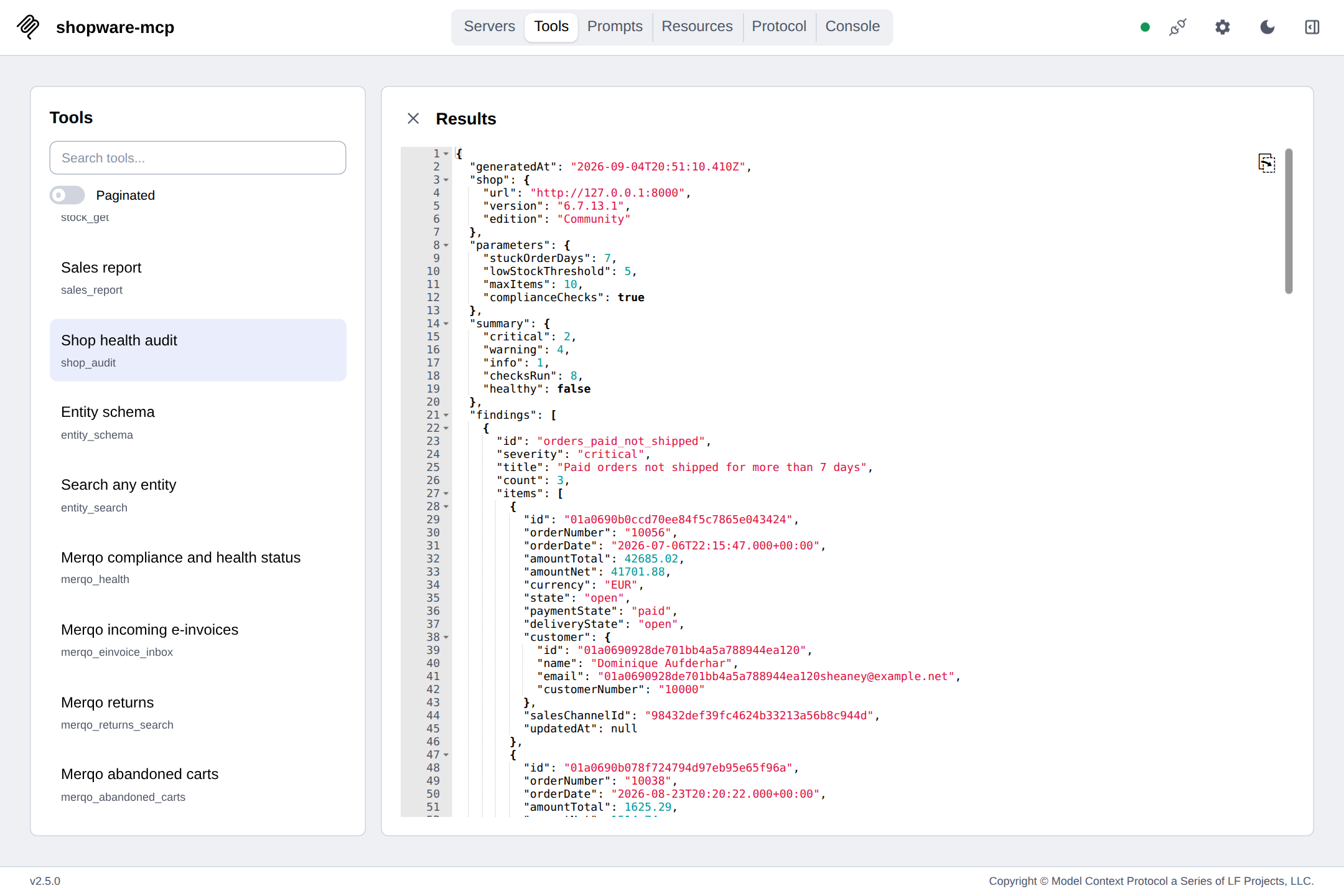
| An audit | shop_audit runs eleven checks in one call: paid orders that never shipped, unpaid orders going stale, shipped orders never completed, products out of stock, without a cover or without a delivery time, promotions past their end date, channels in maintenance, storefronts missing a legal page, extensions with updates waiting, and which EU duties look covered by an installed extension. Prioritised, with samples and a hint per finding. |
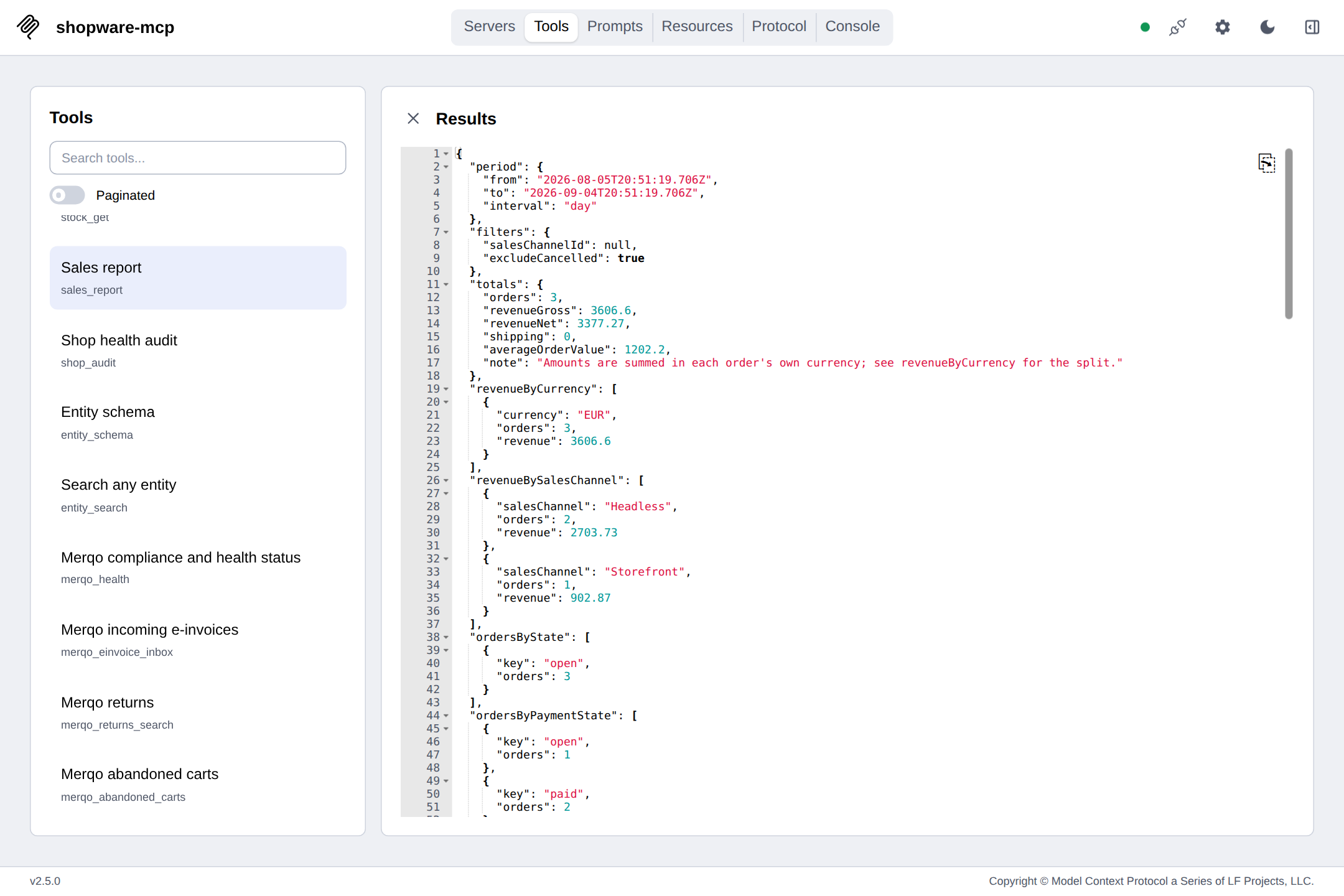
| A report | sales_report asks Shopware to aggregate: gross, net, average order, revenue per currency and channel, orders per state, a day/week/month timeline, the top products and, on request, the change against the period before. The figures were checked against SQL on the same database. |
| An escape hatch | entity_schema describes any of the 200+ entities, a plugin's custom entities included, and entity_search queries them with the same filters. Entities that hold credentials are refused, secrets in the rest are scrubbed. |
| A brake | Read-only unless you start it with --allow-write. Even then every write is a dry run that shows the exact request first, and a write budget can cap how many real writes a process may make. Ship, mark paid, remind, refund, correct stock, note, generate a document: eight narrow writes, nothing else. Secrets never appear in output, logs or errors. |

Shops are not identical, so the tool list is not either: at startup the server looks up which extensions are installed and registers extra tools for the ones it knows. A plain shop gets the core set. A shop with more plugins gets a bigger agent, without configuration.
See it work
Every recording on this page is real output from the server against a Shopware
6.7.13 test shop with generated demo data, replayed from the transcripts in
docs/demo/. Tool calls and results are verbatim, shortened to
fit the screen. The prose is what an MCP host says with them.
One question, nine checks. Three paid orders are still waiting for shipment, the storefront is in maintenance, a summer promotion outlived August. The answer names order numbers and amounts, and offers the safe next step.
Numbers the shop computed itself. Totals, channels, states, a monthly timeline and the top product for eight months, from one call. No order was paged through; Shopware's aggregations did the work.
No tool for that? There is a schema for that. Manufacturers have no
dedicated tool. The agent reads the entity's schema, spots mediaId, and
filters on it. The same path reaches every other entity, custom ones included.
Writes show their hand first. With --allow-write, a stock correction
comes back as the request it would send. Only an explicit dryRun: false
touches the shop, and the result is re-read from Shopware.
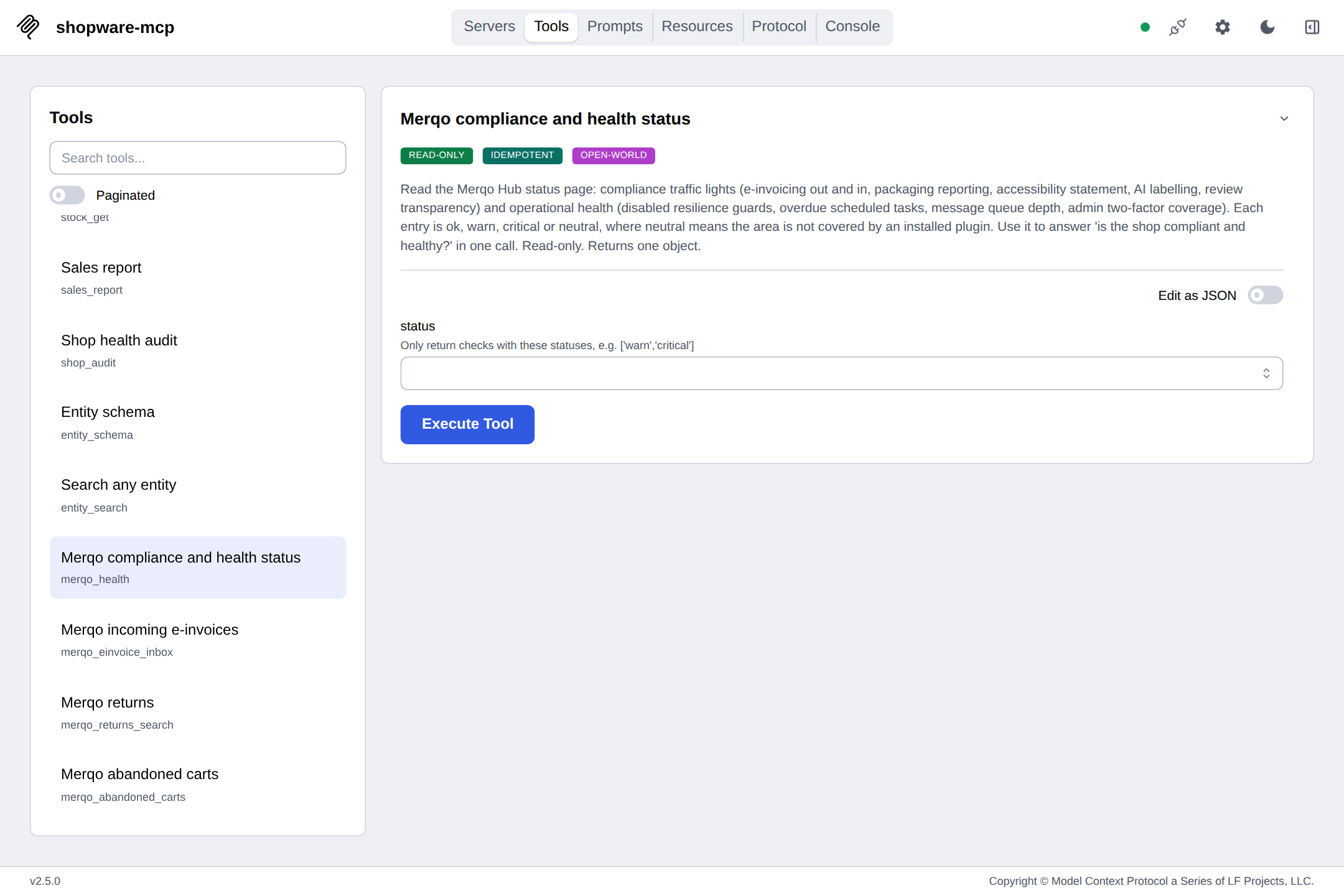
A shop with more plugins gets a bigger agent. The core tools are ready immediately. The extension lookup finishes in the background, four tools appear, the host is told to refresh its list, and a compliance question has an answer.
Know before the agent finds out. shopware-mcp doctor probes what the integration may read, reads its role for the write privileges where it can, and names the missing one per tool. An administrator gets a wall of ticks; a support-desk role gets told exactly what to grant.

Screenshots from the MCP Inspector against the same shop
What's in the box
| Sixteen curated tools | products_search, orders_get, customers_search, stock_get, promotions_list, plugins_list and friends. Each takes { term?, filter?, sort?, page?, limit?, fields? } and returns { total, page, limit, items }. |
| Health audit | shop_audit with tunable thresholds (stuckOrderDays, lowStockThreshold, maxItems). Eleven checks including legal pages per storefront and delivery times, prioritised findings, a hint per finding, and an EU duty overview that names duties and deadlines, never products. |
| Sales report | sales_report for any period, by day, week or month, optionally per sales channel, cancelled orders excluded. compareWithPrevious adds the preceding period and the change in orders, revenue and average order value. Top products resolved by exact product id so ties cannot skew revenue. |
| Any entity | entity_schema lists all entities or describes one: fields, types, flags, associations. entity_search queries it. Long text values are truncated, secrets scrubbed, credential entities refused. |
| Plugin-aware tools | The server detects installed, active extensions and adds tools for the ones it knows. First pack: Merqo. Off with --no-extensions. |
| Documents | order_documents_list, order_document_create (invoice, delivery note, credit note, cancellation, by Shopware's own generator) and document_download, which hands the PDF to the host as an embedded resource while the model sees only the metadata. |
| Guarded writes | stock_set, product_update, order_state_transition, order_delivery_transition (ship, with tracking codes), order_transaction_transition (mark paid, remind, refund), order_note (internal comment), order_document_create, promotion_toggle. Registered only with --allow-write, dryRun: true by default, the re-fetched entity on a real write. SHOPWARE_MCP_MAX_WRITES caps real writes per process. |
| Doctor and init | shopware-mcp doctor says per tool whether this integration can use it and which privilege is missing. shopware-mcp init tests the credentials and prints or writes the config for Claude Desktop, Claude Code, Cursor, VS Code or Zed. |
| Resources and prompts | shopware://shop, shopware://sales-channels, the templates shopware://order/{orderNumber} and shopware://product/{productNumber} so a host can attach a record as context, and three prompts: order_summary, low_stock_report and weekly_review. |
| Shopware's vocabulary | Filters are Shopware Criteria filters (equals, contains, range, equalsAny) on Shopware field paths, including associations like manufacturer.name. State names are the technical names you already know. |
| Portable schemas | Every tool schema is checked to avoid constructs that some MCP clients misread, so the same server works in every host. |
| A solid client | OAuth client credentials with early token refresh, one retry on 401 and on 429/5xx with Retry-After, a per-request timeout, exact totals, inheritance and language headers, a cached entity schema. |
| Two transports | stdio for desktop hosts, stateless Streamable HTTP for everything else, with an optional bearer token. |
| Packaged four ways | npm with build provenance, a Docker image on GHCR for amd64 and arm64, a one-click .mcpb bundle for Claude Desktop that asks for the credentials and a write budget, and a listing in the official MCP registry. |
Who it is for
- You run a shop and want to ask it questions instead of clicking through the admin. Stuck orders, low stock, last month's numbers, one prompt each.
- You run an agency and look after many shops. The core here covers one shop per server; the multi-shop, audited, hosted version is what the author builds for clients (see Open core).
- You build Shopware plugins and want your custom entities reachable by an agent today, and your own tools registered tomorrow.
entity_searchdoes the first; one file undersrc/extensions/does the second. - You build agents and want an MCP server that behaves: compact output, honest totals, dry runs, no surprises in the schema.
60 seconds
1. Create an Integration in your Shopware admin: Settings → System → Integrations → Add integration. Copy the access key ID and the secret; the secret is shown once. For a dev shop tick Administrator, for production give it a read role (see permissions).
2. Let the wizard test the credentials and write the host config for you:
Or run the server by hand:
3. Connect a host (or let init --write do it):
Claude Desktop
Download shopware-mcp.mcpb from the latest release and double-click it, or add this to claude_desktop_config.json:
Claude Code
Cursor, VS Code, Zed, Windsurf and other stdio hosts
They all take the same three fields. Cursor reads .cursor/mcp.json, VS Code .vscode/mcp.json (under servers instead of mcpServers), Zed its context_servers block:
Hosts that read the official MCP registry find it as io.github.bnymnDev/shopware-mcp.
Docker and HTTP hosts
The image serves Streamable HTTP on http://127.0.0.1:3333/mcp. Point any HTTP-capable host at that URL. Add -e SHOPWARE_MCP_HTTP_TOKEN=<random secret> and the endpoint requires Authorization: Bearer <secret>; without a token, keep it on localhost or behind a proxy that authenticates (self-hosting notes).
4. Ask. The first useful question is usually "Is everything okay with the shop?"
Ask it anything
| You say | The agent calls |
|---|---|
| "Is everything okay with the shop?" | shop_audit |
| "How did we do in August?" | sales_report { from, to, interval: "week" } |
| "Which products are below 5 in stock?" | products_search with a range filter, or the low_stock_report prompt |
| "Summarise order 10042 for a support reply." | orders_get, or the order_summary prompt |
| "Which customers ordered more than ten times?" | customers_search with a range filter on orderCount |
| "Is the PayPal plugin up to date?" | plugins_list |
| "Which manufacturers have no logo?" | entity_schema then entity_search on product_manufacturer |
| "Set the stock of SW10084 to 40." | stock_set, dry run first, then for real |
| "Order 10042 shipped with DHL, tracking 00340434." | order_delivery_transition { transition: "ship", trackingCodes } |
| "The bank transfer for 10038 arrived." | order_transaction_transition { transition: "paid" } |
| "How was last week compared to the week before?" | sales_report { compareWithPrevious: true }, or the weekly_review prompt |
| "Send me the invoice for 10042." | order_documents_list, then document_download returns the PDF |
| "Note on 10042: customer called, ships Monday." | order_note |
| "Which of my tools will fail with this integration?" | not a tool: npx shopware-mcp doctor |
Filters, in one screen
Every search tool takes the same filter array, and every entry is a Shopware Criteria filter:
Anything you can filter in the Admin API works here too, associations included.
Need a raw field that the compact output leaves out, such as customFields,
ean or weight? Pass fields: ["customFields", "ean"] and it is added to
every item. Reading a shop in another language? Set SHOPWARE_LANGUAGE_ID.
The full cheat sheet has more.
Tools
| Tool | Access | Purpose |
|---|---|---|
shop_info | read | Shop info |
sales_channels_list | read | List sales channels |
products_search | read | Search products |
products_get | read | Get product |
orders_search | read | Search orders |
orders_get | read | Get order |
order_documents_list | read | List order documents |
document_download | read | Download document PDF |
customers_search | read | Search customers |
customers_get | read | Get customer |
categories_list | read | List categories |
promotions_list | read | List promotions |
plugins_list | read | List plugins and apps |
stock_get | read | Get stock |
sales_report | read | Sales report |
shop_audit | read | Shop health audit |
entity_schema | read | Entity schema |
entity_search | read | Search any entity |
stock_set | write (guarded) | Set stock (guarded) |
product_update | write (guarded) | Update product (guarded) |
order_state_transition | write (guarded) | Transition order state (guarded) |
order_delivery_transition | write (guarded) | Transition delivery state (guarded) |
order_transaction_transition | write (guarded) | Transition payment state (guarded) |
order_note | write (guarded) | Add internal order note (guarded) |
order_document_create | write (guarded) | Create order document (guarded) |
promotion_toggle | write (guarded) | Toggle promotion (guarded) |
Every parameter of every tool: docs/tools.md. Searches return
{ total, page, limit, items } with exact totals, limit is capped at 50, and
errors come back as { error: { status, code, detail } } so the model can
react instead of guessing.
Resources: shopware://shop, shopware://sales-channels, shopware://order/{orderNumber},
shopware://product/{productNumber}. Prompts: order_summary, low_stock_report, weekly_review.
Plugin-aware tools
At startup the server asks the shop which extensions are installed and active,
in the background, and registers extra tools for the ones it knows. A shop that
does not answer simply keeps the core tools. --no-extensions turns the whole
mechanism off.
Today one suite is supported, Merqo, which
adds merqo_health, merqo_einvoice_inbox, merqo_returns_search and
merqo_abandoned_carts. Shops without it never see those tools, and nothing in
the core tools changes either way. Support for another vendor's extensions is
one file under src/extensions/; pull requests are welcome.
Safety
- Read-only by default. Without
--allow-write(orSHOPWARE_MCP_ALLOW_WRITE=true) the write tools are not registered. An agent cannot discover what it cannot call. - Every write is a dry run first.
stock_set,product_update,order_state_transition,order_delivery_transition,order_transaction_transition,order_note,order_document_createandpromotion_toggledefault todryRun: trueand return{ dryRun: true, wouldSend: { method, url, body } }, a list when one call needs several requests. A real write returns the re-fetched entity. - A write budget.
SHOPWARE_MCP_MAX_WRITES=20refuses the twenty-first real write of a process withWRITE_BUDGET_EXHAUSTED; dry runs stay free. No prompt can lift it. - Narrow writes.
product_updatetouches name, description, active and one currency's price. The transition tools only move state machines; nothing moves money. Documents come from Shopware's own generator and are never sent by this server. Nothing else is writable. - Scrubbed reads.
entity_searchstrips passwords, keys, tokens and hashes from every payload and refuses entities that exist to hold credentials or system internals: users, integrations, ACL roles, apps, system config. - No secrets anywhere. Credentials never appear in output, logs or error messages. Logs go to stderr only, at
errorlevel unless you ask for more. - No telemetry. The server talks to your shop and to your host. Nothing else.
- HTTP transport. Set
SHOPWARE_MCP_HTTP_TOKENand every call to/mcpneeds that bearer token, compared in constant time. Without it, bind to localhost (the default) or put it behind a reverse proxy that authenticates; the server warns when it is reachable further without a token. - Requests time out. A shop that stops answering costs one request 30 seconds (
SHOPWARE_MCP_TIMEOUT_MS), not the whole session.
Found something? See SECURITY.md.
Configuration
| Variable | Required | Notes |
|---|---|---|
SHOPWARE_URL | yes | Shop base URL, e.g. https://shop.example.com (trailing slash is stripped) |
SHOPWARE_CLIENT_ID | yes | Integration access key ID |
SHOPWARE_CLIENT_SECRET | yes | Integration secret access key |
SHOPWARE_MCP_ALLOW_WRITE | no | true registers the write tools. Default: off |
SHOPWARE_MCP_MAX_WRITES | no | Real writes one process may perform in total; 0 (default) means no cap |
SHOPWARE_MCP_DEFAULT_LIMIT | no | Default page size for search tools (default 20, max 50) |
SHOPWARE_MCP_EXTENSIONS | no | false disables plugin-aware tools and the extension lookup at startup |
SHOPWARE_LANGUAGE_ID | no | Language UUID for translated fields (sw-language-id). Default: shop default language |
SHOPWARE_MCP_TIMEOUT_MS | no | Per-request timeout for the Admin API in milliseconds (default 30000, 1000 to 600000) |
SHOPWARE_MCP_HTTP_TOKEN | no | Bearer token the HTTP transport requires on /mcp (at least 16 characters). Default: none |
SHOPWARE_MCP_LOG_LEVEL | no | error (default), warn, info, debug. Logs go to stderr only |
CLI flags override the environment: --allow-write, --max-writes <n>, --no-extensions, --http, --port <n>, --host <addr>, --log-level <level>. Commands: doctor [--json] and init [--for <host>] [--write].
The Integration needs read permissions on the entities you query and write permissions on product, order and promotion for the write tools. Administrator is the quick path for a dev shop; use a dedicated role in production (which permissions).
Design principles
- Shopware's vocabulary, not ours. Filters, field paths, state names and entity names are Shopware's. A tool call reads like the Admin API request it becomes, and a Shopware developer needs no second dictionary.
- Compact by default, complete on request. Items carry what a model needs to reason and page. Raw fields come with
fields, more rows withpage, and long text is truncated rather than dumped. - Reading is free, writing is explicit. Write tools exist only when asked for, default to a dry run, and return the exact request. The model sees the consequence before the shop does.
- Let the shop do the maths. Totals, timelines and top products are Shopware aggregations with exact counts, not client-side sums over pages.
- Vendor-neutral core. Extension packs live in their own files, are registered only when the shop has the extension, and never change how the core tools behave. No telemetry, no phone-home.
The reasoning behind individual choices is in docs/decisions.md.
Documentation
| Document | What is in it |
|---|---|
| docs/quickstart.md | Integration, first run, host configs, example questions, the filters cheat sheet |
| docs/tools.md | Every tool with every parameter, generated from the code |
| docs/self-hosting.md | Transports, Docker, reverse proxies, Shopware permissions, operations |
| docs/decisions.md | Design decisions and the reasoning behind each |
| CONTRIBUTING.md | Setup, ground rules, end-to-end tests, releasing |
| SECURITY.md | What to report and where |
| CHANGELOG.md | What changed in each version |
Open core
Everything in this repository is MIT and stays that way. It covers one shop, one operator, interactive use.
The same author builds Merqo, a commercial suite of Shopware extensions for EU compliance and daily operations. This server detects them and adds matching tools, but it never requires them, and the core tools behave the same either way.
Agencies and merchants running this at scale usually need more, and that is what I build and operate for clients:
- Multi-shop: one MCP endpoint that routes to dozens of shops with per-shop credentials and permissions
- Hosted with audit trail: every tool call logged with who, what and when, role-based access, SLA
- Bulk operations and migrations: mass price and stock updates, catalogue imports, safe rollbacks
- Custom agents and Shopware plugins: workflows tailored to your ERP, PIM or support desk
Interested? Open an issue with the consulting label or reach out via github.com/bnymnDev. Using shopware-mcp in production and want it to stay maintained? Sponsoring helps.
Building from source
End-to-end tests against a real Shopware (dockware/dev, or any shop you point them at) run with pnpm test:e2e; see CONTRIBUTING.md.
Status
v0.3. Everything on this page is implemented, covered by unit tests against mocked Admin API responses, and exercised nightly end-to-end against a real Shopware. The recordings above come from Shopware 6.7.13; 6.6 is supported too.
Not in it, on purpose: user management for the HTTP transport (one static token, or a proxy), multi-shop routing and audit trails (the commercial part), and write tools beyond the eight that a support desk needs on a normal day.
Ideas that fit: more extension packs, better error hints for common Shopware
ACL problems, a products_search example gallery. The good first
issues
are a fine place to start.
License
If shopware-mcp answered a question your admin could not, a star helps the next shop find it.