Publish HTML as a tracked link and see who opened it and which sections they read.
Quick Install
Automated & IDE SetupCopy the AI prompt to install this server into Claude Code, Cursor, or another agent — or use 1-click editor setup below.
Not yet automatically verified
We haven't yet run this listing's install command through our automated sandbox check. This isn't a red flag — we're steadily working through the catalog.
Manual Client & Custom JSON ConfigExpand JSON ▾
Client Config & Setup
Choose your client or environment
Target File:
💡 Paste the JSON block into your client's configuration file under mcpServers, then restart the application.
Documentation Overview
HTMLRadar
The open-source DocSend alternative for HTML files.
Read tracking for the decks, reports and proposals you now send as HTML.




HTMLRadar is an open-source tool for sharing an HTML deck, brief, or proposal as a tracked link, and seeing who opened it, which sections they read, and for how long. Not just that it was opened — dwell time, section by section. You know who a reader is when the share's email gate collected an address; otherwise the reader is an anonymous row with the same reading detail.
htmlradar.com · free for 2 tracked links, $15/mo or $150/yr for unlimited · or self-host the whole thing.
Try the public demo, no sign-up — a live tracked link you can open in a browser.
Using Claude? Add HTMLRadar as a connector by pasting one address —
https://mcp.htmlradar.com/mcp. Nothing to install and no API key to make first;
how it works.
Issues and PRs · roadmap · changelog documents v1.2; latest published tag is v1.1.2.
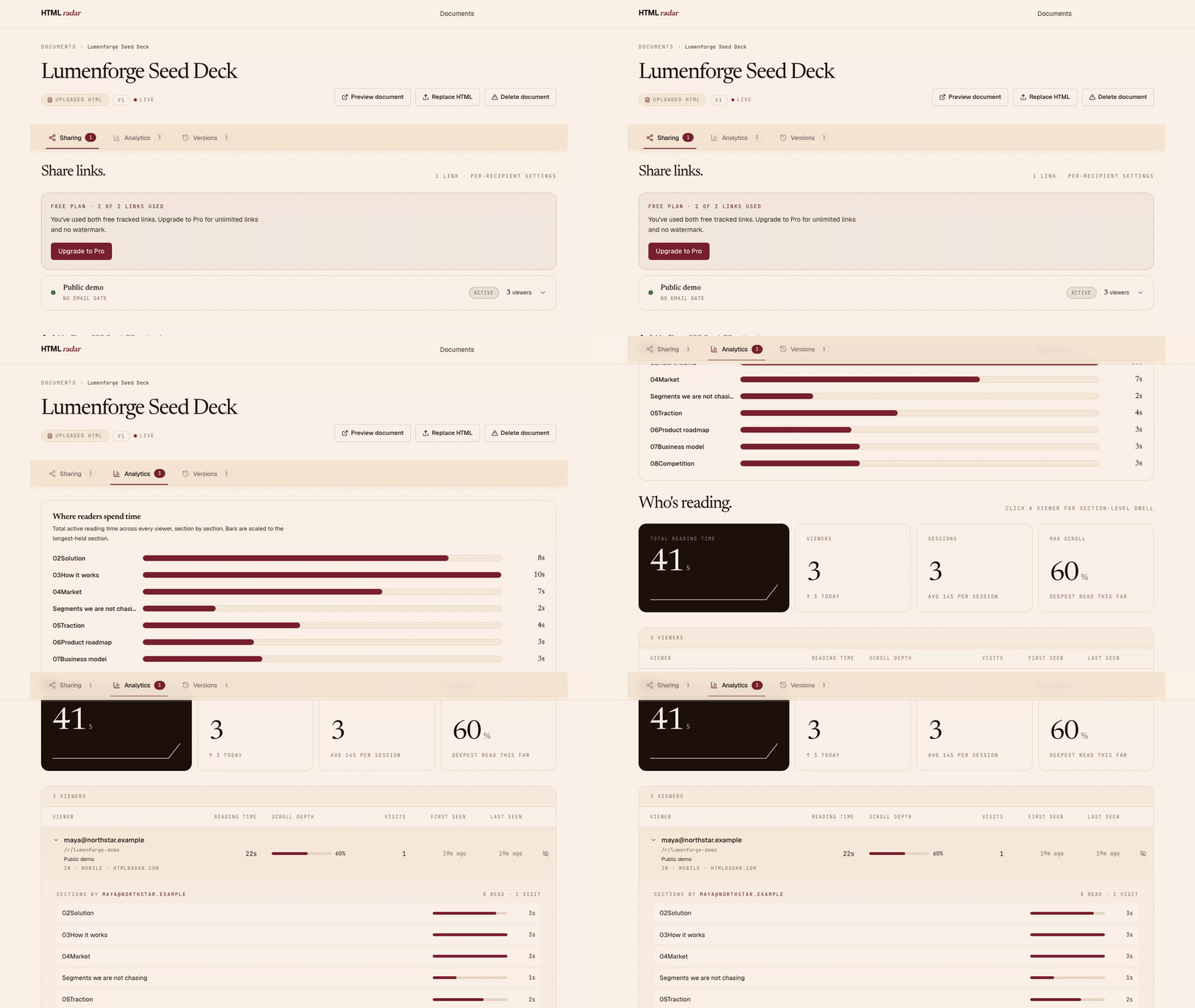
Walkthrough uses synthetic sample data in the real sender dashboard.
Why this exists
The documents that matter — decks, client reports, proposals, board updates — are becoming HTML, because an HTML page can be interactive, reflows to whatever screen opens it, and can be changed after it has been sent. A PDF you have sent is fixed. More of them are written with AI tools now, and ChatGPT, Claude, v0, Lovable and Anthropic Artifacts all produce HTML. The format is what makes these documents better; who typed them is beside the point.
The tracking tooling never followed. When I went looking, I could not find an open-source tool that reported reading at section level for an HTML document. The document-tracking products I did find grew up around uploading a file and tracking that file.
HTMLRadar tracks the document people actually send now, and reports reading at section level rather than a single "opened" flag.
What this is
Send-side analytics for HTML documents. Upload an HTML file (or paste a URL you already host), send a tracked link htmlradar.page/r/{slug}, see who opened it, which sections they dwelled on, and when they bounced. Section-level dwell, not "opened."
What it does
- Section-level dwell. At least half a section must stay visible for one continuous second before its dwell starts qualifying; the read signal fires after three qualified seconds. The tracker auto-detects sections from your HTML: explicit anchored headings → bare
h1/h2/h3(slugged from text) → slide/page containers (section,.slide,.page) → paragraph buckets on plain prose. Dashboard tells you a recipient spent 2m 41s on §03 The Ask, 12s on Problem, and skipped Market sizing. - Per-viewer dashboard, aggregated across every share. One row per person who actually opened the doc, with email + country + device + referrer + total time + scroll depth + visits + first/last seen. Updates live every 30 seconds while the tab is in focus.
- Per-recipient share links. One document, many shares. Each share carries its own email gate, password, expiry, revocation, and email-domain or per-email allow-list.
- Files alongside the deck. Attach PDFs, financial models, images, and ZIPs to any share. Recipients see a small corner pill that opens a side drawer; files are always available when present (the per-share "Lock the deck" toggle controls deck save/print only, never attachments). Every download is logged per session and per filename, and tied to the viewer record when one exists.
- Version history. Replace the HTML after partner feedback. Every existing share keeps the same link and serves the new version on next open. The
v{n}chip on the doc page is a popover with every upload's original local filename, byte size, and timestamp. - Retroactive share access. Change a share's password, expiry, or allow-list without revoking. The proxy re-checks the allow-list on every request — removing an email kicks them out immediately on their next click, not their next browser session.
- Edit + preview without leaving the dashboard. Preview the doc as the recipient sees it before sending (short-lived HMAC token, no gate). Both "Preview document" and "Preview as you" open in a new tab so your dashboard stays where you left it.
- Branded first-open email. When a recipient creates their first real session, HTMLRadar requests an HTML notification — viewer email + doc title + a single "See the read →" CTA back to the dashboard. Tease, not report.
- Engaged-time, not tab-open time. Both per-section dwell and per-session active time apply a 5-second idle watchdog (keydown / scroll / touchstart, mousemove deliberately excluded). That is the same five-second inactivity window engaged-time tools such as Chartbeat and Parse.ly use; those tools also read further interaction signals that HTMLRadar deliberately does not collect. A tab parked while the reader walked away stops counting after 5 seconds.
- Bot / accidental-tap filter. After the document loads, HTMLRadar waits through a 5-second warm-up before creating the session. If the recipient backgrounds the tab or bounces during that wait, there is no session, notification request, or inflated viewer count.
- Data collected. A recipient record holds an email address when a share's gate collects one, otherwise a random identifier (kept in the browser's localStorage where the page can reach it, freshly generated on each load where it cannot — which is the case on the sandboxed proxy-served links); first-seen and last-seen times; visit count; the browser identification string; referrer; country and city; device type; operating system; browser. A session record holds the document version seen, start and last-heartbeat times, active seconds, and maximum scroll depth. A section record holds dwell per section. These records are kept until the owner deletes the document — there is no automatic purge. Not stored in recipient records: raw IP address, cursor positions, keystrokes, page snapshots, session replay. An ungated document shows no tracking notice; the email-gate page shows one sentence ("Reading activity on this document is shared with the sender") and a link to the privacy page. Opt-out is a developer-console call,
window.HTMLRadar.optOut(), followed by a confirmation page — documented, but not something an ordinary recipient will discover. Audit for comparison: what each of seven tools loads in a recipient's browser, HTMLRadar included.
What it deliberately is not
A sender-side analytics tool for one document at a time. Not a CMS, deck builder, static-site host, PDF viewer, or website analytics platform. You bring the HTML.
Architecture
Six packages, two storage backends. Three of the six are Cloudflare Workers, one is the Next.js app on Cloudflare Pages, and two are libraries that ship as bundles.
Document HTML + attachment bytes live in Cloudflare R2. Everything else (sessions, sections, viewers, shares, attachments metadata, version history) lives in Supabase Postgres.
Recipient links live on a second domain, htmlradar.page, while the dashboard and the marketing site stay on htmlradar.com. A recipient document is HTML somebody else wrote, and serving it on the application's own domain would put a stranger's markup on the same origin as a signed-in session, and would let anyone who uploaded a convincing fake sign-in page have it served under our certificate and our reputation. A separate registrable domain removes both problems at once: the document's origin carries no application cookies, and if the content domain ever ends up on a phishing blocklist, the application domain does not. Links sent before the split still work — the worker answers htmlradar.com/r/… with a permanent redirect. Self-hosters choose their own two hosts, or run both roles on one; see docs/self-hosting.md.
Related MCP Servers
Reviews
No reviews yet — be the first to share how this listing worked for you.
Frequently Asked Questions about Share
AllMCPs Directory Badge
Showcase your server listing on GitHub or your project documentation. Embed this dynamic SVG badge to highlight official listing status and live engagement.
Badge Style:
Live Dynamic SVG Preview
Markdown (GitHub README)
[](https://allmcps.com/mcp/share)HTML Embed
<a href="https://allmcps.com/mcp/share"><img src="https://allmcps.com/api/badge/share?style=directory" alt="Share on AllMCPs" /></a>Technical Specs & Signals
CategoryDeveloper Tools
37Quality signal: Fair · 37/100How this signal is calculated ▾
Server availabilityNot measured
Not scored for repo-hosted servers — we can't reach the running server, only its GitHub page. Hosted MCP endpoints are health-checked live.
Verified ownership10/20
Documentation & tools16/30
Adoption & activity2/15
Community engagement0/10
A guidance signal from public completeness & health data — not a user rating. New listings start lower and rise as they add docs, get verified, and grow adoption. Signals we can't observe for a listing are skipped, not counted against it.
Supply-chain signal
No high-severity advisories surfaced by our automated scan.
Critical 0High 0Medium 0Low 0
Scanned 1h ago via OSV.dev · htmlradar-mcp (npm)
Own this project?
This directory is pre-filled from public sources. Claim via GitHub README, site badge, or DNS TXT to unlock edit access and the Official badge — proof is checked automatically, then reviewed by our team.
Free dofollow backlink: add your website and place the AllMCPs badge on it — no claim needed. We detect it automatically and keep it verified as long as the badge stays live.
Claim & get free dofollowShare & Embed
Add our SVG badge (dark/light directory styles) or embeddable widget to your site.