Seco Labor MCP README
The full upstream README, mirrored here for reference. Install config, tool schemas, adoption signals, and an original overview live on the Seco Labor MCP listing page.
🇨🇭 Part of the Swiss Public Data MCP Portfolio
SECO Labor Market MCP Server





🌐 English | Deutsch
An MCP (Model Context Protocol) server for Swiss labor market data from SECO (Staatssekretariat für Wirtschaft) and AMSTAT via opendata.swiss.
Overview
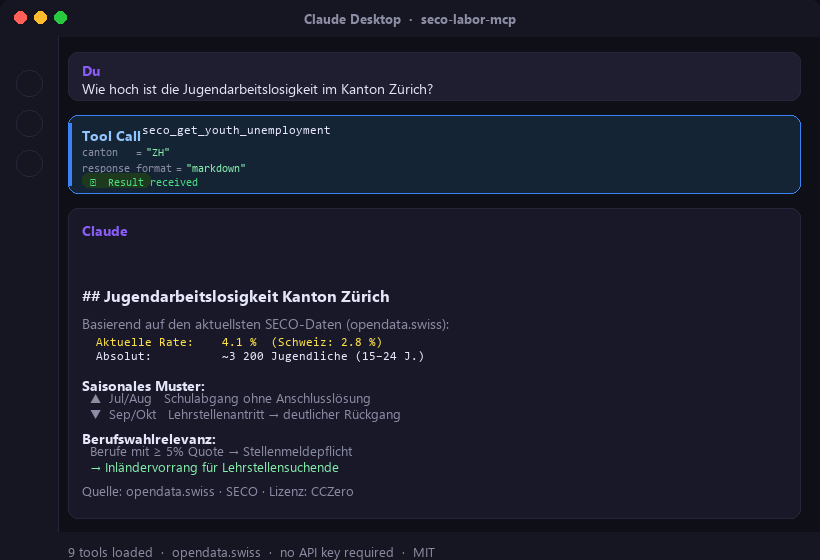
This server connects AI models to Swiss labor market statistics — unemployment rates, job seekers, open positions, youth unemployment, and occupational breakdowns — all without requiring an API key.
Primary audiences:
- 🏫 Schulamt / Education planning — youth unemployment, vocational guidance data
- 📊 Research & analysis — labor market trends, cantonal comparisons
- 🤖 AI agents — automated labor market monitoring and reporting
Anchor query:
"Welche Berufsgruppen haben im Kanton Zürich die höchste Jugendarbeitslosigkeit, und welche Lehrberufe unterliegen der Stellenmeldepflicht?"
→ More use cases by audience →
Data Sources (Phase 1 — No Auth Required)
| Source | Description | Status |
|---|---|---|
| opendata.swiss | CKAN catalogue; the pinned BFS table T3.3.0.1 carries the SECO annual series | ✅ Live |
| arbeit.swiss | Monthly press reports (PDF, structured URL pattern) | ✅ Live |
| amstat.ch | AMSTAT reference portal | ⚠️ JavaScript SPA, no public REST API |
| unfallstatistik.ch | Unfallstatistik UVG (SSUV/KSUV c/o Suva) — occupational accidents and diseases | ⚠️ PDF only, no API (see below) |
Architecture
Where the figures come from — and what is missing
SECO is no longer a publisher on opendata.swiss. Verified 2026-08-14:
organization_show returns 404, and none of the 176 entries in
organization_list is SECO. Until then the server filtered every search on
that organisation and therefore returned nothing — a name lookup that
misses looks exactly like an empty search.
The registered unemployed and job seekers are still SECO's figures: the BFS
publishes them in table T3.3.0.1 and names SECO in the footer. The server
reads that table through a pinned dataset id (sources.py), checked
against the live source by a live test.
| Series | 2000 | 2025 |
|---|---|---|
| Registered job seekers (SECO) | 124.6 | 214.1 |
| Registered unemployed (SECO) | 72.0 | 133.7 |
| ILO unemployed (BFS) | 126.5 | 248.5 |
thousands, annual average
The three series do not measure the same thing: in 2000 the ILO figure is 1.76× the registered one. The server reports them separately and labelled, and never converts one into the other.
The cantonal layer: four cantons, four schemas
There is no national monthly series — but four cantons publish their own
RAV figures, each in its own portal with its own column names. For those,
seco_get_unemployment_overview(canton=…) returns real values:
| Canton | Granularity | from | Level | Note |
|---|---|---|---|---|
| TG | monthly | 2016-01 | canton | only series by age class → youth unemployment as a count |
| FR | monthly | 2004-01 | canton and Switzerland | carries the national monthly figure as a comparison row |
| ZG | monthly | 1993-01 | canton | youth unemployment only as a rate, not a count |
| ZH | annual | 1991 | municipality | no monthly values; districts and regions sit in the same column as municipalities and are separated out |
The other 22 cantons get a named refusal — no figure from another canton and no national aggregate. Partial coverage that feels complete is worse than none.
The four series are not comparable with each other and do not add up to a Swiss figure: different time axes, different geographic levels, and in ZG's case a rate rather than a count.
Still not available: unemployment by occupational group, open positions as a national series, and youth unemployment for Switzerland or for 24 of the 26 cantons. The affected tools say so and return no substitute figure. These values exist interactively on amstat.ch, which offers no interface a server could call.
Tools
| Tool | Description | Key Use Case |
|---|---|---|
seco_search_datasets | Search labour-market datasets on opendata.swiss (publisher shown per hit) | Discovery |
seco_get_dataset | Full metadata + download links for a dataset | Data access |
seco_get_unemployment_overview | Registered unemployed: national annual, cantonal for TG/FR/ZG/ZH | Labor market overview |
seco_get_youth_unemployment | Youth unemployment (15–24) — TG (count) and ZG (rate) only | 🎓 Berufswahlberatung |
seco_get_job_seekers | Registered job seekers, national, annual series from 2000 | Training demand |
seco_get_open_positions | Open positions — no national series available | Sector analysis |
seco_get_unemployment_by_occupation | Breakdown by Berufshauptgruppe — no machine-readable source | 🎓 Vocational guidance |
seco_get_monthly_report_url | Generate/verify PDF report URL | Source access |
seco_list_cantons | All 26 canton codes and names | Utility |
seco_get_uvg_overview | UVG key figures on occupational accidents and diseases | Risk overview |
seco_get_uvg_by_branch | Results per NOGA 2008 economic branch | 🎓 Vocational guidance |
seco_get_uvg_trends | Ten-year accident time series per branch | Trend analysis |
12 of a maximum of 15 tools.
Unfallstatistik UVG (SSUV)
The three seco_get_uvg_* tools cover the risk side of the same labour market
the unemployment tools describe: how many occupational accidents and diseases
occur per branch, and how that develops over ten years.
The publisher is not SECO. The Unfallstatistik UVG is issued by the
Koordinationsgruppe KSUV and the Sammelstelle SSUV c/o Suva, Lucerne. The
seco_ prefix addresses this server, not the source; every response names the
actual publisher in its source field.
Architecture decision: C (dump-first)
Verified live on 2026-08-05, full write-up in
PROBE_REPORT_UVG.md.
The source has no API. A link scan across every data page returned 165 PDFs
and zero files with .csv, .xlsx or .json. opendata.swiss does not list the
source at all (count=0 for six of seven search terms), and the BFS dam-api
silently ignores its filter parameters. What remains is machine-readable in
practice but not by design:
| Access | Format | Refresh |
|---|---|---|
schluesselzahlen_d.htm | HTML table, 5 years, Switzerland-wide | annually |
Ts{YY}.pdf | annual edition, tables 1.2 and 2.4 by NOGA | annually, June |
WirtKl_{BUV|NBUV}_{NN}.pdf | ten-year series per NOGA division | annually, January |
PDFs are cached for 24 h and fetched with 2s/4s/8s backoff.
What every response tells you
source_freshness.data_year— the data year, not the edition year. The 2026 edition reports 2024; that two-year lag is stated, not buried.totals_check— parsed rows are summed and compared against the total printed in the same publication. A broken layout shows up here instead of becoming a plausible wrong number.significant— the source marks statistically significant year-on-year changes with an asterisk. That flag is preserved per data point, so a change is only reported as significant where the source says so.
Installation
Claude Desktop (stdio)
Add to claude_desktop_config.json:
Cloud / SSE
The SSE server binds to 127.0.0.1 (loopback) by default to prevent
NeighborJack on shared networks. For container deployments where you actually
need to accept traffic from outside the container, set HOST=0.0.0.0
explicitly — ideally in your Dockerfile / orchestrator config, and only behind
an upstream proxy or firewall:
Development
Usage Examples
Search for youth unemployment data
Get cantonal unemployment for Zürich
Get monthly report URL
Key Concepts
Arbeitslose vs. Stellensuchende
Eselsbrücke: Arbeitslose ⊂ Stellensuchende — Arbeitslose sind eine Teilmenge.
| Term | Definition | Dec 2025 |
|---|---|---|
| Arbeitslose | RAV-registered, immediately available | ~149'000 (3.2%) |
| Stellensuchende | All RAV-registered (incl. training programs) | ~233'900 |
Youth Unemployment Seasonality
- July/August: Sharp increase (school leavers without placements)
- September/October: Decline (apprenticeship starts)
- The residual that remains after the autumn decline signals structural need for bridge programs (Brückenangebote)
Stellenmeldepflicht (since 2020)
Occupations with ≥5% unemployment rate must be reported to the RAV before posting publicly. The list changes annually. This is directly relevant for vocational counseling — these professions have highest availability for Swiss job seekers.
Portfolio Synergies
| Server | Synergy |
|---|---|
swiss-statistics-mcp | BFS population/employment data for deeper context |
zurich-opendata-mcp | City of Zurich-level education and social data |
swiss-snb-mcp | Economic context (GDP, wages) for labor market interpretation |
fedlex-mcp | ALV (Arbeitslosenversicherung) legislative framework |
Known Limitations
amstat.arbeit.swisshas no public REST API (JavaScript SPA) → workaround via CKAN- Occupational/sectoral detail requires CSV download from SECO resources
- Monthly press report URL patterns may vary for older reports
- Cantonal sub-municipal data not available at this level
- UVG figures come from PDF parsing — the layout was stable across the 2025 and
2026 editions, but a redesign can break it. The
totals_checkin every response is what makes such a break visible rather than silent. - UVG data lags roughly two years (the 2026 edition reports 2024)
- UVG branch detail follows NOGA 2008 and groups some divisions (
41 – 42,77, 79 – 82); there is no cantonal breakdown at this level - Detailed UVG data beyond the publications sits behind the SSUV closed user group and is out of scope for this no-auth server
Phase 2 roadmap:
- Automatic CSV caching with 24h TTL
- Direct XLSX parsing for cantonal breakdowns
- Integration with
zh-education-mcpfor Schulamt-specific correlations
Data License
Two different licences apply — the code of this server is MIT either way, but the data is not covered by it.
SECO / AMSTAT data published on opendata.swiss is under Creative Commons CCZero (public domain). Source: Staatssekretariat für Wirtschaft (SECO) — seco.admin.ch
Unfallstatistik UVG data is not openly licensed. The publication states:
«Abdruck – ausser für kommerzielle Nutzung – mit Quellenangabe gestattet.» (Reproduction permitted, except for commercial use, with attribution.)
That is a non-commercial restriction with an attribution requirement. It belongs
to KSUV/SSUV and cannot be lifted by this repository's MIT licence: the MIT terms
cover the code, not the figures the code retrieves. If you use this server
commercially, the UVG tools are not covered — clarify directly with the
Sammelstelle (unfallstatistik@suva.ch). Every UVG response repeats this
restriction in its source field, because a README is not passed to the model.
Safety & Limits
| Aspect | Details |
|---|---|
| Access | Read-only (readOnlyHint: true) — the server cannot modify or delete any data |
| Personal data | No personal data — all sources are aggregated, anonymous public statistics |
| Rate limits | No enforced external limits; server caps queries at 20 results by default; 30 s HTTP timeout |
| Authentication | No API keys required — opendata.swiss and arbeit.swiss are publicly accessible |
| Licenses | SECO data under Creative Commons CCZero (public domain) |
| Terms of Service | Subject to ToS of: opendata.swiss, SECO, arbeit.swiss |
| GDPR / DSG | Fully compliant — no personal data transmitted or stored; all data is official public statistics |
MCP Protocol Version
The protocol version is negotiated at the initialize handshake by the SDK,
not chosen by this server. The revision it is built and audited against is
2025-11-25, which is LATEST_PROTOCOL_VERSION in the pinned mcp
release that fastmcp brings in.
tests/test_protocol_version.py holds three things against each other: this
line, that SDK constant, and the revision a real handshake against the server
object actually returns. An SDK bump that changes the revision therefore fails
CI instead of drifting silently.
The sister servers in this portfolio pin a pair of revisions — a handshake
ceiling and a modern one — because mcp 2.x serves two protocol eras over the
same server. fastmcp 3.x pins mcp 1.x, where mcp.types.version does not
exist and one revision is the whole story. test_das_sdk_kennt_hier_nur_eine_aera
is tied to the SDK rather than to this paragraph and fails the day an upgrade
brings the two-era constants in.
Contributing
See CONTRIBUTING.md for development guidelines.
Security
See SECURITY.md for the security posture and how to report a vulnerability.
License
Released under the MIT License — Copyright © 2026 Hayal Oezkan.
Author
Hayal Oezkan · github.com/malkreide
Installation
Run via uv's uvx — no clone or manual install needed. Add to your MCP client config (mcpServers for Claude Desktop, Cursor and Windsurf; use a top-level servers key for VS Code in .vscode/mcp.json):