SafeSelect MCP README
The full upstream README, mirrored here for reference. Install config, tool schemas, adoption signals, and an original overview live on the SafeSelect MCP listing page.

MCP
Agents can look.
They cannot mutate.
Read-only PostgreSQL & MongoDB access for coding agents.
Debug with real database context, without exposing write tools—even when your existing credentials allow writes. SafeSelect puts local, project-scoped policy between your agent and your data.
Get started → · Website · Compare approaches · DBeaver → Codex guide





Runtime and distribution






Discover structure, inspect bounded rows, explain queries, and diagnose connectivity—without giving the agent write-capable tools or database credentials. Start with development data or a sanitized replica, then review the policy and effective database permissions before connecting to a more sensitive environment.
[!NOTE] SafeSelect is a safety boundary for agent access, not a replacement for database permissions. Use least-privilege database users when you can; SafeSelect still constrains overpowered credentials when agents connect through it.
Current backend support: PostgreSQL and MongoDB.
Where It Helps
- Debug an application against realistic data without exposing mutation tools.
- Let an agent inspect schemas, indexes, query plans, and bounded rows during development.
- Explore MongoDB collections through bounded reads and sampled schema inference.
- Reuse existing DBeaver, Docker Compose, or MongoDB Compass connections.
- Give coding agents database context while keeping policy, limits, secrets, and audit under your control.
Why SafeSelect?
SafeSelect is intentionally narrower than general-purpose database MCP servers. It is not a tool builder, SQL workbench, or remote database gateway. It is a local safety boundary for agents that need database visibility, not database power.
| SafeSelect prioritizes | What this means |
|---|---|
| Local stdio transport | No network listener or open MCP port |
| Read-only tools | Agents do not receive write-capable database tools |
| Credential-independent safety | Even DBA credentials are constrained to SafeSelect's read-only tool surface |
| Fail-closed enforcement | Policy violations terminate the process |
| Secret isolation | Passwords stay in Keychain or environment variables |
| Project-scoped policy | Each repository defines its own allowed data surface |
| Embedded sidecar | One installed binary reaches JDBC and MongoDB drivers behind Rust policy |
What Makes It Different?
The combination matters: PostgreSQL and MongoDB inspection, a fixed database read surface, local stdio, project policy, connection import and reproducible security evidence. Read-only modes and layered controls also exist in other projects; they are not exclusive to SafeSelect.
See the dated comparison for DBHub, MongoDB MCP Server, Postgres MCP Pro and SchemaBrain—including when each is a better fit.
Agents can look, but they cannot mutate through SafeSelect's database tools. This boundary does not cover a shell, another MCP server or direct credentials also available to the agent. Use least-privilege database users and review the threat model and limits.
Backend Support
| Backend | Status | Tools |
|---|---|---|
| PostgreSQL | Supported | Discovery, indexes/statistics, select, and explain |
| MongoDB | Supported | Discovery, find, aggregation, distinct/count, explain, profiling, schema inference, and anonymized fixtures |
Architecture
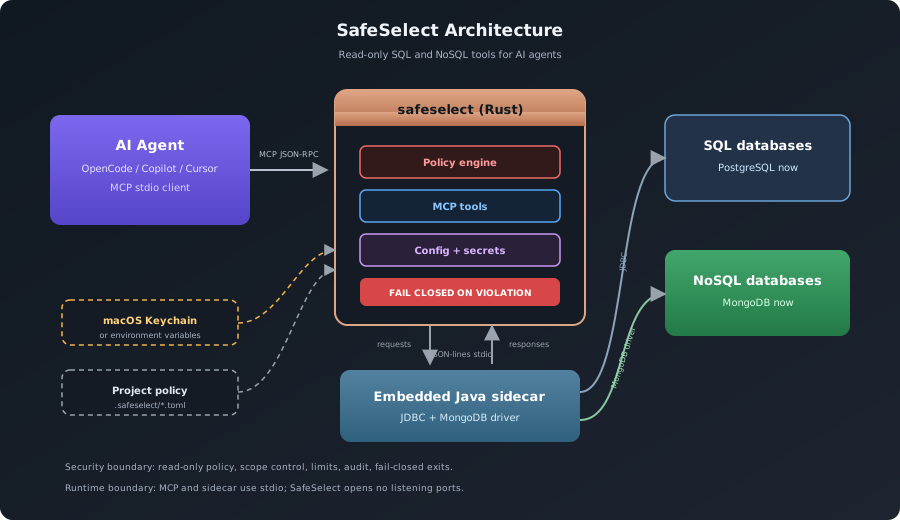
The agent talks to SafeSelect through MCP stdio. SafeSelect enforces policy in Rust, stores secrets outside project files, and reaches databases through an embedded Java sidecar: JDBC for SQL backends and the MongoDB driver for MongoDB. The Rust to Java channel is JSON-lines over stdin/stdout: no sockets, no open ports.
See it in action
Complete onboarding: from Homebrew to a protected agent

Install SafeSelect from Homebrew, import an SSH-backed DBeaver connection,
keep the password in macOS Keychain, install the OpenCode integration, and see
the agent read a paid order while its DELETE attempt is rejected. Focused
agent and backend clips remain in the complete demo gallery.
Quick Start
Install SafeSelect with one of the following methods:
Prebuilt binaries (macOS & glibc Linux)
Download a platform-specific, prebuilt binary for macOS or glibc-based Linux
from the latest GitHub release.
The verified installer selects the matching macOS or glibc Linux architecture,
checks the published SHA-256 digest, and installs to ~/.local/bin:
Set PREFIX to choose another installation directory. SafeSelect still needs
a Java 17+ runtime at execution time.
Homebrew (macOS)
asdf (macOS & Linux)
After installing the binary, configure a project database and its MCP entry:
SafeSelect uses any available Java 17+ runtime rather than requiring a specific
package-manager formula. If Java is missing or too old, install or select a
Java 17+ runtime before running database commands. On macOS with Homebrew, you
can install one with brew install openjdk@17.
The generated MCP name defaults to safeselect-<project>-<environment>.
The generated MCP entry is a stdio server scoped to one project and environment:
SafeSelect uses each client's official MCP configuration contract, pins the
absolute repository path, and defaults to user scope. Add --local for a
project-scoped entry where the client supports it. See
AI agent integration for exact paths, scopes, and manual
configuration.
Guided MCP Context
Clients that support MCP prompts can invoke read_only_database_debugging for a
safe investigation checklist. Clients can also read
safeselect://guide/read-only-database-debugging for the same static workflow
and boundary notes. Neither capability exposes database data, credentials, or
write access; use the database tools below for discovery and bounded reads.
Agent Workflow
Agents should use SafeSelect in this order:
database_infolist_tablesthendescribe_table; inspectlist_table_indexesor bounded statistics when useful for SQLlist_databases,list_collections, thendiscover_document_schemafor NoSQLselect/explain, or the bounded MongoDB read tool that matches the taskcheck,connect, orreconnectwhen connectivity is stale
Agents must discover relation or collection structure before querying unfamiliar data and use each discovery response's next_suggestion instead of guessing column or field names. SQL descriptions are catalog metadata; MongoDB schemas are inferred from a bounded, non-exhaustive sample.
MongoDB query documents must remain complete nested JSON values. Clients that
flatten nested tool arguments can pass filter, projection, and sort as
JSON-encoded object strings and pipeline as a JSON-encoded array string.
redact_fields also accepts a JSON-encoded string array. Flattened keys are
rejected so a lost filter or redaction can never become a less constrained
fallback.
MongoDB server-side JavaScript is never available: $where, $function, and
$accumulator are rejected recursively in filters, projections, sorts, and
aggregation pipelines before the MongoDB driver receives them. When rejected,
rebuild the request with declarative MQL operators; SafeSelect has no setting
that enables JavaScript.
Query responses include row_count, byte_count, elapsed_ms, and a human-readable elapsed value so agents can reason about result size and latency.
Every MCP success and error includes one contextual next_suggestion. Agents
should follow that single safe action, never blindly repeat an invalid request,
and stop when the suggestion is terminal. For clients that only show an MCP
error summary, SafeSelect also includes the trusted next suggestion in that
summary without exposing database-derived detail.
Security Model
- Fail closed: security violations terminate the MCP process.
- Read only: SQL allows
SELECT,EXPLAIN, andWITH; NoSQL backends allow discovery and read-only document reads. - No server-side JavaScript: MongoDB
$where,$function, and$accumulatorare rejected in Rust and again in the Java sidecar. - Scoped access: schemas, relations, databases, and collections can be allowed or denied.
- Hard limits: row count, result bytes, and timeouts are enforced; MongoDB read commands receive the same timeout as
maxTimeMS. - Secret isolation: passwords live in macOS Keychain or environment variables, never in project config.
- Driver verification: JDBC drivers are checked by SHA-256 before use.
- Audit trail: query text is hashed before being recorded; the current session exposes bounded audit metadata through
audit_statusandaudit_recent.
Deliberate Limits
- SafeSelect does not expose database writes, migrations, administration, or arbitrary command execution.
- PostgreSQL and MongoDB are the supported backends today; broad connector count is not the goal.
- MCP transport is local stdio. SafeSelect is not a remote database gateway.
- MongoDB schema discovery is sampled and bounded, not an exhaustive schema guarantee.
- SafeSelect complements database-native least privilege; it does not replace it.
MCP Tools
| Area | Tools |
|---|---|
| SQL | list_tables, describe_table, list_table_indexes, list_table_partitions, get_database_stats, get_table_stats, select, explain |
| MongoDB reads | list_databases, list_collections, find_documents, aggregate_documents, distinct_documents, count_documents, explain_documents |
| MongoDB analysis | profile_document_field, discover_document_schema, generate_document_fixture, list_collection_indexes, get_database_stats, get_collection_stats |
| Connection | database_info, check, connect, disconnect, reconnect |
| Audit | audit_status, audit_recent |
| Config | config_validate, config_show, config_set_password, config_rename_environment, config_delete_environment, config_reset |
| Setup | import_compose, driver_list, driver_add, driver_download, agent_detect, agent_install, agent_status, agent_uninstall |
When no .safeselect/ directory exists, safeselect serve --environment <env> enters setup mode automatically and exposes only the setup-safe tools.
[!IMPORTANT] Setup mode does not expose query tools. Agents can help import and validate configuration before any database inspection tools become available.
CLI Essentials
| Command | Purpose |
|---|---|
safeselect serve --environment <env> | Start the MCP server |
safeselect check --environment <env> | Verify config, secrets, tunnels, sidecar, and backend connectivity |
safeselect doctor [--environment <env>] | Print concise findings with stable codes for every environment by default |
safeselect posture [--environment <env>] | Inspect PostgreSQL posture for every environment by default |
safeselect import-dbeaver <zip> | Import DBeaver connections |
safeselect import-compose [--path <path>] | Import from docker-compose |
safeselect import-compass [--path <path>] | Import MongoDB Compass connections |
safeselect agent install <client> --environment <env> | Install an MCP entry |
safeselect config set-password --environment <env> | Store the database password |
safeselect config set-ssh-password --environment <env> | Store the SSH password |
safeselect uninstall | Remove installed binaries, global state, audit data, and Keychain entries |
safeselect uninstall --binary-only | Remove only user-local binaries and preserve configuration |
Use safeselect --help or a command-specific --help for the full CLI.
Uninstall checks both release-installer and Cargo binary locations.
MongoDB Compass imports support SSH-tunneled mongodb+srv:// connections by resolving
the SRV target and rewriting the local endpoint with the required TLS and direct-connection
options.
Configuration
Global state lives in ~/.config/safeselect/ by default. Project policy lives in .safeselect/ at the repository root:
SafeSelect walks upward from the current directory to find .safeselect/. Use --project <path> when an agent or script should target a specific repository.
Supported Agents
| Client | User scope | Project scope | Integration |
|---|---|---|---|
| OpenCode | Yes | Yes | JSON/JSONC mcp |
| OpenAI Codex | Yes | Yes | lossless TOML mcp_servers |
| Claude Code | Yes | Yes | native claude mcp scopes |
| Cursor | Yes | Yes | .cursor/mcp.json |
| Windsurf | Yes | No | global Windsurf MCP config |
| GitHub Copilot | Yes | Yes | servers in MCP JSON |
| Gemini CLI | Yes | Yes | .gemini/settings.json |
SafeSelect never silently falls back to a broader scope. In particular,
--local for Windsurf fails with a clear correction because Windsurf does not
document a project-scoped MCP configuration.
Build From Source
Requirements: Rust 1.85+ and Java 17+. The bootstrap requires Homebrew or
asdf; otherwise install makevn first. sshpass is optional for
password-based SSH tunnels. Add ~/.local/bin to your PATH before invoking
safeselect without its full path.
Documentation
- Installation guide
- AI agent integration
- On-demand Codex code review
- Security model
- Security Proof
- Security test suite
- Security policy
- Distribution
- Changelog
Release notes are generated from CHANGELOG.md.
License
MIT - see LICENSE.