Sabline README
The full upstream README, mirrored here for reference. Install config, tool schemas, adoption signals, and an original overview live on the Sabline listing page.
Sabline
Run code an AI wrote without handing it everything you can reach.
Each function declares what it may touch. You grant the run one folder, one host or a number of calls, and the runtime refuses anything else the moment it's tried.
Not a security boundary by itself: an interpreter in the program's own process enforces the budget. From 8.4 the operating system is asked to hold the same budget under it - fully on Linux, partly on macOS and on Windows - and each run says which it got (THREAT_MODEL.md, docs/confinement.md).


Playground · Documentation · Guides · Reference · Paper
Formerly Velaris - why the name changed
Who it is for. The person about to run a program a model wrote - on a laptop, in CI, behind an MCP server - who wants what it can touch bounded by what they said, not by what the program says about itself. It bounds programs written in Sabline, not a Python or shell script the same model might write instead.
See it refuse, in one command - no arguments, no network, under a
minute. It writes the kind of script an agent writes (read ./.env, post it
to a webhook), runs it with no budget given, and shows the refusal and the
run's receipt; then the same task inside a budget:
It writes what it runs and reads nothing of yours; --keep leaves the files,
and sabline receipt show renders either receipt as a page.
This project was called Velaris until 8.6.0. The name belongs to an
unrelated company in the same market (velaris.io), so it was given up
rather than contested. Everything else is unchanged, and nothing written
against the old name stops working in 8.x: the velaris command, import velaris, the VELARIS_* environment variables, a committed
velaris.capabilities, and a velaris.audit/1 or velaris.receipt/1
document are all still read, each saying once that the name has changed.
docs/renamed.md lists every published address and where
it now points; STABILITY.md says what goes in 9.0.
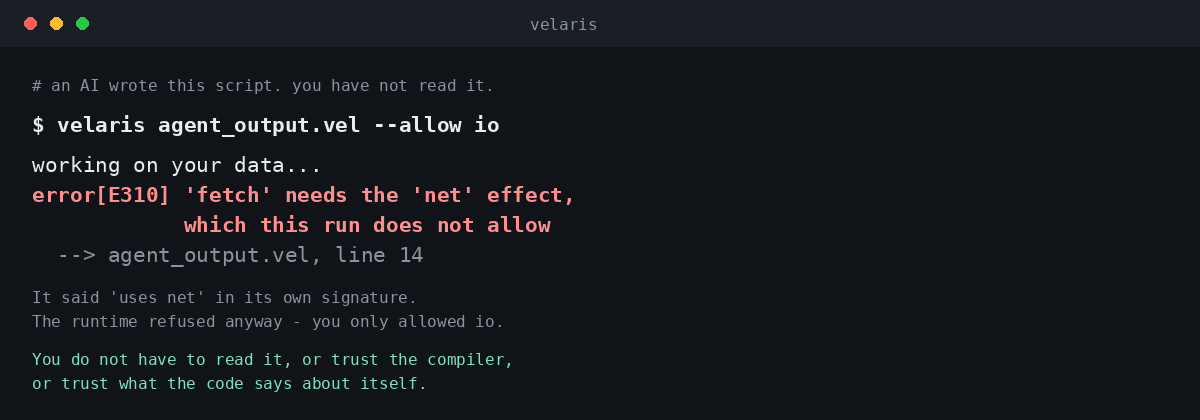
That program cannot open a socket, read a file, call Python, or ask the clock. Not "shouldn't" — the runtime refuses, and a refusal cannot be caught and carried past. You do not have to read the code, understand it, or trust the compiler's analysis of it.
Since 5.0 that is what a run with no --allow gets: io, the
console. It used to be all seven effects, which meant the answer to
"what may this program do?" was "everything" until an operator said
otherwise. Widen it by naming what the program needs
(--allow io,fs:read:./data); --allow all grants every effect and
writes one line to stderr saying so.
--allow io,ffi:math,json grants Python for those modules only; a call
that reaches any other module — named, or reached through an attribute of
a granted one — is refused (E311). A granted module can still do whatever
that module itself can do: ffi:os is the operating system. Since 3.0
the same grammar
narrows every coarse effect: fs:read:./data, fs:write:./out,
net:api.example.com:443, net:*.example.com, and @100 for at most
that many operations in a run; env is its own effect, so an
io-only program cannot read the environment. timeout and
max_memory_mb are available through the library and every door, and
on a door the operator's limits are ceilings a caller cannot raise.
It is still not a security boundary - but the
caveats every review raised, the ffi cliff, unbounded execution, and
fs and net with no path or host list, are now precise permissions
rather than holes. It is a real guard for the situation everyone is
now in — running a program someone, or something, else wrote.
The other half: promises, proven
That ensures is not a comment or a runtime assert. The Z3 theorem
prover verifies it for every possible input before execution — and
refutes it with an exact counterexample when it lies.
A rule the customer wrote
A commerce platform lets each customer write their own discount rule. This one has the shape most of them have: a percentage off once the basket passes a threshold, a flat amount off as well, and a cap on the two together.
The two ensures are what the platform needs to know about a rule it
did not write: a discount is never a surcharge, and what is left after
it is never negative. Both are settled for every basket and every rule
the types allow, before the program runs.
examples/discount.vel is the whole program —
proven, and it runs under --allow io.
examples/discount_bad.vel is the same
rule with the last if deleted. The cap still holds the discount to a
fixed ceiling; nothing holds it to what the basket is worth:
The amounts are in paise: a basket worth nothing, a flat discount of two paise held down to a cap of one, and one paisa handed back anyway. The program does not run.
A sandbox answers a different question. It can stop this rule reading a file or opening a socket; it cannot tell you whether the arithmetic holds.
A key it cannot print
Effects say a program printed something. They do not say whether what
it printed was the secret. Secret of T (6.0, 7.0) is the other half: the
compiler tracks the value, and refuses any program that hands it to
anything that emits.
examples/secret.vel reads an API key, builds
the request that would carry it, and prints a summary of that request.
examples/secret_bad.vel is the same
program with one more line:
Nothing ran, nothing was logged, and no reviewer had to notice the
line. A list of secrets, a map of them, or a record with one secret
field carries it too, so the whole structure is refused at a sink — a
Request record holding the key cannot be printed either.
And a program cannot look at the key either. key == "" is a
Secret of Bool, not a Bool, and an if or while on one is
E563. That is the rule that makes the rest mean something: with
length and code_at, a plain Bool from == is not one bit, it is
a loop that reads the whole key out —
— so a rule that stopped print(key) and allowed that would be a
decoration, not a type. The line is drawn at the branch.
declassify(value, "why") is the only way out. It needs
uses declassify in the signature, a reason written in the call, and
the declassify grant at run time — and it is what the audit reports,
so a consumer can ask whether a program ever lets a secret out without
running it:
To look at a secret, a program says so — declassify(key == "", "…")
gives back a Bool you can branch on, at the cost of the effect, the
grant and a reason in the audit. That is the trade: not silence, a
statement.
What this does not do: it only sees values env() and
read_file_secret() produced, so a password read with read_line, or
handed in through args(), or fetched from a vault over net, is an
ordinary Text with no protection at all. And it is not
non-interference — a program still chooses how long to run and whether
to stop. SPEC.md §3.1 states the rules and
THREAT_MODEL.md states the limits.
Related work
TACIT ("Securing Agents With
Tracked Capabilities", ACM CAIS '26;
arXiv 2603.00991) has agents write
Scala 3, whose capture checking tracks file, network and command
capabilities as values in the type system;
CaMeL has a model turn the user's
request into a restricted subset of Python and tags every value with its
provenance and permitted readers, checking a policy at each tool call;
WASI gives a WebAssembly module only the resources
its host hands it. Sabline is a small language a model learns from a
card of about 5,300 words, in which functions declare their effects, the runtime
enforces the operator's budget at each operation, and contracts are
checked by the Z3 theorem prover. From 6.0 it also tracks one kind of
data: Secret of T, which env() and read_file_secret() produce and
which cannot reach anything that emits, cannot be branched on, and
leaves only through declassify — an effect of its own. That is
narrower than what CaMeL and TACIT do: they tag every value with its
provenance and permitted readers, and TACIT follows capabilities
through polymorphism, where Sabline marks two builtins' results and
refuses generic code over them unless a signature says so.
Until 5.0 its command line also granted every effect when no budget was
given, where a WASI module given nothing reaches nothing; from 5.0 a
run with no budget gets io alone.
The capability
format is published separately, under CC0, as
sabline-spec,
whose PRIOR_ART.md
sets out these differences and the older work in full. From 4.1 it
holds a conformance corpus an implementation in any language can run -
ratchet, none needing a prover - written from this repository's suites
and held to them by a drift test; sabline conformance runs it against
this implementation, and CI does so on every leg.
Why Sabline
| Guarantee | What it means |
|---|---|
| Effects are visible | uses io, net, fs, ffi — a function without uses net can never touch the network, transitively, and one without uses ffi can never call out to Python. Hidden behavior does not compile. |
| Promises are proven | requires / ensures / loop invariant, verified by Z3 with modular call summaries — including records, maps, nested lists, quantified list properties, failure paths, and floats in genuine IEEE-754 (the prover refutes x + 0.1 + 0.1 == x + 0.2 with the exact double that breaks it). |
| Failure is unignorable | -> Int or fail in the signature; callers must check or try. Forgetting the error path is a compile error — builtins included. |
| Secrets cannot be printed, or looked at | Secret of T — what env() and read_file_secret() return. Nothing that emits or can fail will take one, a structure holding one carries it, every operation over one keeps it (a comparison included), and no if branches on one. declassify(value, "why") is the only way out: an effect of its own, with its reason named in the audit. SPEC.md §3.1 says what it still does not claim. |
| Fast where it's safe | Pure functions over numbers, list reads, and text — including text built inside them — JIT to native code via LLVM (~10,000× on hot arithmetic, ~45× on text building), differential-tested against the interpreter. Native reads are bounds-guarded and text is built in a runtime-owned buffer, so results always match interpreted. |
Why floats are proven in IEEE-754 rather than as real numbers, and what that costs: docs/floats.md.
Loops without written invariants are handled where the boring
invariants suffice: the compiler proposes bounds on each counter and
keeps the ones a loop step cannot break (see examples/inferred.vel).
Anything richer — membership, sortedness — still needs an invariant
line.
The prover never claims "proven without running" unless the counterexample is premise-complete — untranslatable assumptions abandon the proof to runtime checks rather than risk a false alarm. Soundness reports are treated as security issues.
Install
Standalone executable (no Python required) — download for Windows / Linux / macOS from the latest release, then:
With Python 3.10+:
Zero install — the playground runs the real compiler in your browser.
Optional extras for source installs: pip install ".[full]" adds
z3-solver (compile-time proofs) and llvmlite (native speed);
without them, promises are checked at runtime and everything runs
interpreted — same language, honestly degraded. With llvmlite
installed, native code is the default: a pure function the compiler
can compile runs as machine code unless --no-native forces the
interpreter. There is no --native flag.
Everyday ergonomics
Function values are lifted to real functions, so proofs and native
compilation apply to them unchanged — and they can carry their own
requires / ensures, proven like any other function's. A function
value takes a copy of the locals around it when it is made
(SPEC.md §12a); a promise on one that does is checked while
it runs.
Where it plugs in
Use it from your own program
The budget is enforced the same way it is on the command line. There is
an MCP server too, so an assistant can write, audit and sandbox-run
Sabline without leaving the conversation — see
EMBEDDING.md and the versioned sabline.audit/1 format.
Calling run with a timeout or a memory cap starts a fresh interpreter
every time. A pool keeps workers alive under one fixed budget:
200 sequential bounded runs of a small program: 46.6 s a process at a
time, 0.5 s on a pool. pool.run takes no allow — the budget belongs
to the pool, a worker is killed and replaced unless the run finished
cleanly, and a reused worker has every piece of mutable state reset
first. check_pool.py asserts each of those, including a program that
widens its own budget through ffi and cannot widen it for the next
one. The rules are stated in full in EMBEDDING.md.
A platform whose customers write the rules
examples/platform/ is that pattern as a small
FastAPI service, in one file. A customer submits Sabline source; the
service audits it, stores it with its capability surface, and answers
with what it declares — effects, hosts, paths, modules, the proven
share, its contracts function by function, and the narrowest budget that
would run it. It does not run it. A surface wider than the platform
permits is refused there, naming the grants that would have to be added.
Running happens on a sabline.Pool whose budget is the platform's.
Submit examples/discount.vel and the answer
says "proven_share": 100.0 with "status": "proven" on every promise,
including the two that matter to whoever is taking the payment: the
discount is never a surcharge, and what is left is never negative. That
is the sentence a platform can show a customer before offering to enable
a rule, and it is not one a sandbox can produce.
A program that calls your tools
The runner's first cut (8.5). A host process offers a program tools through
a manifest - a JSON Schema for each tool's arguments, a cost, a ceiling -
and the operator's budget says which may be called and holds arguments to
patterns. A call that is outside either is refused before the host hears of
it, and the receipt records every call, the patterns that held it and the
ceiling. examples/runner/host.py is a whole
host in Python: it offers search and send_email, and the second example
program is refused when it tries to mail outside corp.com. The protocol
is JSON lines on standard input and output
(docs/runner.md); there is
no framework adapter yet, and a tool's result is not yet marked as the
host's words rather than the program's - that is Untrusted, in 9.0.
sabline skill verify reports the tools and the budget a skill's
programs would need, without running them.
Written by a model, audited by you, run in a box
sabline audit is written for the reviewer: what the program reaches,
what it promises, how much of that is proven rather than checked
while running, what can fail, and the exact command to run it safely.
sabline attest (4.2) puts that audit in an in-toto Statement whose
subjects are the program's files by sha256, ready to sign with cosign
or sigstore-python; EMBEDDING.md shows both, and every
release carries one, signed, for an example program.
agent_loop.py closes the circle — a model writes it, sabline check --json hands back errors with fixes, and it iterates until the program
compiles and its promises prove.
From 8.3, the rest of a run's life: sabline eval runs a program as an
evaluation harness does, under a profile its command line cannot relax (no
net, ffi or env, time and memory limits, a stop honoured, the worker
confined where the operating system offers it, and a receipt always -
docs/eval.md); sabline receipts diff names what a run did
that its audit, or its earlier runs, did not; sabline replay makes a run
again from its receipt on the same bytes, or refuses; sabline test --from-contracts runs each promise on the inputs the prover finds its
requires allows; and sabline verify holds an attestation or a receipt to
its type and its bytes. docs/structurally-impossible.md
lists what cannot occur in a Sabline program, each with a test, and
docs/crosswalk.md maps each guarantee and each known
gap onto the OWASP, AIUC-1 and NIST frameworks.
Running code you did not write
The runtime refuses any effect outside the budget you grant, whatever
the source claims — and a refusal cannot be caught and carried past.
From 8.4 the operating system is asked to hold the same budget, so a fault
in Sabline itself is refused by the kernel: Landlock and seccomp on Linux
(full), a sandbox profile on macOS and a job object with a lowered token on
Windows (both partial). sabline doctor says what your machine offers, a
receipt says what a run got, and --no-confine turns it off
(docs/confinement.md).
Not a security boundary (ffi grants everything Python can do, and widens
what the system is asked to hold), but a real guard for running a program
you have not read.
Checking everything at once
One command that exercises the language, the standard library, the prover, native compilation, JSON, dates, CSV, the host language and the network.
Measured against other tools
102 small programs — 80 with one deliberate defect, 22 correct controls —each written three times with the same behaviour, in Sabline, in JavaScript for Deno, and in Python. One harness runs every program through every tool and records what was caught before running, what was caught while running, and what was missed. The twelfth category (7.1) is indirect authority: the calling code is the same before and after, and only a dependency's declared budget widened between two versions.
| caught before running | caught while running | missed | false positives on the 22 controls | |
|---|---|---|---|---|
| Sabline 8.6 | 54 | 16 | 10 | 4 |
| Deno 2.9 | 8 | 43 | 29 | 0 |
| Python 3.13 | 0 | 32 | 48 | 0 |
The ten Sabline misses are in the table by design. Two were
there from the start: a loop that stops one item early with no
contract to contradict, and a program that prints rm -rf build for
its caller and touches nothing. Eight are in five categories added in
8.7 for Sabline to lose: a private file posted to the one host the task
is granted, a second program run beside the one the task needs, and a
granted library doing I/O of its own. Its four false positives are
there by design too: two correct loops its termination rule cannot show
end, and two correct results too big for a 64-bit whole number. Every
row is in
benchmark/RESULTS.md — regenerated by one
command, python benchmark/run.py. The same programs against WASI,
Starlark, a Python sandbox and CaMeL as well - each of which does better
than Sabline on some of them, and the page says which first - are on
/competitors.html.
Programs worth running
examples/ledger.vel — an expense tracker: records, integer cents,
file persistence, sorted reports.
examples/wordcount.vel — text analysis:
sabline examples/wordcount.vel --allow fs:read,io <file> [n] counts
word frequencies and prints a ranked histogram.
examples/linkcheck.vel — a link checker you would actually run:
sabline examples/linkcheck.vel --allow io,net <url> ..., non-zero exit
when something is broken.
examples/fetcher.vel — an HTTP tool: checks a status, then summarises
a page, with every network call declared and every failure handled.
JSON
Paths walk objects and lists, every read can fail (a missing field is a possibility, not a crash), and none of it is an effect — parsing text is pure.
Reaching other languages
py / py_int / py_float / py_json call Python functions, and
py_new / py_do / py_field / py_close hold real objects — a
database connection, a session — so every library Python has is
reachable — but only from a function that declares uses ffi, and it
can fail like anything else that leaves your program.
The standard library reaches outside
Written in Sabline, so they carry their effects — a program using
http shows net, one using db shows ffi, and a pure function
can call neither.
From 8.5 four of them talk to the services an operations script talks to,
and none calls Python, so the audit of a program that uses one shows no
ffi at all:
| Library | Reaches | Example |
|---|---|---|
azure.vel | Azure Resource Manager: GET, PUT, PATCH, DELETE, paging, ARM's errors. net:management.azure.com:443 | azure_groups.vel: resource groups and tag drift |
github.vel | the GitHub REST API: repos, issues, pulls, checks, releases, contents, the rate limit. net:api.github.com:443 | github_issues.vel |
k8s.vel | the Kubernetes API: list, get, watch-once; every function that changes the cluster begins write_ | k8s_pods.vel: the pods that are not running |
aws.vel | S3 and STS, signed with Signature Version 4 in Sabline | aws_buckets.vel |
A token or a key goes in as a Secret of Text and the library says, in the
audit, the one place it leaves: a bearer token through declassify with a
reason that names the host, an AWS signature through hmac_sha256_chain,
listed as hmac signature - the key itself never stops being a Secret
(THREAT_MODEL.md says why that is sound).
check_batteries.py runs each against a stand-in for its service on every
CI leg. sabline-kit is
a template repository that starts from the Azure script.
Libraries
A library is compiled before it is accepted and kept in your repository where you can read it. No registry, no resolver, nothing fetched at build time.
sabline add writes sabline.lock beside sabline.toml: every
vendored library with its source, the sha256 of the exact bytes that
arrived, and the version of Sabline that added it. sabline deps --verify fails if a file's hash differs from the lock or a locked
library is not on disk — a line worth having in CI. Adding a library
that is already vendored, with different bytes, is refused with both
digests printed; --force replaces it.
Imports
A named import prefixes that library's functions, so two libraries that
both export distance can be used in the same file. A program sent to the
HTTP door or the MCP server imports only .vel files inside the directory
the door serves, and the library does the same given import_root=; any
other import is refused (E515) before the file is read (8.1).
Shipping a program
Your program, its imports, the standard library and the compiler, in one file. It is compiled and proof-checked before it is built.
sabline eject (8.1) writes the program, its imports and a copy of the
runtime into a directory whose main.py fixes the budget, checks every
file's digest and refuses a budget that could let one run rewrite the next,
with a pinned requirements.txt, the PyInstaller command, and a README
saying what holds once ejected - the budget - and what does not: the
proofs are a record of eject time, and no later fix reaches it.
Tooling
sabline trace program.vel (watch every call as it happens) ·
sabline test program.vel (runs every test_* function written in
Sabline) ·
sabline check program.vel (compile without running; several files at
once, --json for tools) ·
sabline explain program.vel (a walkthrough of every function: effects,
promises, and whether they are proven — explain <folder> maps a whole
project) ·
sabline repl (definitions are proof-checked as you type them) ·
sabline fmt (canonical style, --check for CI) · sabline lsp
(errors as you type in any LSP editor; a VS Code extension lives in
editor/vscode) ·
sabline doctor · sabline new · --json errors for automation.
Standard library
Written in Sabline, in stdlib/std.vel — and it
keeps its own promises: sort carries ensures is_sorted(result),
max_of requires a nonempty list, and violating a library requires
is a compile error at your call site. Full
reference,
generated from the real compiler.
Numbers
Whole numbers are 64-bit. Arithmetic that outgrows that range is an error, not a silent wrap — and the same error whether your code is interpreted or running as machine code. Floats are IEEE-754 doubles, proven as such.
Money is neither. money(1250, "INR") is 12.50 rupees held as 1250
paise: an exact whole number of minor units, with the currency in its
type, so INR meeting USD is a compile error and no Float goes near it.
Dividing an amount says how it rounds — percent_of(claim, 25, 1000, "half_up") — or it does not compile, and money.split(payout, 3)
gives parts that provably add up to the payout. See
examples/settlement.vel and
SPEC.md §4.3.
The reference
SPEC.md states precisely what the language means: semantics, evaluation order, effect propagation, what "proven" covers today, and what Sabline deliberately does not have — including why it has no concurrency model.
Stability
Semantic versioning: breaking changes only at major versions.
STABILITY.md says what that covers - the language, the
error codes, sabline.audit/1, the library API, the budget grammar and
the command line - what it does not, the rules for deprecating and
removing, and every time this project has broken the rule, 3.3 and 3.4
among them. CI tests every push on Linux, Windows and macOS, Python
3.10 and 3.12, with and without the optional dependencies. Errors are
stable, numbered, and
fully documented.
How much is proven
Over this repository's examples and standard library, sabline proofs examples stdlib proves the promises of 70 of the
examples are built to be refused, and their promises are false on purpose.
Using Sabline in CI
The GitHub Action audits the Sabline programs in a repository - its
.vel files - and reports what they may touch to GitHub code scanning.
It does not read Python, JavaScript, Go or anything else: a repository
with no .vel file prints no .vel files found and the job is green.
The case it serves is narrow, and it is the one this language exists
for - an agent wrote a script, the script is in Sabline, and the
effects it declared and the promises it did not prove should land in
the Security tab rather than in a reviewer's head.
Copy this into .github/workflows/sabline.yml:
The Action is pinned to a commit, with its tag in the comment beside it: a tag can be moved to other code after you copied it, and a commit cannot. Pinned that way it installs the Sabline of that commit, as it does at a tag.
That is the whole workflow. With no with: block the Action installs
Sabline and the prover, checks every .vel file in the repository,
fails the job if one does not compile or carries a promise the prover
refutes, and uploads its findings as SARIF 2.1.0 with
github/codeql-action/upload-sarif, pinned to a commit. A private
repository needs code scanning enabled; set sarif: "false" if it has
neither that nor security-events: write. On a pull request from a
fork the job's token cannot upload, so that step is skipped - the file
is still written, and its path is the sarif-file output. The findings
print to the job log either way.
What appears in the Security tab
One alert per finding, on the line that caused it, with a link to its row on the errors page. These are the rule IDs, and a real message from each:
| rule | level | what an alert says |
|---|---|---|
E300 | error | function 'fetch' calls 'read_file' which needs effect 'fs', but 'fetch' declares no effects (it is pure) |
E520 | error | 'to_int' can fail - that cannot be ignored |
E700 | error | promise cannot be kept: 'discount' ensures result >= 0 - proven without running the program: price = 9 gives result = -1 |
E701 | error | this call can break a promise: 'discount' requires price >= 0, but 'main' can call it with price = -3 - proven without running the program |
unproven-promise | warning | 'count_rows': ensures result >= 0 - not proven before running; checked while the program runs |
contract-coverage | note | 'total' takes or returns data and promises nothing about it |
capability-widened | error | net is needed by sync.vel, not in the surface of sabline.capabilities (a new effect, net) |
capability-effect-gained | error | 'main' now declares net, which it did not in sabline.capabilities: net: calls pull at line 6, which declares net |
capability-narrowed | note | surface: "net" is no longer needed - the baseline gives more than the code needs; capabilities init --force records the narrower surface |
dependency-capability-widened | error | npm:mixed 0.1.0 -> 0.2.0: net:telemetry.example.net is needed by lib/report.vel (a new effect, net) |
dependency-effect-gained | error | npm:mixed 0.1.0 -> 0.2.0: 'render' now declares net: net: calls post at line 3 |
dependency-install-script | error | npm:textkit 1.0.0 -> 1.1.0: an install-time script was added: npm postinstall: node setup.js [registry manifest, tarball package.json]; what it does is not derived |
dependency-surface-unknown | note | npm:textkit 1.0.0 -> 1.1.0: capability surface unknown. Neither 1.0.0 nor 1.1.0 holds a .vel file, so there is no declared capability surface to compare. ... |
dependency-added | note | npm:textkit 1.0.0 -> 1.1.0: now declares helper ^2.0.0 (dependencies); its own surface was not examined |
dependency-narrowed | note | sabline.lock:mailer 6ed598a1e2bf -> 3f7a9875d0de: surface: "net:collector.example.net" is no longer needed |
Every code in the compiler's error table is a rule of its own, so a
parse error (E1xx), an unknown function (E200) or a type error
(E5xx) arrives the same way; E3xx are the effect codes and E7xx
the prover's. Under check --strict an unproven promise is an error
rather than a warning, and a loop not shown to end is E612. The
uses-io, uses-fs and loop-not-shown-to-end notes come from
sabline audit --sarif, which the Action does not run; pr-comment
below is where the Action reports those. The dependency-* rows come
from deps-diff, below, and only when that input is on; each lands on
the line of the lockfile that pins the upgraded version.
Sabline's suggested fixes are sentences, while a SARIF fix must hold
the exact bytes to change, so they travel in each result's
properties.fixes rather than as SARIF fixes with an edit made up to
fill the slot.
The budget a repository declares
sabline capabilities init records the capability surface a
repository's .vel files need - effects, paths, hosts, Python modules,
how many file and network operations a run can perform, and each
function's effects - in sabline.capabilities; commit it. From then on
the Action runs sabline capabilities check on every push and fails
any change that needs more, naming what widened, the file, function and
line that introduced it, and the edit to the baseline that would accept
it. Those are the capability-* rows above, and they go to code
scanning beside the check's.
The comparison is always with that file, never with the previous
commit: capability added across many small commits, none alarming by
itself, fails at every one of them until someone widens the file, where
the change shows in review. A pull request that deletes
sabline.capabilities fails too, since that would turn the ratchet
off; capabilities: "off" in the workflow is the way to turn it off,
where the change is visible. Without the file the ratchet is simply
off. EMBEDDING.md has the rules; check_ratchet.py
holds them, including a six-commit history that fails only at the
commit that reaches the network.
What an upgrade gained
A dependency can change what it can do between two versions while its name, its publisher and its list of dependencies stay the same. The npm package postmark-mcp is a documented case: Koi Security reported in September 2025 that versions 1.0.0 to 1.0.15 worked as an email tool, and that 1.0.16 added a blind copy of every outgoing message to an outside address. A signature from the same publisher verifies both versions; an SBOM lists the same dependencies for both.
sabline deps-diff compares two versions of one dependency:
For a Sabline library it computes each version's capability surface
from its .vel files, as capabilities init would, holds the newer
one to the older one as capabilities check holds a tree to its
baseline, and reports what the newer one gained - effects, hosts,
paths, Python modules, operation counts, and functions that declare an
effect they did not - with the file, line and call of each:
A caller that already declared net for its own request compiles
against both versions, so the compiler has nothing to refuse; the
difference is in what the dependency declares, and that is what this
reads. The benchmark's category 12 is three programs of that shape and
For any other package it reads what the registry and the package's
archive declare, and nothing more: the install-time scripts npm or pip
runs (preinstall, install, postinstall, npm's node-gyp rebuild,
setup.py, the build backend, a .pth file that imports) and whether
each was added or changed - including a changed file behind an
unchanged command, and, when a registry's manifest and the tarball's
package.json disagree, the scripts of both, since which one npm runs
has changed between npm versions - and the declared dependencies. It
does not derive what Python or JavaScript code can do, and does not
guess: it reports the capability surface as unknown, and exits 3
rather than 0. That
answer is often all there is. By Koi Security's account 1.0.16 of
postmark-mcp changed nothing but the code that added the copy, so
deps-diff would have found no install script and no dependency to
report, and would have said the surface is unknown. (npm has since
unpublished every version of that package; today deps-diff reports
that neither version can be read.)
Exit codes: 0 when both surfaces were derived and nothing was gained; 1
when something was gained; 3 when nothing visible was gained and the
surface was not derived; 2 when a version could not be read. --json
is sabline.deps-diff/1; --sarif writes the dependency-* results
above. A package argument names where to read it - pypi:, npm:,
git: or dir: - and a bare name is refused, so an npm package is
never compared with a PyPI package of the same name.
SABLINE_NPM_REGISTRY and SABLINE_PYPI_URL point it at a mirror.
With deps-diff: "true", on a pull request the Action runs
sabline deps-diff --against the base: it reads the lockfiles the pull
request changed - package-lock.json, npm-shrinkwrap.json,
requirements*.txt pins, Pipfile.lock, poetry.lock, uv.lock,
pdm.lock and sabline.lock, whose vendored libraries it compares
file against file - compares every upgraded dependency, up to 30, and
posts one comment saying what each gained, editing that comment on
later runs rather than adding another. A lockfile it does not read
(yarn.lock, pnpm-lock.yaml, and others) is named in the comment as
changed and not read. An entry resolved from git, a path, or a registry
or index other than the one it reads is left out and said, because the
public package of the same name would be a different package; so is
every pin of a requirements*.txt that sets another index. The
findings go to code scanning when sarif is on. It needs
pull-requests: write, and it never fails the job.
The permissions a pull request gives its workflows
With permissions-ratchet: "true" (8.3), on a pull_request event the
Action runs sabline permissions-ratchet --against the pull request's base
commit. It compares the permissions: blocks of every workflow file in
.github/workflows at the head with the base, job by job, and fails the job
on any widening, with an error on the file and line. A widening is a scope
whose level rises (none < read < write); a job left with no block, its own or
the workflow's, so that it takes the repository's default token permissions;
or a new job or workflow file that gives any permission. A narrowing is
reported and does not fail. A job renamed is a job removed plus a new job,
and the new job is compared with no permissions. The input is off by default.
It is the one input that helps a repository with no .vel file, and it runs
whether or not there is one. A workflow it cannot read with confidence - an
anchor, a tab, a key written twice, a second document - fails the step rather
than being taken as having no permissions; so does a base commit it cannot
fetch. It compares files, not what GitHub runs, so it does not see the
permissions of a reusable workflow a job calls, which that workflow's own
block governs; the repository's default token setting; or the base branch's
copy of a pull_request_target workflow, which is what runs. --json writes
sabline.permissions-ratchet/1, which is provisional.
Everything else the Action takes
With pr-comment: "true" on a pull_request event the Action posts one
comment holding the sabline audit of every .vel file the pull
request changes - effects and Python modules reached, proven share, the
safe command, and warnings such as a loop not shown to end - and edits
that same comment on later runs instead of adding another. The comment
also carries the ratchet's result and a sabline review of the branch
against its base: surface, proven share, new fallible functions, new
hosts and paths, and a one-word risk computed from those facts alone.
It uses the REST API with the job's own GITHUB_TOKEN, so the job needs
permissions: pull-requests: write. The audit is posted whether or not
the checks passed; a file that does not compile is reported as such.
The same SARIF without the Action, for SonarQube
(sonar.sarifReportPaths), Azure DevOps or anything else that reads it:
One run, driver Sabline with its version, and a rule for every code in
the error table plus the findings that are not errors. Each result has
the file, the line and Sabline's message.
Or without installing anything:
What a reviewer should read before allowing agent-written Sabline to run: THREAT_MODEL.md, COMPLIANCE.md and the verification steps in SECURITY.md. incidents/ is the same question asked from the other end: publicly reported attacks in this lane since 2023, each with the shape written as a Sabline program and a verdict on whether it refuses — including the ones where the honest verdict is that it does not. It is a catalogue of shapes, not a claim that Sabline would have prevented the real events.
Project
Roadmap · Support and expectations · How the compiler works · Maintainers · Security policy · Stability · Changelog
Maintained by one person, in the open, with the limits stated plainly in SUPPORT.md.
Cite this repository
The author is Palakurthi Gowri Shankar (family name Palakurthi). CITATION.cff holds the citation, and GitHub offers it as "Cite this repository" beside the file list. A preprint describing Sabline is forthcoming; until it is published, cite the repository. The capability format is cited separately, from sabline-spec's own CITATION.cff. PROVENANCE.md records the dates and the archive identifiers.
Contributing
The implementation is the package sabline/, one readable
module per stage, in pipeline order — lexer to command line; sabline.py
starts it. Start with
ARCHITECTURE.md for how it fits together, and
MAINTAINERS.md for what review looks like.
Looking for somewhere to start? See the good first issues — small, self-contained tasks, each with the file to open and what "done" means.
The 97 example programs run_tests.py runs, in examples/, each
carry an expected verdict, and 36 of them are designed to be rejected —
each rejection demonstrates a guarantee. Before any change ships:
License
MIT © Palakurthi Gowri Shankar