π RuView
 Start here |  Hardware |  Models |
 AI toolkit |  Smart home |  Cognitum Seed |
See through walls with WiFi
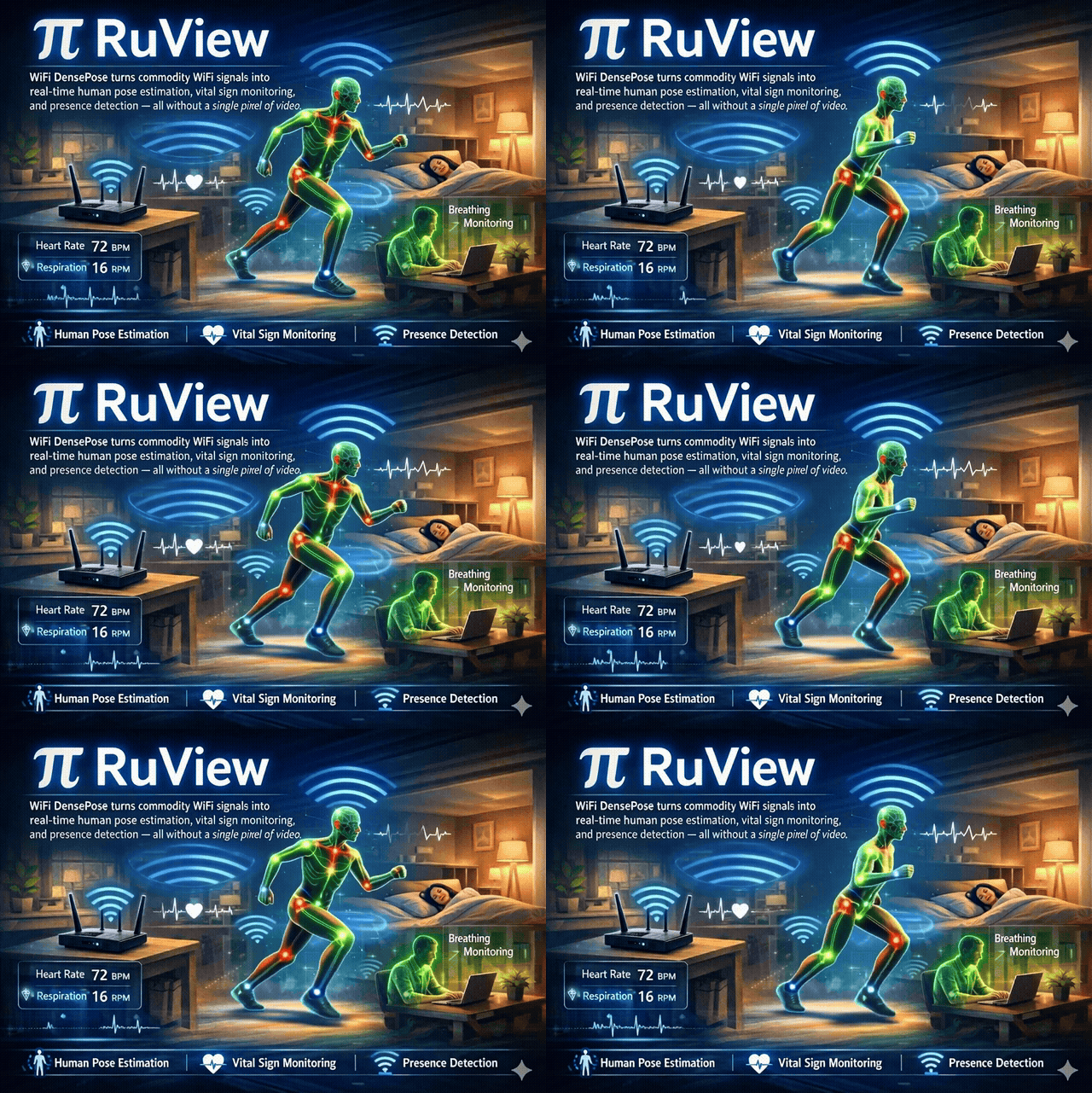
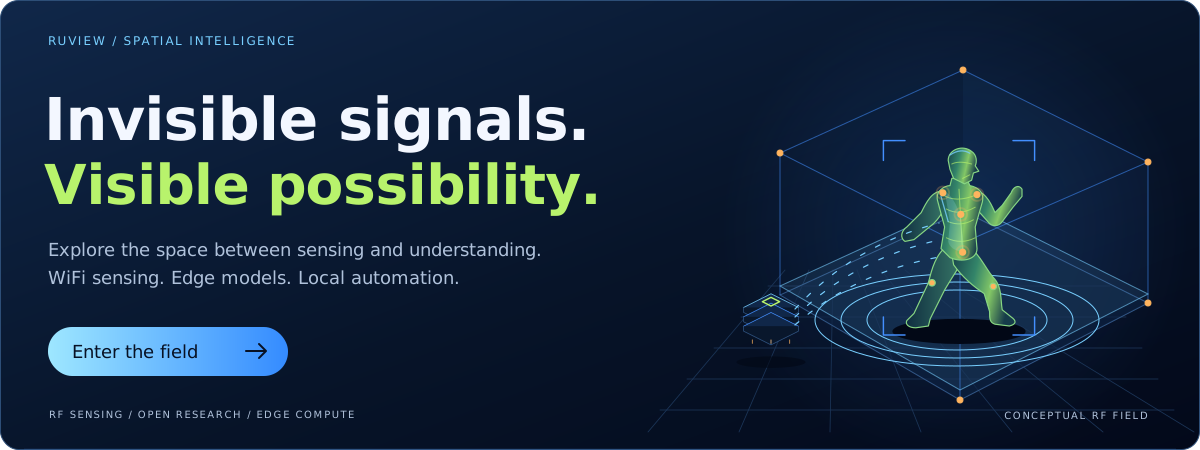
Turn ordinary WiFi into a spatial intelligence / sensing system. Detect people, measure breathing and heart rate, track movement, and monitor rooms — through walls, in the dark, with no cameras or wearables. Just physics.
Works natively with the four major smart-home ecosystems: Home Assistant via the HA-DISCO MQTT publisher, Apple Home & HomePod as a discoverable HAP-1.1 bridge, Google Home + Amazon Alexa via the same HA bridge or a Matter endpoint. Siri, Google Assistant, and Alexa can voice presence and vitals by room with zero custom skills.





Drop into any Home Assistant install with one
--mqttflag. Or pair into Apple Home / Google Home / Alexa / SmartThings as a Matter Bridge. Ships 21 entities per node (11 raw signals + 10 inferred semantic states: someone-sleeping, possible-distress, room-active, elderly-inactivity-anomaly, meeting-in-progress, bathroom-occupied, fall-risk-elevated, bed-exit, no-movement, multi-room-transition) plus 3 starter HA Blueprints. Seedocs/integrations/home-assistant.md· ADR-115.
π RuView is a WiFi sensing platform that turns radio signals into spatial intelligence.
Every WiFi router already fills your space with radio waves. When people move, breathe, or even sit still, they disturb those waves in measurable ways. RuView captures these disturbances using Channel State Information (CSI) from low-cost ESP32 sensors and turns them into actionable data: who's there, what they're doing, and whether they're okay.

What it senses:
- Presence and occupancy — detect people through walls, count them, track entries and exits
- Vital signs — breathing rate and heart rate, contactless, while sleeping or sitting
- Activity recognition — walking, sitting, gestures, falls — from temporal CSI patterns
- Environment mapping — RF fingerprinting identifies rooms, detects moved furniture, spots new objects
- Sleep quality — overnight monitoring with sleep stage classification and apnea screening
Also included:
- Camera-free pose — estimate 17 body keypoints from WiFi CSI
- Built-in model workflow — record CSI, train models, load RVF files, and switch LoRA profiles
- Local automation — HOMECORE provides state, history, automations, signed Wasm plugins, voice hooks, and HomeKit support
- Unified RF world model — combine WiFi CSI, radar, UWB, and cellular sensing in one privacy-bounded scene model; accuracy is still synthetic until real-data validation
- Governed evidence — attach privacy policy, uncertainty, provenance, and witness records to sensing events
- RuView MetaHarness — use an AI operator to onboard, calibrate, train, verify, and check sensing claims
 Presence and motion |  Breathing and vital signals |
 Pose research and limitations |  Edge sensor mesh |
RuView MetaHarness — guided operation for humans and AI agents
The RuView-specific metaharness we created is published as @ruvnet/ruview. It provides:
- source-cited guidance;
- device access for CSI nodes, radar and LiDAR;
- firmware flashing with boot evidence;
- one MCP server, usable over stdio or HTTP for ChatGPT, with a live console widget;
- a Claude Code mod;
- guarded Claude Code/Codex agents;
- deterministic verification;
- an honesty check for accuracy claims.
Companion packages: homecore (Homecore developer metaharness) and @ruvnet/ruview-kernel (the vitals pipeline as WASM).
# Check the local setup and get source-cited guidance
npx @ruvnet/ruview@0.9.1 doctor
npx @ruvnet/ruview@0.9.1 guidance --topic sensing --query "model loading"

# Hardware: what is plugged in, live CSI from your nodes, a 60 GHz radar kit
npx @ruvnet/ruview@0.9.1 devices
npx @ruvnet/ruview@0.9.1 esp32 --watch                       # ESP32 + Realtek RAC1 nodes, live view
npx @ruvnet/ruview@0.9.1 esp32 --seconds 45 --analyze        # live CSI through the vitals kernel
npx @ruvnet/ruview@0.9.1 mmwave --source esphome --host <kit-ip>

# Agents: MCP over stdio, or over HTTP for ChatGPT (token-protected, read tools only)
npx @ruvnet/ruview@0.9.1 mcp start
RUVIEW_MCP_GRANTS=device-access npx @ruvnet/ruview@0.9.1 mcp start --http

# Claude Code: a live sensing pane (/ruview), shipped in the package
npx @ruvnet/ruview@0.9.1 mod

# Run a read-only RuView agent through Codex
npx @ruvnet/ruview@0.9.1 agent run --host codex --repo . \
  --prompt "Find the nearest tests and cite the source files"

# Check claims, replay the deterministic proof, search the reviewed brain
npx @ruvnet/ruview@0.9.1 claim-check --file REPORT.md
npx @ruvnet/ruview@0.9.1 verify
npx @ruvnet/ruview@0.9.1 brain search --query "calibration"
Safety:
- Agent runs are read-only by default. Workspace writes require both
--allow-writeand--confirm. - Hardware reads need the
device-accessgrant. - Flashing and calibration never run over the HTTP transport.
Built on RuVector and Cognitum Seed, RuView runs entirely on edge hardware — an ESP32 mesh (as low as $9 per node) paired with a Cognitum Seed for persistent memory, cryptographic attestation, and AI integration. No cloud, no cameras, no internet required.
The system learns each environment locally using spiking neural networks that adapt in under 30 seconds, with multi-frequency mesh scanning across 6 WiFi channels that uses your neighbors' routers as free radar illuminators. Every measurement is cryptographically attested via an Ed25519 witness chain.
RuView turns ordinary WiFi into a contactless sensor. A $9 ESP32 board reads the radio reflections off the people in a room, and a small pretrained model — published on Hugging Face at ruvnet/wifi-densepose-pretrained — tells you who's there, how they're breathing, and how their heart rate is trending. The model fits in 8 KB (4-bit quantized) and runs in microseconds on a Raspberry Pi. (The v2 encoder reports an honest, label-free held-out temporal-triplet accuracy of 82.3% — up from 66.4% raw; the older "100% presence" figure was measured on a single-class recording and has been retracted in favor of this.) No cameras, no wearables, no app on the user's phone.
Built for low-power edge applications
Edge modules are small programs that run directly on the ESP32 sensor — no internet needed, no cloud fees, instant response.








What How Speed / scale 🫁 Breathing rate Bandpass 0.1–0.5 Hz on wrapped phase, circular variance, zero-crossing BPM (#593) 6–30 BPM, real-time 💓 Heart rate Bandpass 0.8–2.0 Hz, zero-crossing BPM 40–120 BPM, real-time 👤 Presence detection Trained head on Hugging Face ( ruvnet/wifi-densepose-pretrained; v2 encoder = 82.3% held-out temporal-triplet acc, honestly re-benchmarked) + a phase-variance fallback that needs no model< 1 ms, ~30 s ambient calibration 🧬 CSI embeddings 128-dim contrastive encoder shipped on Hugging Face, 4-bit quantised variant fits in 8 KB 164,183 emb/s on M4 Pro 🦴 17-keypoint pose estimation cog-pose-estimationCog v0.0.1 — signed aarch64 + x86_64 binaries on GCS, loadspose_v1.safetensorsvia Candle (the committedpose_v1is a first-cut on-device model: PCK@20 = 3.0%, below the ADR-079 ≥35% target, and its runtime path is still aconfidence=0stub — see Model weights: what's real, what's not; the 82.69% figure below is the separate published MM-Fi benchmark, not this live cog). Train your own from paired data in 2.1 s on an RTX 5080 (ADR-101, benchmarks). SOTA on MM-Fi: hits (ensemble 83.59%), beating MultiFormer (72.25%) and CSI2Pose (68.41%) on the matched MM-Fi protocol — self-corrected and auditable on
Quick start options — Docker, ESP32-S3/C6, Cognitum Seed, and Python
# Option 1: Docker (simulated data, no hardware needed)
docker pull ruvnet/wifi-densepose:latest
export RUVIEW_API_TOKEN=$(openssl rand -hex 32)   # required; the container exits 64 without it
docker run -p 127.0.0.1:3000:3000 -e RUVIEW_API_TOKEN ruvnet/wifi-densepose:latest
# Open http://localhost:3000
# ESP32 nodes in Docker also need a UDP source guard (RUVIEW_UDP_ALLOW);
# see docs/user-guide.md "Receiving ESP32 frames in Docker".

# Option 2a: Live sensing with ESP32-S3 hardware ($9)
# Flash firmware, provision WiFi, and start sensing:
python -m esptool --chip esp32s3 --port COM9 --baud 460800 \
  write_flash 0x0 bootloader.bin 0x8000 partition-table.bin \
  0xf000 ota_data_initial.bin 0x20000 esp32-csi-node.bin
python firmware/esp32-csi-node/provision.py --port COM9 \
  --ssid "YourWiFi" --password "secret" --target-ip 192.168.1.20

# Option 2b: WiFi 6 + 802.15.4 research sensing with ESP32-C6 ($6-10, ADR-110)
# Same csi-node firmware compiled for the C6 target — picks up the C6
# overlay (sdkconfig.defaults.esp32c6) automatically.
cd firmware/esp32-csi-node
idf.py set-target esp32c6 && idf.py build
idf.py -p COM6 flash
# C6 boot extras (vs S3): HE-LTF subcarrier tagging in ADR-018 bytes 18-19,
#   802.15.4 mesh time-sync on channel 15, TWT setup when the AP supports it,
#   opt-in LP-core wake-on-motion for ~5 µA battery seed nodes.
# v0.6.7 adds: real LP-core RISC-V motion-gate program (debounce + motion
#   counter) and a Wi-Fi 6 soft-AP with TWT Responder so two C6 boards can
#   benchmark real iTWT without buying an 11ax router. Both default off,
#   flip CONFIG_C6_{LP_CORE,SOFTAP_HE}_ENABLE to turn them on.

# Option 3: Full system with Cognitum Seed ($140)
# ESP32 streams CSI → bridge forwards to Seed for persistent storage + kNN + witness chain
node scripts/rf-scan.js --port 5006           # Live RF room scan
node scripts/snn-csi-processor.js --port 5006  # SNN real-time learning
node scripts/mincut-person-counter.js --port 5006  # Correct person counting

# Option 4: Python — live on PyPI (ADR-117)
pip install ruview                        # or: pip install wifi-densepose
# Both ship the same compiled PyO3 wheel (~250 KB, abi3-py310, Linux/macOS/Windows).
# Add [client] for the asyncio WebSocket + paho-mqtt clients:
pip install "ruview[client]"              # or: pip install "wifi-densepose[client]"

# from ruview import BreathingExtractor, HeartRateExtractor   # equivalent to:
# from wifi_densepose import BreathingExtractor, HeartRateExtractor
# from ruview.client import SensingClient, RuViewMqttClient


[!NOTE] CSI-capable hardware recommended. Presence, vital signs, through-wall sensing, and all advanced capabilities require Channel State Information (CSI) from an ESP32-S3 ($9) or research NIC. The Docker image runs with simulated data for evaluation. Consumer WiFi laptops provide RSSI-only presence detection.
Hardware options for live CSI capture:
Option Hardware Cost Full CSI Capabilities ESP32 + Cognitum Seed (recommended) ESP32-S3 + Cognitum Seed ~$140 Yes Presence, motion, breathing, heart rate, fall detection, multi-person counting, 17-keypoint pose (signed Cog binary — first-cut on-device model, see Model weights: what's real, what's not), 105-cog catalog, persistent vector store, kNN search, witness chain, MCP proxy ESP32 Mesh 3-6× ESP32-S3 + WiFi router ~$54 Yes Same capabilities as above without the persistent-memory features ESP32-C6 research node (ADR-110, witness, reviewer guide, firmware v0.7.0) ESP32-C6-DevKit ($6–10) ~$10 Yes (Wi-Fi 6 capable) Dual-target CSI with 99.56% measured ESP-NOW sync match and measured HE-LTF capture on IDF 5.5.2. TWT and ~5 µA operation still need hardware validation. Research NIC Intel 5300 / Atheros AR9580 ~$50-100 Yes Full CSI with 3x3 MIMO Qualcomm CSI beta (ADR-268)
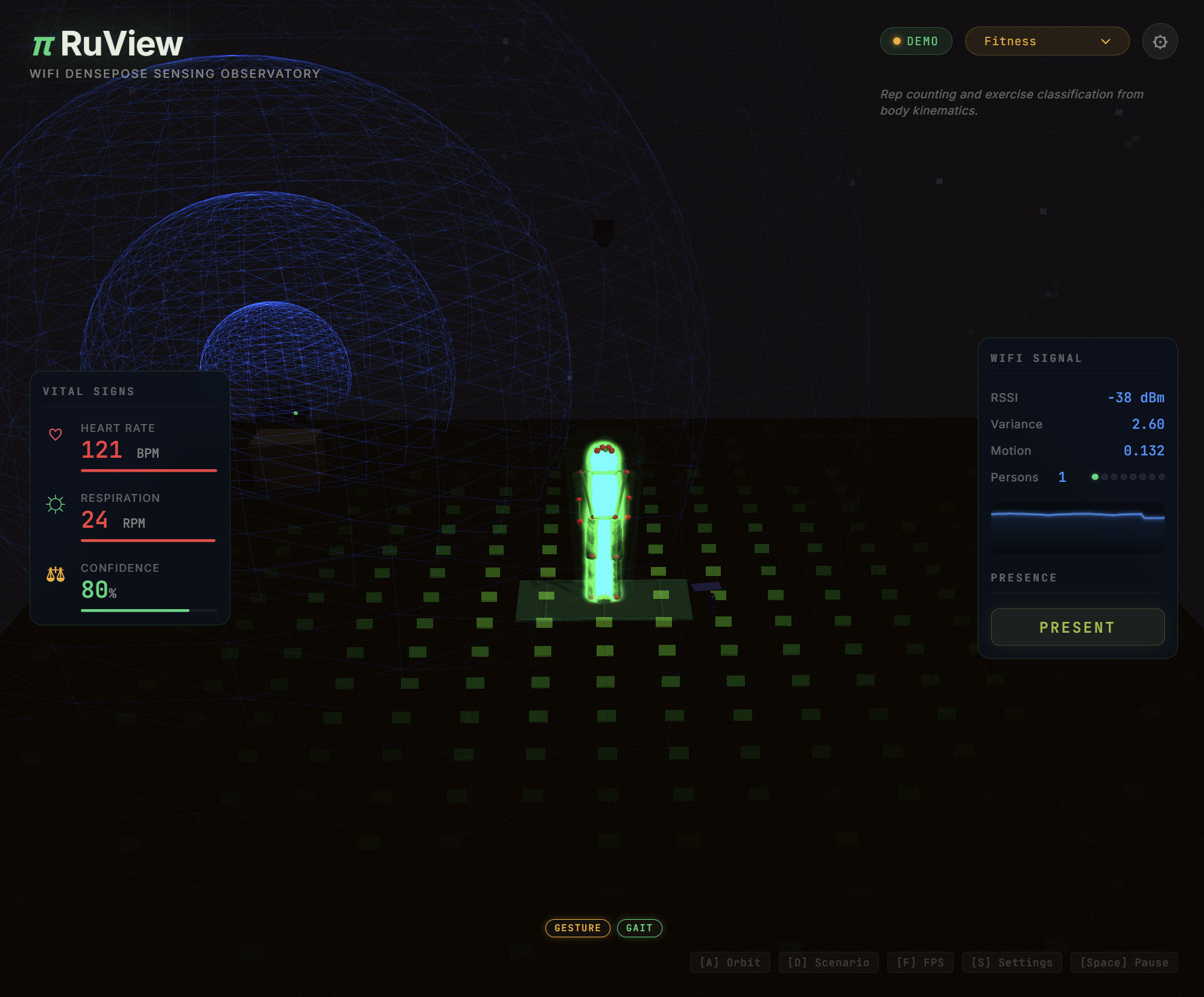
Real-time pose skeleton from WiFi CSI signals — no cameras, no wearables (demo visualization; the live CSI-only single-ESP32 17-keypoint model is still first-cut — see Model weights: what's real, what's not)
▶ Live Observatory Demo | ▶ Dual-Modal Pose Fusion Demo | ▶ Live 3D Point Cloud | ▶ three.js Demos (5)
The server is optional for visualization and aggregation — the ESP32 runs independently for presence detection, vital signs, and fall alerts.
Live ESP32 pipeline: Connect an ESP32-S3 node → run the sensing server → open the pose fusion demo for real-time dual-modal pose estimation (webcam + WiFi CSI). See ADR-059. (The webcam supplies ground-truth pose in this dual-modal demo; the CSI-only on-device 17-keypoint model is still first-cut — see Model weights: what's real, what's not.)
three.js scene gallery at
/three.js/— five progressively richer ADR-097 demos: helpers, cinematic, GLTF skinned, FBX skinned, and a live MediaPipe→Mixamo retargeting feed driven by ESP32 CSI. Demos 04 and 05 require a local MixamoX Bot.fbx(license boundary — not redistributed).
🤗 Pretrained model on Hugging Face
Pretrained CSI weights live at ruvnet/wifi-densepose-pretrained — 12.2M training steps on 60K frames / 610K contrastive triplets, 82.3% held-out temporal-triplet accuracy (up from 66.4% raw; the older "100% presence" figure was measured on a single-class recording and has been retracted), 4-bit quantized variant fits in 8 KB. The release includes a contrastive CSI encoder producing 128-dim embeddings (164,183 emb/s on M4 Pro) and a presence-detection head. Per-node LoRA adapters are included for environment-specific fine-tuning.
# Download the model bundle
pip install huggingface_hub
huggingface-cli download ruvnet/wifi-densepose-pretrained --local-dir models/wifi-densepose-pretrained
What works today vs. what's pending wiring:
| Consumer | Format used | Status |
|---|---|---|
| Python training / evaluation / embedding extraction | model.safetensors | ⚠️ The published file's header is NUL-padded, which the reference safetensors.torch.load_file rejects (issue #1522) — pending a corrected re-upload. csi-embed-v2.safetensors in the same repo is unaffected and loads normally. |
| Inspect / re-export the bundle | model.rvf.jsonl (line-by-line JSON) | ✅ Works — plain JSONL |
Sensing-server --model <PATH> flag | native RVF, model.safetensors, or model.rvf.jsonl | ✅ Native RVF loads directly; safetensors and JSONL auto-convert in memory |
Loader scope: --model now accepts native RVF and auto-converts the published safetensors or JSONL files. The quantized model-q*.bin files still need a compatible reader, and loading weights does not supply the matching pose-decoder architecture or establish end-to-end pose accuracy.
Quantization choices (all in the HF repo): model-q2.bin (4 KB) · model-q4.bin ⭐ recommended (8 KB) · model-q8.bin (16 KB) · model.safetensors full (48 KB)
The separate 17-keypoint pose-estimation model is now published at ruvnet/wifi-densepose-mmfi-pose — 82.69% torso-PCK@20 on MM-Fi (single model) / 83.59% (3-model ensemble + TTA), beating the prior published SOTA MultiFormer (72.25%) and CSI2Pose (68.41%) on the matched random_split protocol. See Results & proof below.
Results & proof

See the measured benchmarks, witness records, and one-command reproducibility check.
View benchmark and proof details
| What | Where | Numbers |
|---|---|---|
| MM-Fi pose model (SOTA) | ruvnet/wifi-densepose-mmfi-pose | 82.69% torso-PCK@20 (single) · 83.59% (ensemble+TTA) · 75K-param micro variant 74.30% |
| AetherArena benchmark Space | ruvnet/aether-arena | self-correcting, auditable MM-Fi leaderboard |
| Full MM-Fi study (honest picture) | docs/benchmarks/mmfi-wifi-sensing-study.md | pose + action; zero-shot cross-subject ~64%, labeled in-room calibration → 72.2% |
| Efficiency frontier | docs/benchmarks/wifi-pose-efficiency-frontier.md | SOTA-beating MM-Fi pose in a ~37 KB int4 model; live ESP32 compatibility not established |
| Pretrained encoder | ruvnet/wifi-densepose-pretrained | 82.3% held-out temporal-triplet, 8 KB int4 |
| Reproducible proof (Trust Kill Switch) | archive/v1/data/proof/verify.py + |
Model weights: what's real, what's not
See which checkpoints are validated, experimental, or architecture-only.
View model maturity details
"WiFi → pose" means three different things in this repo, at three different maturity levels. Read the label, not the headline (ADR-187):
| Tier | Checkpoint(s) | Honest status |
|---|---|---|
| Real & validated | ruvnet/wifi-densepose-pretrained (CSI encoder + presence head) · ruvnet/wifi-densepose-mmfi-pose (17-keypoint pose) · cog-person-count/count_v1 | MEASURED / published. Presence = 82.3% held-out temporal-triplet accuracy (the old "100% presence" figure was retracted); MM-Fi pose = 82.69% torso-PCK@20 on the random_split protocol. These are the pose/presence numbers the project stands behind today. |
| Real but weak (honestly labeled) | committed v2/crates/cog-pose-estimation/cog/artifacts/pose_v1.safetensors | First-cut on-device model. PCK@20 = 3.0% / PCK@50 = 18.5% on a 217-sample holdout — below the ADR-079 target of ≥ 35%. Learns coarse structure (r_hip 77% PCK@50); distal/face joints near-random. Its runtime path in cog-pose-estimation/src/inference.rs is still a centred-skeleton stub returning confidence=0 — the weights are not yet wired in. Full disclosure in the cog README. |
| Architecture only, no weights | archive/v1 DensePoseHead | Random kaiming_normal_ init, no checkpoint of any kind (zero .pth/.onnx/.safetensors files under archive/v1/). Deprecated and superseded — see . Do not expect real pose output from it. |
🧩 Edge Module Catalog

Add signed modules for health, security, buildings, industry, research, AI, and more.
Browse the full edge module catalog
Browse and install modules at seed.cognitum.one/store or on your appliance at http://<appliance>:9000/cogs. Each module is a small signed binary that runs beside the sensing stack. The appliance updates the catalog over the air and verifies every module before installation (ADR-100, ADR-102).
🫀 Health — 14 modules
| ID | What it does | Size | Difficulty |
|---|---|---|---|
air-quality-index | Track indoor air quality with CO2 and particle sensors | 8 KB | Easy |
baby-cry | Sustained mid-band energy detector for nursery / infant monitoring. Audio-only, no camera. | 451 KB | Easy |
breathing-sync | Detects when two people breathe in sync | 10 KB | Hard |
cardiac-arrhythmia | Spots irregular heartbeats and abnormal heart rhythms | 8 KB | Hard |
cough-detect | Acoustic transient + spectral cough detector with 30s cluster aggregation. Early-warning signal for respiratory illness. | 451 KB | Easy |
dream-stage | Tracks your sleep stages — light, deep, and dreaming | 14 KB | Hard |
fall-detect | Two-stage impact + stillness fall detector over ambient feature stream (ESP32 motion / mic). Optional ruview-mode for CSI-based pose reinforcement. |
🔬 How It Works
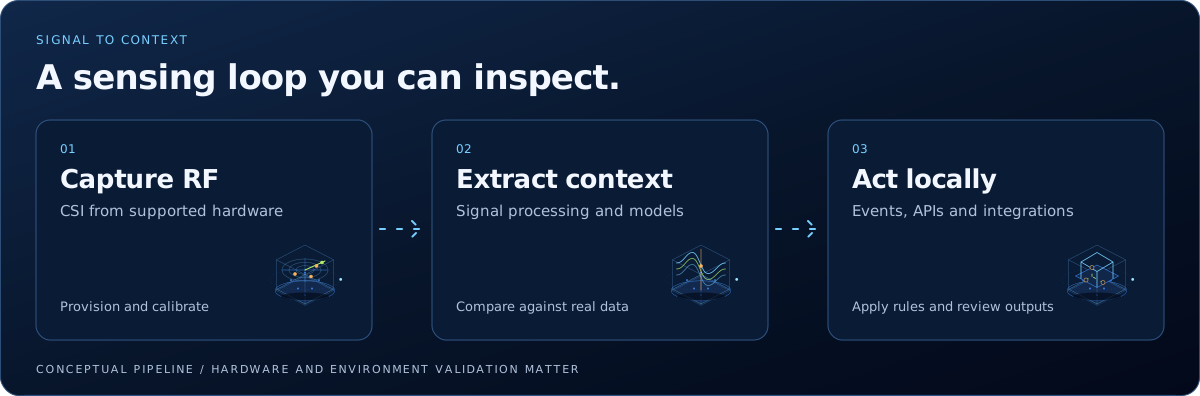
WiFi routers flood every room with radio waves. When a person moves — or even breathes — those waves scatter differently. WiFi DensePose reads that scattering pattern and reconstructs what happened:
WiFi Router → radio waves pass through room → hit human body → scatter
    ↓
ESP32 mesh (4-6 nodes) captures CSI on channels 1/6/11 via TDM protocol
    ↓
Multi-Band Fusion: 3 channels × 56 subcarriers = 168 virtual subcarriers per link
    ↓
Multistatic Fusion: N×(N-1) links → attention-weighted cross-viewpoint embedding
    ↓
Coherence Gate: accept/reject measurements → stable for days without tuning
    ↓
Signal Processing: Hampel, SpotFi, Fresnel, BVP, spectrogram → clean features
    ↓
AI Backbone (RuVector): attention, graph algorithms, compression, field model
    ↓
Signal-Line Protocol (CRV): 6-stage gestalt → sensory → topology → coherence → search → model
    ↓
Neural Network: processed signals → 17 body keypoints + vital signs + room model
    ↓
Output: real-time pose, breathing, heart rate, room fingerprint, drift alerts
The Self-Learning system (ADR-024) provides camera-free representation-learning components. Cross-room pose remains a separate, data-gated problem: MERIDIAN (ADR-027) is Proposed, while the measured calibration reference requires labeled CSI/keypoint pairs and model-specific adapters. See the model compatibility boundary.
🏢 Use Cases & Applications
Safety boundary: these are research and prototype applications, not medical devices, emergency systems, or safety-certified controls. Vital-sign and pose outputs require independent validation on the exact hardware, room, subjects, and failure conditions before operational use.
WiFi sensing works anywhere WiFi exists. No new hardware in most cases — just software on existing access points or a $8 ESP32 add-on. Because there are no cameras, deployments avoid privacy regulations (GDPR video, HIPAA imaging) by design.
Scaling: Each AP distinguishes ~3-5 people (56 subcarriers). Multi-AP multiplies linearly — a 4-AP retail mesh covers ~15-20 occupants. No hard software limit; the practical ceiling is signal physics.
| Why WiFi sensing wins | Traditional alternative | |
|---|---|---|
| 🔒 | No video, no GDPR/HIPAA imaging rules | Cameras require consent, signage, data retention policies |
| 🧱 | Works through walls, shelving, debris | Cameras need line-of-sight per room |
| 🌙 | Works in total darkness | Cameras need IR or visible light |
| 💰 | $0-$8 per zone (existing WiFi or ESP32) | Camera systems: $200-$2,000 per zone |
| 🔌 | WiFi already deployed everywhere | PIR/radar sensors require new wiring per room |
🏥 Everyday — Healthcare, retail, office, hospitality (commodity WiFi)
| Use Case | What It Does | Hardware | Key Metric | Edge Module |
|---|---|---|---|---|
| Elderly care / assisted living | Fall detection, nighttime activity monitoring, breathing rate during sleep — no wearable compliance needed | 1 ESP32-S3 per room ($8) | Fall alert <2s | Sleep Apnea, Gait Analysis |
| Hospital patient monitoring | Continuous breathing + heart rate for non-critical beds without wired sensors; nurse alert on anomaly | 1-2 APs per ward | Breathing: 6-30 BPM | Respiratory Distress, Cardiac Arrhythmia |
| Emergency room triage | Automated occupancy count + wait-time estimation; detect patient distress (abnormal breathing) in waiting areas | Existing hospital WiFi | Occupancy accuracy >95% | Queue Length, Panic Motion |
| Retail occupancy & flow | Real-time foot traffic, dwell time by zone, queue length — no cameras, no opt-in, GDPR-friendly | Existing store WiFi + 1 ESP32 | Dwell resolution ~1m | Customer Flow, |
🏟️ Specialized — Events, fitness, education, civic (CSI-capable hardware)
| Use Case | What It Does | Hardware | Key Metric | Edge Module |
|---|---|---|---|---|
| Smart home automation | Room-level presence triggers (lights, HVAC, music) that work through walls — no dead zones, no motion-sensor timeouts | 2-3 ESP32-S3 nodes ($24) | Through-wall range ~5m | HVAC Presence, Lighting Zones |
| Fitness & sports research | Explore motion and breathing cadence without a wearable or camera; reliable posture correction requires a validated compatible pose model | 3+ ESP32-S3 mesh + edge host | Prototype; no live S3 pose accuracy claim | Breathing Sync, Gait Analysis |
| Childcare & schools | Naptime breathing monitoring, playground headcount, restricted-area alerts — privacy-safe for minors | 2-4 ESP32-S3 per zone | Breathing: ±1 BPM | Sleep Apnea, Perimeter Breach |
| Event venues & concerts | Crowd density mapping, crush-risk detection via breathing compression, emergency evacuation flow tracking | Multi-AP mesh (4-8 APs) | Density per m² | Customer Flow, |
🤖 Robotics & Industrial — Autonomous systems, manufacturing, android spatial awareness
WiFi sensing gives robots and autonomous systems a spatial awareness layer that works where LIDAR and cameras fail — through dust, smoke, fog, and around corners. The CSI signal field acts as a "sixth sense" for detecting humans in the environment without requiring line-of-sight.
| Use Case | What It Does | Hardware | Key Metric | Edge Module |
|---|---|---|---|---|
| Cobot safety zones | Detect human presence near collaborative robots — auto-slow or stop before contact, even behind obstructions | 2-3 ESP32-S3 per cell | Presence latency <100ms | Forklift Proximity, Perimeter Breach |
| Warehouse AMR navigation | Autonomous mobile robots sense humans around blind corners, through shelving racks — no LIDAR occlusion | ESP32 mesh along aisles | Through-shelf detection | Forklift Proximity, Loitering |
| Android / humanoid spatial awareness | Ambient human pose sensing for social robots — detect gestures, approach direction, and personal space without cameras always on | Onboard ESP32-S3 module | 17-keypoint pose | Gesture Language, Emotion Detection |
🔥 Extreme — Through-wall, disaster, defense, underground
These scenarios exploit WiFi's ability to penetrate solid materials — concrete, rubble, earth — where no optical or infrared sensor can reach. The WiFi-Mat disaster module (ADR-001) is specifically designed for this tier.
| Use Case | What It Does | Hardware | Key Metric | Edge Module |
|---|---|---|---|---|
| Search & rescue (WiFi-Mat) | Detect survivors through rubble/debris via breathing signature, START triage color classification, 3D localization | Portable ESP32 mesh + laptop | Through 30cm concrete | Respiratory Distress, Seizure Detection |
| Firefighting | Locate occupants through smoke and walls before entry; breathing detection confirms life signs remotely | Portable mesh on truck | Works in zero visibility | Sleep Apnea, Panic Motion |
| Prison & secure facilities | Cell occupancy verification, distress detection (abnormal vitals), perimeter sensing — no camera blind spots | Dedicated AP infrastructure | 24/7 vital signs | Cardiac Arrhythmia, Loitering |
| Military / tactical | Through-wall personnel detection, room clearing confirmation, hostage vital signs at standoff distance |
🧠 Self-Learning WiFi AI

Learn compact room fingerprints from raw CSI and adapt the model to each environment.
View self-learning architecture and commands
Every WiFi signal that passes through a room creates a unique fingerprint of that space. WiFi-DensePose already reads these fingerprints to track people, but until now it threw away the internal "understanding" after each reading. The Self-Learning WiFi AI captures and preserves that understanding as compact, reusable vectors — and continuously optimizes itself for each new environment.
What it does in plain terms:
- Turns any WiFi signal into a 128-number "fingerprint" that uniquely describes what's happening in a room
- Learns entirely on its own from raw WiFi data — no cameras, no labeling, no human supervision needed
- Recognizes rooms, detects intruders, and classifies activities using only WiFi (named person-identity is an experimental, data-gated research capability — see below, not a shipped feature)
- Runs on an $8 ESP32 chip (the entire model fits in 55 KB of memory)
- Produces both body pose tracking AND environment fingerprints in a single computation
Key Capabilities
| What | How it works | Why it matters |
|---|---|---|
| Self-supervised learning | The model watches WiFi signals and teaches itself what "similar" and "different" look like, without any human-labeled data | Deploy anywhere — just plug in a WiFi sensor and wait 10 minutes |
| Room identification | Each room produces a distinct WiFi fingerprint pattern | Know which room someone is in without GPS or beacons |
| Anomaly detection | An unexpected person or event creates a fingerprint that doesn't match anything seen before | Automatic intrusion and fall detection as a free byproduct |
| Person re-identification (experimental, research) | A real per-channel similarity matcher (Soul Signature §3.6, wifi-densepose-bfld); measured result: on WiFi-only cardiac+respiratory channels alone two people are not separable (gap ~0.0005) | Honest research capability — named identity is not claimed and is data-gated on enrollment with the decisive AETHER/body-resonance channel. See #1021 |
🧩 Claude Code & Codex Plugin
Use the in-repo plugin for guided setup, sensing, training, and verification in Claude Code or Codex.
View plugin installation and commands
RuView's Claude Code plugin and Codex prompt mirror cover onboarding, ESP32 setup, sensing apps, model training, advanced sensing, CLI/API/WASM, mmWave radar, and witness verification. The source lives in plugins/ruview/; the marketplace manifest is .claude-plugin/marketplace.json.
# In Claude Code — add this repo as a plugin marketplace, then install:
/plugin marketplace add ruvnet/RuView
/plugin install ruview@ruview

# Or try it for one session without installing (from a local clone of the repo):
claude --plugin-dir ./plugins/ruview

# Then, in Claude Code:
#   /ruview-start      → onboarding (Docker demo / repo build / live ESP32)
#   /ruview-flash      → build + flash ESP32 firmware
#   /ruview-provision  → provision WiFi creds, sink IP, channel/MAC, mesh slots
#   /ruview-app        → run a sensing application (presence / vitals / pose / sleep / MAT / point cloud)
#   /ruview-train      → train / evaluate / publish a model (incl. GPU on GCloud)
#   /ruview-advanced   → multistatic / tomography / cross-viewpoint / mesh-security
#   /ruview-verify     → tests + deterministic proof + witness bundle
Codex (OpenAI CLI): cp plugins/ruview/codex/prompts/*.md ~/.codex/prompts/ — the seven /ruview-* commands are mirrored as Codex prompts; plugins/ruview/codex/AGENTS.md carries the project rules. See plugins/ruview/codex/README.md.
Verify the plugin structure: bash plugins/ruview/scripts/smoke.sh. Full details: plugins/ruview/README.md.
Live sensing pane (Claude Code mod): the same marketplace also lists , a Claude Code mod.
📖 Documentation

Start with the user, build, and calibration guides; expand for the full reference map.
Browse all documentation
| Document | Description |
|---|---|
| User Guide | Step-by-step guide: installation, first run, API usage, hardware setup, training |
| Build Guide | Building from source (Rust and Python) |
| Calibration & Room Training Guide | What calibrate/enroll/train-room actually enforce: minimum frame counts, per-anchor quality gates, the pet/small-motion presence-detection caveat, and empty-room baseline conditions — grounded in the real code, not just ADR-135/151 |
| Trust State & Engine Errors | What engine_error_count and demoted mean on /api/v1/status, exact trigger conditions, the current diagnostic gap (no per-cause breakdown), the WDP_GUARD_INTERVAL_US recovery path, and why a converted Hugging Face model isn't shown to be the cause in code |
| Home Assistant + Matter Integration | Works with Home Assistant via MQTT auto-discovery + Works with Matter (Apple Home / Google Home / Alexa / SmartThings) — full entity catalog, 3 starter blueprints, Lovelace dashboards, privacy mode, threshold tuning (ADR-115). |
🚧 Beta software
Beta Software — Under active development. APIs and firmware may change. Known limitations:
- ESP32-C3 and original ESP32 are not supported (single-core, insufficient for CSI DSP)
- Single ESP32 deployments have limited spatial resolution — use 2+ nodes or add a Cognitum Seed for best results
- Camera-free pose accuracy is limited (PCK@20 ≈ 2.5% with proxy labels) — camera ground-truth training targets 35%+ PCK@20; the pipeline is implemented, but the data-collection and evaluation phases (ADR-079 P7–P9) are still pending.
Contributions and bug reports welcome at Issues.

📄 License
MIT License — see LICENSE for details.
🤝 Creator Affiliate Program
For TikTok · Instagram · YouTube creators — earn 25% on every Cognitum sale you refer. The RuFlo, RuView, and RuVector videos you're already making have done millions of views; get paid for the orders they drive. Click-tracking activates instantly; commissions activate after a quick manual review (usually under 24 hours).
Apply now → cognitum.one/affiliate
📞 Support
GitHub Issues | Discussions | PyPI
WiFi DensePose — Privacy-preserving human pose estimation through WiFi signals.