rowstile: access rules in a policy file, enforced by Postgres
Authorization inside your Postgres. Sharing, groups, nested folders and tenants, written in one policy file and compiled to row-level security. There is no authorization service to run beside the database, and no permission data to copy into one and keep in step: the rules read the tables your app already has.
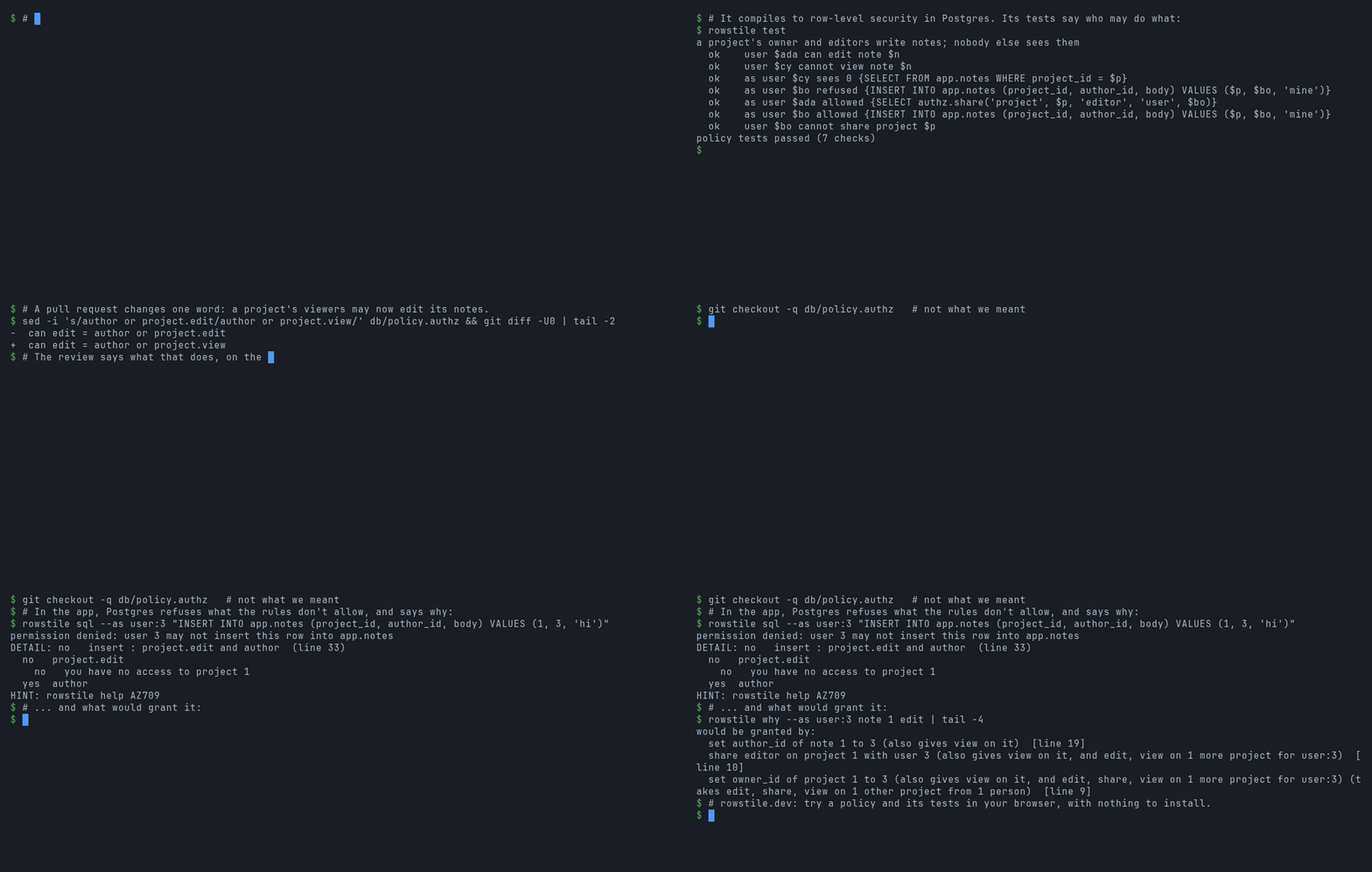
Write who-can-do-what in one small file, next to the data it depends on. The rowstile
command compiles it into plain SQL: views, trigger-maintained tables for inheritance, row-level
security policies, and functions for app code: checks, sharing, "who has access", "why", access
requests, reviews, audit. Each change to the policy ships as a migration for the tool your app
already uses (Alembic, Prisma, Drizzle Kit, plain SQL). Nothing is installed in the database first,
and nothing has to run next to it: any Postgres 16, 17 or 18 works, managed or not, and the owner of
your tables runs the migrations, no superuser needed.
app role app_user                               -- the Postgres role the app connects as
type user = app.users
type folder = app.folders
  owner  : user   = owner_id                    -- a relation read from a column
  parent : folder = parent_id
  editor : user   = app.folder_editors(folder_id -> user_id)   -- ... or from a link table
  can edit = owner or editor or parent.edit     -- inherited down the tree
  can view = edit
rules app.folders
  select : view
  update : edit
The app says who is asking in each transaction and queries its tables as usual; RLS filters every read and checks every write:
BEGIN;
SELECT authz.act_as('user', '42');         -- a trusted backend, or:
-- SELECT authz.login_key('ak_...');       -- an API key (optionally limited by scopes)
-- SELECT authz.login_jwt('eyJ...');       -- a JWT from your identity provider
SELECT * FROM app.folders;                             -- only the folders 42 may view
SELECT authz.can('folder', 7, 'edit');                 -- ask directly
SELECT * FROM authz.perms_of('folder', ARRAY['7', '8']);  -- a list's buttons, in one call
COMMIT;
Is it for you?
It fits when:
- your app's data is in one Postgres database;
- who may see or change a row depends on other rows: its owner, the members of a team (teams inside teams), a folder or a project that passes access down, a tenant, what people share with each other;
- you were about to add an authorization service and keep it in step with the database, or your hand-written row-level security has become hard to test and to change.
It doesn't when:
- what decides access is in several databases, or outside Postgres;
- a browser reads the tables through Supabase's Data API (its roles are not the app role: a backend has to sign in);
- one tree takes many moves and links a second (they wait for each other);
- you need an outside audit or a vendor behind it today: rowstile is a 0.x preview with one maintainer.
Status
rowstile is a 0.x preview. Until 1.0, a minor release may change the language, the authz.* functions, the
SDKs and the file formats; each release still upgrades a database from the one before it, and the changelog
says what to do. What a 0.x release promises.
rowstile was called rowfence until 0.1.0-alpha.1; another product had the name first. The changelog says what to change.
Installing
Only an alpha is published so far, 0.1.0-alpha.7: ask for it.
npm i -D rowstile@next         # the command with its own Python: a TypeScript app needs none
pip install --pre rowstile     # the command and the Python SDK: rowstile[fastapi], [sqlalchemy], ...
docker run --rm -u "$(id -u):$(id -g)" -v "$PWD:/work" ghcr.io/rowstile/rowstile:0.1.0-alpha.7 migrate
npm brings the Python for Linux (glibc and musl, x64 and arm64), macOS (x64 and arm64) and Windows x64. The
image runs as root unless told otherwise: -u makes the files it writes yours. Installing
has the rest: alphas and release candidates, the extras, the repository.
From this repository, put core/cli on PATH. rowstile init then finds the stack (Next.js, Prisma,
Drizzle, FastAPI, SQLAlchemy, Alembic), writes rowstile.toml for its migration tool, adds the SDK's
packages and says which line to change.
Docs
- Getting started: from a schema to a policy, its tests, the edit loop and the first migration, in about fifteen minutes.
- rowstile and the alternatives: authorization services, policy engines, rules in the ORM, row-level security by hand; and how rowstile is checked.
- Your stack: FastAPI, Next.js, other Node and Python apps, and the SQL any other language sends.
- Cookbook, troubleshooting, running rowstile, managed Postgres (Neon, Supabase), files in S3-compatible storage, error codes.
- Reference: the policy language, app code, , , , , , , .
This repository
| folder | what |
|---|---|
core/ | the compiler and the rowstile command, their tests and the benchmarks |
sdk/ | the SDKs: Python (FastAPI, SQLAlchemy, psycopg, asyncpg) and TypeScript (Next.js, Prisma, Drizzle, pg, postgres.js, React) |
integrations/ | each SDK's conformance suite: a small app and the checks it must pass |
examples/ | complete apps built on rowstile: a file manager and a messenger |
editor/ | the VS Code and Zed extensions, a Tree-sitter grammar (Helix, Neovim); other editors start rowstile lsp |
review-ci/ | the policy review for pull requests: a GitHub action and a GitLab CI template |
docs/ | the guides and the reference, as Markdown; site/ builds them into the docs site |
playground/ | rowstile in the browser (Pyodide and PGlite) |
packaging/ | how rowstile is installed: npm, PyPI and a Docker image |
Contributing
A question, or something you built with rowstile: Discussions. Issues and pull requests are welcome: CONTRIBUTING.md says how a change gets in, and the code of conduct how we work together. What changed in each release: CHANGELOG.md. How releases are numbered and made: RELEASING.md.
Security
rowstile has not been audited by anyone outside the project. The threat model says what it protects and from whom. Report a vulnerability privately: SECURITY.md.
How the project itself is run, as the OpenSSF Scorecard measures it (pinned actions, what each workflow's
token may do, known vulnerabilities in dependencies, review, releases):
The project's own answers to the OpenSSF Best Practices criteria, at the passing level: how it is documented,
changed, tested and secured, each answer with where to check it:
License
Apache License 2.0; see LICENSE. Copyright 2026 Salaheddine EL HSSANI.