RoundWatch README
The full upstream README, mirrored here for reference. Install config, tool schemas, adoption signals, and an original overview live on the RoundWatch listing page.
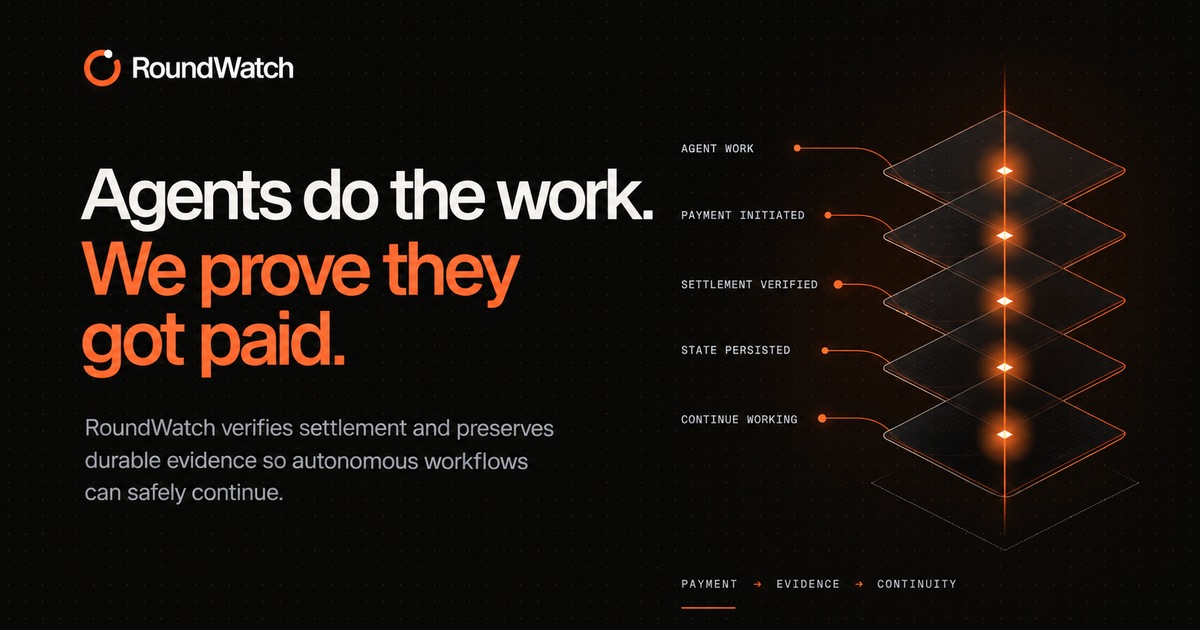
RoundWatch
Durable Algorand USDC payment monitoring for autonomous x402 workflows.
Website · Quickstart · Technical guide · Live API · OpenAPI · llms.txt · MCP Registry · Architecture





RoundWatch watches one exact future Algorand MainNet USDC payment when no transaction ID exists yet. A caller defines the expected payment, pays a one-time x402 service fee, receives a durable watch ID, and can exit. RoundWatch persists the obligation and scan progress, then exposes verified on-chain evidence for later retrieval.
Production: Algorand MainNet · Circle USDC · x402 v2 · GoPlausible facilitator · Bazaar metadata live (catalog visibility under requalification) · remote MCP endpoint · durable restart recovery.
What it solves
A short-lived agent, job, or service may need to know whether a particular payment arrives after the caller has stopped running. Keeping that caller alive to poll an Algorand Indexer is unnecessary if a durable observer can own the wait instead.
RoundWatch lets a caller define the expected payment, purchase one watch through x402, and exit. The service persists the obligation, continues scanning Algorand, and records the matching transaction for later retrieval.
A backend that already operates durable Indexer or subscriber infrastructure may reasonably implement this itself. RoundWatch is for callers that do not want to own that operational component.
Lifecycle
- The client submits the exact expected sender, receiver, atomic amount, and optional invoice note.
- x402 returns payment requirements and the client signs the service payment locally.
- GoPlausible verifies and settles the service payment.
- RoundWatch activates the persisted watch only after the exact service-payment transaction is confirmed; that transaction's confirmed round becomes the scan baseline.
- The caller may exit while RoundWatch polls the Algorand Indexer.
- The watch becomes
matchedwhen an exact future USDC asset transfer appears. - The caller reads the durable result with
GET /v1/watch/:id.
See Architecture for the normal, recovery, and matching paths.
See Operations for readiness, backup/restore, retention, and incident procedures.
See Roadmap for the current product direction and prioritization.
Live production service
| Property | Current value |
|---|---|
| API | https://roundwatch-api.onrender.com |
| Create a watch | POST /v1/watch |
| Read a watch | GET /v1/watch/:id |
| Liveness | GET /health |
| Readiness | GET /ready |
| Network | Algorand MainNet |
| CAIP-2 | algorand:wGHE2Pwdvd7S12BL5FaOP20EGYesN73ktiC1qzkkit8= |
| Asset | Circle USDC, ASA 31566704 |
| Service price | 0.02 USDC (20000 atomic units) |
| Service receiver | EQPLN32HPLPGBCNPOZUL6BL34CTNQGT3VAAMNAJWSIZGQ5CUNXOHB634XY |
| Facilitator | https://facilitator.goplausible.xyz |
| Hosting | Render, with persistent SQLite storage mounted at /data |
| Eligibility deadline | 30 minutes from durable creation; terminal expired requires complete validated chain coverage through a fixed closing checkpoint |
| Work budget | 500 durable background work turns per watch; exhaustion terminates as indeterminate, never as expired |
| Open-obligation capacity | 50 globally; 5 per verified service payer |
The production server does not contain or need a wallet mnemonic or private key.
Economics v1 is live in production as of 2026-09-20 at
80ed94c746f2eac4a784a3738c6dbe8306ecfa3e. An external unsignedPOST /v1/watchreceived HTTP402and verified MainNet,exact, ASA31566704, the approved receiver, challenge tag, and amount20000. The historical paid MainNet proof below remains evidence of the earlier0.001 USDCcontract.
API
Health and readiness
GET /health is liveness only. Use GET /ready to decide whether the durable service is ready for paid traffic. Render's platform health check must target /ready; /health must remain a lightweight process-liveness endpoint and must not be used as the paid-traffic readiness signal.
Production response:
Readiness:
A ready production instance returns HTTP 200:
Create a watch
Example body:
An ordinary request receives 402 Payment Required. An x402-capable client reads the payment requirements, signs the advertised service payment, and retries the same request. RoundWatch returns success only after settlement and durable activation succeed:
Request fields:
| Field | Required | Rules |
|---|---|---|
idempotencyKey | Yes | String, 8–128 characters. It is globally unique in the service database. Reuse returns HTTP 409 with the existing public watch record and does not activate a second watch. |
expectedSender | Yes | Checksum-valid 58-character Algorand address. |
expectedReceiver | Yes | Checksum-valid 58-character Algorand address. It is the receiver of the future invoice payment, not necessarily the RoundWatch service receiver. |
atomicAmount | Yes | Positive integer string, at most JavaScript's maximum safe integer (9007199254740991). For six-decimal USDC, 1000 means 0.001 USDC. |
invoiceNote | No | Exact UTF-8 note to match, 1–128 bytes when present. |
The watched asset is not a request field. The server selects the USDC ASA from its explicit network configuration: MainNet ASA 31566704 or TestNet ASA 10458941.
The server controls the lifetime, work budget, and admission policy. Before purchase, RoundWatch advertises the 30-minute eligibility window and 500-turn background work budget. The eligibility clock starts when the durable obligation is prepared, before x402 settlement completes, so settlement delay consumes part of that 30-minute window. Callers cannot override either bound. Passing the wall-clock deadline does not itself expire a watch; proof requires complete chain coverage through a closing checkpoint. If the work budget is exhausted first, the watch terminates as indeterminate with terminalReason=work_budget_exhausted, never as a false expired. At most 50 unfinished obligations may be open globally and at most 5 may be open for the verified service payer. Capacity exhaustion returns HTTP 429 before settlement.
Read a watch
The response is { "watch": ... }. This abridged matched example shows the stable consumer-facing fields; the live record also exposes settlement and scan metadata when available:
Unknown IDs return HTTP 404.
Watch states
| State | Meaning |
|---|---|
settlement_pending | The watch specification and deterministic service-payment identity are persisted, but activation is not yet proven. Reconciliation can recover a settlement/activation crash window. |
active | The exact service-payment transaction is confirmed; its confirmed round is the activation baseline and initial scan cursor. The poller is looking for the future invoice payment. |
matched | An exact matching future asset transfer was found. The matching transaction ID and confirmed round are stored. |
settlement_unknown | Settlement did not produce an immediately usable activation. settlementReconciliationTerminal=false means exact reconciliation may still recover it; true means reconciliation reached a final fail-closed outcome and will not retry. |
expired | The deadline's complete eligible chain range was scanned through a fixed closing checkpoint with no exact match. The terminal record remains readable. |
indeterminate | The durable per-watch work budget was exhausted before a positive match or complete expiry proof. The record is terminal and does not claim absence. |
Exact matching
A transaction matches only when all configured properties agree:
- sender;
- receiver;
- network-selected USDC ASA;
- atomic amount; and
- invoice note, when the request supplied one.
Only confirmed top-level direct asset transfers strictly after the confirmed service-payment round are considered. The exact eligibility boundaries are confirmed-round > activationRound and round-time < expiresAt: a same-round invoice is ineligible, and a block timestamp exactly equal to the deadline is also ineligible. Sender, receiver, ASA, atomic amount, and optional note must match. Inner transactions, clawback transfers, and asset close-out transfers are explicitly outside the current RoundWatch matching contract and do not count as invoice payments. Processing time does not affect eligibility.
x402 payment and recovery
The Hono resource server uses x402 v2 and the hosted GoPlausible facilitator. Before settlement, RoundWatch persists the deterministic Algorand service-payment transaction ID and immutable receiver, ASA, atomic amount, payer, FirstValid, and LastValid terms derived from the verified signed payload. After settlement, an exact Indexer lookup supplies the confirmed service-payment round, which becomes both the activation baseline and initial cursor.
If the process stops after on-chain settlement but before activation is committed, the reconciliation worker looks up that exact transaction under persisted exponential backoff. It activates only when the original immutable terms agree. A bare 404 is retryable; only a sufficiently covered post-LastValid historical absence search can establish terminal nonpayment. A definitive confirmed mismatch fails closed. The free recovery-without-ID lookup preserves the watch-ID disclosure boundary while returning explicit retryable/terminal, stable reason, and next-action metadata for an exact unresolved checkpoint.
All Indexer calls share one token-bucket/concurrency dispatcher. Scans use finite round windows and page-level validation; each page and retry consumes capacity. Each durable work turn is additionally guarded to at most four logical Indexer request opportunities for active polling or three for settlement reconciliation, so the default 500-turn contract has a conservative 2,000-background-request ceiling. Indexer response bodies are capped at 8 MiB before JSON parsing and continuation tokens are capped at 4 KiB, so a malformed or hostile upstream cannot allocate unbounded parser/token memory. Any response body that is not consumed because of a declared-size rejection, allowed 404, or other non-OK status is explicitly cancelled before the dispatcher slot is released. Validated historical scan pages may be reused across sweeps, but the process-local LRU is bounded by both entry count and serialized payload bytes. Pagination tokens stay in memory, so restart replays the unfinished window from its durable cursor. When the deadline has passed, RoundWatch fixes an indexed block whose timestamp is at or after the deadline as closingRound; only complete validated coverage through that round can produce expired. Status reads never manufacture expiry from wall time.
Local development
Requirements:
- Node.js 24;
- pnpm 12.3.4 (declared by the workspace); and
- a TestNet account only if you intentionally exercise a paid local flow.
Install dependencies:
Copy apps/server/.env.example to apps/server/.env and configure a public TestNet receiver address:
Then start the server:
Free checks:
The readiness request must return HTTP 200 before a paid watch can be admitted. It is backed by a cached SQLite write/rollback probe, poller and reconciler progress/error freshness in production, and a filesystem free-space floor. A non-ready service returns HTTP 503 from watch creation before x402 verification. The final request should return HTTP 402 before any payment. The server's default local route is /spike/watch, not the production /v1/watch route.
Paid TestNet utilities use apps/client/.env and keep signing in the client process. Never use a funded MainNet mnemonic for local development and never commit an .env file. The automated test suite does not require a wallet or make payments.
TestNet and MainNet separation
| Configuration | TestNet | MainNet |
|---|---|---|
| Selection | Default when omitted, or ROUNDWATCH_NETWORK=testnet | Must set ROUNDWATCH_NETWORK=mainnet |
| Watch route | /spike/watch | /v1/watch |
| USDC ASA | 10458941 | 31566704 |
| CAIP-2 | algorand:SGO1GKSzyE7IEPItTxCByw9x8FmnrCDexi9/cOUJOiI= | algorand:wGHE2Pwdvd7S12BL5FaOP20EGYesN73ktiC1qzkkit8= |
| Discovery tag | roundwatch-spike-0 | x402-global-challenge |
| Public base URL | Optional | Required, HTTPS, and non-loopback |
| Database path | Local default allowed | Explicit absolute persistent path required |
See Deployment before operating MainNet.
Tests and CI
Run the local verification suite:
GitHub Actions runs with read-only repository permissions, pins third-party actions and the Gitleaks image by immutable revisions, performs a full-depth history scan, rejects tracked .env files other than examples, installs from the frozen lockfile, audits production dependencies for High/Critical advisories, typechecks both workspaces, runs server and MainNet safety tests, and builds the production image. Dependabot monitors both npm/pnpm dependencies and GitHub Actions. Tests are synthetic/read-only and do not authorize MainNet spending.
Security model
- Wallet signing belongs to the client; the resource server needs only its public receiver address.
- MainNet startup validates the network, receiver address, HTTPS endpoints, public base URL, and persistent database path.
- Service settlement is reconciled against exact on-chain fields before recovery activation.
- Future invoice matching is exact, and activation never starts without a safe round cursor.
- SQLite uniqueness on the idempotency key prevents duplicate watch creation.
- Transactional global/per-payer admission and the shared finite Indexer dispatcher bound persistent and external work; capacity rejection happens before settlement.
- MCP and free recovery POSTs have independent anonymous request admission before body parsing; MCP version/envelope/tool-argument validation follows the supported modern/legacy contract instead of permissive coercion.
.envfiles and wallet material must never be committed; CI enforces tracked-env and full-history secret checks.
The status API is not an authenticated vault: anyone who knows a watch ID can query its public record. Status and other watch-specific responses use Cache-Control: no-store. Do not put sensitive information in invoiceNote or use RoundWatch metadata as a secret store. /health is liveness only; use /ready to check durable storage and background-worker readiness before directing paid traffic. The challenge release retains terminal rows until deliberate operator maintenance; there is no public deletion API. See Security and Operations for trust boundaries and operational procedures.
MainNet proof
The production flow was executed successfully on 2026-09-16:
- x402 service settlement:
OJMUUHJPZVXS6MNW4TISXXAZIHAPNYNM446DAFY35OAJOBDDOPYA, confirmed round65095955; - durable watch:
7c606f02-0257-4dfd-b59c-a13b61f480f0; - later invoice transfer:
VZKWYELPR4HHXPXM476NRLNU4JUKAEUUD4HGHFNAHDRD5IBFB2MA, confirmed round65096073; - RoundWatch reported the same invoice transaction as matched at round
65096073.
Independent MainNet Indexer verification confirmed both transfers used Circle USDC ASA 31566704, the expected sender and receiver, and atomic amounts 1000 for the service payment and 1 for the watched invoice. The matched watch persisted across multiple Render redeploys.
After the initial MainNet proof, the production service received a larger correctness/resource hardening merge at 18e8712431bc02a904dd5a3f227b2f5a49e9f6f7. That release replaced wall-clock-only expiry with chain-time eligibility plus a fixed closing checkpoint, activated watches from the exact confirmed service-payment round, bounded all Indexer work through a shared dispatcher, added fair bounded servicing across watches, and strengthened settlement reconciliation and pagination validation. Render deployed that merge successfully and free production smoke checks returned the expected MainNet health, x402 402, and status behavior.
A follow-up production fix at d05fabaea6124ed5658dd13cf06167a885aefeb0 replaced an invalid Bazaar example receiver with a checksum-valid Algorand address and added regression coverage. A post-deploy external 402 smoke decoded the live payment-required header and verified the production URL, MainNet network, exact scheme, ASA 31566704, amount 1000, and checksum-valid Bazaar example addresses. No second paid MainNet E2E was performed after these hardening releases or is implied.
GoPlausible Bazaar had discovered the production resource on 2026-09-16 with the correct URL, network, asset, amount, receiver, challenge tag, and settleCount: 1. The merchant leaderboard entry then showed bazaar: true, challenge: true, settles: 1, and volume: 0.001. That is historical evidence, not a permanent catalog guarantee.
A fresh 2026-09-24 qualification initially reported the RoundWatch resource absent, but raw catalog forensics corrected that parser error: GoPlausible stores the exact production URL under a top-level resourceUrl field. The resource is present, but its stored payment/discovery terms are stale at the original 1000 atomic (0.001 USDC) contract. A fresh authorized 0.02 USDC settlement advanced the same catalog record's lastSeen / settleCount without refreshing its stored accepts amount to the live 20000 atomic price.
Detailed evidence is in MainNet Readiness.
Current limitations
- The current challenge-release policy is a 30-minute eligibility deadline, a 500-turn durable work budget, 50 global open obligations, and 5 open obligations per verified service payer. These are operational safety bounds, not a commercial SLA or final pricing/capacity policy.
- There is no cancellation operation, SLA, or long-term pricing policy.
- The current deployment is a single application instance with an in-process poller/reconciler and local persistent SQLite. It is not a horizontally coordinated worker system.
- Each poll sweep gives every active watch at most one bounded servicing turn; pagination yields between sweeps, and FIFO Indexer dispatch enforces the global request bound. The tuning values are not an SLA or arbitrary-scale claim.
- Results are retrieved by polling; there is no webhook or push-notification API.
- Watch status is readable without authentication by anyone who knows the watch ID.
Repository structure
Historical TestNet development evidence remains in RoundWatch Spike and Fault Injection. The current product and production contract are described here and in the four operational documents linked above.