Deterministic Artifact Evaluation preflight and run-path grader for research repositories.
Quick Install
Automated & IDE SetupCopy the AI prompt to install this server into Claude Code, Cursor, or another agent — or use 1-click editor setup below.
Not yet automatically verified
We haven't yet run this listing's install command through our automated sandbox check. This isn't a red flag — we're steadily working through the catalog.
Manual Client & Custom JSON ConfigExpand JSON ▾
Client Config & Setup
Choose your client or environment
Target File:
💡 Paste the JSON block into your client's configuration file under mcpServers, then restart the application.
Documentation Overview
Research Repo Doctor
Get your research artifact ready for Artifact Evaluation before the deadline: scan the repo, scaffold the easy fixes, verify the run path, and generate the appendix.
Web demo for public repos: https://research-repo-doctor-bckncrcwwmg6jrbsrd6btj.streamlit.app/ If the hosted demo is waking up or reinstalling dependencies, the local zero-install command below is the reliable fallback:
Maintainers can check anonymous demo access with
python scripts/check_live_demo.py https://research-repo-doctor-bckncrcwwmg6jrbsrd6btj.streamlit.app/.
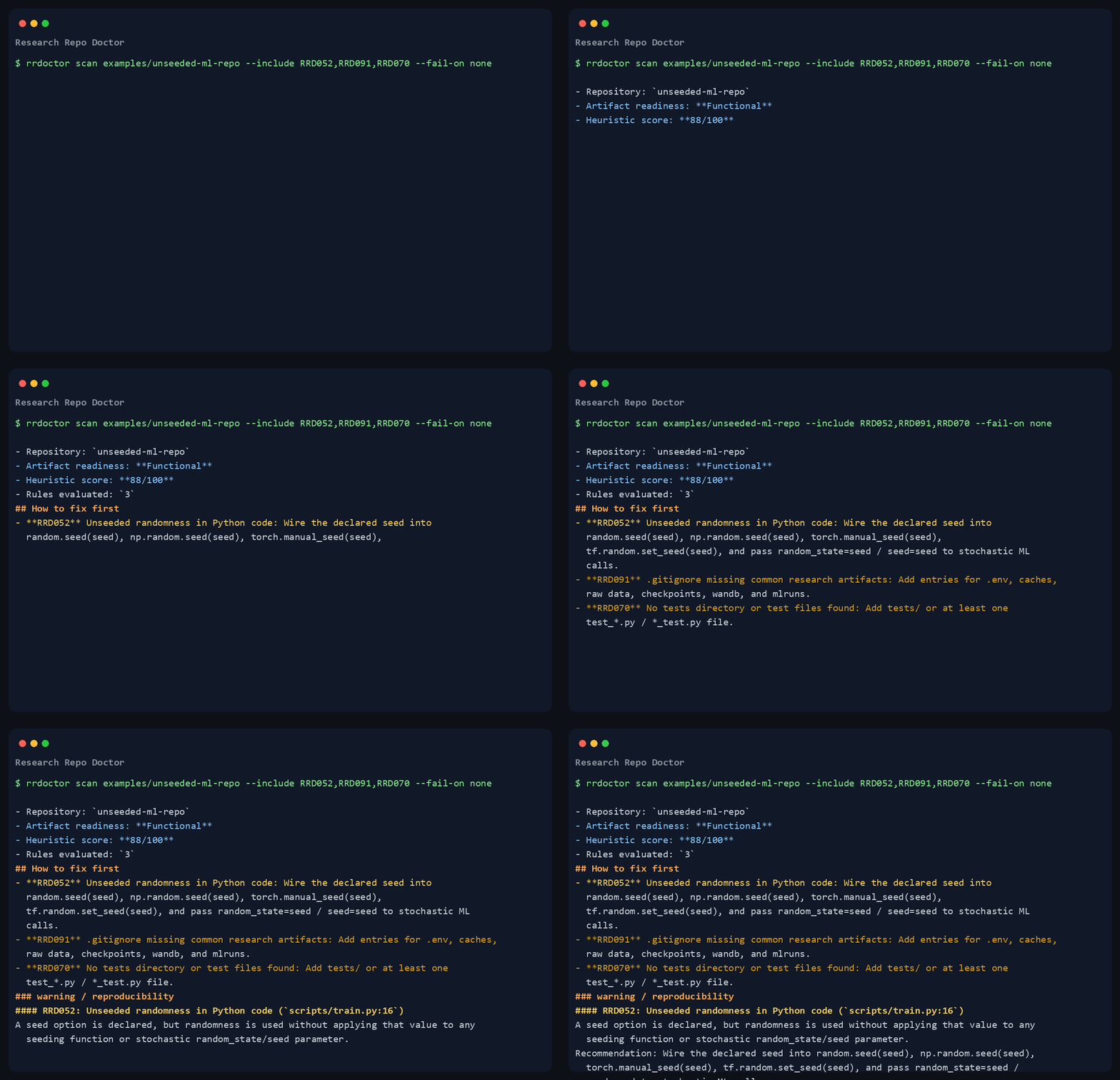




rrdoctor is a local CLI and GitHub Action for research artifact preparation. It audits
whether a repo is reviewable, citable, and close to runnable; scaffolds safe mechanical
fixes; maps findings to an AE-style readiness level; and turns the rest into a checklist
any coding agent or human can finish.
Make it a pull-request gate
The GitHub Action is the main adoption path: run the CLI while preparing the artifact, then keep the same deterministic preflight on every pull request.
The full GitHub Action guide covers sticky PR comments, new-finding baselines, agent plans, appendices, and complete AE prep packets.
AE deadline loop
For trusted repositories, rrdoctor verify --run can go beyond static checks. For supported
Python repositories it creates a temporary isolated environment, installs declared
dependencies, and executes the declared entrypoint there under a timeout. Other ecosystems
retain an explicit resolver preflight. With the default gate (--fail-on error), failed or
blocked dynamic L2/L3 steps return a nonzero exit code. Use --command when the artifact has
a specific smoke-test or quickstart command that reviewers should run. Dynamic mode may run
dependency build/install hooks as well as the entrypoint, so never use it on untrusted code.
rrdoctor prepare writes the report, agent plan, artifact appendix, and verification ladder
into one local evidence directory.
Artifact Evaluation chairs and lab maintainers can use the AE chair guide for optional pre-submission wording and CI examples.
For public calibration evidence, see the 80-repository data brief and the nanoGPT first-run regression case study.
What it catches
- "Your
--seedflag does nothing."RRD052spots code that declares a seed option but never callsrandom.seed,np.random.seed,torch.manual_seed,tf.random.set_seed, orrandom_state=seed. - "This worked on my laptop." Local-only data paths, missing data provenance, and undocumented retrieval steps.
- "The environment silently changed." Unpinned dependencies, missing runtime versions, undeclared imports, and absent dependency manifests.
- "The notebook lies." Stale outputs, out-of-order execution, checkpoint artifacts, and secret-like notebook output.
- "Reviewers cannot tell how to cite or rerun this." Missing license, citation, CI, tests, changelog, results provenance, or experiment entrypoint.
Install
Run once, without installing:
Alternatives:
Developer install from source:
Fix the easy gaps
Let rrdoctor create the safe scaffolding for you. It is deterministic, idempotent, and
never overwrites existing files.
It can scaffold missing governance docs, citation metadata, data/results provenance notes,
a reproducible-seed helper, changelog entries, and common research .gitignore entries.
The hard parts become a reviewable plan:
Use with your coding agent
Paste this into Claude Code, Cursor, GitHub Copilot, or any other coding agent:
The final command is the objective gate: it verifies the agent's work against the starting baseline and fails only on newly introduced errors.
Copyable agent templates are available for Agent Skills / Claude Code-style workflows and Cursor project rules under integrations/.
Keywords: research software, reproducibility, artifact evaluation, repository audit, auto-fix, coding agents, AGENTS.md, GitHub Action, notebooks, data availability, citation metadata.
Help calibrate the rules
The fastest way to improve rrdoctor is real scan feedback from real research repositories. After one scan, the low-friction 10-minute trial report asks only what was useful, wrong or missing, and whether the tool fits a real deadline. For a focused rule report, please open a false-positive, false-negative, scan-case, or new-rule issue. Include the rule ID, command, rrdoctor version, and a sanitized minimal repo shape. See feedback and calibration for the short checklist.
Why this matters
Research code often lands on GitHub under deadline pressure. A reviewer or future lab member finds a promising repository and then loses hours because the environment is underspecified, data paths are local, notebooks contain stale outputs, dependencies are unpinned, or the citation is unclear.
Research Repo Doctor turns those recurring release blockers into deterministic checks with concrete remediation - and, where it is safe to do so, scaffolds the mechanical starting points. It is built to sit in the ordinary maintenance path: run locally while preparing a release, then run automatically on pull requests through GitHub Actions.
The audit runs without an AI API key, network access, or hosted service. That same determinism makes it an honest grader: it can verify fixes made by a person or a coding agent.
What's new in 0.2.24
- Better systems-artifact coverage: existing checks now recognize Cargo, CMake, Meson, container, and Nix evidence plus documented artifact scripts and Cargo commands across entrypoint, test, CI, and release workflows.
- Quieter static scans: target-source
SyntaxWarningnoise is suppressed, and escaped Python exception text no longer looks like a local Windows path. - A rechecked first-run trust case: public PyPI
rrdoctor==0.2.23still scores nanoGPT asFunctionalat 76/100 with 0 errors, while the original noisyRRD050andRRD063findings remain absent. - An explicit JOSS boundary: the draft-paper notes now separate the more-than-six-month public-history gate from research-use, authorship, conflict-of-interest, and AI-disclosure evidence that maintainers must supply.
- A configuration file that actually governs the scan: CLI and MCP calls
load the target repository's
.rrdoctor.ymlfrom any working directory; profile, report, threshold, failure, include/exclude, and rule settings now work beneath explicit CLI overrides.
What's new in 0.2.23
Related MCP Servers
Adoption & maintenance
Factual signals from GitHub, npm, and our automated checks — not a rating.
GitHub stars
1
Stargazers on the source repository.
Last commit
2mo ago
Most recent push to the default branch.
Reviews
No reviews yet — be the first to share how this listing worked for you.
Frequently Asked Questions about Research Repo Doctor
AllMCPs Directory Badge
Showcase your server listing on GitHub or your project documentation. Embed this dynamic SVG badge to highlight official listing status and live engagement.
Badge Style:
Live Dynamic SVG Preview
Markdown (GitHub README)
[](https://allmcps.com/mcp/research-repo-doctor)HTML Embed
<a href="https://allmcps.com/mcp/research-repo-doctor"><img src="https://allmcps.com/api/badge/research-repo-doctor?style=directory" alt="Research Repo Doctor on AllMCPs" /></a>Technical Specs & Signals
CategoryDeveloper Tools
6/9 checks healthy over the last 46d
39Quality signal: Fair · 39/100How this signal is calculated ▾
Server availabilityNot measured
Not scored for repo-hosted servers — we can't reach the running server, only its GitHub page. Hosted MCP endpoints are health-checked live.
Verified ownership10/20
Documentation & tools16/30
Adoption & activity3/15
Community engagement0/10
A guidance signal from public completeness & health data — not a user rating. New listings start lower and rise as they add docs, get verified, and grow adoption. Signals we can't observe for a listing are skipped, not counted against it.
Supply-chain signal
No high-severity advisories surfaced by our automated scan.
Critical 0High 0Medium 0Low 0
Scanned 2d ago via OSV.dev · rrdoctor (PyPI)
Own this project?
This directory is pre-filled from public sources. Claim via GitHub README, site badge, or DNS TXT to unlock edit access and the Official badge — proof is checked automatically, then reviewed by our team.
Free dofollow backlink: add your website and place the AllMCPs badge on it — no claim needed. We detect it automatically and keep it verified as long as the badge stays live.
Claim & get free dofollowShare & Embed
Add our SVG badge (dark/light directory styles) or embeddable widget to your site.