RepoRipple README
The full upstream README, mirrored here for reference. Install config, tool schemas, adoption signals, and an original overview live on the RepoRipple listing page.
RepoRipple
Know what a code change can break before you merge it.




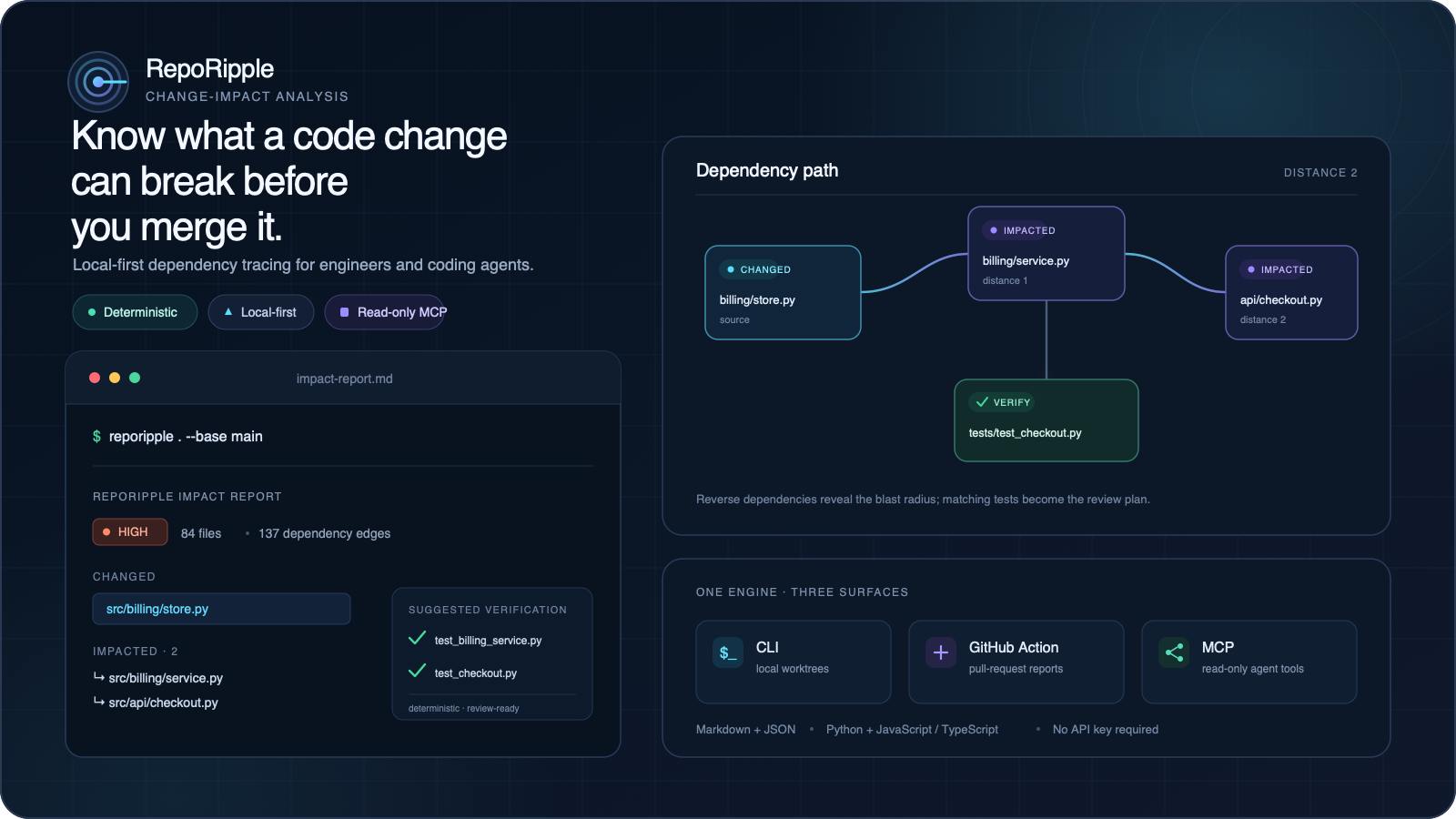
RepoRipple is a local-first change-impact analyzer for engineers and coding agents. It builds a lightweight dependency graph from a repository, reads the current Git diff, traces reverse dependencies, recommends relevant tests, and emits a review-ready Markdown or JSON report.
The deterministic analyzer requires no API key, hosted service, source upload, or framework integration. An optional, explicitly requested OpenRouter explanation can turn its anonymized evidence into a short narrative without changing the underlying analysis.
PyPI · Portfolio case study · MCP setup · v0.2.0 release
Why RepoRipple?
Code graphs explain how a repository is connected. RepoRipple applies that graph to the change in front of you:
- Which files depend on the code I changed?
- How far does the blast radius travel?
- Which tests are most relevant?
- Did I touch authentication, payments, deployment, or another sensitive area?
- Should this pull request be blocked for additional review?
- What structured context should I give a coding agent?
Install and run
Run it once without installing:
Three product surfaces
| Surface | Best for | Output |
|---|---|---|
| CLI | Local review, scripts, and CI gates | Markdown or JSON impact report |
| GitHub Action | Pull-request evidence and risk thresholds | Job summary, artifact, and optional stable PR comment |
| MCP server | Codex, OpenCode, Cursor, Claude Code, and VS Code | Typed forecast_change and analyze_worktree tools |
GitHub Action
Add RepoRipple to a pull-request workflow to create Markdown and JSON impact reports and append the Markdown report to the GitHub job summary:
The Action accepts path, base, max-depth, fail-on, and reports-directory. It outputs
markdown-report, json-report, and risk-level. For reproducible builds, pin RepoRipple to a
release commit SHA and use fetch-depth: 0 so the requested base revision is available.
This repository's own pull-request workflow demonstrates a fork-safe commenting design. Analysis runs with read-only contents access. A separate job updates one stable RepoRipple comment only for branches in the same repository; fork pull requests keep their report in the job summary and downloadable artifact without receiving a write-capable token.
Coding-agent tools (MCP)
RepoRipple can expose the same deterministic analysis to Codex, OpenCode, Cursor, Claude Code, and VS Code over a local, read-only MCP server. From a source checkout:
Launch the published package without a clone:
The server provides forecast_change for proposed edits and analyze_worktree for
actual Git changes. See the
MCP setup guide for
client-specific commands and configuration.
The architecture guide explains how the CLI, GitHub Action, MCP server, and optional explanation layer share one deterministic analysis engine.
Example report
How it works
- Discovers Python, JavaScript, and TypeScript source files.
- Extracts Python imports with the standard-library AST and relative JS/TS imports with a focused parser.
- Builds forward and reverse dependency relationships.
- Gets changed files from an explicit base revision or the local worktree.
- Traverses dependents to a configurable depth.
- Adds test recommendations, documentation reminders, and deterministic risk signals.
The core intentionally avoids LLM scoring. Results stay reproducible, private, fast, and usable in CI. Optional AI explanations can be layered over the JSON output without making correctness depend on a model.
Optional OpenRouter explanation
AI explanation is off by default and is activated only by --explain. The deterministic risk level, evidence, report, and --fail-on exit status remain authoritative even if OpenRouter is unavailable or returns an invalid response.
First inspect the exact key-free body that would leave your machine:
The preview does not read an API key and does not make a network request. When you are satisfied with the payload, provide the key through the environment and explicitly request an explanation:
There is no command-line key option and RepoRipple does not read a key from a file. The integration uses only the Python standard library and applies all of these controls to every request:
- Repository names, paths, source, diffs, scanner-warning text, and user identifiers are not transmitted.
- Files and risk signals become opaque evidence IDs such as
E001; returned IDs are schema-validated and mapped back to labels locally. - The response must satisfy a strict JSON Schema, and unknown evidence IDs or extra fields are rejected.
- OpenRouter routing requires zero data retention (
zdr: true), denies data collection, and selects only providers that support every requested parameter. - Provider prices are capped at $0.25 per million input tokens and $1 per million output tokens, with a 450-token response limit.
- Requests have a 10-second timeout and retry at most once after an explicit retryable HTTP response; ambiguous network timeouts are not retried.
- Token usage and reported request cost are included in Markdown and JSON output.
The pinned default model is openai/gpt-6-luna. Override it with --explain-model or
REPORIPPLE_OPENROUTER_MODEL; privacy, schema, and price controls remain mandatory. Privacy
filters may reduce provider availability, and the request fails closed when no eligible provider
satisfies them. OpenRouter's ZDR policy prevents eligible providers from retaining prompts and
responses after processing; it does not mean the request stays on your machine. See OpenRouter's
structured outputs,
ZDR controls, and
provider routing controls.
CLI reference
When no base or explicit path is supplied, RepoRipple analyzes staged, unstaged, and untracked files. On a clean checkout it falls back to the latest commit.
--explain and --explain-preview are mutually exclusive. With JSON output, either flag returns a wrapper containing deterministic_report plus the explanation or preview; ordinary JSON output is unchanged.
Supported analysis
| Capability | Status |
|---|---|
| Python absolute and relative imports | Supported |
| JavaScript/TypeScript relative imports | Supported |
| Reverse-dependency paths | Supported |
| Test-file recommendations | Supported |
| Markdown and JSON reports | Supported |
| Risk-based CI exit code | Supported |
| MCP tools for coding agents | Supported |
| Privacy-filtered OpenRouter explanations | Optional |
| Monorepo package aliases | Planned |
| Go, Rust, and Java imports | Planned |
| GitHub pull-request reports and comments | Supported |
Development
Privacy and security
RepoRipple's deterministic analysis runs locally and does not transmit repository contents. It
invokes Git using argument arrays rather than a shell and reads only supported, non-symlinked
source files outside common generated and dependency directories. The MCP server constrains every
repository request to its configured --root and exposes read-only tools only. Network access
occurs only when --explain is present; --explain-preview remains fully local so the outbound
body can be audited first.
License
MIT