Register MCP README
The full upstream README, mirrored here for reference. Install config, tool schemas, adoption signals, and an original overview live on the Register MCP listing page.
🇨🇭 Part of the Swiss Public Data MCP Portfolio
register-mcp





MCP Server for the Swiss Federal Commercial Register (Zefix/Handelsregister), with a company-UID join to the official gazettes (SHAB + cantonal Amtsblätter)
Overview
register-mcp provides AI-native access to two Swiss federal data sources, joined on the UID, all without authentication:
| Source | Data | API |
|---|---|---|
| Zefix (Handelsregister) | Swiss companies, legal forms, registered-office data | ZefixREST v1 |
| Amtsblattportal | Everything published about a specific company (by its UID): HR mutations, calls to creditors, bankruptcy | amtsblattportal.ch v1 |
The two sources share one key — the UID. The value is in the join: Zefix tells you whether a company exists; the gazette tells you what has been published about it.
The gazette access here is deliberately company-scoped only — keyed on a company UID or a specific publication id. There is no free-text / person-name gazette search in this server; that would be a profiling tool over the gazette's person-data rubrics (bankruptcy, debt-collection, inheritance). Broad Amtsblatt platform search (procurement, cantonal notices, full-text) is proposed as a separate amtsblatt-mcp — see docs/amtsblatt-mcp-proposal.md and the Data Protection & Scope section below.
Designed for Swiss public administration use cases: vendor verification, contract partner due diligence, and supplier onboarding — all via natural language queries.
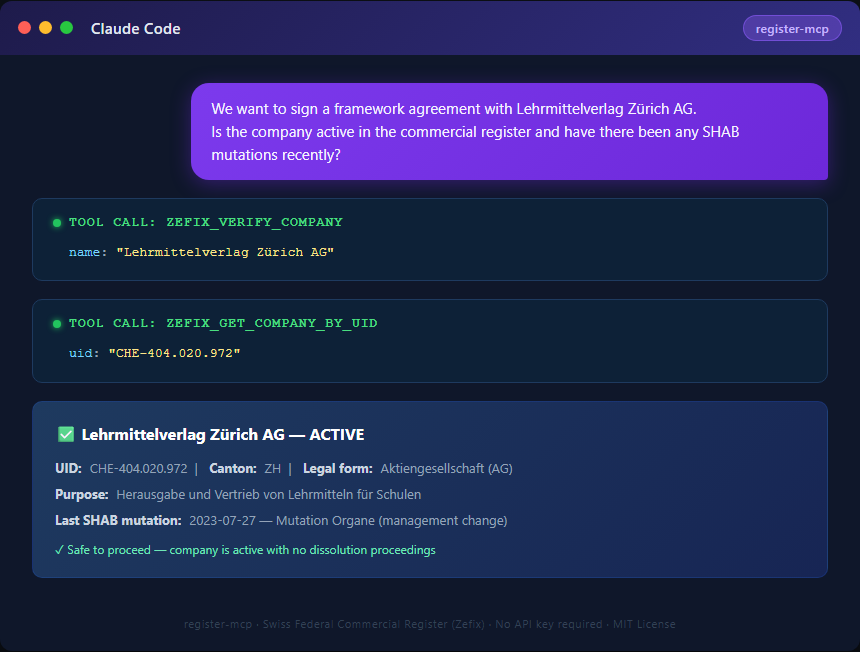
Anchor demo query: "Before we sign a framework agreement with Lehrmittelverlag Zürich AG: is the company active in the commercial register, what is its UID and stated purpose — and, via that UID, what has the official gazette published about it (HR mutations, calls to creditors, any bankruptcy)?"
That single question walks the whole tool chain across both sources:
Features
- 🏛️ 9 tools across two sources — company search & verification (Zefix) + the company-scoped gazette join (SHAB/cantonal)
- 🔗
gazette_company_publications— the UID join: everything published about a company - 🛡️ Data-protection-safe by construction — the only gazette entry points are UID- or id-scoped; no person-name search entry exists (see Data Protection & Scope)
- 🔍
zefix_verify_company— quick active/dissolved status check - 🌐 Bilingual output (Markdown / JSON) with per-source attribution +
provenance - 🔓 No API key required — open data from zefix.admin.ch and amtsblattportal.ch
- ☁️ Dual transport — stdio (Claude Desktop) + SSE (cloud)
Prerequisites
- Python 3.11+
- uv (recommended) or pip
Installation
Or with uvx (no permanent installation):
Quickstart
SSE / Cloud Deployment
When running with MCP_TRANSPORT=sse, the server enforces:
-
Bearer-token auth — set
MCP_API_KEYto a secret string. Clients must sendAuthorization: Bearer <key>on every request. Missing or wrong → HTTP 401. The server refuses to start withoutMCP_API_KEYset. -
Rate limiting — sliding window per bearer-token hash. Defaults: 60 req / 60 s. Tunable via
MCP_RATE_LIMITandMCP_RATE_WINDOW. Exceeding the limit returns HTTP 429 withRetry-After. -
Structured JSON logging — every tool call emits one line to stderr with
tool,status,latency_ms. Auth failures and rate-limit events are logged at WARNING level. Configure verbosity withLOG_LEVEL(defaultINFO). -
Reference-data cache — Zefix legal-forms are cached for 24h (
LEGAL_FORMS_TTLseconds) to avoid an extra upstream call per tool invocation. -
Egress allow-list — outbound HTTP is restricted to
www.zefix.admin.chandamtsblattportal.chvia anhttpxrequest hook that also fires on redirects. ALocationheader pointing elsewhere raisesEgressDeniedand is never followed. Override withMCP_ALLOWED_HOSTS=host1,host2(comma-separated, lower-case).⚠️ Upgrade note (0.2.x → 0.3.0):
amtsblattportal.chwas added to the default allow-list when the gazette tools shipped. If your deployment pinsMCP_ALLOWED_HOSTS, that value overrides the default entirely — addamtsblattportal.chto it, or everygazette_*call will raiseEgressDenied. -
Optional OpenTelemetry tracing — install with
pip install register-mcp[otel]and setOTEL_EXPORTER_OTLP_ENDPOINT(e.g.http://otel-collector:4318/v1/traces). Without the extra or without the env var the server stays silent — no hard dependency on the OTel SDK.
For multi-instance deployments, place a real gateway (Cloudflare, Railway internal networking, an API-Gateway with Redis-backed rate limiting) in front of the in-memory limiter, which is per-process by design.
Container deployment
A minimal multi-stage Dockerfile ships with the repo. The image runs as a
non-root mcp user; dependencies are resolved from uv.lock (uv sync --frozen), so the build is reproducible.
For local iteration there is a compose.yaml with read_only, cap_drop: ALL
and no-new-privileges:
See SECURITY.md for hardening notes (egress restriction, key rotation, SIEM forwarding).
Try it immediately in Claude Desktop:
"Is Lehrmittelverlag Zürich AG active in the commercial register?" "Look up the company with UID CHE-108.954.978" "List all Swiss legal forms"
Configuration
Claude Desktop
Edit ~/Library/Application Support/Claude/claude_desktop_config.json (macOS) or %APPDATA%\Claude\claude_desktop_config.json (Windows):
Or with uvx:
Config file locations:
- macOS:
~/Library/Application Support/Claude/claude_desktop_config.json - Windows:
%APPDATA%\Claude\claude_desktop_config.json
Cloud Deployment (SSE for browser access)
For use via claude.ai in the browser (e.g. on managed workstations without local software):
Render.com (recommended):
- Push/fork the repository to GitHub
- On render.com: New Web Service → connect GitHub repo
- Set start command:
python -m register_mcp.server --http --port 8000 - In claude.ai under Settings → MCP Servers, add:
https://your-app.onrender.com/sse
💡 "stdio for the developer laptop, SSE for the browser."
Available Tools
Zefix — commercial register (6):
| Tool | Description |
|---|---|
zefix_search_companies | Search companies by name, canton, legal form |
zefix_get_company | Full company profile by internal EHRAID |
zefix_get_company_by_uid | Company lookup by UID (CHE-xxx.xxx.xxx) |
zefix_verify_company | Quick active/dissolved status check |
zefix_list_legal_forms | All Swiss legal forms with IDs |
zefix_list_municipalities | Swiss municipalities with BFS IDs |
Amtsblattportal — the company-scoped gazette join (3):
| Tool | Description |
|---|---|
gazette_company_publications | The UID join. All gazette publications for a company UID, newest first, optional (validated) rubric/time filters |
gazette_get_publication | Single publication incl. XML full text, defensively parsed (by publication id) |
gazette_source_status | Reachability of both sources + cache ages (rubrics, legal forms) |
The prefix is gazette_, not shab_, because the source covers SHAB and the cantonal gazettes. Every entry point is UID- or id-scoped — see Data Protection & Scope. Broad, non-company gazette search (procurement, cantonal full-text) is scoped to the separate amtsblatt-mcp.
Example Use Cases
| Query | Tool |
|---|---|
| "Is Lehrmittelverlag Zürich AG active?" | zefix_verify_company |
| "Look up CHE-108.954.978" | zefix_get_company_by_uid |
| "Find companies named Migros in canton ZH" | zefix_search_companies |
| "What has been published about CHE-116.115.052?" | gazette_company_publications |
| "Show the full official text of that HR deletion notice" | gazette_get_publication |
| "Are both data sources reachable right now?" | gazette_source_status |
Architecture
Data Source Characteristics
| Source | Protocol | Coverage | Auth |
|---|---|---|---|
| Zefix | REST/JSON | Swiss companies, legal forms, registered offices | None |
| Amtsblattportal | REST/JSON (list) + XML (full text) | SHAB + cantonal gazettes, 2.79M publications | None |
| ZefixPublicREST (planned) | REST/JSON | Signatories, capital, full history | Basic Auth (free) |
| UID Register (planned) | SOAP | MwSt, NOGA codes, cross-validation | Public (20 req/min) |
The UID join — Zefix ↔ Amtsblatt
The two sources share exactly one key: the UID (CHE-XXX.XXX.XXX). That is
what turns them from two data sets into one workflow.
Two properties of the source shape this path (both verified in
docs/probe-shab.md):
- The bulk list carries no company UID (
meta.uidisnull). The company UID lives only in the single-publication fetch —meta.uidin the single JSON, or<uid>in the XML (which also carries the full text). So the join runs list → per-hit single fetch → match against the Zefix UID. gazette_company_publicationsfilters the corpus byuids=<UID>directly, so in practice you get the company's publications in one call without walking every record.
Procurement lives in the separate amtsblatt-mcp
Public procurement (Submissionen) is not a federal SHAB rubric and is not
covered by this server. It exists only as a cantonal OB-<canton> rubric,
only a few cantons publish it in this portal, and most — including Zürich —
route tenders through simap.ch, a separate platform.
Procurement, cantonal notices, and broad full-text search are scoped to the
proposed amtsblatt-mcp server, which applies
a fail-closed green-rubric allow-list. See that proposal for the full
OB-* coverage map and the rubric traffic-light table.
SB≠ Submissionen.SBis Schuldbetreibungen (debt collection), a person-data-heavy rubric this server never exposes as a search entry.
Data Protection & Scope
This section is not a footnote — it is the reason the server is shaped the way it is.
The Amtsblattportal systematically publishes rubrics containing personal data of
natural persons: bankruptcies (KK), debt-collection (SB), calls to
creditors (LS/SR), inheritance/estate calls (ES, TE-*), and building
applications with owner names. Those publications are public — but making them
systematically queryable by name through an AI agent is a repurposing the
publication never intended, and under the revised Swiss Federal Act on Data
Protection (revDSG) a "show me every debt-collection entry for person X" tool
is a profiling instrument. Deliberate design choices follow:
- No person-based search entry. No tool takes a natural person's name, birth
date or address. The only gazette entry points are keyed on a company UID
(
gazette_company_publications) or an opaque publication id (gazette_get_publication). A firm's own bankruptcy is returned via its UID — that is corporate data about a legal person, not name-based profiling. - No free-text gazette search here.
keywordandcantonsare not even on the internal query-parameter allow-list, so no future code change can smuggle a corpus-wide keyword search in. Broad search lives inamtsblatt-mcpbehind a fail-closed green allow-list (procurement, HR, official notices only). - No persistence of publication content. The server is a pass-through; only the rubric taxonomy and Zefix legal-forms list are cached in memory (24 h). Official publications carry statutory deletion periods — a store that outlived them would actively undermine those periods.
- Fail closed. Rubric codes are validated against the live taxonomy before any call; an unknown code is refused, not silently widened.
The broad-platform counterpart, its green/yellow/red rubric classification and
its fail-closed design are specified in
docs/amtsblatt-mcp-proposal.md.
Architecture decision
ARCH A — live-API-only, consistent with the existing Zefix integration (decided 2026-07-18).
The Amtsblattportal is queried live on every call. All endpoints respond in
0.2–2.0 s, and the use case — targeted company and topic research — does not
need a local bulk copy. A bulk dump would mean mirroring 2.79M records, with an
ongoing sync burden and staleness risk, for no benefit to the join-on-UID
workflow. The taxonomy (/rubrics) and the Zefix legal-forms list are the only
data cached, each for 24h in memory, because they change at most a few times a
year and every filtered call needs them.
Phased Implementation
| Phase | API | Auth | Status |
|---|---|---|---|
| Phase 1 | ZefixREST/api/v1 | None | Current |
| Phase 2 | ZefixPublicREST/api/v1 | Basic Auth (free, email zefix@bj.admin.ch) | Planned |
| Phase 3 | UID-Register SOAP | Public (20 req/min) | Planned |
Phase 2 will add: signatory details, share capital, full historical entries. Phase 3 will add: MwSt status, NOGA industry codes, cross-register validation.
Project Structure
Known Limitations
- Search by canton without a name filter may return API errors (Zefix API limitation)
- Phase 1 Zefix API may be rate-limited under heavy load; retry after a short delay
- ZefixPublicREST (new API) requires registration: email zefix@bj.admin.ch
Amtsblattportal — verified behaviour (live-checked 2026-07-18)
| Call | HTTP | Status | Records | Note |
|---|---|---|---|---|
/publications?publicationStates=PUBLISHED | 200 | OK | 2,790,323 | baseline (full corpus) — never queried unfiltered |
?uids=CHE-116.115.052 | 200 | OK | 4 | the join — core (and only) gazette entry |
?uids=…&rubrics=HR | 200 | OK | – | optional, validated rubric narrowing on the join |
/publications/{id}/xml | 200 | OK | – | full text, rubric-specific schema |
/rubrics | 200 | OK | – | taxonomy (for code validation) |
?rubrics=ZZZZ (invalid) | 200 | Silent Empty | 0, total: null | Quirk 2 |
?uid=… (wrong param name) | 200 | Silent Ignore | 2,790,323 | Quirk 1 |
Free-text (
keyword) and broadcantonssearch are not performed by this server — those probe results live indocs/probe-shab.mdand inform the separateamtsblatt-mcp.
Zefix — verified behaviour (live-checked 2026-08-15)
Found by the weekly live suite, not by the unit tests — which stayed green throughout.
Call to firm/search.json | HTTP | Result |
|---|---|---|
{"name": "Migros", …} | 200 | 35 hits |
| a name with no hits | 404 | NORESULT envelope — not an empty 200 |
{"uid": "109741634", …} | 400 | Bad Request — there is no uid field |
{"name": "CHE-999.999.999", "searchType": "CONTAINS"} | 200 | «CHEMAM - 999», UID CHE-113.593.998 |
a dissolved firm without activeOnly: false | 404 | NORESULT — as if it never existed |
Three shapes, one shipped bug each:
- No hits answer with HTTP 404, carrying the NORESULT envelope. Every call
therefore goes through
_zefix_post_search; a rawraise_for_status()makes the friendly branch unreachable. That is howzefix_verify_companyshipped answering "Eintrag nicht gefunden. Bitte EHRAID oder UID prüfen" to a name search, where neither an EHRAID nor a UID was in play. A fixture that puts the NORESULT body into a 200 makes exactly that dead branch look green. - A hit list is not an answer. UID lookup searches the name field with
searchType: CONTAINS, soCHE-999.999.999returns a real company under a UID that is not its own. Defence: exact digit match or nothing — nofirms[0]fallback. The former fallback produced a complete, plausible, formatted record about somebody else, indistinguishable from a correct answer. - Without
activeOnly: false, "dissolved" looks like "never existed". Zefix returns only active entries by default;zefix_verify_companysets the flag deliberately. A firm with no UID comes back as a string of blanks (uid: " ",uidFormatted: null), not asnull.
Three quirks are defended in code (details in the CHANGELOG under Known findings):
- Quirk 1 — Silent Ignore (critical). Unknown query parameters are dropped
silently and return the full 2.79M corpus with HTTP 200. Defence: query
strings are built exclusively from an
ALLOWED_GAZETTE_PARAMSallow-list, and every filtered response is plausibility-checked — atotalabove 2,000,000 is rejected as "filter ignored by upstream — result not trustworthy". - Quirk 2 — Silent Empty. An invalid rubric code returns HTTP 200 with an
empty result. Defence: the
/rubricstaxonomy is cached 24h and every code is validated before any call, failing with the five closest valid codes. - Quirk 3 — Two-step fetch. The JSON list carries only
meta; the content lives only in the per-rubric namespaced XML. Defence: namespace-agnostic defensive parsing (meta+publicationTextmandatory, HRcompanywhen present, everything else inadditional_fields).
Safety & Limits
Rate Limits
| API | Limit | Notes |
|---|---|---|
| ZefixREST (Phase 1) | Not officially documented | Throttling possible under heavy load — retry after 1–2 s |
| ZefixPublicREST (Phase 2) | Not officially documented | Requires prior registration (free) |
| UID-Register SOAP (Phase 3) | 20 req/min | Hard limit, publicly documented |
Data Privacy
- Read-only access — all tools carry
readOnlyHint: True; the server performs no write, delete, or mutation operations against any API - No person-based search entry — no tool accepts a natural person's name, birth date or address; gazette access is UID- or publication-id-scoped only (see Data Protection & Scope). This is a deliberate revDSG-driven design choice, not an accident of the API
- No persistence of publication content — the server is a stateless pass-through; only the rubric taxonomy and Zefix legal-forms list are cached in memory (24 h), never publication bodies, so statutory deletion periods are respected
- Public register data only — the Zefix Handelsregister is a public federal register (HRegV); gazette data returned is likewise legally public, retrieved per company UID
- No personal tracking — the server does not transmit user identity, query history, or session data to the upstream sources
Terms of Service & Data Sources
- Zefix API ToS: Usage of the Zefix REST API is governed by the zefix.admin.ch terms of use. The data is published under the Open Government Data (OGD) Switzerland principles.
- SHAB: Swiss Official Gazette of Commerce — published by the Federal Chancellery (BK). Public by law.
- Institutional use: This server is designed for read-only queries in public administration workflows. Not suitable for mass harvesting or automated surveillance use cases.
Security
- No credentials are stored or transmitted (Phase 1)
- Phase 2 credentials (
ZEFIX_USER,ZEFIX_PASSWORD) are passed via environment variables only — never hardcoded - All HTTP calls use HTTPS exclusively
- Tool inputs are validated via Pydantic v2 before any API call is made
Demo
📽️ Terminal GIF coming soon — see
docs/demo/to generate it locally with vhs
Example interaction:
→ More use cases by audience →
To generate the demo GIF locally:
MCP Protocol Version
This server speaks two protocol eras over the same endpoint. The client's first request on a connection decides which one applies; a later claim from the other era is refused.
| Era | Revision | Who reaches it |
|---|---|---|
initialize handshake | 2024-11-05 … 2025-11-25 | What today's clients speak. The server answers with the revision asked for, or with the 2025-11-25 ceiling when the request asks for something newer. |
| Per-request envelope | 2026-07-28 | A request carrying the 2026-07-28 _meta envelope opens a modern connection. |
Both revisions are pinned in
tests/test_protocol_version.py and asserted
against the installed SDK, so a Dependabot bump of mcp cannot move either one
silently. This server builds no ASGI app to send an initialize through, so
the gate asserts the SDK constants rather than a measured response — the
weaker form, named rather than left unsaid.
Note that the SDK's LATEST_PROTOCOL_VERSION is an alias for the modern
era, not for the handshake era — pinning against it alone would leave the era
that current clients actually negotiate free to drift.
Update policy. When the gate fails, do not edit the constant blindly: read
the spec changelog between the two revisions, verify the server still behaves,
then move the constant, this section, README.de.md and
CHANGELOG.md together.
Testing
The unit-test payloads are recorded, not invented. Source, retrieval date,
selection rule, redaction and SHA-256 per file are in
tests/fixtures/PROVENANCE.md.
Two things are stated there rather than papered over. Personal data: the
gazette carries debt-collection notices and Zefix carries the full SHAB text
naming registered persons with their place of residence — the recorded payloads
keep the shape and redact those values, with the complete list of redacted
fields alongside. Zefix needs no credentials: until 2026-08-08 this
repository recorded no Zefix fixtures because the recording script measured
HTTP 401. The measurement was right about the wrong address — the script asked
ZefixPublicREST, while the server speaks to ZefixREST, which answers with no
authentication at all.
The live suite
ci.yml runs -m "not live": a foreign 503 must not redden a stranger's pull
request, because a suite that does gets switched off, and a switched-off suite
checks nothing. The exclusion has a safety net —
.github/workflows/live-tests.yml runs
weekly (cron: "31 5 * * 1") plus workflow_dispatch.
The verdict is read from the JUnit XML rather than the exit code, by
scripts/classify_live_run.py, because a live
run has three answers and not two:
| State | Meaning | Issue |
|---|---|---|
clear | the suite ran and was green | closes an open one |
finding | the suite ran and something fell | opens or updates one |
unknown | the suite did not run — failed install, timeout, renamed marker, everything skipped | left untouched |
tests - skipped == 0 is unknown, not clear: pytest exits 0 when every test
was skipped, and a job that books that as green closes an issue on a comparison
that never happened.
One caveat when editing that workflow: the pull-request checks do not cover
it — it has no push or pull_request trigger, so a green PR says nothing about
it. Verify changes with a manual workflow_dispatch run on the branch before
merging.
Changelog
See CHANGELOG.md
Contributing
See CONTRIBUTING.md
Security
See SECURITY.md (Deutsch) for the security posture and how to report a vulnerability.
License
MIT License — see LICENSE
Author
Hayal Oezkan · malkreide
Credits & Related Projects
- Zefix: zefix.admin.ch — Swiss Federal Commercial Register (BJ/FOJ)
- Amtsblattportal: amtsblattportal.ch — SHAB and cantonal gazettes (SECO / Swiss Confederation)
- Protocol: Model Context Protocol — Anthropic / Linux Foundation
- Related: fedlex-mcp — Commercial register ordinance (HRegV)
- Related: zurich-opendata-mcp — Company seat + geodata
- Related: swiss-statistics-mcp — Industry statistics by NOGA
- Related: swiss-snb-mcp — Economic indicators
- Portfolio: Swiss Public Data MCP Portfolio
Installation
Run via uv's uvx — no clone or manual install needed. Add to your MCP client config (mcpServers for Claude Desktop, Cursor and Windsurf; use a top-level servers key for VS Code in .vscode/mcp.json):