REAPER MCP server: let Claude read your session, set FX, write automation and measure mix moves.
Quick Install
Automated & IDE SetupCopy the AI prompt to install this server into Claude Code, Cursor, or another agent — or use 1-click editor setup below.
One-click editor setup isn’t available for this listing yet — we don’t have a confirmed install command, and we’d rather show nothing than point your editor at the wrong package or host. Follow the project’s own setup instructions, linked above.
Manual Client & Custom JSON ConfigExpand JSON ▾
No confirmed setup config for this listing yet. We only publish a config block when the install details come from the project itself — its README, its docs, or a verified owner. We haven’t found those for Reaper Daemon, and we’d rather show nothing than a guess you’d paste into your client. Follow the project’s own setup instructions for the current steps.
Documentation Overview
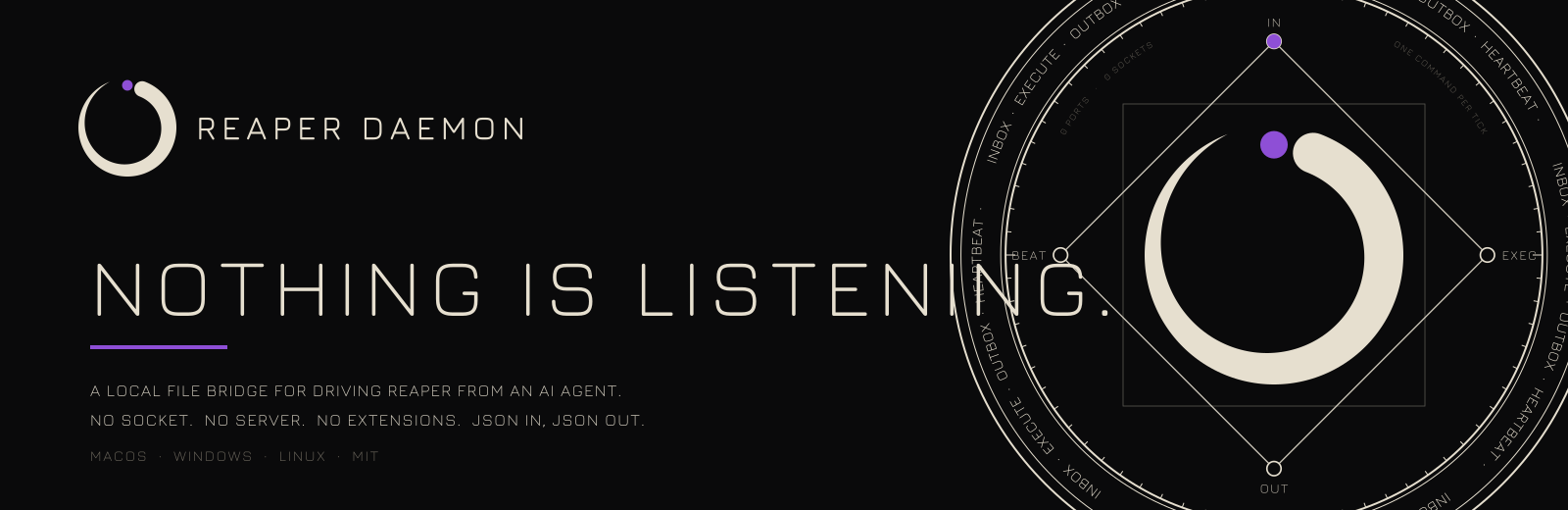
Reaper Daemon

Reaper Daemon is a REAPER MCP server and file bridge for driving REAPER from an AI agent, including mixing your session with Claude or any other agent. No network socket, no port, no extensions.
The agent drops a JSON command file in a folder. A Lua script inside REAPER
runs it and writes a JSON result back. That's the whole protocol. It works
with Claude Code, Codex, Cursor, or anything else that can read and write
files, and an optional stdio MCP server, reaper_mcp.py, exposes the same
bridge as tools for Claude Desktop and any other MCP client.
macOS, Windows, Linux. Pure Lua inside REAPER, plain Python 3 outside, no pip packages for the core bridge and MCP server. Audio-to-drum MIDI transcription uses a separate optional model environment. Every change runs inside a REAPER undo block, so Ctrl+Z reverts anything an agent does.
Install
Restart REAPER, then check the bridge is alive:
Prefer ReaPack, or want to load the bridge by hand? See docs/install.md.
Claude plugin
The repository is also a Claude plugin. It bundles the MCP server with four skills: drum programming, drum humanizing, guitar and bass parts, and MIDI for an existing arrangement. The plugin drives the install above, so clone and run the installer first.
When you add the plugin, Claude asks for two settings:
- Reaper Daemon folder: where you cloned it. Default
~/reaper-daemon. - Python command: default
python3. On Windows, usepythonorpyifpython3isn't on your PATH.
Cowork doesn't ask, so it uses those defaults. To try the plugin in Claude Code straight from your clone:
The MCP server runs on your computer, next to REAPER. It works in Claude Code and in Cowork sessions on your machine. Chat on claude.ai loads the skills but can't reach REAPER.
Mix with an AI agent
Point Claude, or any agent talking to Reaper Daemon, at your open REAPER
session and ask it to work on the mix. It reads every plugin and parameter
with scan_fx, sets FX values in real units like "-2.5 dB", and writes
automation. verify_change captures the track before and after a move and
reports what changed in the audio, so you are not taking its word for it.
Every move sits inside a REAPER undo block, and your ears make the call.
Example prompts:
- "The bass is muddy around 300 Hz, pull it down."
- "Bring the vocal down so it sits with the mix instead of on top."
- "Tune the bass until its LUFS is down 3 dB."
- "What plugins are on the drum bus, and what are they set to?"
See MCP server for setup and Verify for what the measurements do and do not prove.
What it does
| Area | Commands |
|---|---|
| Project | transport, tempo, cursor, time selection, render, save |
| Tracks | add, delete, rename, select, volume, pan, mute, solo, arm, color |
| Routing | read sends and receives, create sends, toggle master feed |
| FX | add, remove, bypass, reorder, set parameters, write automation, save chains |
| Markers, regions, media items | full read and write |
| MIDI | insert MIDI files, plus a drum DSL with humanization |
| Transcription | turn an audio item into drum MIDI with an optional local analysis runtime |
| Guitar and bass | shred renders a humanized riff, band cuts a whole rhythm section |
| Discovery | scan_fx dumps every plugin and parameter; discover_drum_map reads any kit's note map |
| Verify | measure loudness, spectrum and dynamics before and after a mix move |
The bridge knows nothing about any specific plugin or drum library. Agents discover what a project contains and act on it by name.
Three ways to talk to it
CLI. One Python entry point for everything an agent does.
MCP server. reaper_mcp.py wraps the bridge as tools over stdio.
Ask Claude Desktop to "measure the drums" and it does.

Daemon Console. A chat panel docked inside REAPER, backed by a headless Claude Code session that always knows which track you have selected.
Docs
| Install | one-line installer, ReaPack, manual load |
| CLI | reaperd.py reference |
| MCP server | setup for Claude Desktop and other clients |
| Daemon Console | the in-REAPER chat panel |
| Drums | kit discovery, stem profiling, humanize |
| Drum workshop | separate composition briefs, MIDI comparisons, scoped audition feedback |
| Drum transcription | audio to MIDI, background jobs, kit mapping |
| Guitar and bass | shred and band |
| Mix recipes | capture, compare and rebuild a mix setup |
| Verify | closed-loop mix moves with measured proof |
| Protocol | the file wire format |
| Troubleshooting | silent captures, stale heartbeats |
| Security | trust model and the optional token |
| Develop | tests, CI, repo layout |
Agents should read AGENTS.md, CLAUDE.md, and bridge/command_schema.md. Two bundled skills, arrangement-midi and drum-humanize, cover MIDI composition and drum humanization.
Security
Any process that can write to inbox/ can drive REAPER. Keep the bridge
folder local and off shared drives. Details in docs/security.md.
What it runs and sends
Everything runs on your machine. The MCP server and CLI are plain Python with no network calls. The bridge is a Lua script inside REAPER. It trades JSON files with the server through the Reaper Daemon folder, which also holds logs and the MIDI files it generates. Renders and captures write audio files only if you turn on audio writes, which are off by default. Nothing leaves your computer.
Three optional pieces do more, and only if you install them:
- Drum transcription downloads its Python packages and model weights during setup, and Demucs downloads its weights on the first separation job. Audio stays local.
analyze_trackandcompare_tracksrun Post Mortem from your PATH.- The Daemon Console starts a Claude Code session on your machine, which talks to Anthropic like any Claude Code session.
License
MIT. See LICENSE.
Keyboard performance setup, MIDI/controller tests and template saving are documented in the performance workflow.
Related MCP Servers
Reviews
No reviews yet — be the first to share how this listing worked for you.
Frequently Asked Questions about Reaper Daemon
AllMCPs Directory Badge
Showcase your server listing on GitHub or your project documentation. Embed this dynamic SVG badge to highlight official listing status and live engagement.
Badge Style:
Live Dynamic SVG Preview
Markdown (GitHub README)
[](https://allmcps.com/mcp/reaper-daemon)HTML Embed
<a href="https://allmcps.com/mcp/reaper-daemon"><img src="https://allmcps.com/api/badge/reaper-daemon?style=directory" alt="Reaper Daemon on AllMCPs" /></a>Technical Specs & Signals
CategoryDeveloper Tools
27Quality signal: Emerging · 27/100How this signal is calculated ▾
Server availabilityNot measured
Not scored for repo-hosted servers — we can't reach the running server, only its GitHub page. Hosted MCP endpoints are health-checked live.
Verified ownership8/20
Documentation & tools11/30
Adoption & activity1/15
Community engagement0/10
A guidance signal from public completeness & health data — not a user rating. New listings start lower and rise as they add docs, get verified, and grow adoption. Signals we can't observe for a listing are skipped, not counted against it.
Own this project?
This directory is pre-filled from public sources. Claim via GitHub README, site badge, or DNS TXT to unlock edit access and the Official badge — proof is checked automatically, then reviewed by our team.
Free dofollow backlink: add your website and place the AllMCPs badge on it — no claim needed. We detect it automatically and keep it verified as long as the badge stays live.
Claim & get free dofollowShare & Embed
Add our SVG badge (dark/light directory styles) or embeddable widget to your site.