Local knowledge graph memory for agents. SHACL rules refuse bad facts; SPARQL and time travel.
Quick Install
Automated & IDE SetupCopy the AI prompt to install this server into Claude Code, Cursor, or another agent — or use 1-click editor setup below.
One-click editor setup isn’t available for this listing yet — we don’t have a confirmed install command, and we’d rather show nothing than point your editor at the wrong package or host. Follow the project’s own setup instructions, linked above.
Manual Client & Custom JSON ConfigExpand JSON ▾
No confirmed setup config for this listing yet. We only publish a config block when the install details come from the project itself — its README, its docs, or a verified owner. We haven’t found those for Quipu, and we’d rather show nothing than a guess you’d paste into your client. Follow the project’s own setup instructions for the current steps.
Documentation Overview
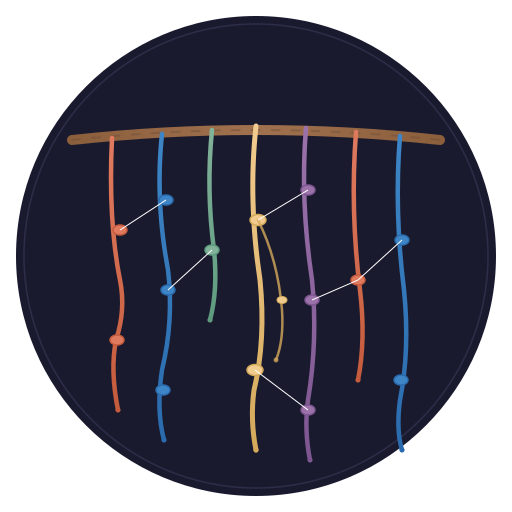
quipu
🪢 A memory for your agents that refuses facts that break your rules


Quipu is a knowledge graph for AI coding agents and the people who run them. It stores what your agents learn as facts, checks every write against rules you declare (SHACL shapes), and refuses the facts that break them, so bad knowledge never gets in. It keeps every version of every fact, so you can ask what was true last Tuesday, and it answers standard SPARQL 1.1. It comes as a command-line tool, a REST server, and a Rust library, and agents reach it through bobbin's MCP server.
A quipu is the Andean knotted-cord record: cords are entities, knots are facts.
Why you would want it
- Bad facts are refused, not cleaned up later. A write that breaks a shape fails with the rule it broke, so an agent can correct it on the spot.
- Nothing is overwritten. Every fact carries when it was recorded and when it was true, so you can query the graph as it was at any moment.
- Standard, and measured. It passes all Working Group–approved W3C SPARQL 1.1 Query, Update, Protocol and Results tests, scored alongside other stores in the conformance report.
The long form (sharing between stores, the feature list, the architecture and a comparison): Why Quipu.
Install
Linux x86_64: download the checksummed release.
Anywhere else, build from source (needs a Rust toolchain):
The crate is quipu-ai; it installs quipu and quipu-server, plus two test
utilities (quipu-shacl-conformance, seed-fixtures) you can ignore.
Check it:
If that prints an older version, another copy is earlier on your PATH:
which -a quipu.
First success in three commands
Write a rule (every Person needs a name), two people who follow it, and one
who does not:
Then load the good facts, ask a question, and try the bad one:
The last command exits 1 and writes nothing: Carol breaks the rule, so she never enters the graph. That refusal at write time, with the reason attached, is what Quipu is for.
On your own data
| you want to | run |
|---|---|
| load Turtle, checked against your shapes | quipu knot <file.ttl> --shapes <shapes.ttl> |
| ask a SPARQL question | quipu read '<sparql>' |
| see the graph as it was on a date | quipu read '<sparql>' --valid-at 2026-09-01 |
| see what depends on an entity | quipu impact <entity-IRI> |
| keep shapes in the store, so every write is checked | quipu shapes load <name> <shapes.ttl> |
| explore it in a browser, or over HTTP | quipu-server --db <file> --bind 127.0.0.1:3030 |
Every command and flag: CLI reference. The HTTP endpoints: REST API.
Wire it into your agent
Agents can connect directly: quipu-server serves streamable HTTP at /mcp, and
quipu mcp --db store.db provides stdio using the companion server binary.
Build both with cargo build --release --features full. Protected stdio writes use
--mcp-token-file /path/to/private-token; HTTP writes use the existing bearer policy.
Quipu defines 46 MCP tools (48 with owl), from one shared schema manifest.
Bobbin's knowledge_* tools and existing REST-backed proxies remain compatible.
See the connection and authentication guide.
No binaries? Quipu is in the MCP Registry,
so VS Code's @mcp Extensions search (and other registry-aware clients) can
install it in one click. That runs the published image, which needs Docker and
nothing else:
The graph lives at /data/quipu.db in the quipu-data volume, so it survives
restarts and starts empty. Change the volume name in your client's MCP config to
keep one graph per project.
- MCP Registry name:
mcp-name: io.github.scbrown/quipu
Setup and every tool: bobbin's Quipu integration guide and Quipu's MCP tools reference. Any other client can use the REST API directly.
Before you start
Platforms. The release is built for Linux x86_64. On macOS and anywhere else, build from source; it needs a Rust toolchain and nothing else.
What each build includes. quipu needs the shacl feature and
quipu-server needs shacl, onnx and server. --features full, as in the
source install above, turns on all of them. The feature list:
Installation.
What's next
- The Quipu book: concepts, tutorials and reference, in reading order
- Docs map: every design note and document in this repository, routed
- Quick Start: the library, the REST server and the reasoner, step by step
🧺 The stack
Caboodle installs these together and proves each one works; every tool also stands alone.
| tool | what it gives your agents |
|---|---|
| caboodle | one wizard that installs the stack and proves it works |
| quipu (you are here) | a knowledge graph that refuses facts that break its rules |
| camayoc | the starter vocabulary, and how new knowledge earns its way in |
| bobbin | search and context over your repositories, served over MCP |
| yupana | which code calls which: the blast radius before an edit |
| desire-path | the tool calls your agents get wrong, so you can fix them |
Contributing
See RELEASING.md for how a release is cut.
📜 License
Related MCP Servers
Reviews
No reviews yet — be the first to share how this listing worked for you.
Frequently Asked Questions about Quipu
AllMCPs Directory Badge
Showcase your server listing on GitHub or your project documentation. Embed this dynamic SVG badge to highlight official listing status and live engagement.
Badge Style:
Live Dynamic SVG Preview
Markdown (GitHub README)
[](https://allmcps.com/mcp/quipu)HTML Embed
<a href="https://allmcps.com/mcp/quipu"><img src="https://allmcps.com/api/badge/quipu?style=directory" alt="Quipu on AllMCPs" /></a>