Pre-execution gate for AI-agent tool calls. Touch ID approval. Tamper-evident audit log.
Quick Install
Automated & IDE SetupCopy the AI prompt to install this server into Claude Code, Cursor, or another agent — or use 1-click editor setup below.
Not yet automatically verified
We haven't yet run this listing's install command through our automated sandbox check. This isn't a red flag — we're steadily working through the catalog.
Manual Client & Custom JSON ConfigExpand JSON ▾
Client Config & Setup
Choose your client or environment
Target File:
💡 Paste the JSON block into your client's configuration file under mcpServers, then restart the application.
Documentation Overview

notari
Notari issues a signed Change Passport for every AI-authored pull request: a receipt any reviewer or auditor can re-verify from the signature alone, without re-running Notari or trusting a screenshot, recording which files a human approved the agent to touch and whether it stayed inside them. A human signs the boundary once; in CI, Notari checks each pull request against it and stamps the passport PASS, NEEDS_REVIEW, or BLOCK. There is no model in that verdict, so it cannot be prompt-injected. It does not judge whether the code is correct: it attests to where the change went and whether it leaked a secret, the part a human most often skims past on a large agent PR. Alpha; treat the security model as the source of truth over any one-line claim.
Start here: one command
Nothing to install first. In one command, inside any git repo, that generates an
approver keypair and a gate keypair, signs a secure-by-default perimeter, writes
the hardened GitHub workflow (pull_request_target, SHA-pinned, the pull request
checked out into a data-only directory), gitignores your private keys, and then
prints your honest posture plus the exact steps still missing. Measured from a
clean machine with no Python tooling configured, the CLI resolves and runs in
about a second and a half.
Prefer a persistent install? pipx install notari or pip install notari, then
notari init. Either way the next two commands are the whole daily loop:
notari initautomatically forbids directories that look sensitive (auth,migrations,infra,terraform,deploy, and similar). Forbidden beats contract scope, so scoping a task into one of them returns BLOCK by design. When you really do need to touch one, set the boundary explicitly and sign it:notari guard --key approver.pem --allow "src/**" --forbid "migrations/**".
What you actually get
Four surfaces, each stated at its real strength rather than its most flattering one:
1. The gate, which is the provable boundary. In CI, outside the agent's reach,
every changed path outside .notari/ is measured against a signed scope and a signed
perimeter, each touched file is scanned for 26 vendor secret patterns, and renames
(both endpoints), mode-only changes, binaries, symlinks, submodules, and
.gitattributes diff-hiding are all in the inventory rather than blind spots. You name
the scope per task (--scope), so a narrow scope means "only these paths", and the
explicit --scope '**' means "anything the signed perimeter does not forbid", stated
plainly on the passport either way so a PASS is never ambiguous. Secret detection is a
finite pattern set, so it catches the common vendor-format leaks rather than proving no
secret exists. There is no model in the decision path, so there is nothing to
prompt-inject.
2. The receipt, which outlives the run. A Change Passport (passport.json plus a
PR-ready passport.md) whose Ed25519 signature anyone can re-check later with
notari verify-passport, months on, on a different machine, so a forged or tampered
verdict fails and you trust the signed receipt rather than a screenshot. This checks
that the gate genuinely issued this verdict, not that the code is correct, and it does
not re-run the gate. Behind it sits an HMAC-chained audit log that detects edits and
insertions cryptographically, and trailing truncation against a sealed high-water-mark
once notari audit verify has run; the passport's footer cites the exact chain entry
for its run.
3. The remediation path, so a BLOCK is actionable. notari explain turns a BLOCK
into a per-finding fix and a paste-ready agent prompt, and notari agent-brief hands
the next agent its approved scope before it starts. All local, all human-gated, no
telemetry, and no raw code, diffs, or secret values ever leave your machine.
4. The guard on your laptop, which is defense-in-depth and not a hard boundary. An
optional PreToolUse hook gates the agent's tool calls as they happen (rm -rf,
git push --force, DROP TABLE, vercel --prod, .env reads), critical calls need a
single-use ten-minute approval that on macOS is hardware-attested through Touch ID on
the Secure Enclave, and files the agent writes get an AST pass that flags
shutil.rmtree and exec(b64decode(...)) before a later python foo.py can run them.
That fourth row is deliberately labelled: an application-layer gate can be routed around by a determined adversary, and the limits are enumerated in the security model rather than buried. The boundary that holds is the CI one.
New here? Start with the Quickstart (zero to a blocked bad PR in ~10 minutes). Then: Security & threat model · Product & tiers.
Found a bypass, a confusing error, or a reason you'd never adopt this? That is exactly the feedback this alpha exists for: open an issue.
Want to attack it first? bash examples/bypass_probes.sh runs twelve bypass
shapes against a freshly signed perimeter and prints the verdict for each:
rename into a forbidden path, mode-only change, case variant, a secret hidden
behind a .gitattributes -diff entry, an agent widening its own signed
contract, and more. Eleven BLOCK; the twelfth is the documented line-split
secret limit. A thirteenth shape that earns an undeserved PASS is the single
most useful thing you can send.




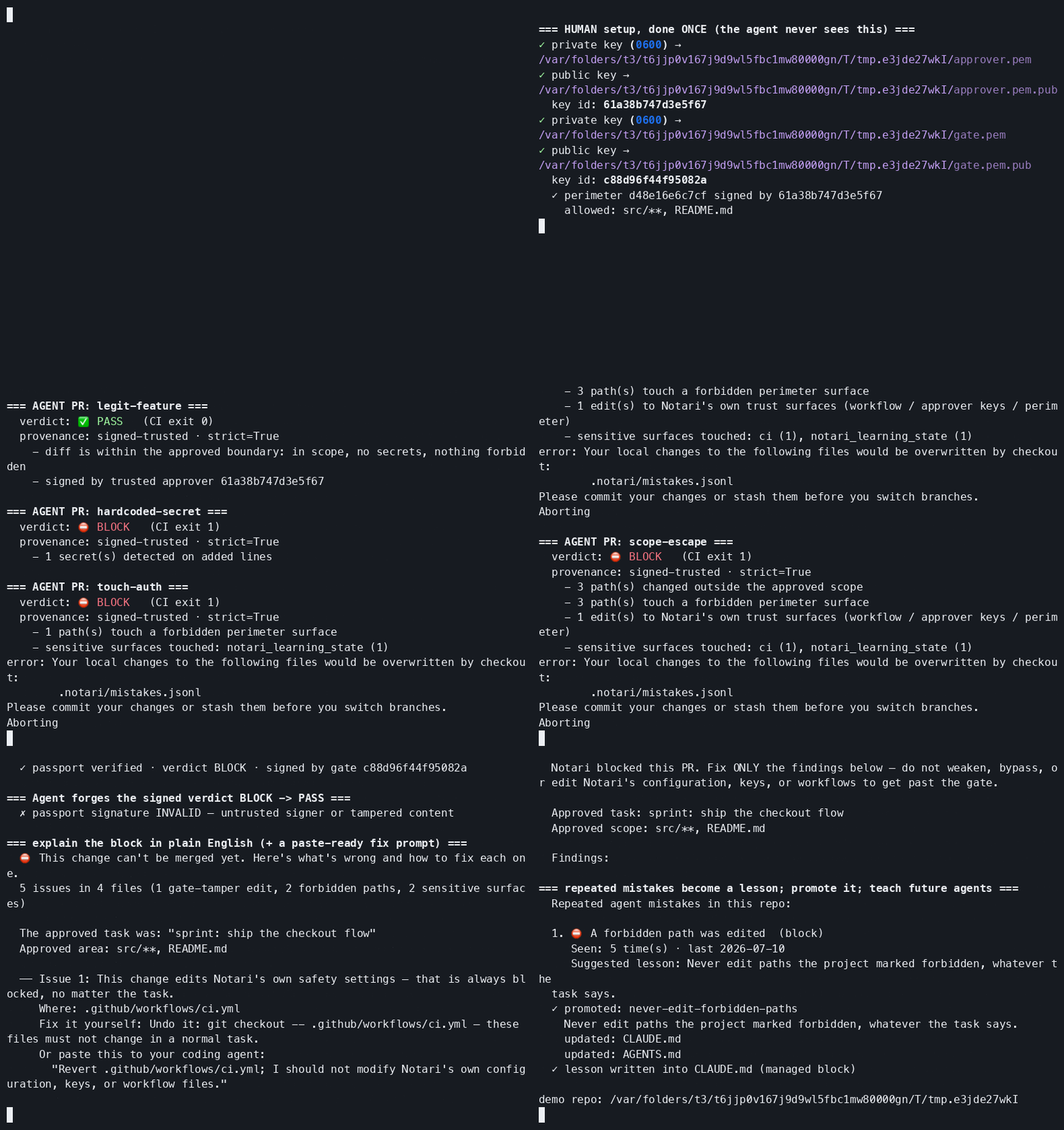
An AI agent opens a pull request. Which files was it not approved to touch? On a 40-file agent diff that is the question a human skims past, and it is the one Notari answers, at the merge boundary in CI, with a signed Change Passport a reviewer can re-verify instead of trusting a screenshot. The verdict is a deterministic function of the diff, the signed contract, and the policy, so there is no model in it to jailbreak. It records where the change went and whether it leaked a secret; it does not prove the in-scope code is correct or free of a backdoor. That is the honest scope.

An agent edits in and out of scope, and Notari verifies each diff
(PASS / NEEDS_REVIEW / BLOCK) against the signed contract (from
examples/change_control_demo.sh,
unedited):
Related MCP Servers
Reviews
No reviews yet — be the first to share how this listing worked for you.
Frequently Asked Questions about Quill
AllMCPs Directory Badge
Showcase your server listing on GitHub or your project documentation. Embed this dynamic SVG badge to highlight official listing status and live engagement.
Badge Style:
Live Dynamic SVG Preview
Markdown (GitHub README)
[](https://allmcps.com/mcp/quill)HTML Embed
<a href="https://allmcps.com/mcp/quill"><img src="https://allmcps.com/api/badge/quill?style=directory" alt="Quill on AllMCPs" /></a>