Quartermaster README
The full upstream README, mirrored here for reference. Install config, tool schemas, adoption signals, and an original overview live on the Quartermaster listing page.
Quartermaster





-purple)





This project started because I wanted to prototype a dam.
Nothing serious — a short demo, maybe more if it worked out. Before building anything, I wanted to see what I already owned that could speed it up. So I searched my library for "dam": nothing came back. Of course nothing came back — no asset is called a dam. But spread across four packages I already owned were curved concrete meshes, a water system, some rocky terrain. Everything the dam needed. I'd had most of it for years and never once connected the pieces.
That's what ~1,500 assets across two stores did to me when this started — a library that has since grown past 7,500 assets across five ecosystems. Almost all of it from bundles and sales, none of it remembered. And it's not just me — no AI assistant knows either. Ask one for help and it either builds everything from scratch or sends you shopping, while hundreds of dollars of exactly-the-right-thing sits on your disk.
Quartermaster indexes everything you own across the Unity Asset Store, Fab, Quixel Megascans, Gumroad and Leartes Cosmos — locally, on your machine — and serves it to your coding agent over MCP. It's the tool I wished existed that day: ask about a dam, get told you already own curved concrete meshes.
Every result is something you own or can claim free — nothing is invented.
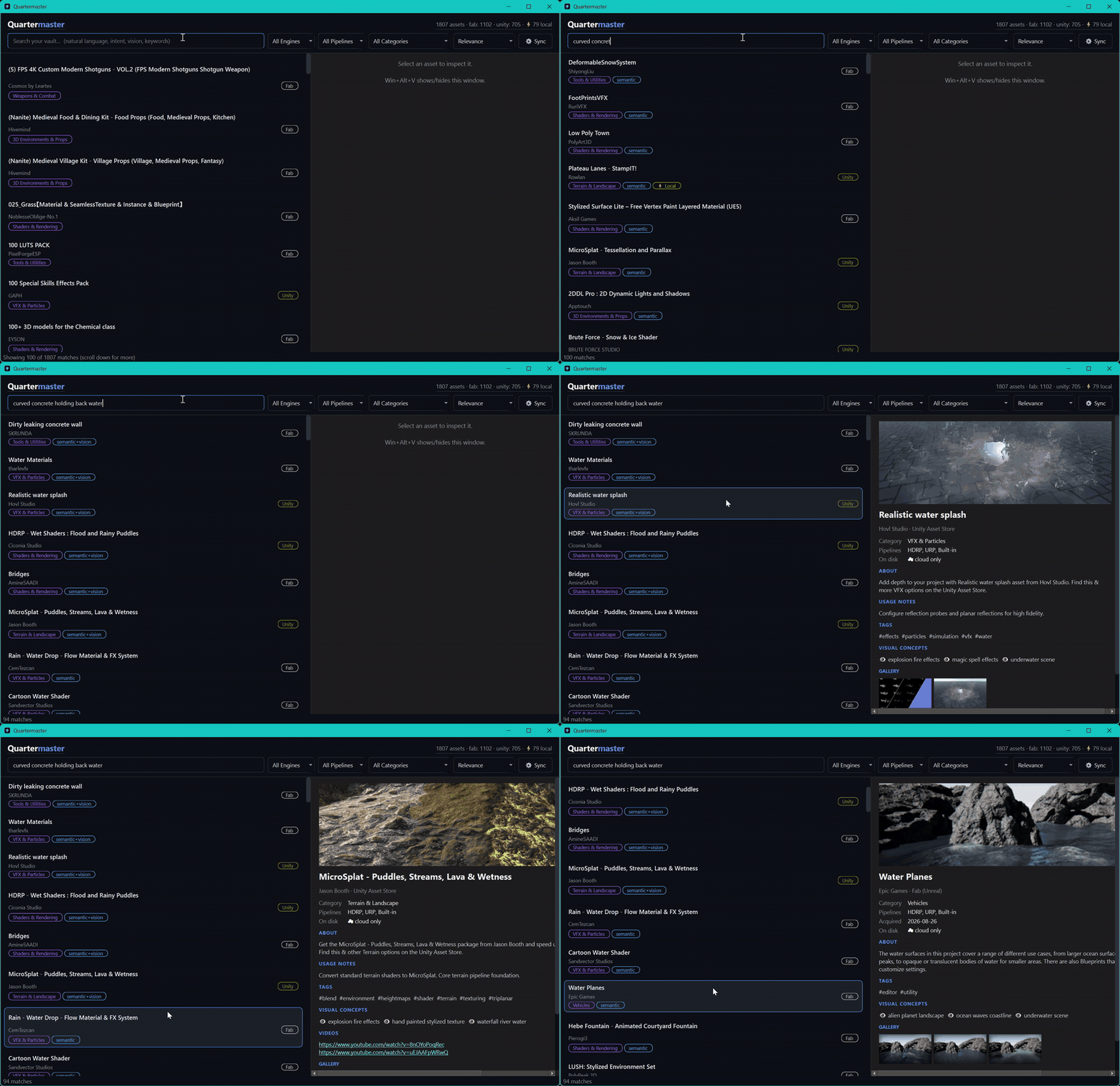
Typing a description, not a name — none of those results share a word with the query.
Why Quartermaster? A quartermaster's job was never remembering what's in stores — it's making sure you're equipped when it's time to move. That's nearer the real problem than forgetting is. I hadn't lost anything; I knew I owned stuff. What I couldn't do was get from "I want to prototype a dam" to "open these four packages" without an hour of digging first — and maybe more if it worked out doesn't survive an hour of digging. Ideas that arrive that way don't get rejected. They just quietly don't happen, and you never find out whether they would have.
What it indexes
| Source | What comes in | How |
|---|---|---|
| Unity Asset Store | Owned packages, descriptions, gallery art | Authenticated harvest |
| Fab (Epic) | Owned Unreal and Unity listings | Authenticated harvest |
| Quixel Megascans / Megaplants | The catalog, with texel density, scan area and map lists | Public catalog sync |
| Gumroad | Owned products | Authenticated harvest |
| Leartes Cosmos | Owned and claimable Cosmos inventory, with deep screenshot galleries (18 on average, up to 71) | Authenticated harvest |
Everything lands in one SQLite table behind one search surface, so a query crosses all of them at once. Nothing is engine-scoped: a Megascans surface and a Unity shader come back from the same question if they both answer it.
The part nobody tells you
Neither store will admit what you own.
Unity removed /account/purchases (404 since August 2026). Fab has no ownership API, no export button, nothing. Your purchase history exists only inside their private GraphQL, behind SSO, MFA, and bot detection.
Getting at it took four attempts, three of them failures:
- Playwright's bundled Chromium — Epic's captcha refuses it outright ("enable JavaScript").
- Playwright driving your real browser — injects detectable hooks; Epic throws a second security wall after the password.
- Debugger attached during sign-in — same result. Anything touching the login flow gets flagged.
- What actually works: stop automating the sign-in entirely. You log in through an ordinary browser window — no debug port, nothing between you and the store — because the automation was itself what tripped the risk systems. Only after you're done, on a session you established yourself, does Quartermaster attach a debugger and replay the store's own paginated queries — with its own CSRF headers, its own chunking (42 IDs per request, because that's what Unity's client sends).
That trick is most of this project. The rest — search, linting, unpacking — is honestly straightforward by comparison.
Two hard-won rules baked into the design, if you ever hack on this yourself:
- Browsers must close gracefully (
taskkillwithout/F). An abrupt kill loses Unity's device-trust cookie and you'll get MFA-challenged on every future session. - Never run a library fetch headless. Headless triggers Unity's risk system even with valid cookies.
Quixel Megascans, and why your Fab library looks short
Fab's library view and the Megascans catalog are not the same list, and there is no export that reconciles them — you can hold rights to far more Megascans content than your library page displays. Whatever the cause, the practical result is the same: scrolling and hand-searching for something you already have.
Quartermaster sidesteps it. It syncs the Quixel Megascans and Quixel Megaplants seller catalogs from Fab directly — 5,580 listings as of this writing — independently of what your library view shows, and files them next to everything else you own, tagged by status:
vault_owned— in your librarycatalog_grant— claimable free under the Epic Content License, not yet acquired
Both are searchable, and every result says which it is, so an agent can tell "you own this" from "you can have this for nothing" without guessing.
Megascans rows also carry their physical specs where the listing publishes them — texel density, scan area, and the map list (basecolor, normal, displacement, cavity, AO, roughness…). That is the difference between an agent telling you it found a rock and an agent telling you it found a 1×1 m scan at 8192 px/m with displacement — which is the part that decides whether it's usable.
What you get
Search that understands intent & vision. This is the dam problem.
- Exact keywords via SQLite FTS5.
- Natural language intent via local ONNX text embeddings (
BAAI/bge-small-en-v1.5) — "concrete structures for holding back water" surfaces meshes and shaders whose listings never mention dams. - Cross-modal visual understanding via ONNX CLIP embeddings (
Qdrant/clip-ViT-B-32) — searching "gothic cathedral" literally scores your screenshots and promo renders, finding assets even when their text descriptions are completely silent. A visual hit also hands back which screenshot matched, not just the cover art. - Every result shows its working. Each hit carries a
matchfield —keyword,semantic+vision,keyword+semantic+vision— so you and your agent can see which signal fired. A pure-vision hit on a listing with useless marketing copy is a different kind of result than an exact title match, and it should be legible as one. - Concept tags mined from screenshots. The offline vision pass scores every gallery image against a visual vocabulary and writes the survivors back into the FTS index, so "medieval village" and "dark horror atmosphere" become keyword-searchable on assets whose descriptions never said either. The vocabulary is a JSON file you can replace — see
docs/concepts.md. All three signals are fused with 3-way Reciprocal Rank Fusion (RRF) on your CPU. No GPU, no vector database process, no cloud API — ONNX Runtime and a numpy matrix, in the same process as everything else.
Measured on a ~7,500-asset vault: ~520 MB peak RAM with both models resident, ~1.4 s for the first query (loading BGE and CLIP), ~85 ms warm after that. The models load lazily, so an agent that never searches never pays for them.
Ground truth about your disk. Scans %APPDATA%/Unity/Asset Store-5.x/ and Epic's VaultCache so every result knows whether it's already downloaded or cloud-only. Agents prefer what's local — a zero-download import beats a 4 GB one.
A linter for stacks. Two vegetation renderers will fight. A MicroSplat module without core MicroSplat silently does nothing. A URP-only shader in an HDRP project renders pink. Quartermaster catches these before you spend an afternoon on them.
Direct unpacking. Extracts cached .unitypackage files straight into Assets/, dropping /Demo/, /Samples/, /Documentation/ and PDFs on the way in — typically 60–80% less bloat per package. Every declared path is normalized and asserted inside <project>/Assets/; escapes are structurally impossible, not just filtered.
Install
The standalone bundle — download Quartermaster-windows-x64.zip from Releases, unzip anywhere. No Python required.
Quartermaster.exe— Desktop GUI withWin+Alt+Vspotlight search, store harvesting, library browsing, and direct unpacking.Quartermaster-mcp.exe— Standalone MCP stdio server for Claude Desktop, Cursor, Antigravity, and Windsurf.
Your library data lives safely in %LOCALAPPDATA%\Quartermaster, so upgrades are simple folder replacements with zero data loss.
From source — needs Python 3.10+.
Seed your library:
1. Sign in. The one step that needs you. A normal browser window opens; 2FA and captchas behave exactly as they always do. Close it when you're done and the session persists locally.
2. Harvest and enrich. Long-running, resumable, safe to re-run — each picks up where it stopped.
3. Build the local indexes, then scan your disk.
semantic build and vision build are what make "concrete structures for holding back water" and visual concept queries find your assets. Skip them and search still works, but only on exact keywords.
Run local_scan after you have a catalog, not before. Scanned against an empty vault it has nothing to match filenames against, so it files every cached package as its own bare entry. Harmless — the next scan reconciles them against the real catalog — but you'll see doubles until then.
Already have CSV exports from the stores? Skip the browser entirely:
Connect your agents:
Option A: Auto-registration (one command)
Registration merges into existing client configs and creates a .quartermaster-backup first. It won't clobber your other servers.
Option B: Manual config Paste the server block into your client configuration:
Standalone binary:
From source:
Claude Desktop reads %APPDATA%/Claude/claude_desktop_config.json, Cursor ~/.cursor/mcp.json, Windsurf ~/.codeium/windsurf/mcp_config.json.
[!NOTE] First-run model warm-up: On the very first natural language or vision search, the embedding models (
BAAI/bge-small-en-v1.5andclip-ViT-B-32) are downloaded and cached locally by ONNX Runtime (~150 MB). The first query may take 3–5 seconds while loading into memory; every subsequent query executes in ~100 ms.
Agent tools
| Tool | Answers |
|---|---|
search_owned_assets(query, ...) | What do I own that fits this? Hybrid keyword + semantic. |
get_asset_details(asset_id) | Full metadata, usage notes, gallery, store URL. |
get_stack_recommendations(brief) | Maps a feature brief onto owned packs. |
validate_stack(asset_ids) | Will these fight each other? Role conflicts, missing prerequisites. |
list_stack_recipes() | Curated production stacks resolved against your library. |
audit_project(project_dir) | Engine, version, render pipeline of a target project. |
import_asset_to_project(asset_id, project_dir) | Unpack a local package into Assets/. |
list_asset_categories() | Category breakdown and counts. |
get_vault_stats() | Totals by source and category, local vs cloud. |
Two files let you teach Quartermaster your own vocabulary, no code changes needed:
data/recipes.json— roles, prerequisites, and curated stacks. This is what the conflict linter reasons with: which assets compete for the same job, what needs what, and which combinations you consider a known-good stack.data/concepts.json— the visual vocabulary CLIP scores your screenshots against. The shipped list is game-shaped; if you do archviz or previs, replace it and rebuild.
Both are plain JSON read at runtime, and both have a reference page under docs/.
Other ways in
-
Desktop app (
run_desktop.bat) — PySide6 spotlight search with tray icon; pressWin+Alt+Vanywhere in Windows. Runs alongside your agent without getting in its way — the database runs in WAL mode, so the GUI writing while your agent searches never blocks either of them.It is more than the search bar, though that is the part you will use most:
- Hit space on any result for a full-size preview, the way Finder does it. Detail panes carry up to 24 gallery shots, decoded and cached in the background.
- Megascans rows show their scan specs inline — texel density, physical dimensions, PBR map list — so you can tell a 5785 px/m cliff from a 1 m tiling surface without opening the store page.
- Reveal in Explorer, Unpack to Unity (same sandbox and demo-stripping as the MCP tool), and Copy Context, which dumps an asset's title, publisher, pipelines, formats, specs and disk path as a plain-text block you can paste straight into a chat.
- Filter by source (Unity, Fab, Quixel, Gumroad, Cosmos), by pipeline (HDRP, URP, Built-in), or to what is already on disk.
- Logins, harvests and the Quixel sync all run from here with live progress and a running ETA, and every one of them is resumable.
-
Web UI (
run_ui.bat) — dark-mode dashboard athttp://localhost:7890. -
In Unity — import
editor_bridge/Quartermaster-Bridge.unitypackage, thenWindow > Quartermaster. Search and import without leaving the editor. Small aside: that bridge package is generated bysrc/build_bridge.py, which writes the same tar formatunpacker.pyreads. Dogfooding on purpose.
Security
This thing holds store sessions and writes into your projects, so it takes the local API seriously:
- Every state-changing endpoint requires a token (generated on first run, stored in
data/.auth_token, mirrored for the Unity bridge). Send it asX-Quartermaster-TokenorAuthorization: Bearer; the web UI gets aSameSite=Strictcookie automatically. - Cross-origin requests are rejected even with a valid token.
- The unpacker sandbox collapses
..segments, strips drive letters and control characters, relocates anything outsideAssets/underAssets/_Quartermaster_Imported/, and asserts the final path lands inside the project — enforced by tests, not vibes (python run_tests.py -v). - The image proxy is domain-allowlisted, blocks private ranges and metadata endpoints, re-validates every redirect hop, caps sizes, and prunes the oldest entries once the cache passes its file cap.
Nothing phones home. Your library, embeddings, disk paths, and store sessions stay on this machine.
Configuration
Optional keys in config.json (created on first run):
| Key | Default | Purpose |
|---|---|---|
server_port | 7890 | Web UI / API port. |
embedding_model | BAAI/bge-small-en-v1.5 | Any fastembed-compatible model. Change it and rebuild the index. |
fab_vault_dirs | auto-detected | Override Fab VaultCache locations. |
strip_dirs / strip_exts | demos, docs, PDFs | What the unpacker discards. |
enrich_batch_size / enrich_batch_pause | 20 / 3s | Politeness throttle for enrichment. |
media_cache_enabled | true | Disk cache for proxied cover art. |
Honest limitations
- Windows-first, Linux-capable. Windows is the tested platform, and the
Win+Alt+Vhotkey is Windows-only. Alinux-x64build ships and disk scanning knows the Linux and macOS cache roots, but they see far less mileage than the Windows paths do. There is no macOS build. - One machine, one user. No sync, no server mode. Deliberate.
- Harvesting is scraping. Unity and Fab change their internals whenever they feel like it, and have — the chunk sizes, endpoints, and GraphQL shapes in here are correct as of the day I shipped, not forever. When a fetch comes back empty,
data/store_harvest.logrecords every JSON response seen; that's where to start digging. - Taxonomy is heuristic. Categories are inferred via a multimodal blend of word-boundary tokens, store tags, and zero-shot CLIP visual concept mining from screenshots. Highly stylized titles without screenshots default to
Tools & Utilities, though semantic vector search and hybrid search always cover the entire vault regardless of assigned category. Tuning the visual vocabulary is documented indocs/concepts.md. - Indexing stops at the package boundary & store metadata is noisy. Search operates across titles, descriptions, tags, and whole-image CLIP embeddings of gallery screenshots. It faces two structural limits:
- No internal asset indexing: It does not unpack archive contents to index individual sub-meshes, prefabs, or internal filenames (e.g. searching for a specific architectural sub-element like a "pantile" or "curved concrete riser" inside a modular environment pack won't hit unless declared in the listing text or prominent in gallery renders).
- Vacuous store boilerplate: A noticeable fraction of store listings (particularly Unity's templated
og:description) contain pure marketing boilerplate ("Elevate your workflow with...") that carries zero technical information. The visual CLIP embeddings exist precisely to bridge this gap, but whole-image vectors cannot always resolve fine-grained sub-elements.
- Unpacking is Unity-only. Fab assets are indexed and searchable, but
.unitypackageextraction obviously doesn't apply.
When it breaks
Open an issue. It's a solo project, so I can't promise a response time, but I do read them.
What helps, by symptom:
- A fetch came back empty or short. This is the most likely thing to break, because the stores change their
internals without notice.
data/store_harvest.logrecords every JSON response the harvest saw — the tail of that file is the whole diagnosis. Include it. - Search returns nothing sensible. Check
python -m src.vision statusfirst. An unbuilt index degrades to keyword-only silently, and that accounts for most "search is broken" reports. - Wrong categories, or a conflict that isn't real. That's usually the knowledge base rather than the code —
docs/recipes.mdanddocs/concepts.mdcover how to fix it yourself, and a PR todata/recipes.jsonwith a rule I don't own the assets to test is genuinely welcome. - The standalone won't start. It's
--windowed, so it fails silently.%LOCALAPPDATA%\Quartermaster\data\crash.logis where it lands.
If you build something cool with this, I'd genuinely like to hear about it.
A note on the stores
Quartermaster reads your own account, from your own machine, in a browser you signed into yourself. It holds no credentials, ships nothing to any server of mine, and has no telemetry — the session lives in a local browser profile and the library in a local SQLite file. There is no shared backend to leak.
It is not affiliated with, endorsed by, or connected to Unity Technologies, Epic Games, Gumroad or Leartes Studios. Unity, the Unity Asset Store, Fab, Unreal Engine, Quixel, Megascans, Gumroad, Leartes and Cosmos are trademarks of their respective owners. Automating access to any service is your call to make against that service's terms, and this tool doesn't make it for you.
License
MIT. See LICENSE.