Generates tests from acceptance criteria, then converges code with an agent that never sees them.
Quick Install
Automated & IDE SetupCopy the AI prompt to install this server into Claude Code, Cursor, or another agent — or use 1-click editor setup below.
One-click editor setup isn’t available for this listing yet — we don’t have a confirmed install command, and we’d rather show nothing than point your editor at the wrong package or host. Follow the project’s own setup instructions, linked above.
Manual Client & Custom JSON ConfigExpand JSON ▾
No confirmed setup config for this listing yet. We only publish a config block when the install details come from the project itself — its README, its docs, or a verified owner. We haven’t found those for qikly, and we’d rather show nothing than a guess you’d paste into your client. Follow the project’s own setup instructions for the current steps.
Documentation Overview
qikly








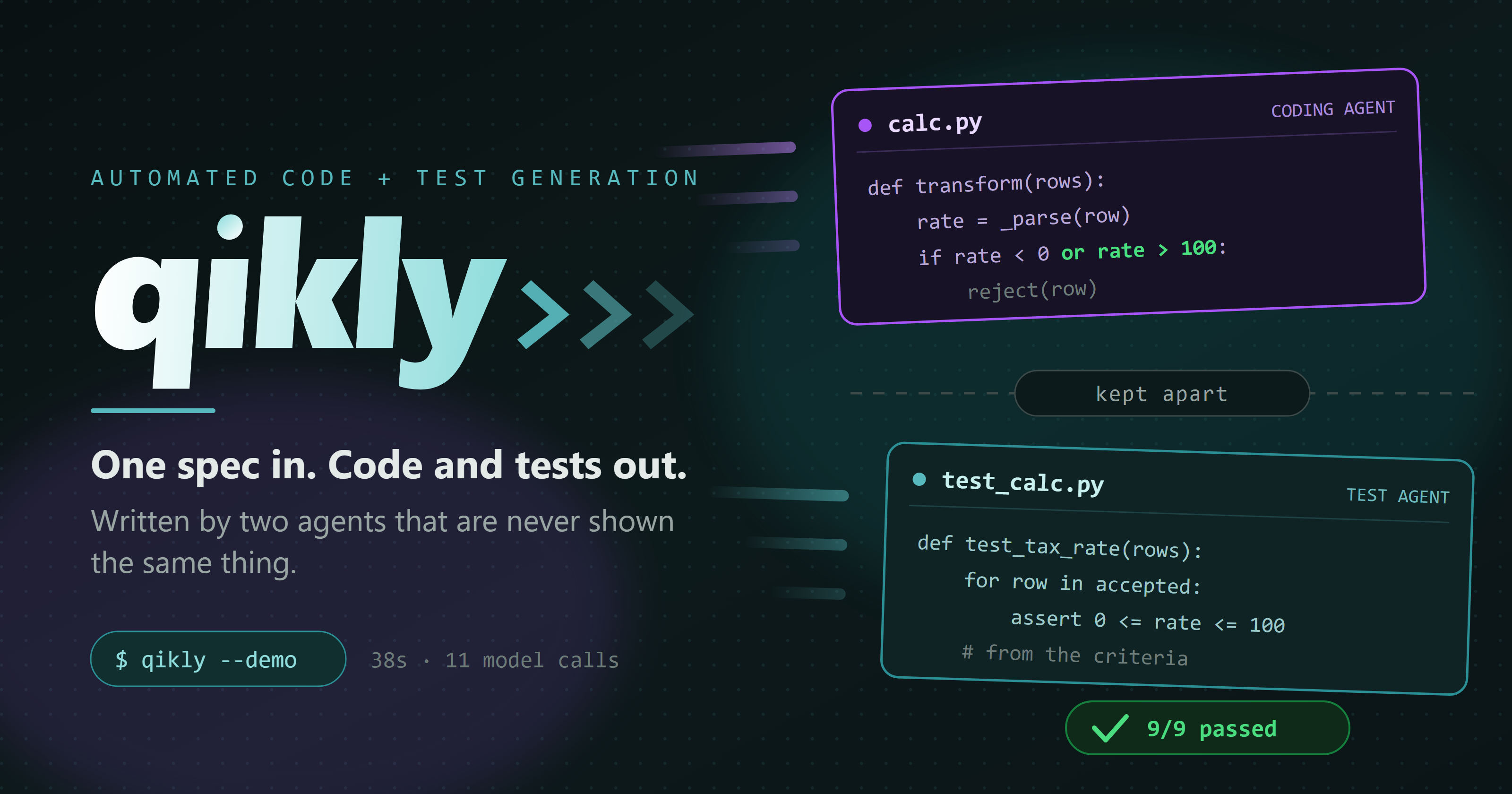
New: an agent Skill.
qikly --install-skillteaches Claude Code, Gemini CLI, Codex or Cursor how to drive qikly. What the Skill contains.
The problem: Your AI writes both the code and its tests. How do you know the tests are really valid?
Who it is for: a developer or team pointing an AI coding agent at a
self-contained Python module that transforms data, for example an ETL step, a
merge, a calculation or a validation routine, who does not want to trust a
green suite when the same agent wrote both the code and the tests. It suits one
module at a time in small to mid-sized repositories: when a test fails, only
the files that failure names are loaded, so runs stay small and quick. It fits
most naturally where verification already has to be independent, such as
automotive, medical devices, fintech and defence: ADAS_HEADWAY, a bundled
example, checks following distance from forward-radar samples. See What it is for.
Start here
Four ways in. Pick the row that matches what you have, and ignore the rest of this page until it has run.
| If you want to | Run | Costs |
|---|---|---|
| See the split for yourself, before anything else | qikly --explain CALC_TAX | nothing, no API key |
| Watch a real run end to end | qikly --demo | needs a key, about half a minute and well under a cent |
| Start from a finished example in a project of your own | qikly --example | nothing to set it up |
| Point it at your own module | qikly --scaffold my_module.py | nothing to set it up |
--demo works in a throwaway demo/<timestamp>/ folder it expects you to
delete. It is for watching, not for building in. --example and --scaffold
create a real project in the directory you are standing in, and those are the
two to start from.
Then five steps from your module to a first run.
The idea
Imagine a student who writes the exam paper, writes the answer key, and then sits the exam. They pass, and nobody would accept that as evidence they know the material. That is what happens when one model gets a specification containing the acceptance criteria and writes both the code and the suite that checks it: everything goes green, and the green means nothing.
qikly takes the answer key away from the student. It generates a test suite from the acceptance criteria, then writes an implementation and repairs it against that suite until every test passes or a retry budget runs out, recording every failure, every piece of reasoning and every diff.
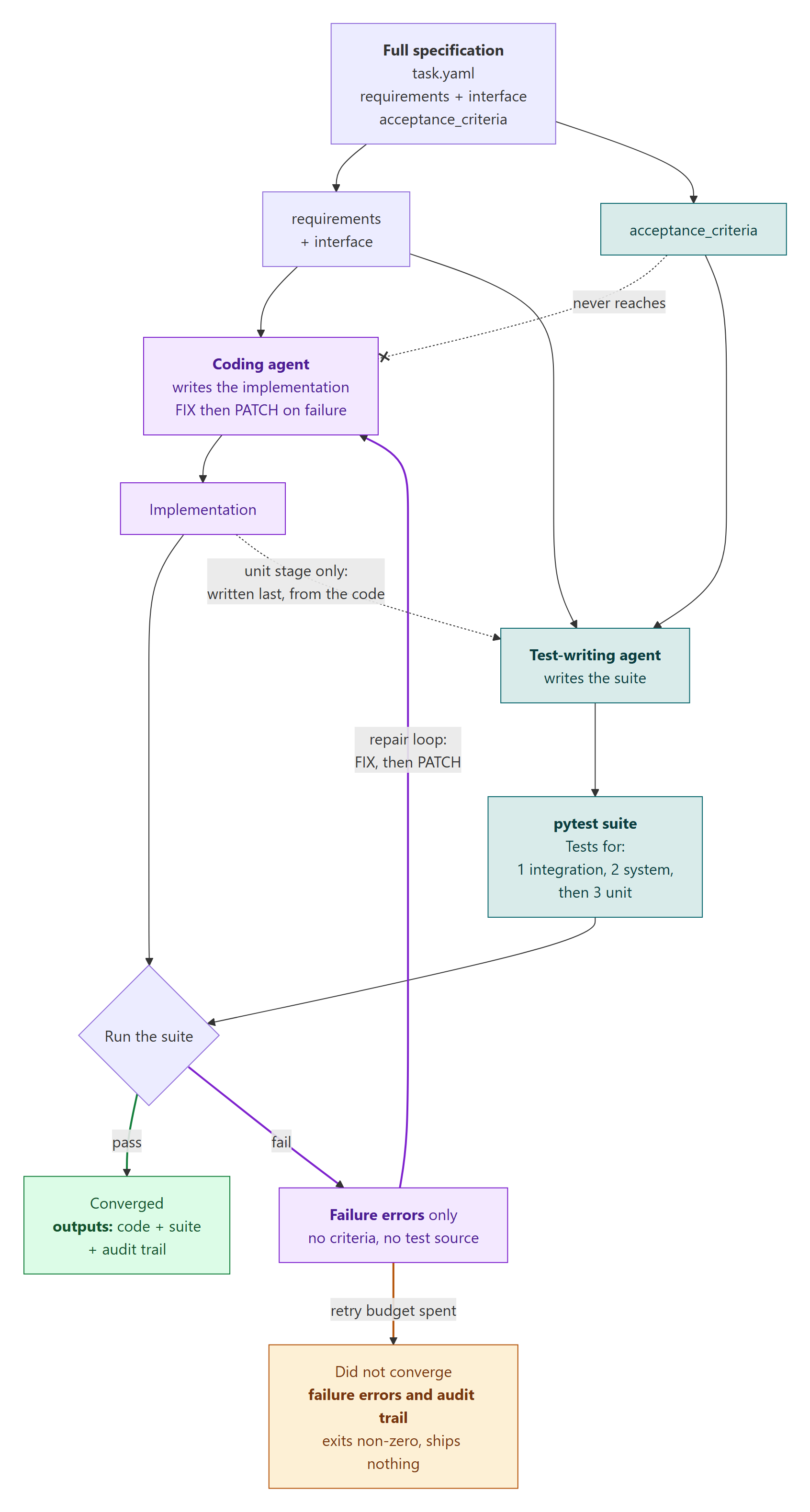
The part that makes the result mean something: the coding agent never sees
acceptance_criteria. It gets the specification with that section stripped
out, the same vague brief a developer works from, while test generation gets
it in full. When a test fails, the agent sees pytest's output for that test and never
the acceptance criteria. Without that asymmetry both sides read the same spec
identically and every test passes first try, which proves nothing.
Purple is what the coding agent can see. Teal is what the standard is
written from. They never touch. A run that never converges is still worth having: it exits
non-zero, names the blocking tests, and keeps the same complete record. The purple arrows are the repair loop, and that is where
almost all of a run happens: a failing suite sends the agent the failure text
and nothing else, it produces a FIX and a PATCH, and the suite runs again,
until the stage passes or the retry budget runs out. It never sees the criteria
themselves, so it cannot write code shaped to a bar it was handed.
tests/test_withholding.py fails the build if any call site lets one through.
A run works through three stages, integration then system then unit:
- Integration and system tests are generated first, from the spec alone, before any code exists. They cannot see an implementation because there is not one yet.
- The coding agent writes the implementation, from the spec minus the criteria.
- pytest runs. On failure the model produces a FIX (failure summary, root cause, plan, and the files it intends to touch) and then a PATCH (a unified diff of only those files), applied all or nothing. Repeat until the stage passes or the budget is spent.
- Unit tests are generated last, once real code exists for them to name. This is the only stage allowed to see the implementation.
- Clearing a stage re-runs the earlier ones, so a later fix cannot silently break something that already passed.
Every arrow back into FIX carries the pytest error text and nothing else, which means the failing tests and not the specification they came from. Unit tests come last because they are the only ones that need to name real functions, which makes them the only stage allowed to read the implementation. Re-running the earlier stages after each success is what stops a later repair quietly breaking something that already passed.
Test generation sees the requirements, the input and output contract, and every acceptance criterion in full. It writes integration, system and unit tests against the standard.
The coding agent sees the same specification with the criteria section removed, plus the text of whatever test just failed. The same vague brief a developer usually works from.
Two ways to get a test suite, and what each can prove
| Code-derived suite most commercial test generators, and qikly's own unit tests | Spec-derived suite qikly's integration and system tests |
|---|---|
| Written from the code as it is today | Written from the acceptance criteria you wrote |
| You supply nothing but the repository | You supply a written statement of what correct means |
| Catches behaviour changing tomorrow | Catches behaviour being wrong today |
| Cannot catch the code being wrong now: today's bug becomes tomorrow's assertion | Cannot catch anything nobody wrote down |
| Right choice when nobody wrote the intent down and you need a safety net | Right choice when the intent exists in a ticket, a spec page or a Gherkin file |
Both are useful and they answer different questions. qikly is not purely one
or the other: integration and system tests are written from the criteria
before any code exists, the unit stage is written last from the code that just
passed them, and --refine-criteria reads a converged implementation to
propose criteria the first draft missed. Each of those reads the code on
purpose, and none of them can question it.
What makes this different
Related MCP Servers
Reviews
No reviews yet — be the first to share how this listing worked for you.
Frequently Asked Questions about Qikly
AllMCPs Directory Badge
Showcase your server listing on GitHub or your project documentation. Embed this dynamic SVG badge to highlight official listing status and live engagement.
Badge Style:
Live Dynamic SVG Preview
Markdown (GitHub README)
[](https://allmcps.com/mcp/qikly)HTML Embed
<a href="https://allmcps.com/mcp/qikly"><img src="https://allmcps.com/api/badge/qikly?style=directory" alt="Qikly on AllMCPs" /></a>Technical Specs & Signals
CategoryDeveloper Tools
27Quality signal: Emerging · 27/100How this signal is calculated ▾
Server availabilityNot measured
Not scored for repo-hosted servers — we can't reach the running server, only its GitHub page. Hosted MCP endpoints are health-checked live.
Verified ownership8/20
Documentation & tools11/30
Adoption & activity1/15
Community engagement0/10
A guidance signal from public completeness & health data — not a user rating. New listings start lower and rise as they add docs, get verified, and grow adoption. Signals we can't observe for a listing are skipped, not counted against it.
Own this project?
This directory is pre-filled from public sources. Claim via GitHub README, site badge, or DNS TXT to unlock edit access and the Official badge — proof is checked automatically, then reviewed by our team.
Free dofollow backlink: add your website and place the AllMCPs badge on it — no claim needed. We detect it automatically and keep it verified as long as the badge stays live.
Claim & get free dofollowShare & Embed
Add our SVG badge (dark/light directory styles) or embeddable widget to your site.