An MCP server that gives AI assistants access to PubMed, Europe PMC, FDA & UK drug labelling, and ClinicalTrials.gov.
A peer-reviewed pub crawl through the literature — the label — and the trial.









Quick start · Tools · Examples · Architecture · Roadmap · Contributing
✨ What is PubCrawl?
PubCrawl connects your AI assistant (Claude Desktop, Cursor, or any MCP-compatible client) directly to the primary sources clinicians and researchers actually use — so you can ask a question in plain English and get an answer grounded in PubMed, Europe PMC, FDA/UK drug labelling, and ClinicalTrials.gov, with real PMIDs, NCT IDs, and DOIs you can verify.
Every tool is a thin, deterministic wrapper over an official API. Nothing is invented; every result cites its source.
The thing no other MCP server does
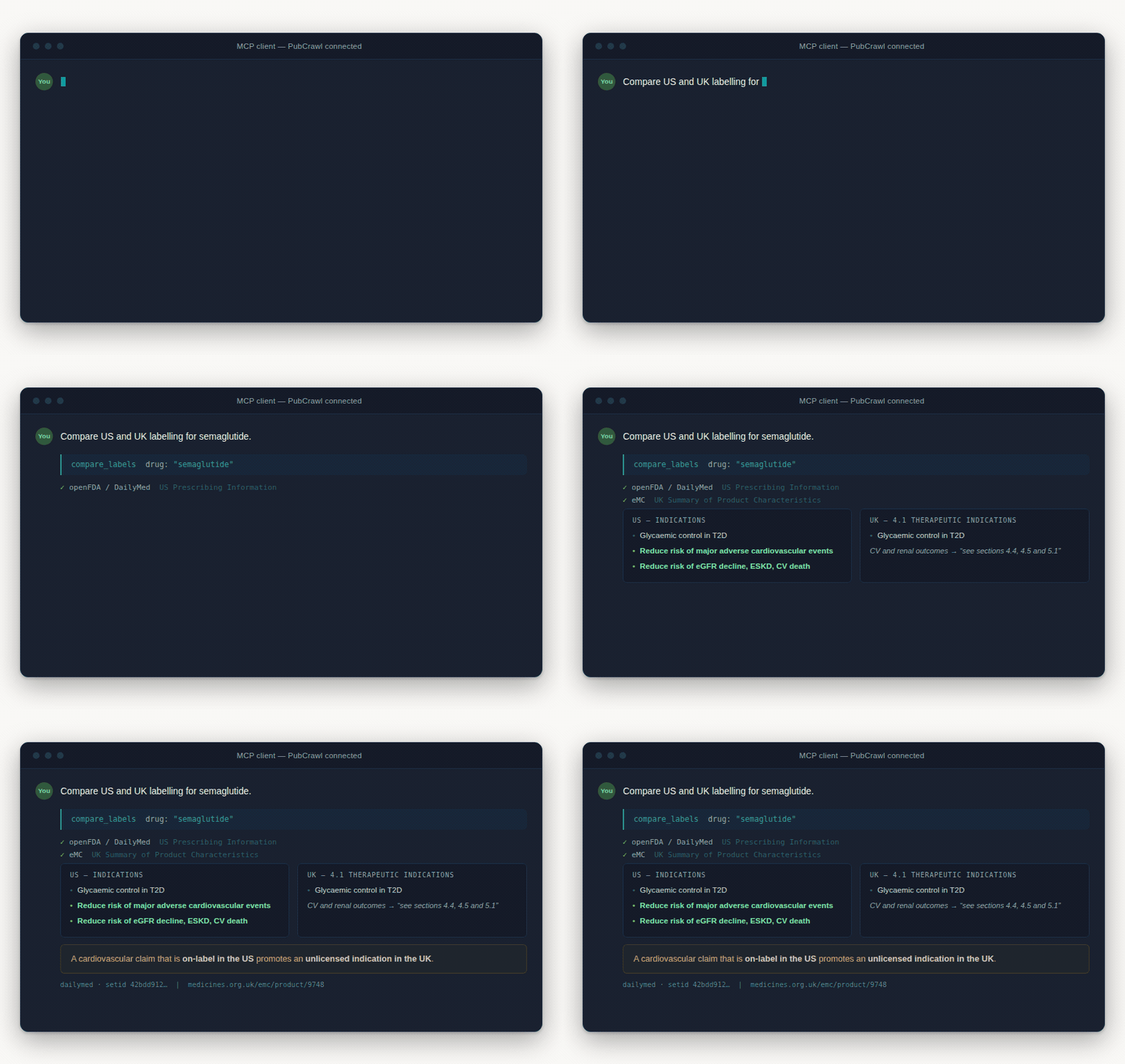
Ask "compare US and UK labelling for semaglutide" and PubCrawl pulls both live labels and maps equivalent sections — US Indications and Usage ↔ UK 4.1 Therapeutic indications, and so on — so the differences are visible instead of assumed:
| US Prescribing Information | UK SmPC | |
|---|---|---|
| Indications | glycaemic control · reduce risk of MACE in T2D with established CVD · reduce risk of sustained eGFR decline, ESKD and CV death in T2D with CKD | glycaemic control only — CV and renal outcomes appear as cross-references to §4.4/4.5/5.1, not as indications |
| Contraindications | personal or family history of MTC or MEN 2 · hypersensitivity | hypersensitivity only |
A cardiovascular claim that is on-label in the US promotes an unlicensed indication in the UK. If you write, review, or check medical copy for both markets, that gap is the whole job — and compare_labels is the only MCP tool that surfaces it.
Everything else
- 🔬 14 tools across literature, drug labelling, and clinical trials
- 🧾 Verifiable by design — results link back to DailyMed, the eMC, PubMed, and ClinicalTrials.gov
- 📰 Preprints via Europe PMC — surface work ahead of formal publication
- 🆓 No API keys required (an optional free NCBI key raises PubMed rate limits)
- 🧪 Fully typed, tested, and CI-checked — literature retrieval gated by OpenGATE, and labelling & trials by the in-repo fidelity benchmark, on every release
Built by PharmaTools.AI.
🚀 Quick start (60 seconds)
1. Add PubCrawl to your client config — no install step needed, npx fetches it on first run.
For Claude Desktop, edit claude_desktop_config.json:
- macOS:
~/Library/Application Support/Claude/claude_desktop_config.json - Windows:
%APPDATA%\Claude\claude_desktop_config.json
{
  "mcpServers": {
    "pubcrawl": {
      "command": "npx",
      "args": ["-y", "@pharmatools/pubcrawl"]
    }
  }
}
2. Restart your client. PubCrawl appears under + → Connectors.
3. Ask away:
"Compare the US and UK labelling for atorvastatin, and find recent Phase 3 trials for it."
That's it. → More examples · API key & other options
🧰 Tools
📚 Literature
| Tool | What it does |
|---|---|
search_pubmed | Search PubMed with filters for date range, article type, and sort order. Returns PMIDs, titles, authors, journals, and DOIs. |
search_europepmc | Search Europe PMC — a broader corpus than PubMed that also indexes preprints (bioRxiv, medRxiv) and patents. Each result includes an abstract snippet, citation count, open-access status, and a preprint flag. Filter to preprints or open-access only. |
get_abstract | Get the full structured abstract for an article — broken into labeled sections (background, methods, results, conclusions) with keywords and MeSH terms. |
get_full_text | Retrieve the full text of open-access articles from PubMed Central, with parsed sections, figure/table captions, and reference counts. |
find_related | Find similar articles using PubMed's neighbor algorithm, ranked by relevance score. |
format_citation | Generate a formatted citation in APA, Vancouver, Harvard, or BibTeX style. |
trending_papers | Find recent papers on a topic, with optional filtering to high-impact journals (Nature, Science, Cell, NEJM, Lancet, JAMA, etc.). |
💊 Drug labelling
| Tool | What it does |
|---|---|
resolve_drug_name | Convert a brand drug name to its generic (or a generic to its US brand names), with drug class and common indications. Deterministic, via RxNorm/openFDA — no AI. |
get_uspi | Pull US Prescribing Information sections via openFDA (cited to DailyMed) — indications, dosing, warnings, contraindications, and more. |
get_smpc | Retrieve UK Summary of Product Characteristics from the eMC — the UK equivalent of US prescribing information, with numbered SmPC sections. |
compare_labels | Side-by-side comparison of US (USPI) and UK (SmPC) labelling for the same drug, pairing equivalent sections (US Indications ↔ UK 4.1). A missing side is always explained, cut sections are flagged truncated, and us_drug / uk_drug pin a different name per market (Farxiga / Forxiga). |
search_by_indication | Find drugs approved for a medical condition. Searches FDA labelling via openFDA, then cross-references UK availability on the eMC. |
🧫 Clinical trials
| Tool | What it does |
|---|---|
search_trials | Search ClinicalTrials.gov for clinical trials. Filter by condition, intervention, recruitment status, and phase. Returns NCT IDs, sponsors, enrollment, and links. |
get_trial | Get full details for a clinical trial by NCT ID — eligibility criteria, study design, arms, primary/secondary outcomes, locations, and associated PubMed IDs. |
💬 Examples
Once connected, just ask naturally:
Literature
- "Search PubMed for recent clinical trials on semaglutide."
- "Search Europe PMC for preprints on GLP-1 receptor agonists, most cited first."
- "Get the abstract for PMID 38127654, then find related papers and cite them all in Vancouver style."
- "What are the trending papers on CRISPR gene therapy this month, high-impact journals only?"
- "Pull the full text of that PMC article and summarise the methods section."
Drug labelling
- "Get the FDA prescribing information for metformin — just the indications and warnings."
- "Pull the UK SmPC for atorvastatin."
- "Compare US and UK labelling for lisinopril and highlight the differences."
- "What's the generic name and drug class for Ozempic?"
- "What drugs are approved for type 2 diabetes in both the US and UK?"
Clinical trials
- "Find recruiting Phase 3 trials for pembrolizumab in breast cancer."
- "Get the eligibility criteria and primary outcomes for NCT03086486."
Cross-source (where PubCrawl shines)
- "For semaglutide: summarise the US label's cardiovascular indication, then find the pivotal trial and its NEJM publication."
🏗 Architecture
Three layers — tools register the MCP interface, lib clients talk to each external API, and shared cache + parsers keep it fast and consistent.

Each tool file exports a register*Tool(server) function with a zod schema and an async handler. All network calls are rate-limited, cached, and time-bounded. See CLAUDE.md for a full architecture walkthrough and CONTRIBUTING.md to add a tool.
🔧 Configuration
Install options
# Zero-install (recommended): npx fetches it on demand — see Quick start above.

# Or install globally:
npm install -g @pharmatools/pubcrawl

# Config for a global install:
#   { "mcpServers": { "pubcrawl": { "command": "pubcrawl" } } }
NCBI API key (optional)
Without a key, PubMed requests are limited to 3/second. A free key raises this to 10/second.
- Create a free NCBI account at https://www.ncbi.nlm.nih.gov/account/
- Account Settings → API Key Management → create a key
- Add it to your config:
{
  "mcpServers": {
    "pubcrawl": {
      "command": "npx",
      "args": ["-y", "@pharmatools/pubcrawl"],
      "env": { "NCBI_API_KEY": "your_key_here" }
    }
  }
}
HTTP transport
PubCrawl also ships a stateless Streamable HTTP transport for browser-based and hosted clients:
npm run start:http # serves POST /mcp and GET /health on PORT (default 3000)
🗺 Roadmap
Highlights of what's planned — see ROADMAP.md for the full list.
get_europepmc_fulltext— read preprints & OA articles surfaced bysearch_europepmcget_adverse_events— openFDA FAERS adverse-event lookups- EMA / EPAR labelling to complement the US + UK
compare_labels - MeSH query helper for sharper PubMed searches
- MCP resources & prompts for common review workflows
Ideas welcome — open an issue.
🛠 Development
git clone https://github.com/nickjlamb/pubcrawl.git
cd pubcrawl
npm install

npm run dev      # TypeScript watch mode
npm run build    # compile to dist/
npm start        # run the stdio server
npm test         # Vitest unit suite
npm run lint     # ESLint
Unit tests live in tests/ and cover the parsing, caching, citation, formatting and label-pairing logic with fixture payloads (no network calls). CI runs lint → test → build on every push and pull request. New to the codebase? Start with CONTRIBUTING.md.
Measuring fidelity
npm run bench            # labelling + trials fidelity benchmark against the live sources
npm run bench -- --ci    # what the release gate runs: exit 1 if a verified case fails
Two gates run on every release and weekly. OpenGATE's retrieval scorer checks PubMed and Europe PMC records against hand-verified anchors. The in-repo fidelity benchmark does the same for drug labelling and trials: compare_labels is held to a gold set of US/UK anchors (a phrase must appear on one side and must not on the other, so real divergences are surfaced rather than smoothed over) plus a verbatim check that refetches the raw openFDA record and eMC page and confirms every returned sentence is a substring of the source. No LLM judge anywhere in either gate.
📦 Releases & changelog
Versions follow Semantic Versioning. See the CHANGELOG for a full history and Releases for notes and assets.
🤝 Contributing
Contributions are welcome and appreciated — bug reports, new data sources, new tools. Read the contributing guide to get started, then open an issue or a pull request.
📚 Citation
If PubCrawl supports work you publish, please cite it — see CITATION.cff, or:
@software{lamb_pubcrawl,
  author    = {Lamb, Nick},
  title     = {PubCrawl: verifiable biomedical literature, drug labelling and clinical trials for AI assistants},
  year      = {2026},
  publisher = {Zenodo},
  doi       = {10.5281/zenodo.22101559},
  url       = {https://doi.org/10.5281/zenodo.22101559}
}