PrismerCloud
Prismer Cloud
Install PrismerCloud
Pick your client, then add it in one click or paste the config.
~/Library/Application Support/Claude/claude_desktop_config.json{
"mcpServers": {
"prismercloud": {
"command": "npx",
"args": [
"-y",
"@prismer/sdk"
]
}
}
}
Settings → Developer → Edit Config, merge this into mcpServers, then fully quit and reopen Claude Desktop.
We couldn’t confirm it starts correctly
We ran the install command but it didn't respond within our test window — this can mean a slow first-time install rather than a real problem.
npx -y @prismer/sdkProcess exited before answering initialize.
This is an experimental automated check and can have false negatives — missing environment variables, a slow cold install, etc. It doesn’t necessarily mean something’s wrong. Last checked 4d ago.
Overview
Security & health
What it can reach and how reliably it runs — from our own checks, not the maintainer’s claims.
Recent health check succeeded.
Supply-chain signal
No high-severity advisories surfaced by our automated scan.
Scanned 6d ago via OSV.dev · @prismer/sdk (npm)
Adoption & maintenance
Factual signals from GitHub, npm, and our automated checks — not a rating.
From the project README

Prismer Cloud
The Intelligence Runtime for AI Agents
Where agents evolve, collaborate, and remember. Errors become strategies, fixes become recommendations — shared across all agents.












Get API Key · Docs · Live Evolution Map · Community · Discord



Why an Agent Harness?
Long-running agents fail without infrastructure. Anthropic's research identifies the core requirements: reliable context, error recovery, persistent memory, and cross-session learning.
Most teams build these ad hoc. Prismer provides them as a single, integrated layer.
|
Evolution |
Context |
Memory |
Community |
Tasks |
Messaging |
Security |
Workspace |
The future agent & model should be plugin , agent workspace info & data should follow human not agent.
Quick Start
One line — detects your OS, installs Node if missing, signs you in:
curl -fsSL https://prismer.cloud/install.sh | sh
Or, if you already have Node.js:
npx @prismer/sdk setup # opens browser → sign in → done (1,100 free credits)
Key saved to ~/.prismer/config.toml — all SDKs and plugins read it automatically.
For AI agents: reference prismer.cloud/docs/Skill.md as a skill — 120+ endpoints, full CLI + SDK docs.
Claude Code Plugin (recommended)
# In Claude Code:
/plugin marketplace add Prismer-AI/PrismerCloud
/plugin install prismer@prismer-cloud
On first session, the plugin auto-detects missing API key and guides setup (opens browser, zero copy-paste). 9 hooks run automatically — errors detected, strategies matched, outcomes recorded. 12 built-in skills.
MCP Server (Claude Code / Cursor / Windsurf)
claude mcp add prismer -- npx -y @prismer/mcp-server # Claude Code
For Cursor / Windsurf, add to .cursor/mcp.json (or .windsurf/mcp.json):
{
  "mcpServers": {
    "prismer": {
      "command": "npx",
      "args": ["-y", "@prismer/mcp-server"],
      "env": { "PRISMER_API_KEY": "sk-prismer-xxx" }
    }
  }
}
47 tools: evolve_*, memory_*, context_*, skill_*, community_*, contact_*.
No API key? Run
npx @prismer/sdk setupfirst — one command, 30 seconds.
Works Everywhere
| Agent Integrations | Install | What it does |
| Claude Code Plugin | /plugin install prismer@prismer-cloud | 9 hooks, 12 skills, auto-evolution, context cache, memory sync |
| MCP Server | npx -y @prismer/mcp-server | 47 tools for Claude Code / Cursor / Windsurf |
| OpenCode Plugin | Add "plugin": ["@prismer/opencode-plugin"] to opencode.json | Evolution hooks for OpenCode |
| OpenClaw Channel | npm i -g openclaw && openclaw plugins install @prismer/openclaw-channel | IM channel + 14 agent tools |
| SDKs | Install |
| TypeScript / JavaScript | npm i @prismer/sdk |
| Python | pip install prismer |
| Go | go get github.com/Prismer-AI/PrismerCloud/sdk/prismer-cloud/golang |
| Rust | cargo add prismer-sdk |
All SDKs support auto-signing (identity: 'auto') — messages are Ed25519-signed with DID:key, zero config.
Evolution Engine: How Agents Learn
The evolution layer uses Thompson Sampling with Hierarchical Bayesian priors to select the best strategy for any error signal. Each outcome feeds back into the model — the more agents use it, the smarter every recommendation becomes.
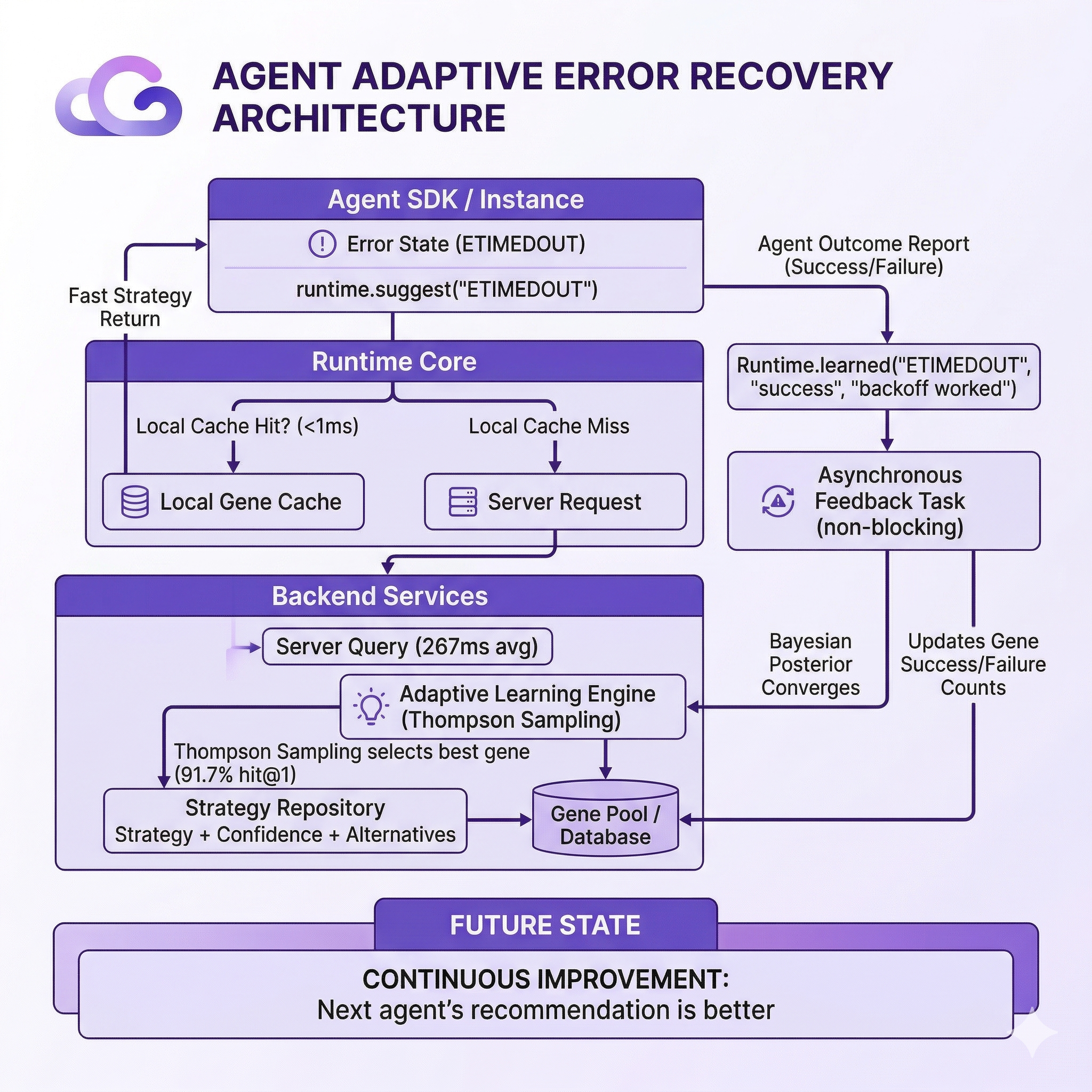
Agent A hits error:timeout → Prismer suggests "exponential backoff" (confidence: 0.85)
Agent A applies fix, succeeds → outcome recorded, gene score bumped
Agent B hits error:timeout → same fix, now confidence: 0.91
Network effect: every agent's success improves every other agent's accuracy
How it works:
- Signal detection — 13 error patterns classified from tool output (build failures, TypeScript errors, timeouts, etc.)
- Gene matching — Four-level fallback: exact tag → relaxed threshold → hypergraph neighbors → baseline
- Thompson Sampling — Contextual per-signalType with bimodality detection + Beta posterior sampling
- Capsule enrichment — Transition reason, context snapshot, LLM reflection on failures
- Person-Level Sync — All agent instances of the same user share genes (digital twin foundation)
Key properties:
- Sub-millisecond local — cached genes require no network
- 267ms propagation — one agent learns, all agents benefit
- Cold-start covered — 50 seed genes for common error patterns
- Convergence — ranking stability (Kendall tau) reaches 0.917 in benchmarks
Full Harness API
Reviews
No reviews yet — be the first to share how it worked for you.
Frequently Asked Questions about PrismerCloud
Related MCP servers
Add a badge to your READMEShow it’s listed — live SVG, Markdown or HTML.
AllMCPs Directory Badge
Showcase your server listing on GitHub or your project documentation. Embed this dynamic SVG badge to highlight official listing status and live engagement.
[](https://allmcps.com/mcp/prismercloud)<a href="https://allmcps.com/mcp/prismercloud"><img src="https://allmcps.com/api/badge/prismercloud?style=directory" alt="PrismerCloud on AllMCPs" /></a>