Industrial predictive maintenance: vibration analysis, bearing faults, ISO 20816-3
Quick Install
Automated & IDE SetupCopy the AI prompt to install this server into Claude Code, Cursor, or another agent — or use 1-click editor setup below.
Not yet automatically verified
We haven't yet run this listing's install command through our automated sandbox check. This isn't a red flag — we're steadily working through the catalog.
Manual Client & Custom JSON ConfigExpand JSON ▾
Client Config & Setup
Choose your client or environment
Target File:
💡 Paste the JSON block into your client's configuration file under mcpServers, then restart the application.
Documentation Overview
Predictive Maintenance MCP Server


Give your AI assistant evidence-based vibration diagnostics — machinery fault detection, ISO-cited severity, and diagnostic reports built to support and accelerate expert decision-making.
An open-source MCP server that turns LLMs into condition monitoring assistants for reliability engineers. Its core design rule: the server refuses to guess. No diagnosis is ever inferred from filenames or statistical parameters alone — a fault indication requires matching spectral evidence. Every severity claim cites ISO 20816-3, and the evaluative wording in reports is authored by the server, not improvised by the model. The AI orchestrates the analysis and presents the evidence — detected fault frequencies, matched fault patterns, severity zones — while the final judgment stays with the engineer. Also available as a Claude Code plugin with 8 diagnostic skills.
See It in Action
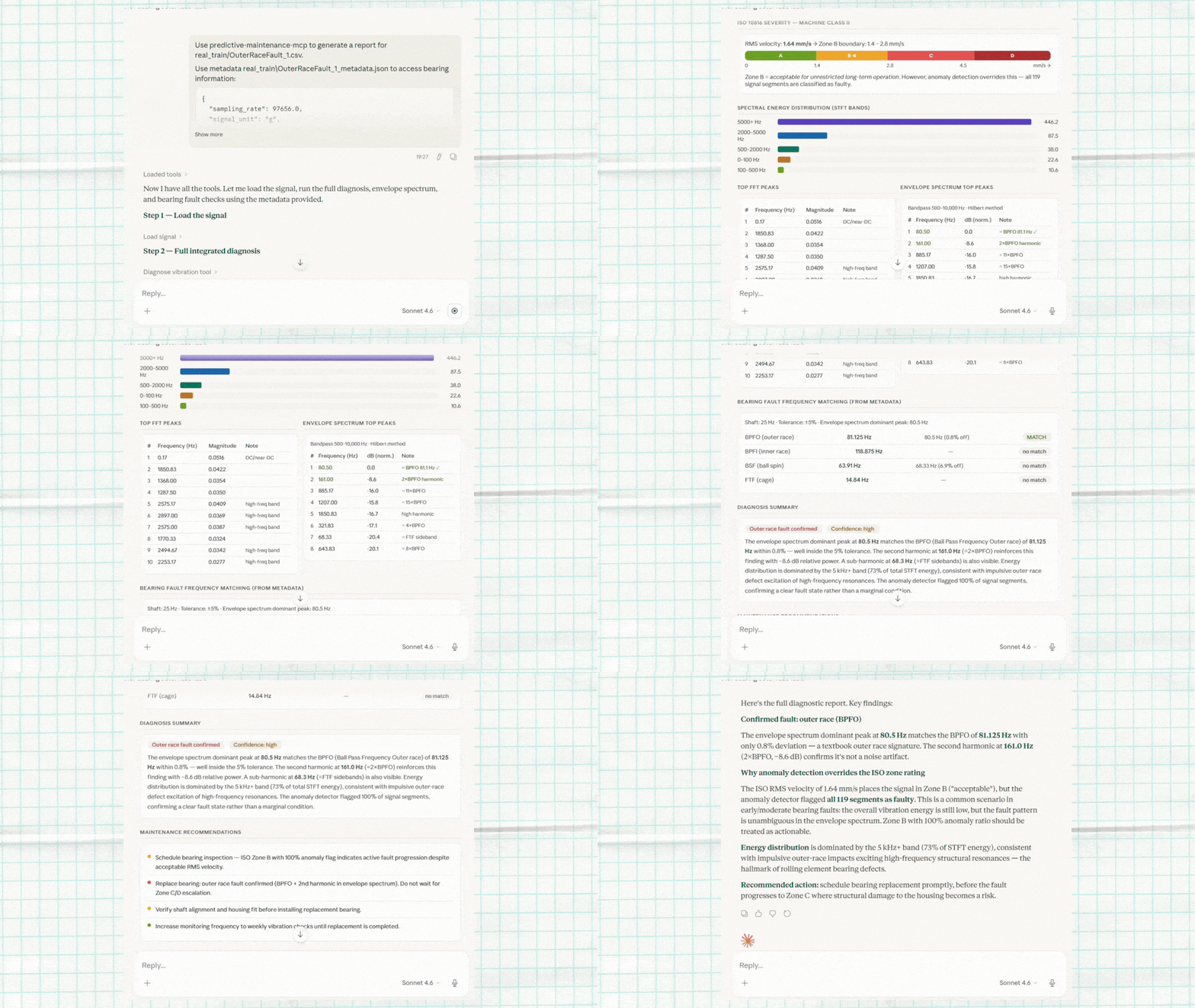
Full diagnostic workflow: load signal → spectral analysis → fault detection → severity assessment → report generation
Choose Your Path
| You are | Start here |
|---|---|
| Reliability / maintenance engineer — diagnostics in plain language, no coding | Engineer's Quickstart |
| AI / MCP developer — run, integrate, and extend the server | Developer's Quickstart · Quick Start below |
| Researcher / evaluator — how the numbers are measured | Benchmark Methodology · Benchmark below |
Quick Start
Get running in ~3 minutes. On Windows, one script wires everything into Claude Desktop — it installs the venv, pre-compiles dependencies, and writes claude_desktop_config.json for you (OneDrive / cloud-sync paths included):
Restart Claude Desktop, then try:
"Load real_train/OuterRaceFault_1.csv and check if the bearing is healthy."
Manual config (macOS / Linux / other MCP clients)
Install the package:
Find the full path to uvx (which uvx on macOS/Linux, where uvx on Windows), then add to your client config — ~/Library/Application Support/Claude/claude_desktop_config.json (macOS) or %APPDATA%\Claude\claude_desktop_config.json (Windows):
Why the full path? Claude Desktop launches servers with a minimal
PATHthat often omits user-local tool directories (e.g.~/.local/bin). Using the full path touvxavoids a silent "command not found" failure. On Windows the typical path isC:\Users\<you>\.local\bin\uvx.exe.
More options: install from source · VS Code setup · Docker / HTTPS deployment · use with local LLMs (Ollama)
Benchmark
A blind, reproducible diagnostic-accuracy benchmark on the public CWRU Bearing Data Center dataset (12 kHz drive-end subset: 60 fault records + 4 normal baselines). Fault labels never reach the system under test — signals enter under opaque ids, a separate scorer is the only label reader, and blindness, checksum integrity, and determinism are enforced by CI-run guard tests, not prose. Results are stratified by the per-record diagnosability grades of the Smith & Randall (2015) reference study, so records that study found undiagnosable by any classical method are reported separately instead of inflating or deflating the headline.
On records the reference study grades clearly diagnosable (Y1+Y2, 44 records): characteristic fault frequency detected on 44/44, correct fault ranked first on 34/44 (77.3%), and 9/9 on the textbook-signature (Y1) stratum. On the 4 healthy baselines, 2 records raised a false indication under the same criterion.
The numbers above are read from the committed, re-runnable artifact (results.json) and drift-guarded by CI: every value is bound to its key in the artifact, and a mismatch fails the build. Methodology, blind protocol, and honest-benchmarking notes: docs/benchmark-methodology.md. Reproduce with:
What Can It Do?
Point the AI at a vibration signal → get the evidence behind the fault — detected frequencies, matched fault patterns, ISO-cited severity — to support your call.
| You say | The AI does |
|---|---|
| "Is this bearing healthy?" | Loads the signal, runs spectral analysis, surfaces matching fault-frequency evidence, cites the ISO 20816-3 severity zone |
| "Generate a full diagnostic report" | Produces an interactive HTML report with charts, fault markers, and server-authored severity wording |
| "Extract specs from test_pump_manual.pdf and diagnose the signal" | Reads the equipment manual, looks up the bearing model, calculates expected fault frequencies, flags which ones the signal actually shows |
| "Train an anomaly detector on my healthy baselines, then flag anomalies" | Trains a model on your normal data, scores new signals, flags outliers for your review |
| "What changed on pump P-101 since the baseline?" | Reads the asset's recorded history, compares the latest acquisitions with the declared reference, and reports each indicator's change with the criterion it applied |
The AI doesn't guess: it calls 41 specialized MCP endpoints (38 tools + 3 prompts) running locally on your machine. Every signal is referenced by a single signal_id handle from load to report. Your data never leaves your infrastructure.
Full endpoint reference, grouped by category: Tool Catalog.
Claude Code Plugin
The project includes a plugin for Claude Code with domain-specific skills that activate automatically during conversation.
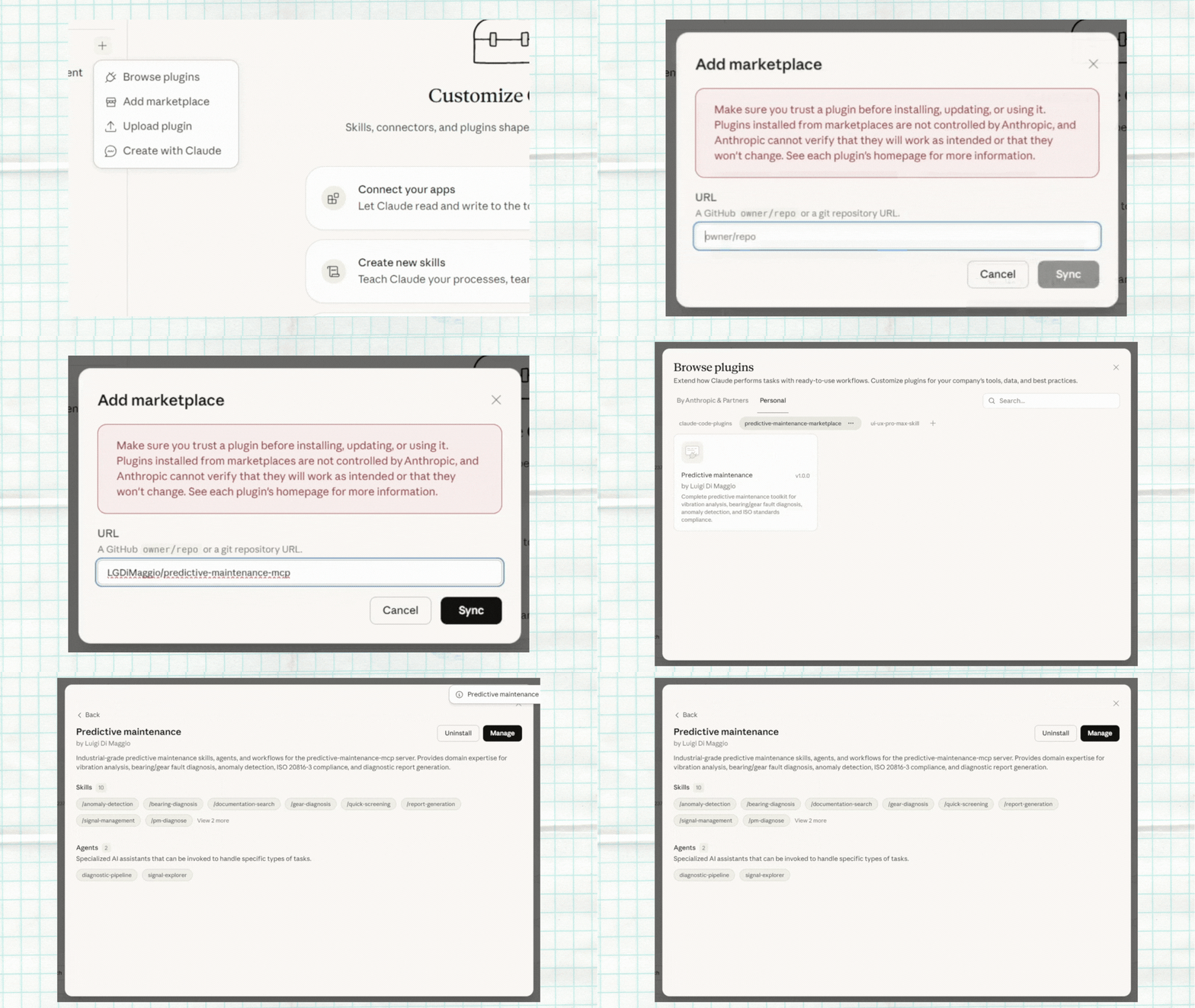
The plugin adds 8 skills that activate automatically based on context (bearing-diagnosis, gear-diagnosis, quick-screening, report-generation, anomaly-detection, signal-management, documentation-search, prognostics), 2 agents that run multi-step diagnostic workflows end-to-end and hand you the evidence (diagnostic-pipeline, signal-explorer), and 3 commands for quick entry points (/pm-diagnose, /pm-screen, /pm-report).
Full skill, agent, and command reference: Plugin README.
Reports
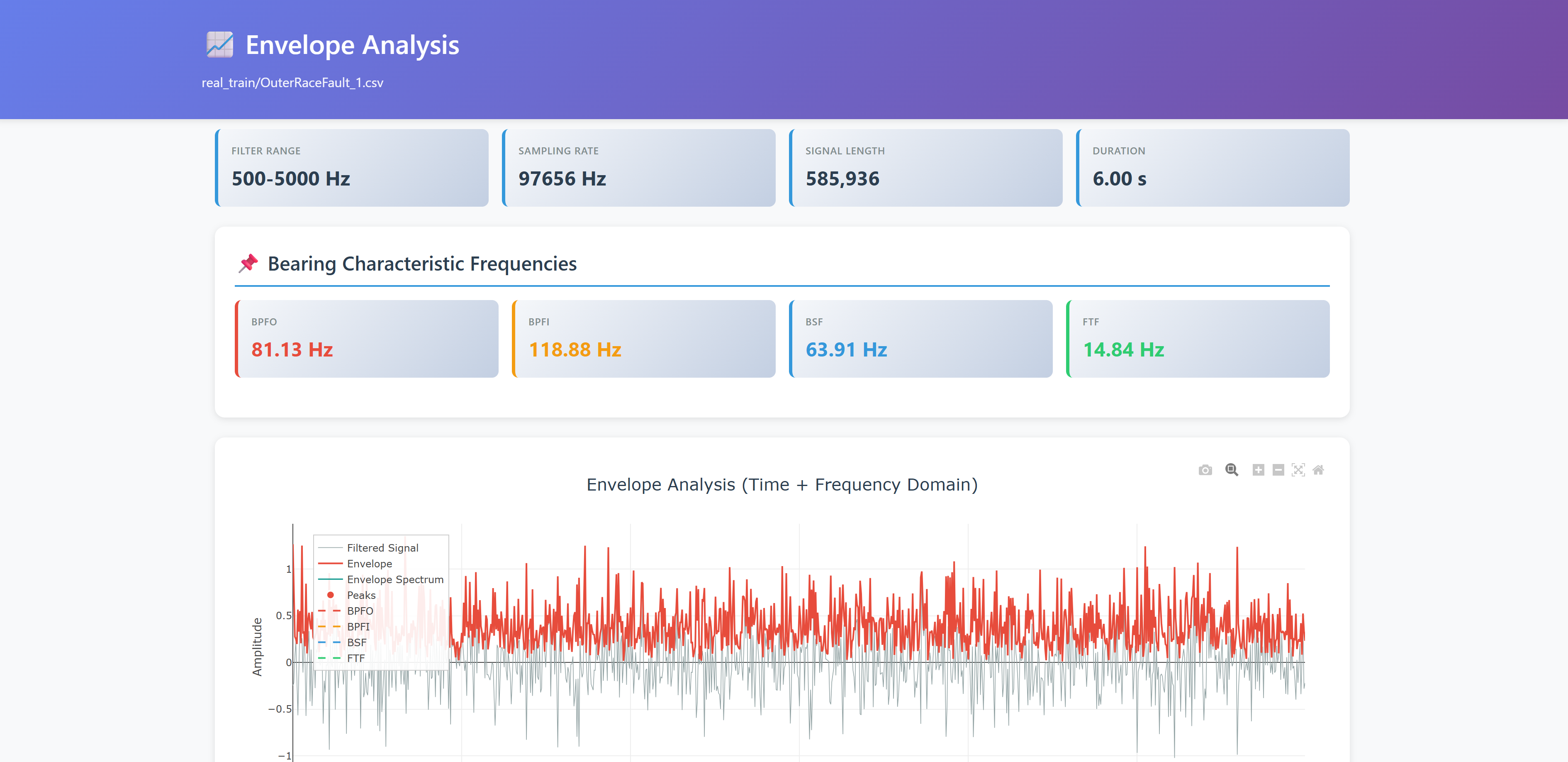
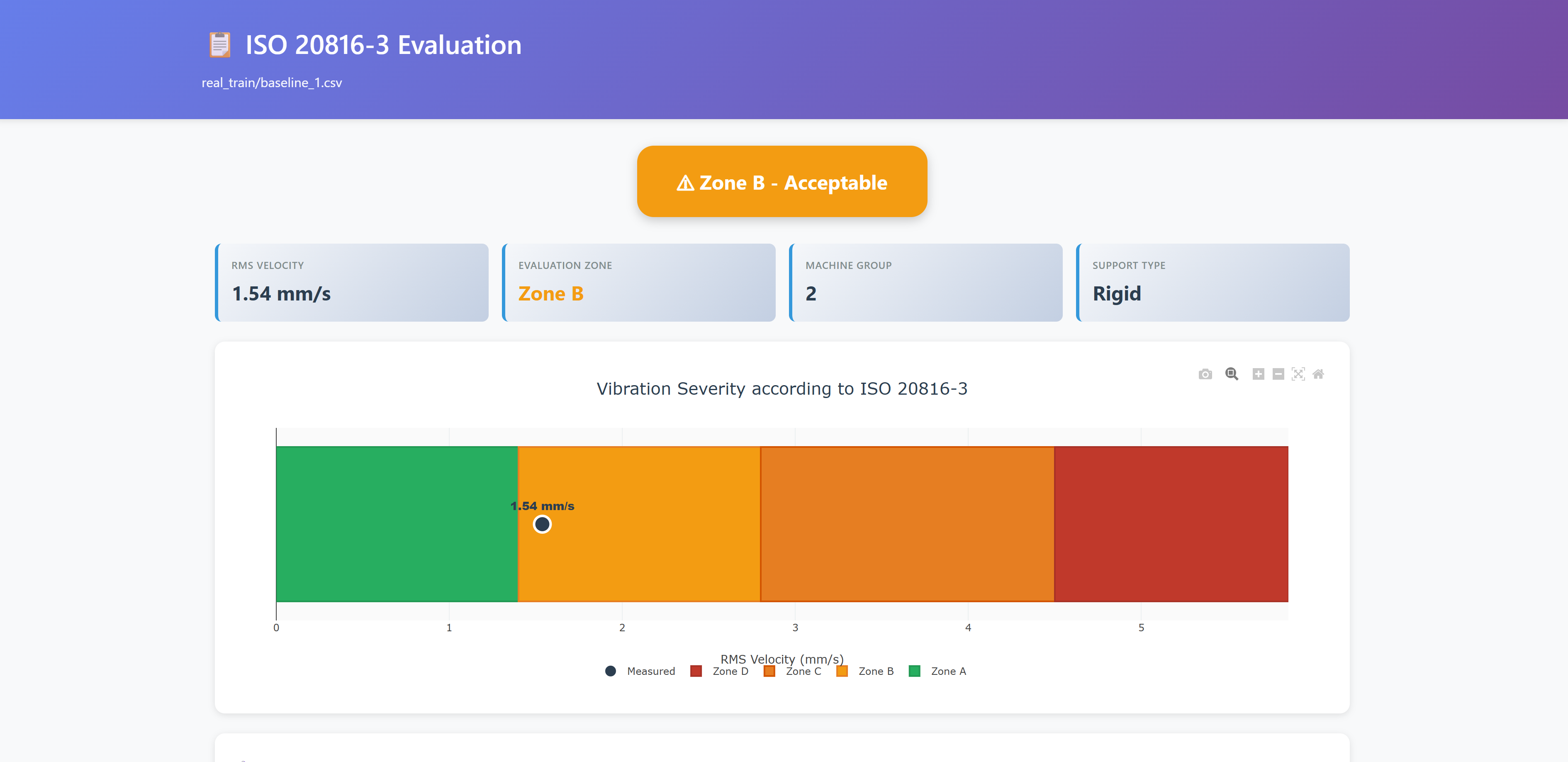
All analysis tools generate interactive HTML reports you can open in any browser — pan, zoom, hover for details. Also supports structured Word (.docx) exports.
Report examples
| Report Type | What it shows |
|---|---|
| Frequency spectrum | Peak detection, harmonic markers |
| Envelope analysis | Bearing fault frequency matching |
| Severity assessment | Vibration health zones (ISO 20816-3) |
| Word document | Full diagnostic narrative with embedded charts |
| PCA visualization | Multi-signal anomaly clustering |
| Feature comparison | Side-by-side signal feature analysis |
Sample Data Included
The project ships with 20 real bearing vibration signals from production machinery tests — ready to use out of the box: a training set (2 healthy baselines + 12 fault signals, inner and outer race) and a test set (1 healthy baseline + 5 fault signals).
Related MCP Servers
Adoption & maintenance
Factual signals from GitHub, npm, and our automated checks — not a rating.
GitHub stars
93
Stargazers on the source repository.
Last commit
7d ago
Most recent push to the default branch.
Reviews
No reviews yet — be the first to share how this listing worked for you.
Frequently Asked Questions about Predictive Maintenance MCP Server
AllMCPs Directory Badge
Showcase your server listing on GitHub or your project documentation. Embed this dynamic SVG badge to highlight official listing status and live engagement.
Badge Style:
Live Dynamic SVG Preview
Markdown (GitHub README)
[](https://allmcps.com/mcp/predictive-maintenance-mcp-server)HTML Embed
<a href="https://allmcps.com/mcp/predictive-maintenance-mcp-server"><img src="https://allmcps.com/api/badge/predictive-maintenance-mcp-server?style=directory" alt="Predictive Maintenance MCP Server on AllMCPs" /></a>