Extract a visual contract from a reference page and measure an implementation against it
Quick Install
Automated & IDE SetupCopy the AI prompt to install this server into Claude Code, Cursor, or another agent — or use 1-click editor setup below.
Not yet automatically verified
We haven't yet run this listing's install command through our automated sandbox check. This isn't a red flag — we're steadily working through the catalog.
Manual Client & Custom JSON ConfigExpand JSON ▾
Client Config & Setup
Choose your client or environment
Target File:
💡 Paste the JSON block into your client's configuration file under mcpServers, then restart the application.
Documentation Overview

Your coding agent cannot see the page it just built. pixelpact measures it against the reference and hands back numbers.


A coding agent writes the CSS and says it is done. It never sees the result. Nothing hands it a number, so the loop cannot close: the agent guesses, you open the page, you send it back, it guesses again. Every round costs you the one thing the agent was supposed to save.
The same gap exists without an agent, when a teammate says a section is finished and nobody in the room has a measurement. The difference is that a person can at least look.
pixelpact reads the reference page and writes down what it actually renders: sizes, colors, spacing, typography, hover and focus states, animation keyframes, design tokens. That file is the contract. Point pixelpact at the implementation and it answers with one line per property that drifted, which is precisely what an agent can act on.
Works with
| MCP clients | Playwright | GitHub Actions | Any framework | Figma |
|---|---|---|---|---|
| Claude Code, Cursor, anything that speaks stdio MCP | the engine it drives | one comment on the pull request | it reads the DOM, not your stack | a frame as the reference, when you want one |
If a browser can render it, pixelpact can measure it.
For coding agents
An agent that writes UI code cannot tell whether it succeeded. pixelpact-mcp gives it the
measurement, so the loop closes without a person in the middle: extract the contract once,
then let the agent check its own work, read the deviation list, fix, and check again.
Tools exposed: extract_contract, check_implementation, diff_pixels,
read_contract_summary.
Why this is not visual regression testing
Percy, Chromatic, Applitools, BackstopJS and Pixeleye all compare your page against a baseline that you approved earlier. That model works once the page already looks right and you want to keep it that way. While you are still building toward a design, there is no baseline to compare with, and the first run of a regression tool simply records whatever you produced.
| Visual regression tools | pixelpact | |
|---|---|---|
| Compares against | a snapshot you approved earlier | the reference design itself |
| Useful when | the UI is already correct | the UI is being built |
| First run on a new page | records, cannot judge | measures against the reference |
| Answer you get | an image diff to inspect by eye | a value per property, with a delta |
| Fits an autonomous agent | needs a human to approve the diff | the numbers close the loop |
The two models are complementary. Use a regression tool to keep a finished page finished, and pixelpact to get it finished in the first place.
Problems pixelpact solves
| Without pixelpact | With pixelpact |
|---|---|
| ❌ A coding agent writes CSS, declares it done, and a person has to open the page to find out that it is not. | ✅ The agent calls the MCP server, reads the deviations, fixes them and checks again. No person in the middle. |
| ❌ Someone says the section is finished, you disagree, and neither of you has a number. The louder opinion wins. | ✅ Every value in the reference is asserted against your page. What failed is listed with expected, actual and the difference. |
| ❌ A regression tool has nothing to compare a brand new page against, so its first run records whatever you happened to build. | ✅ The reference is the baseline from the first minute. Nothing has to be approved before the tool is useful. |
| ❌ Hover, focus and animation values are almost never reviewed, because checking them by hand is slow and boring. | ✅ They are part of the contract, so they are measured on every run like any other value. |
| ❌ An image diff tells you that something changed and leaves you to hunt for what. | ✅ Deviations name the element, the property, the expected value and the measured one. |
| ❌ The design lives in a file nobody opens during code review. | ✅ The contract is committed JSON, so a pull request shows exactly which values moved. |
Install
playwright is a peer dependency, so the browser download stays under your control and a
project that already has Playwright installs nothing extra. Node 22.12 or newer is required.
Quickstart
1. Extract the contract from the reference.
2. Measure your implementation.
3. Fix what it reports, then run it again. The command exits 0 when everything is inside
tolerance and 1 when it is not, so it drops straight into a script or a CI job.
What a contract looks like
A contract is plain JSON, readable and diffable, with no proprietary format and no service behind it.
Because it is a file, you can commit it, review it in a pull request, hand it to another developer, or hand it to an agent.
What a check prints
That is a real run against two copies of one page with four declarations changed. Four edits
produce ten measured deviations, because padding moves the box width and one border-radius
shorthand sets four corners. Run the same check against the reference itself and all 1066
assertions pass, which is the property that matters: a passing check has to mean something.
Add --json to get the same report as a data structure, which is what CI jobs and agents read.
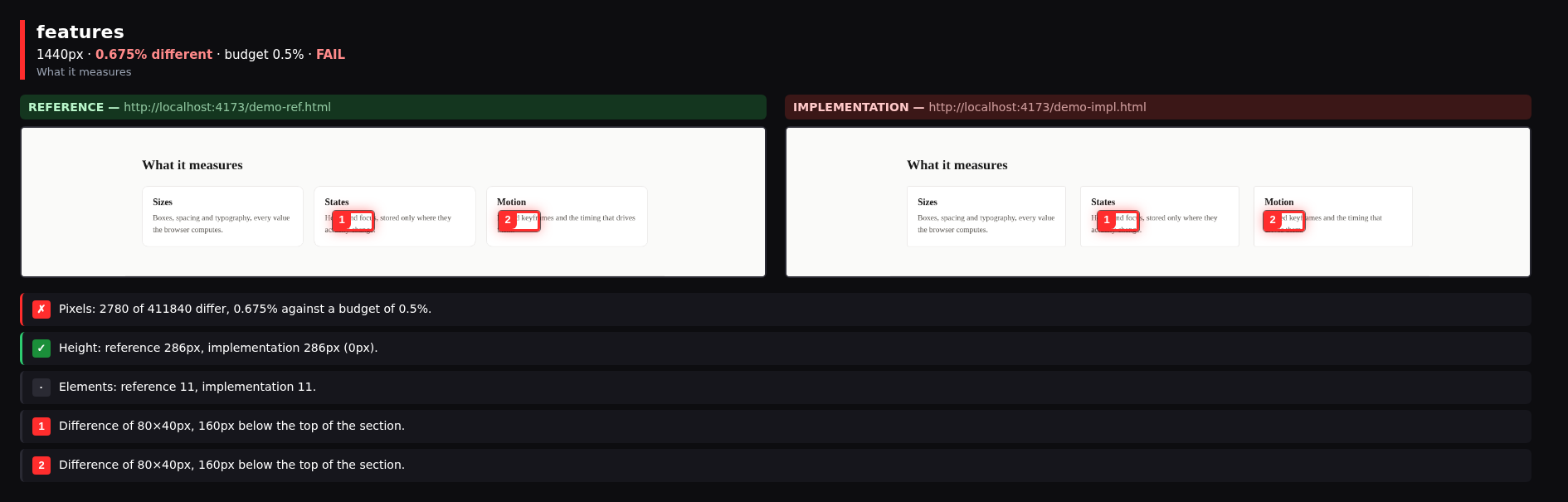
What a side by side run shows
check says which values moved. diff says how many pixels moved. Neither tells a person
where to look. side splits both pages into sections, puts them next to each other, and boxes
what differs.
Related MCP Servers
Reviews
No reviews yet — be the first to share how this listing worked for you.
Frequently Asked Questions about Pixelpact
AllMCPs Directory Badge
Showcase your server listing on GitHub or your project documentation. Embed this dynamic SVG badge to highlight official listing status and live engagement.
Badge Style:
Live Dynamic SVG Preview
Markdown (GitHub README)
[](https://allmcps.com/mcp/pixelpact)HTML Embed
<a href="https://allmcps.com/mcp/pixelpact"><img src="https://allmcps.com/api/badge/pixelpact?style=directory" alt="Pixelpact on AllMCPs" /></a>Technical Specs & Signals
CategoryDeveloper Tools
37Quality signal: Fair · 37/100How this signal is calculated ▾
Server availabilityNot measured
Not scored for repo-hosted servers — we can't reach the running server, only its GitHub page. Hosted MCP endpoints are health-checked live.
Verified ownership10/20
Documentation & tools16/30
Adoption & activity2/15
Community engagement0/10
A guidance signal from public completeness & health data — not a user rating. New listings start lower and rise as they add docs, get verified, and grow adoption. Signals we can't observe for a listing are skipped, not counted against it.
Own this project?
This directory is pre-filled from public sources. Claim via GitHub README, site badge, or DNS TXT to unlock edit access and the Official badge — proof is checked automatically, then reviewed by our team.
Free dofollow backlink: add your website and place the AllMCPs badge on it — no claim needed. We detect it automatically and keep it verified as long as the badge stays live.
Claim & get free dofollowShare & Embed
Add our SVG badge (dark/light directory styles) or embeddable widget to your site.