Read-only attack-path tools: reachable routes to sensitive assets, and what a fix would cut.
Quick Install
Automated & IDE SetupCopy the AI prompt to install this server into Claude Code, Cursor, or another agent — or use 1-click editor setup below.
One-click editor setup isn’t available for this listing yet — we don’t have a confirmed install command, and we’d rather show nothing than point your editor at the wrong package or host. Follow the project’s own setup instructions, linked above.
Manual Client & Custom JSON ConfigExpand JSON ▾
No confirmed setup config for this listing yet. We only publish a config block when the install details come from the project itself — its README, its docs, or a verified owner. We haven’t found those for PerspectiveGraph, and we’d rather show nothing than a guess you’d paste into your client. Follow the project’s own setup instructions for the current steps.
Documentation Overview


Your scanners find issues. This finds the way in.




PerspectiveGraph joins what you already run - Trivy, Semgrep, Cloud Custodian, Falco, plus your AWS and Kubernetes state - into one graph of your real environment, and asks a single question of it: can someone get from the internet, through privilege that is too broad, to something worth stealing?
On a pull request it asks that question before the merge: the check goes red only when this change opens a route, and the fix comes back as its own pull request. Open source (Apache 2.0), runs on your infrastructure, collects no telemetry.
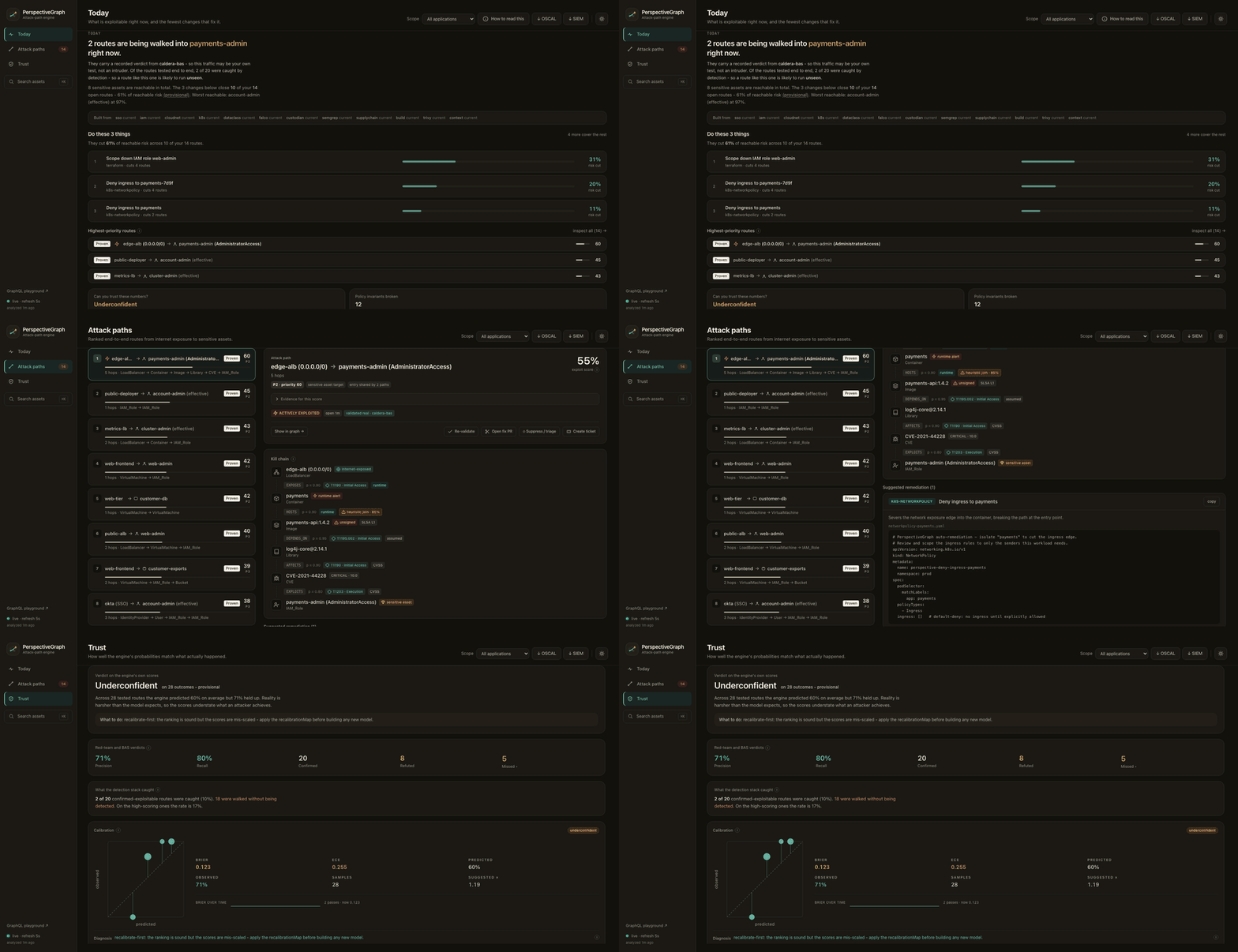
Twelve seconds of make demo: what is exploitable now → the ranked routes → one route's kill
chain and the fix it generates → whether the scores can be trusted. Sample scanner output and
seeded verdicts, not a real environment.
- See it running - the same dashboard, published read-only. Nothing to install.
- Check your own AWS account - one read-only command, no deployment.
- Put it on your pull requests - ten lines of YAML.
A score here is what the model concludes from the evidence it was given, not a measured frequency: nothing has been calibrated against field data yet, and the engine says so itself rather than rounding up. What is measured, and what is not.
Check your own account in 30 seconds
No deployment, no Docker, nothing ingested. One static binary asks AWS's own policy evaluator which of your roles can reach administrator - applying the service control policies, permission boundaries and condition keys that a policy reader on its own does not see:
It is read-only and free: each check is one iam:SimulatePrincipalPolicy dry run, which
creates nothing and costs nothing, and the only permissions it needs are that and
iam:ListRoles, both inside SecurityAudit. Windows builds are on the
releases page; every binary
is signed with cosign and carries SLSA provenance, and two commands
verify both before you run anything.
Add -compare and it also runs the engine over the same account, exiting non-zero where the
two disagree. That is how the engine's
first real false positive
was found, and how it stays fixed. If it disagrees on yours,
report it: no report is more useful. From here, how to evaluate this walks to a
verdict on your own estate in stages that each end in an answer.
See the whole engine in 90 seconds
Pulls the published, cosign-signed images, feeds them sample Trivy / Semgrep / Custodian /
Falco / Kubernetes / IAM / SSO output, and prints the top attack path with its generated fix.
Dashboard on http://localhost:3000, make down to tear it down. It needs Docker, jq and
curl, compiles nothing, and takes about 23 seconds from an empty image cache; make demo-build
is the same demo built from your working tree.
On Kubernetes, the chart is an official package on Artifact Hub:
The chart and the three images it runs (ghcr.io/luiacuaniello/perspectivegraph, -dashboard
and -postgres) are signed with cosign keyless and carry an SPDX SBOM and SLSA provenance:
verify them rather than taking the supply chain on trust.
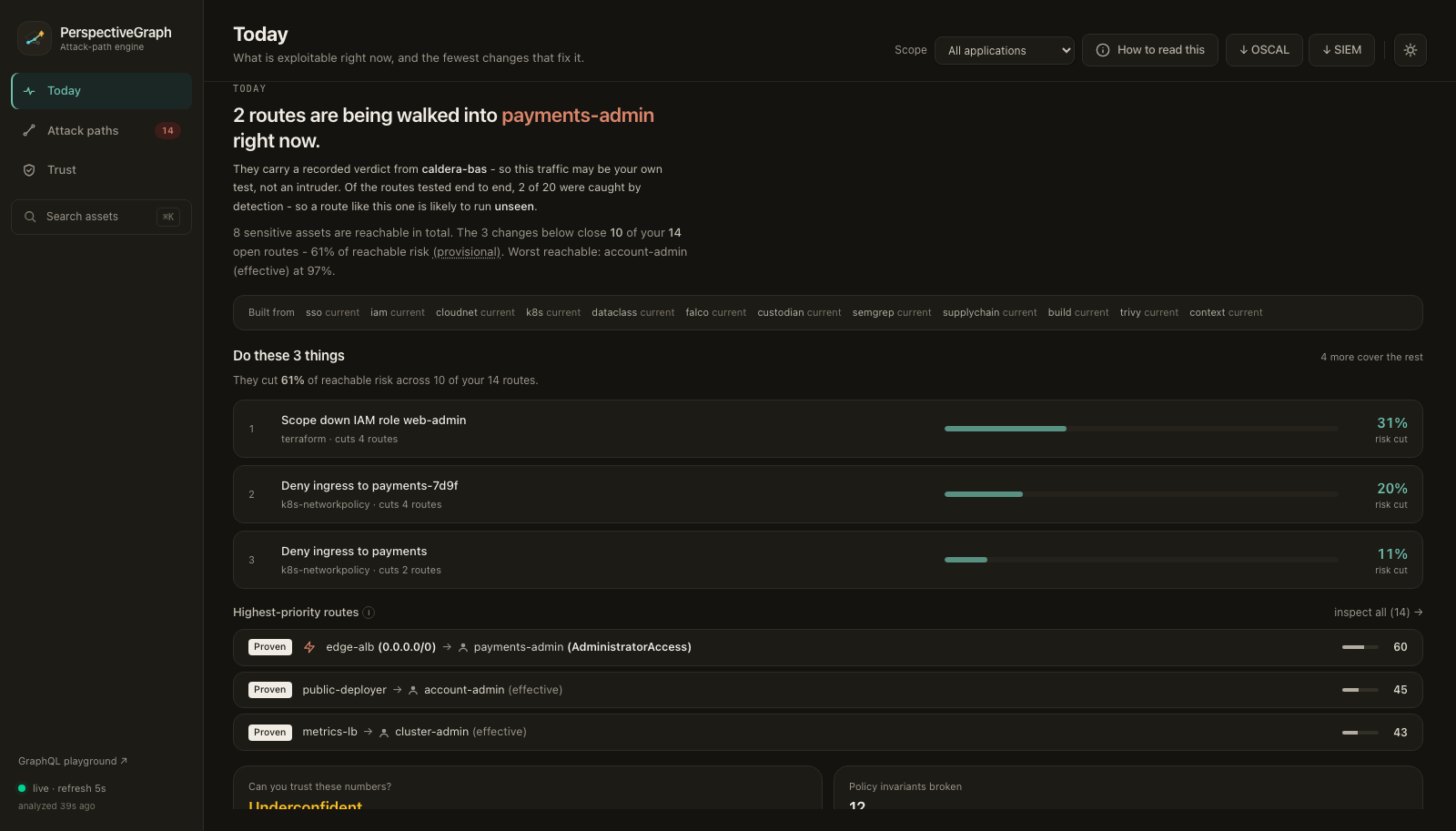
The dashboard opens on the decision, not the inventory: what is being exploited now, the fewest changes that remove the most risk, and how far the numbers can be trusted. Routes are ranked by triage priority - what the route reaches, whether runtime confirmed it, how exposed the entry is - so a lower-scoring route can outrank a higher-scoring one.
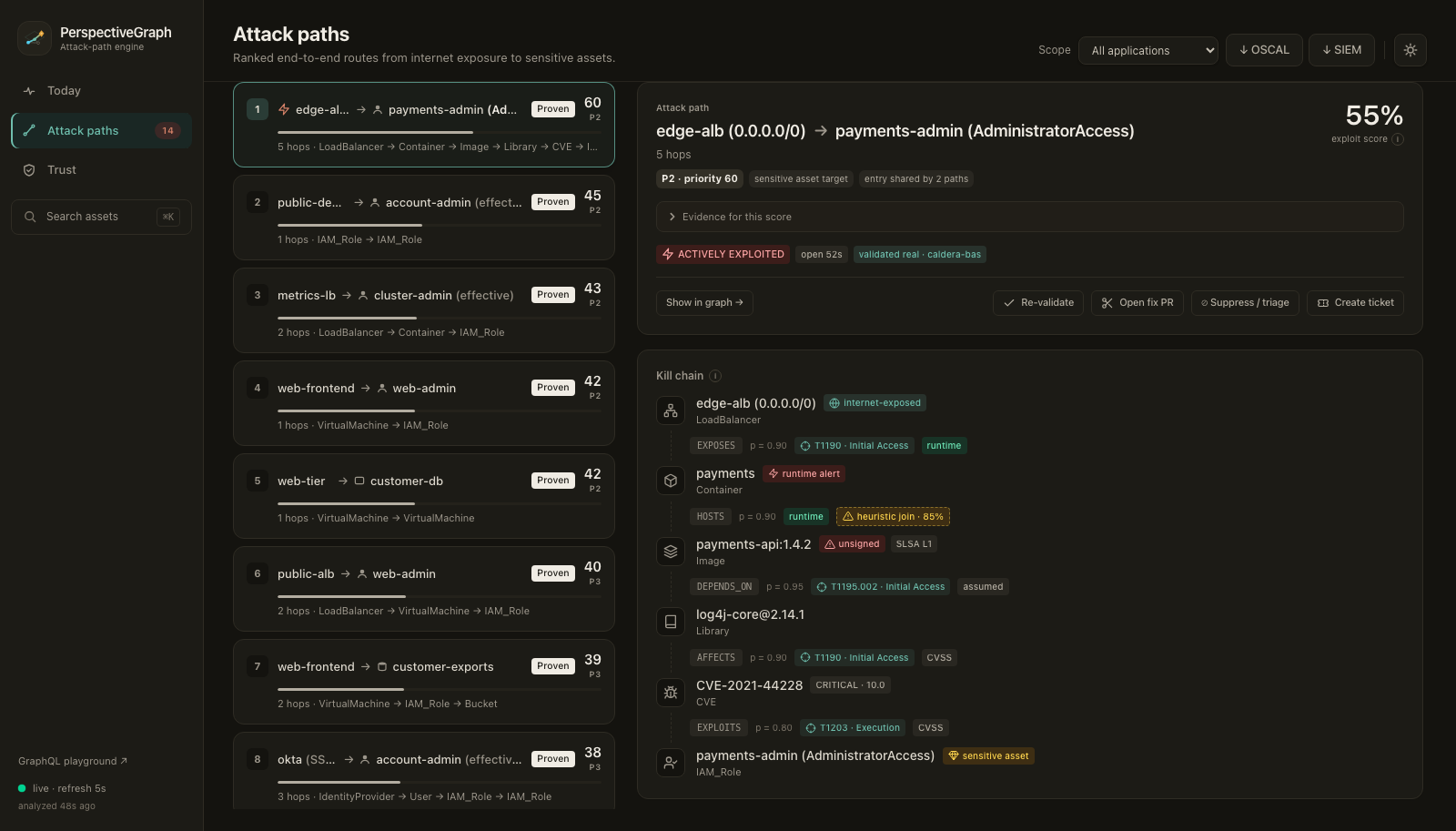 | 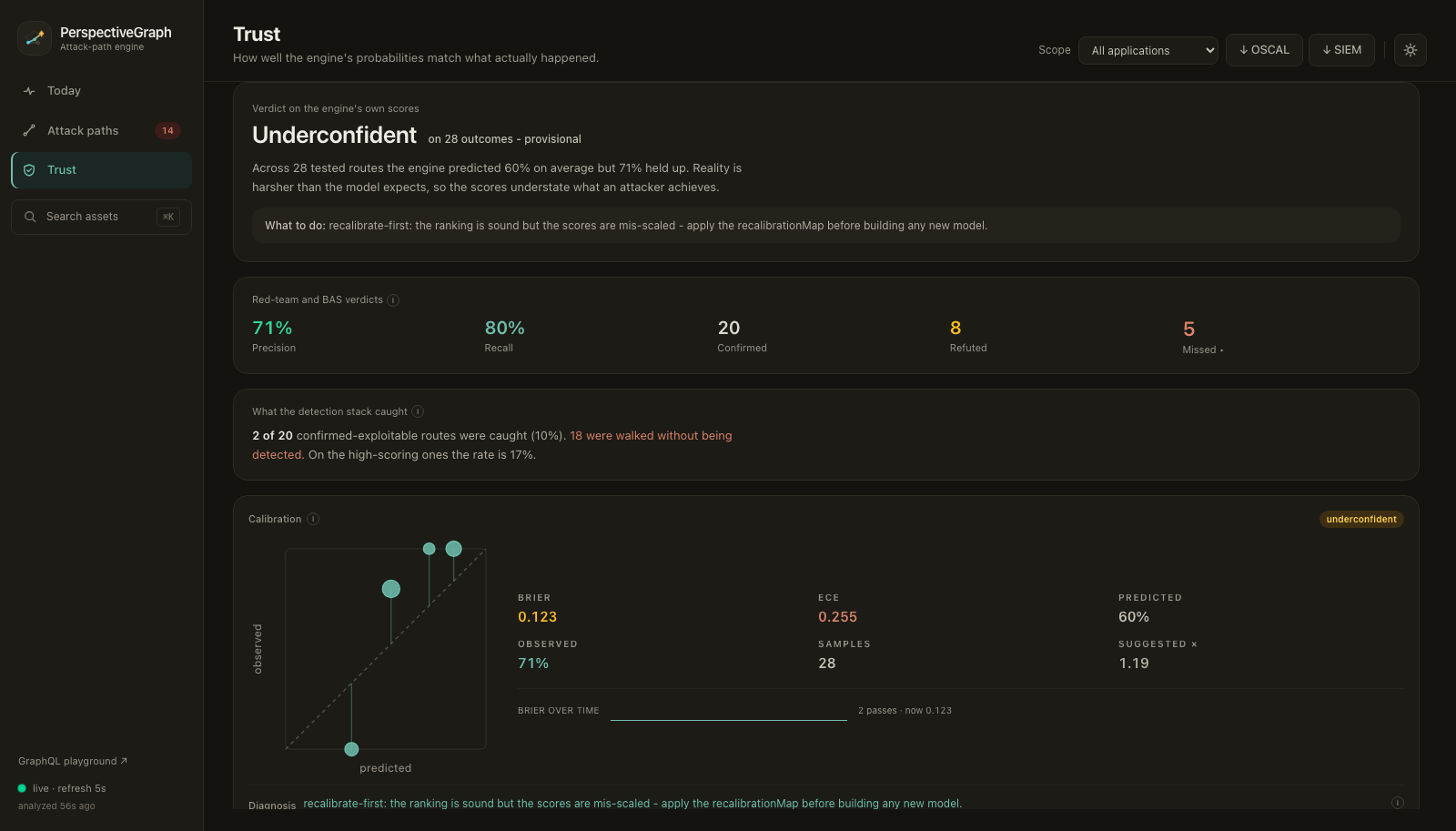 |
| Why the route is P1, one probability with its range, and every hop with what it lets the attacker do and where its probability came from. | Whether the engine's own scores held up against recorded outcomes - and whether there are enough of them to say. |
The screenshots are make demo with seeded verdicts, which is why the calibration panel
gives one ("underconfident": across 14 outcomes generated to exercise it, the engine predicted 60%
where 71% held up). A fresh install and the public demo report
insufficient data instead, until real outcomes exist. The public demo runs on one free VM, so
treat it as best-effort.
Why?
A scanner reports that a container carries a critical CVE. It cannot report that the container sits behind an internet-facing load balancer, runs with a role that reads the production database, and is therefore the one finding out of ten thousand worth fixing this week. That needs the other tools' output in the same graph, which is what this builds. A developer gets a check that goes red only when their change opens a real route; a security team gets a short ranked list of attack paths instead of a flat list of findings.
Block the pull request that opens the path
No deployment required. The runner reads your estate read-only, ingests this pull request's scan, and answers in-process with the same engine:
The check goes red when this change opens a route to a sensitive asset - or makes one likelier - not when it adds a critical CVE: a critical on a host nothing routes to does not fail the build, and a medium on a container that now reaches the production database does. Routes that were there before the change do not count, even when they run through what it touches: the scan is applied to a copy of the estate and compared with it, and nothing is written. It also has a third outcome, because a pipeline whose scan never arrived must not get the same green tick as one that is clean:
| Verdict | Exit | Meaning |
|---|---|---|
clean | 0 | The engine analysed this change: it opens or worsens no critical path |
blocked | 1 | It opens or worsens critical attack paths - the check names them |
unknown | 2 | Nobody analysed it. The scan, the ingest or the SHA is wrong |
Outside GitHub Actions it is one command, and it installs as a Trivy plugin too:
[!WARNING] Fork pull requests get no secrets, so the gate fails closed as
unknownon them. Do not work around it withpull_request_target: that runs your secrets - in local mode, cloud credentials - against the contributor's code.On a public repository, a blocked check prints the route (real asset names, the CVE, the sensitive asset) into a public job log. Use
soft-failand post the detail somewhere private.
The manual covers the rest:
pointing the action at a deployed engine, gating rendered manifests, a pre-collected estate,
rolling the gate out, and every input in action.yml.
Let an agent query it
A language model cannot enumerate thousands of edges reliably or run Dijkstra, and asked for "the attack paths in my account" it will invent plausible ones. So the engine speaks MCP: the agent asks, and reasons over answers it could not have made up.
Related MCP Servers
Reviews
No reviews yet — be the first to share how this listing worked for you.
Frequently Asked Questions about PerspectiveGraph
AllMCPs Directory Badge
Showcase your server listing on GitHub or your project documentation. Embed this dynamic SVG badge to highlight official listing status and live engagement.
Badge Style:
Live Dynamic SVG Preview
Markdown (GitHub README)
[](https://allmcps.com/mcp/perspectivegraph)HTML Embed
<a href="https://allmcps.com/mcp/perspectivegraph"><img src="https://allmcps.com/api/badge/perspectivegraph?style=directory" alt="PerspectiveGraph on AllMCPs" /></a>