Local-first personal memory and model server for trusted MCP agents on macOS.
Quick Install
Automated & IDE SetupCopy the AI prompt to install this server into Claude Code, Cursor, or another agent — or use 1-click editor setup below.
One-click editor setup isn’t available for this listing yet — we don’t have a confirmed install command, and we’d rather show nothing than point your editor at the wrong package or host. Follow the project’s own setup instructions, linked above.
Manual Client & Custom JSON ConfigExpand JSON ▾
No confirmed setup config for this listing yet. We only publish a config block when the install details come from the project itself — its README, its docs, or a verified owner. We haven’t found those for Persome, and we’d rather show nothing than a guess you’d paste into your client. Follow the project’s own setup instructions for the current steps.
Documentation Overview
Personal Model: local-first AI memory for coding agents
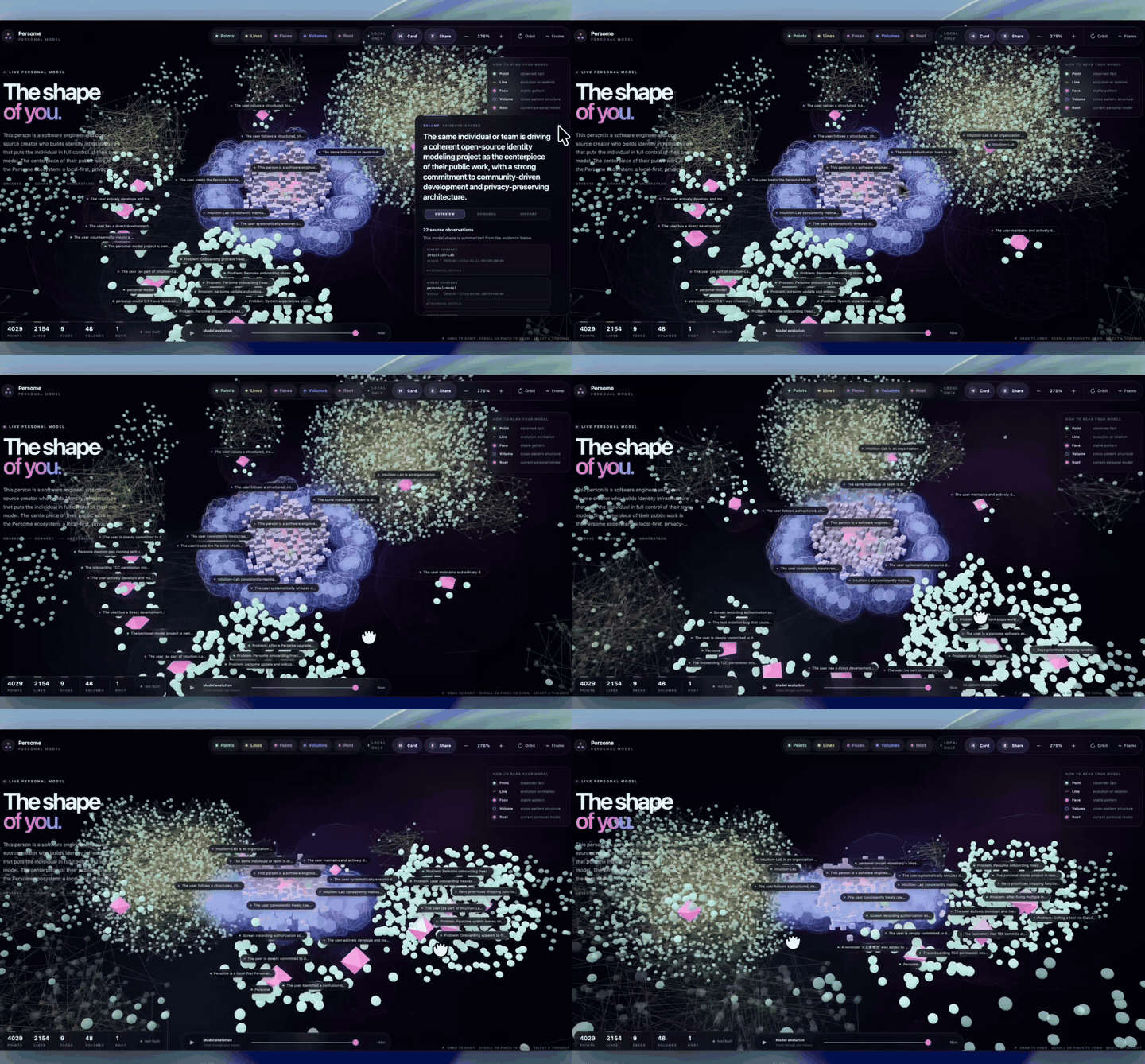
Auto-playing preview · Full-quality demo and v0.3.2 release notes
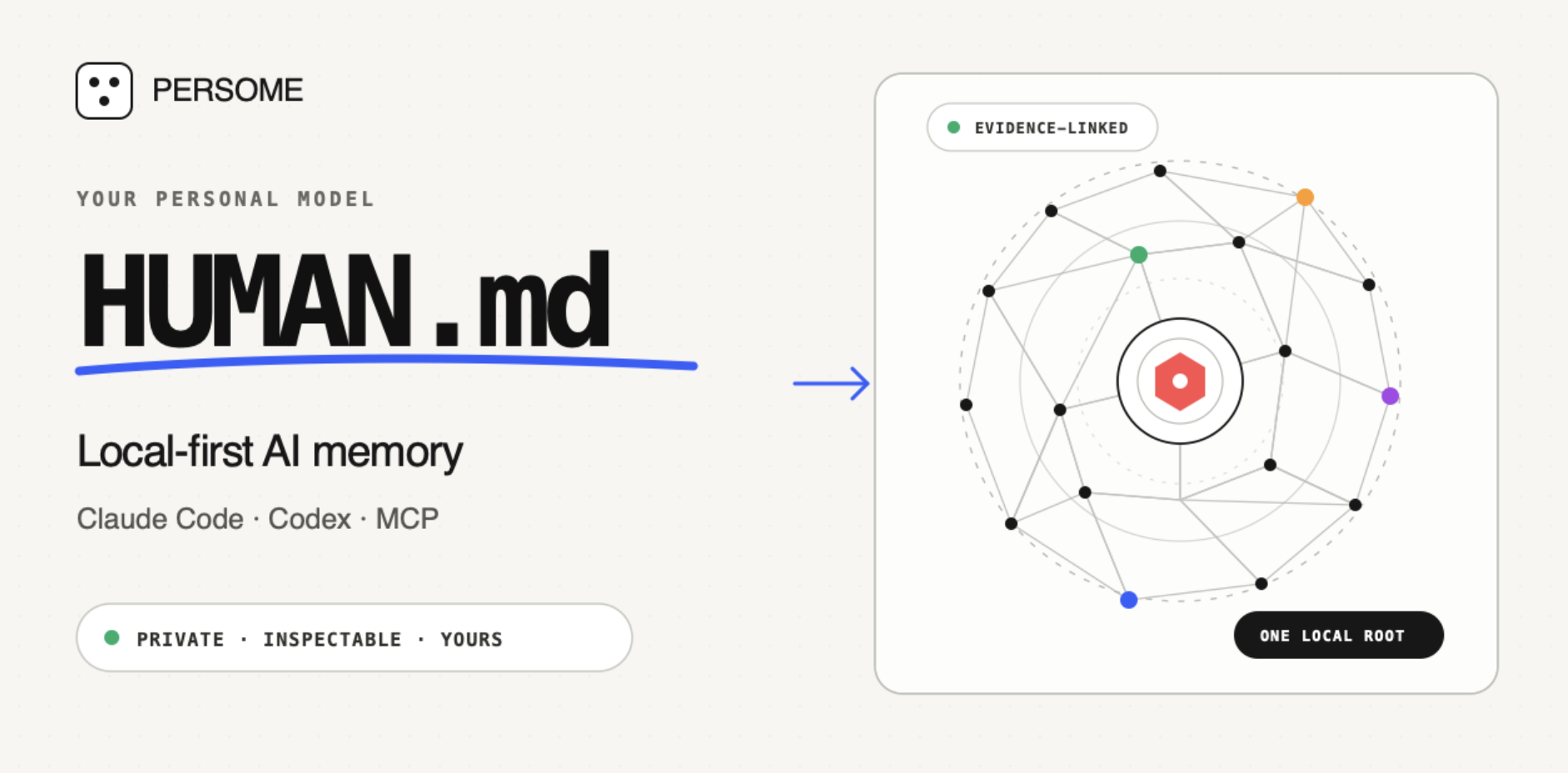
Build your HUMAN.md — one evidence-linked Personal Model for Claude Code, Codex, Cursor Agent, and other trusted MCP clients.
Personal Model is an open-source, local-first long-term memory Runtime. It learns how you think and work from focused activity captured on your Mac after you grant macOS permission, then gives your AI tools inspectable context to continue work and make grounded decisions.
Runs locally on your Mac. Private by default. Yours to inspect, correct, export, and delete.






Install Personal Model · Connect your AI tool · Star Personal Model on GitHub
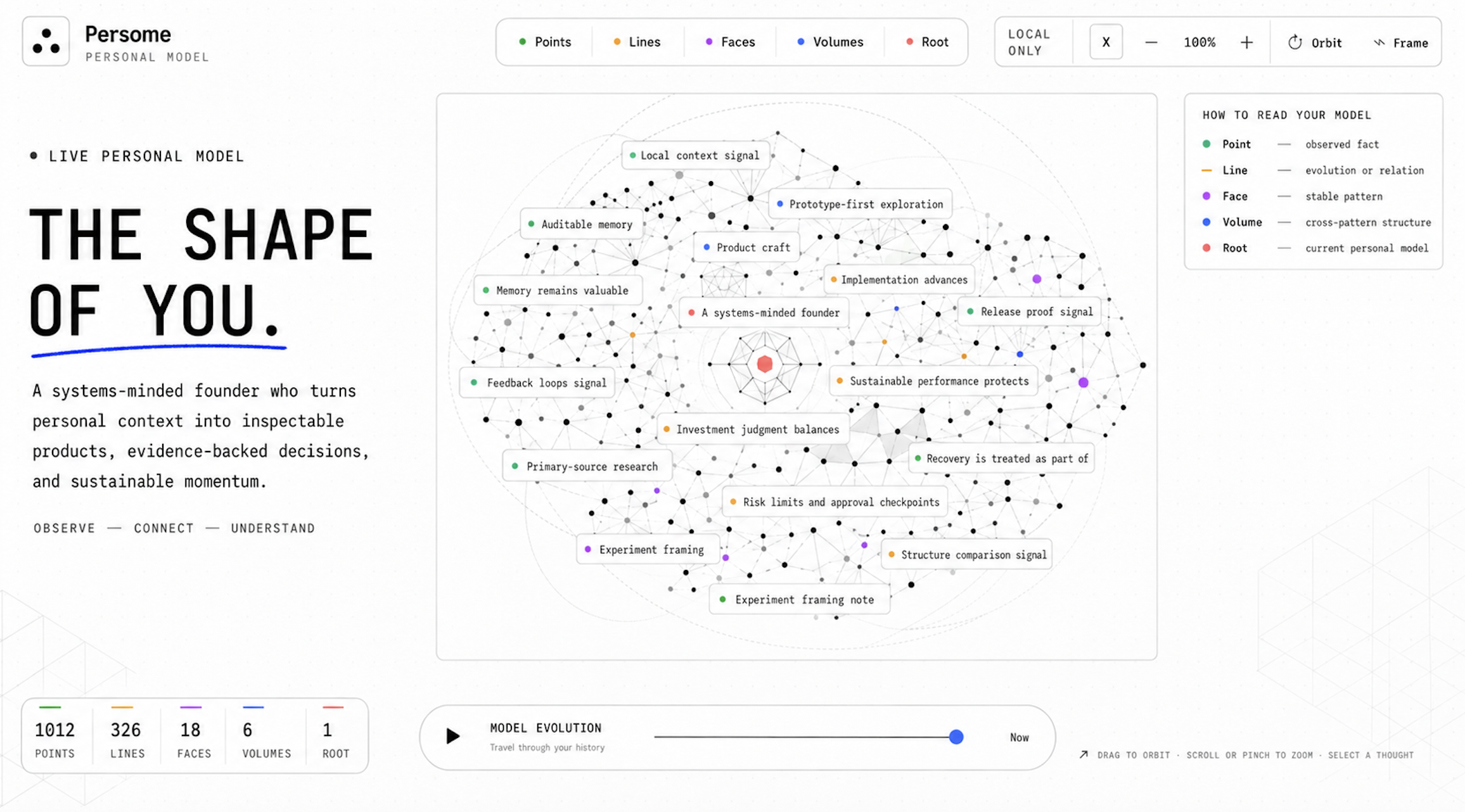
Concept illustration of a mature Personal Model.
Why Personal Model
Personal Model turns focused activity from the apps you use into a portable context layer, keeps it on your Mac, and makes it available to the trusted AI clients you choose.
- One memory across agents. Connect the same Personal Model to Claude Code, Codex, Cursor Agent, and other MCP-compatible clients.
- Evidence, not hidden summaries. Important claims retain source receipts; new evidence can strengthen, revise, or overturn an earlier inference.
- User-owned by design. Inspect, correct, export, or delete your model and data without depending on a hosted memory service.
- More than chat history. Personal Model learns from focused activity after you explicitly grant macOS permissions.
Your Personal Model is your HUMAN.md
Personal Model connects activity into progressively deeper context:
| Layer | Meaning |
|---|---|
| Point | A sourced observation or event |
| Line | A relationship or change over time |
| Face | A pattern supported by related evidence |
| Volume | A higher-order structure across projects or areas of life |
| Root | The current integrated model of you |
The result is a living model of what matters now, how you tend to decide, and where your attention is moving.
Works with Claude Code, Codex, Cursor Agent, and MCP clients
| Client | Connection | Setup |
|---|---|---|
| Claude Code | Native Personal Model installer | persome install claude-code |
| Codex CLI and IDE extension | Native Personal Model installer | persome install codex |
| Cursor Agent CLI | Native Personal Model installer | persome install cursor-agent |
| Claude Desktop | Managed stdio config | persome install claude-desktop |
| opencode | Managed local stdio config | persome install opencode |
| Other compatible clients | Generated MCP JSON | persome install mcp-json --filename persome-mcp.json |
The MCP client guide covers prerequisites, verification, the permission boundary, transport details, HTTP fallback, and troubleshooting.
Personal Model is an MCP server used by trusted MCP clients. Other MCP servers—such as Filesystem, GitHub, Slack, or Google Drive—are separate tools and are not Personal Model integrations unless that path is explicitly built and tested.
Use cases
These visuals show agent workflows enabled by Personal Model. The Runtime supplies evidence-linked local context through MCP; connected agents own task selection and execution, and external actions still require your authority.
1. One Root — A Model of You
Thousands of moments. One evolving model of you.
Personal Model turns sourced observations into relationships, patterns, higher-order structure, and one current Root: what matters now, how you tend to decide, and where your attention is moving.
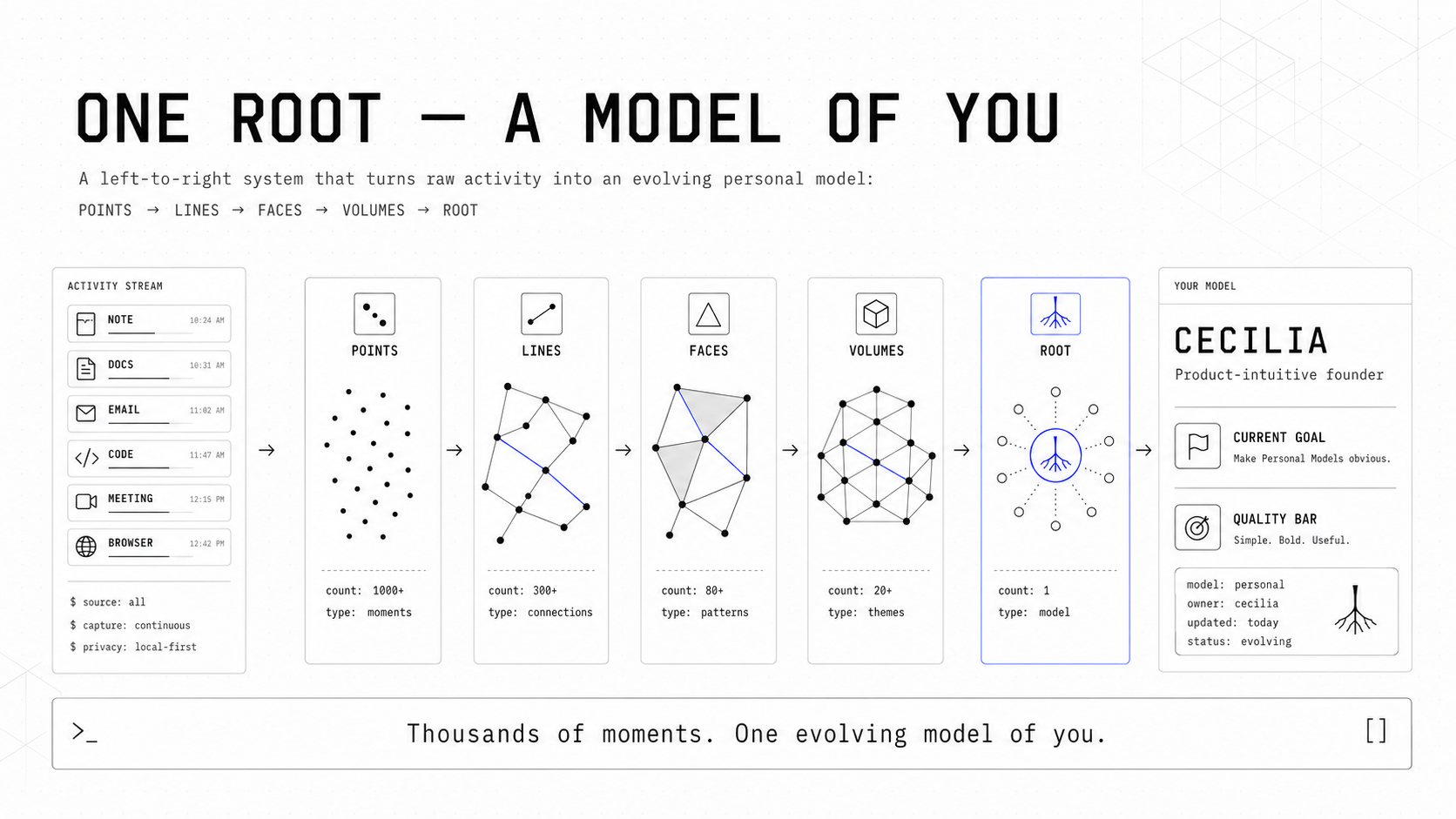
From Points to Lines, Faces, Volumes, and one Root—a living model of who you are and what matters now.
2. Same AI. Different You.
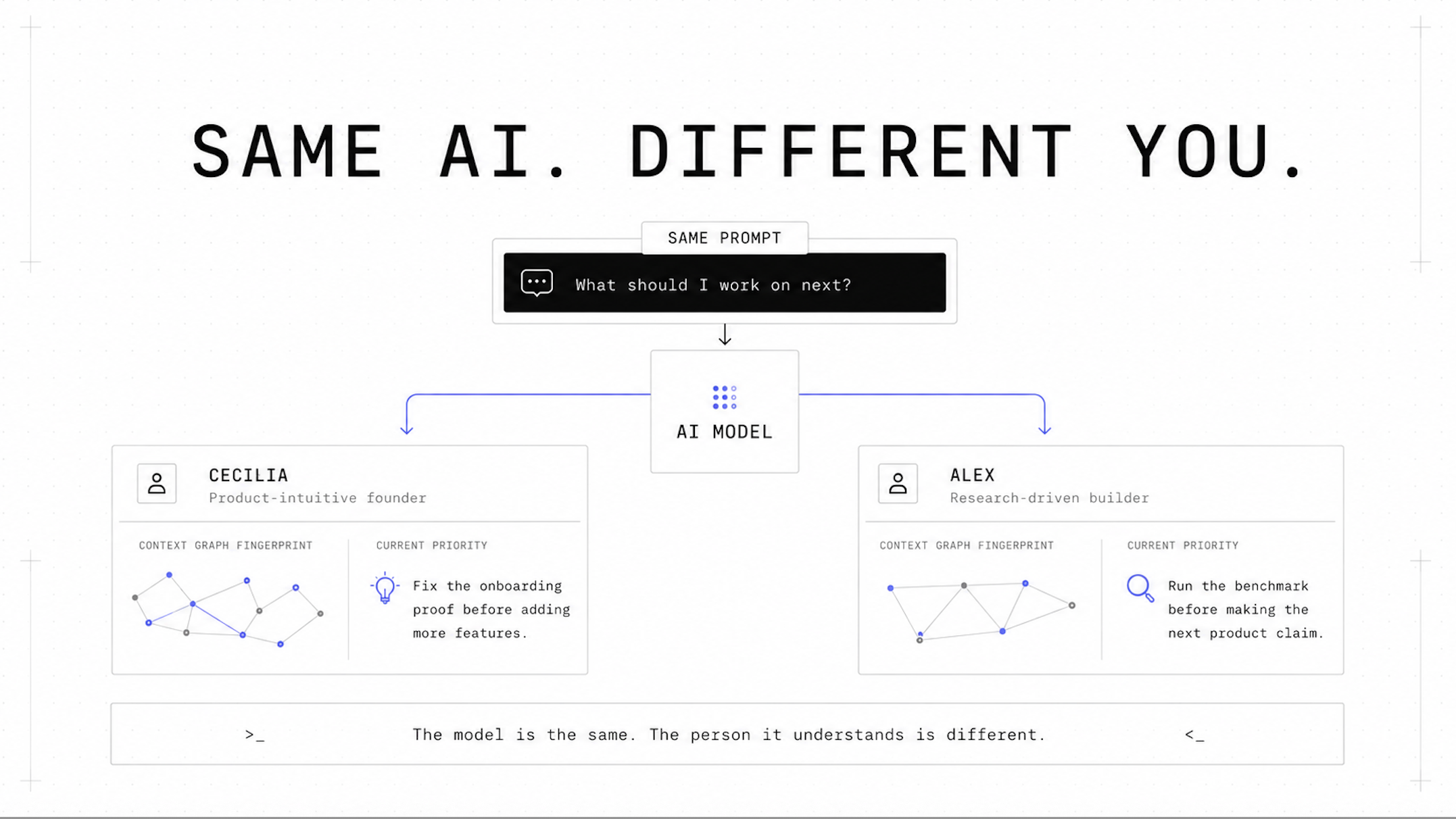
The model is the same. The person it understands is different.
Two people can give the same AI the same prompt and deserve different answers. Your Personal Model changes how an agent prioritizes, decides, writes, and acts—because it understands who it is working for.
The same prompt should not produce the same answer for everyone. Give AI a model of you.
3. One MCP — Turn coding agents into proactive agents
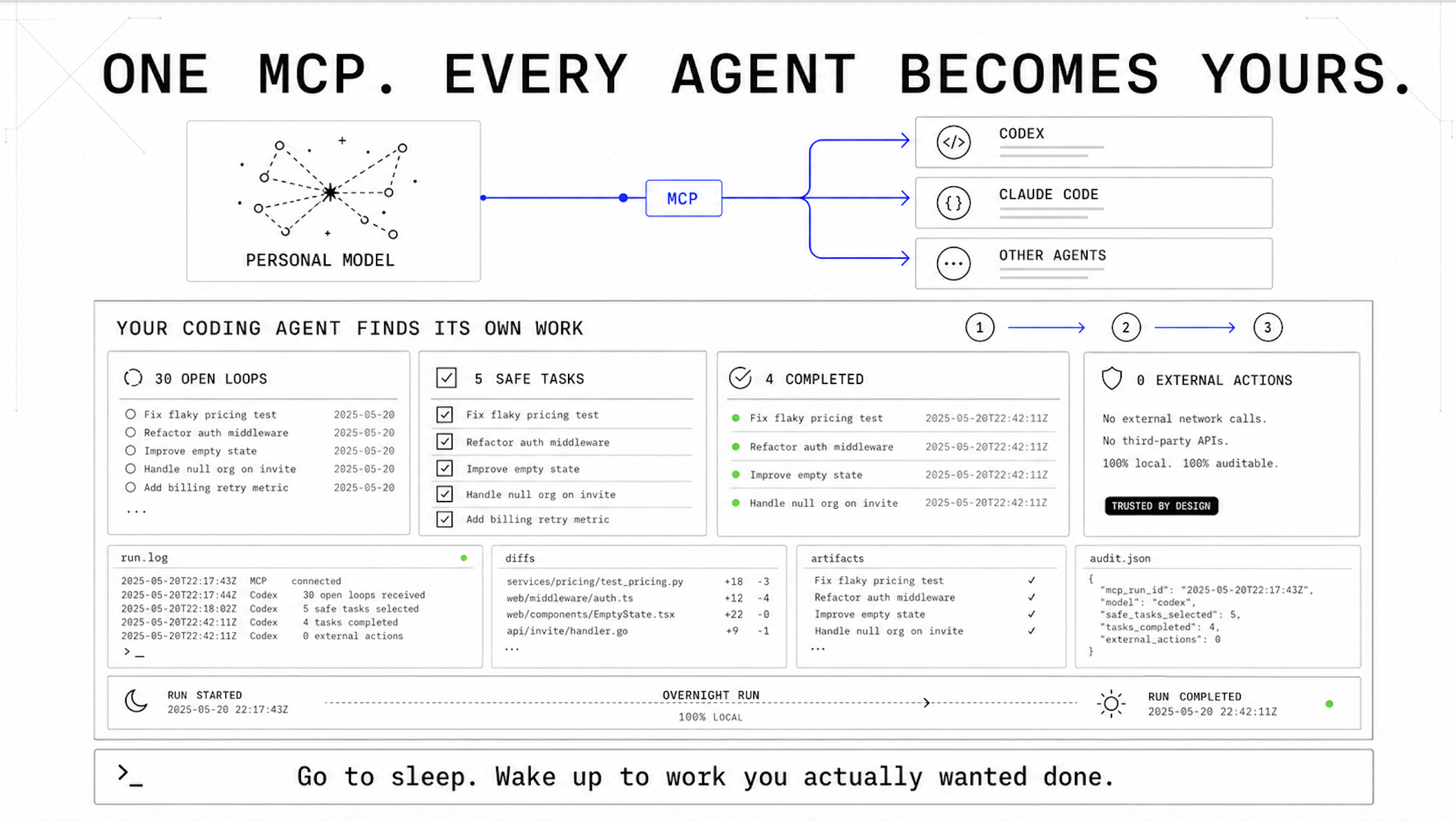
Your coding agent finds its own work
Connect Personal Model once through MCP. Codex, Claude Code, and other trusted agents can use the same model of your goals, priorities, working patterns, and boundaries.
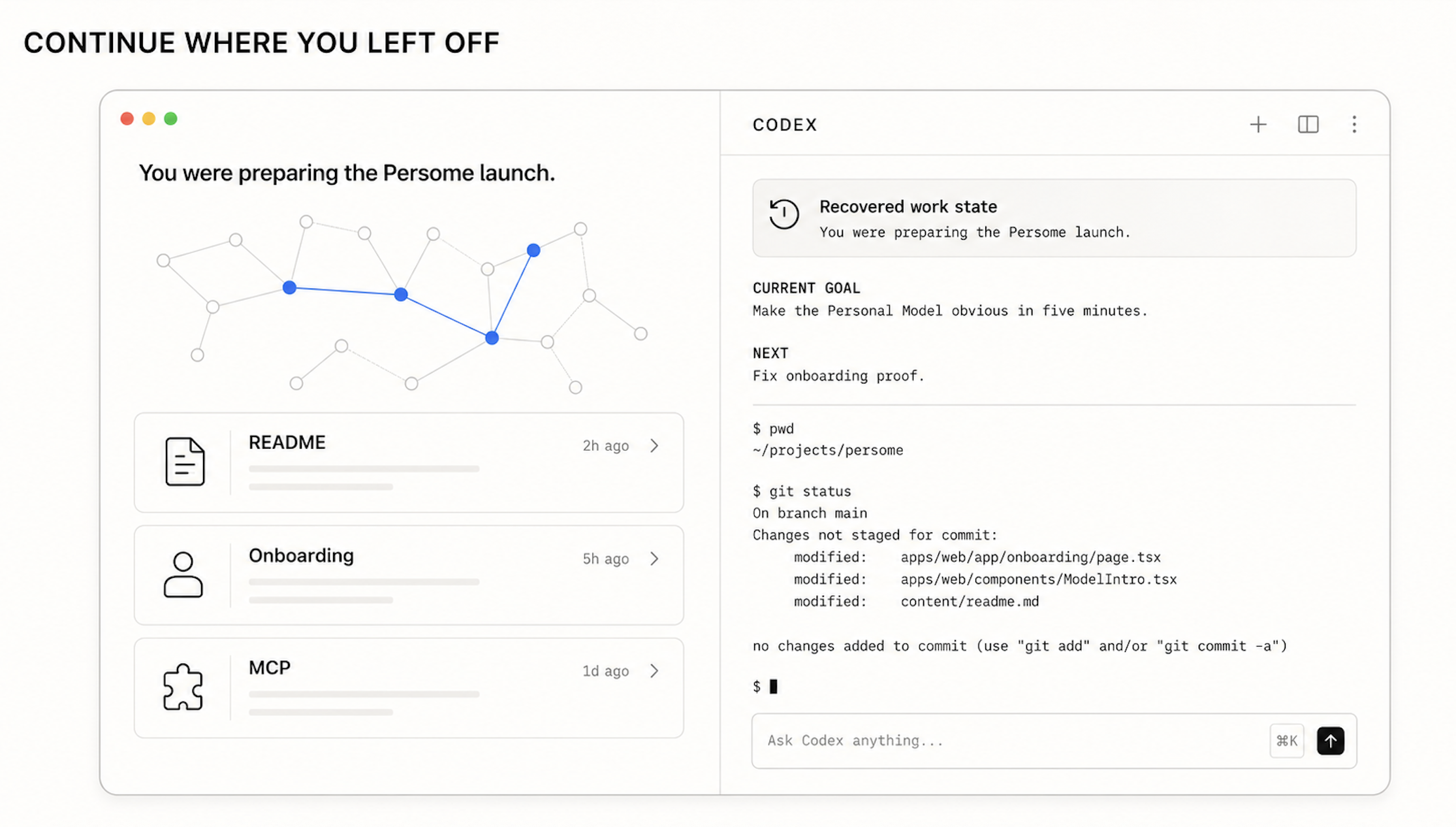
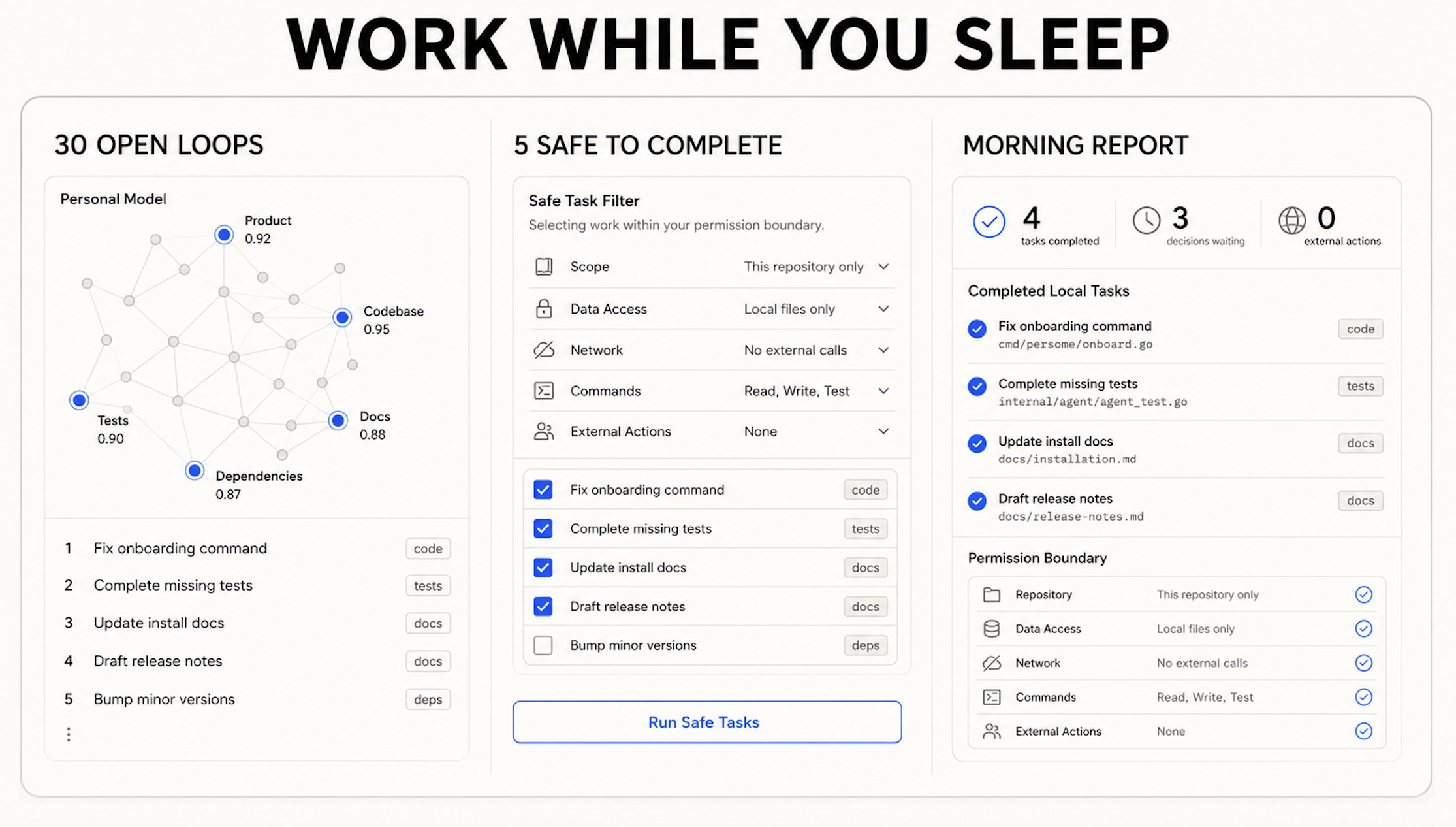
A connected agent can search Personal Model for unfinished work, rank proposed next steps against your priorities, and separate local implementation from external actions that need your approval.
Continue where you left off
Work while you sleep
Install, connect, and verify
Install Personal Model, connect a trusted MCP client, then verify the local Runtime.
1. Install with your data
Requirements: macOS 13 or newer and Xcode Command Line Tools. For the shortest package-managed installation:
The distribution is named personal-model; the installed CLI is persome.
For the most explicit source-based first run:
After successful interactive onboarding, the source installer opens the unified local setup experience immediately.
What onboarding proves
persome onboardexplains each macOS request before it appears.- Accessibility is granted to the versioned
mac-ax-helperand, only when event-driven capture is enabled,mac-ax-watcher. - Screen Recording is requested only when the effective screenshot or local-OCR policy requires pixels. Personal Model never requires Full Disk Access.
- On Apple Silicon, local OCR uses bundled PP-OCRv6; on Intel, it uses the macOS Apple Vision framework. Onboarding verifies the isolated worker on both architectures.
- Unified localhost onboarding offers a read-only, multi-source import and builds the first model
from existing Markdown history. Local folders are always available; Obsidian
and Notion appear only when detected on the Mac. The same sources remain
available through
persome import-data; see the import guide. - It proves the final lifecycle owner and Runtime generation, then reports a fresh-capture receipt in standard daemon mode or an explicit readiness/privacy receipt for supported alternate modes such as trusted ingest.
An LLM is optional for collection and BM25 recall, but required for semantic modeling. You can configure a hosted/local provider for unattended processing:
Related MCP Servers
Adoption & maintenance
Factual signals from GitHub, npm, and our automated checks — not a rating.
GitHub stars
1.3k
Stargazers on the source repository.
Last commit
1mo ago
Most recent push to the default branch.
Directory activity
2 views
Config copies, upvotes, and views on AllMCPs.
Reviews
No reviews yet — be the first to share how this listing worked for you.
Frequently Asked Questions about Persome
AllMCPs Directory Badge
Showcase your server listing on GitHub or your project documentation. Embed this dynamic SVG badge to highlight official listing status and live engagement.
Badge Style:
Live Dynamic SVG Preview
Markdown (GitHub README)
[](https://allmcps.com/mcp/persome)HTML Embed
<a href="https://allmcps.com/mcp/persome"><img src="https://allmcps.com/api/badge/persome?style=directory" alt="Persome on AllMCPs" /></a>Technical Specs & Signals
CategoryKnowledge & Memory
2/4 checks healthy over the last 45d
39Quality signal: Fair · 39/100How this signal is calculated ▾
Server availabilityNot measured
Not scored for repo-hosted servers — we can't reach the running server, only its GitHub page. Hosted MCP endpoints are health-checked live.
Verified ownership10/20
Documentation & tools11/30
Adoption & activity8/15
Community engagement0/10
A guidance signal from public completeness & health data — not a user rating. New listings start lower and rise as they add docs, get verified, and grow adoption. Signals we can't observe for a listing are skipped, not counted against it.
Own this project?
This directory is pre-filled from public sources. Claim via GitHub README, site badge, or DNS TXT to unlock edit access and the Official badge — proof is checked automatically, then reviewed by our team.
Free dofollow backlink: add your website and place the AllMCPs badge on it — no claim needed. We detect it automatically and keep it verified as long as the badge stays live.
Claim & get free dofollowShare & Embed
Add our SVG badge (dark/light directory styles) or embeddable widget to your site.