Order food on DoorDash — compare real fee-included totals; you approve every order.
Quick Install
Automated & IDE SetupCopy the AI prompt to install this server into Claude Code, Cursor, or another agent — or use 1-click editor setup below.
Not yet automatically verified
We haven't yet run this listing's install command through our automated sandbox check. This isn't a red flag — we're steadily working through the catalog.
Manual Client & Custom JSON ConfigExpand JSON ▾
Client Config & Setup
Choose your client or environment
Target File:
💡 Paste the JSON block into your client's configuration file under mcpServers, then restart the application.
Documentation Overview
Peckish 🍜
Feeling peckish? Just ask. An AI ordering agent for DoorDash — it searches,
compares real totals (fees included), builds the cart, and you approve every
order. Built on Claude and DoorDash's official
dd-cli.
One tool layer, three surfaces:
| Surface | Start | Best for |
|---|---|---|
| Terminal chat | peckish | Living in the terminal |
| Local web app | peckish-web → http://localhost:4747 | Consumer-friendly UI: store cards, live quote, Stop button, order modal |
| MCP server | claude mcp add peckish -- npx -y peckish-mcp, or the double-click .mcpb | Claude Desktop / Claude Code users — no API key needed; your Claude subscription powers the model |
Which one is for me?
- Comfortable with a terminal? → Terminal chat. Fastest, most informative.
- Want something that feels like an app? → Local web app. Cards, live quote, a proper Place-order button.
- Already use Claude Desktop or Claude Code? → MCP server. No API key, no separate chat window — Claude itself becomes your ordering agent, and order confirmation appears as a native dialog.
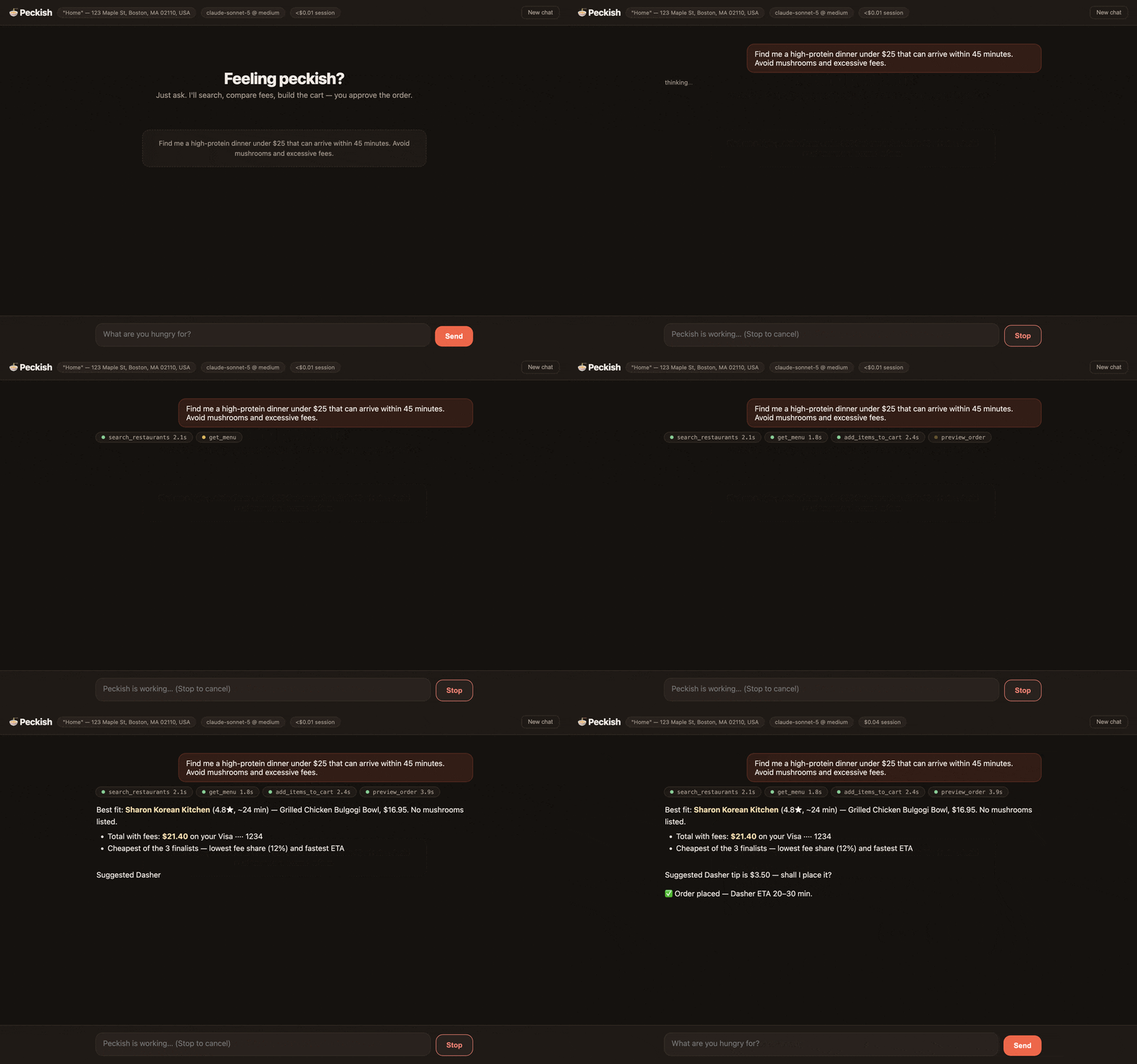
Scripted demo of the web app — store, prices and card are fictional;
the interface and the approval gate are the real ones.
Updates: every release ships with full notes, all artifacts, and a
SHA256SUMS.txt on Releases —
see CHANGELOG.md for the history. Watch the repo (Releases
only) to get notified.
Install in one line — no git clone:
Prefer an app? Download the Mac app (.dmg) — guided setup, no terminal at any step. See Mac app below. Everything runs on your own machine either way, because dd-cli holds your DoorDash session there — a Mac (Apple Silicon) or Linux x86_64, including containers and cloud sandboxes: see Linux, containers and headless hosts.
Get started (user guide)
1. Prerequisites
- A Mac with Apple Silicon (M1–M4) or Linux x86_64 — the two platforms dd-cli publishes builds for. Peckish is local-first: whichever machine you run it on is the backend on every surface, because that's where dd-cli holds your DoorDash session.
- Node.js 20+ —
node --versionto check; install from nodejs.org or brew. - DoorDash CLI access (currently waitlist-gated by DoorDash). Peckish
requires dd-cli ≥ 0.2.1 — on Linux, ≥ 0.2.2, the first release
with Linux builds — and targets ≥ 0.2.5, the current release. Older
binaries still order fine; Peckish reads
dd-cli --versionat startup and turns off only what that build can't do (see dd-cli versions). Download the release from doordash-oss/doordash-cli, verify the SHA256 checksum against the published value, then: No browser on that machine (container, VM, cloud sandbox)? See Linux, containers and headless hosts. - An Anthropic API key for the terminal/web surfaces (console.anthropic.com) — or skip the key entirely and use the MCP surface with your Claude subscription (step 4).
2. Install Peckish
That's it — you now have three commands: peckish (terminal chat),
peckish-web (web app), and peckish-mcp (MCP server).
Or install from source (contributors)
3. Run it — terminal or web
On boot Peckish verifies your DoorDash sign-in, shows your default delivery
address, and flags any open carts you forgot about. If sign-in is missing or
expired, Peckish offers to fix it for you: the terminal asks before launching
dd-cli login (which opens your browser), the web app shows a sign-in card,
and mid-conversation the agent can offer the same assist on any surface — you
approve, sign in in the browser, and it picks up where it left off. On a
machine with no browser, Peckish skips that offer and tells you how to inject
a token instead — see below.
4. Or run it inside Claude — no API key
Claude itself becomes the ordering agent, and your Claude subscription pays for the model. Pick whichever fits your client:
Claude Code — one line:
Claude Desktop — download peckish-0.2.2.mcpb from
Releases and
double-click it. Claude Desktop installs it like a browser extension: no
terminal, no Node install, no JSON editing.
Or configure Claude Desktop by hand
Add to ~/Library/Application Support/Claude/claude_desktop_config.json:
If dd-cli isn't at ~/.local/bin/dd-cli, add
"env": { "DD_CLI_PATH": "/your/path/to/dd-cli" } — desktop apps don't
inherit your shell PATH.
Peckish is also listed in the MCP Registry
as io.github.CydVilla/peckish, so clients that browse the registry can find
it directly.
Restart Claude Desktop and ask it to find you dinner. Order confirmation appears as a native dialog; clients that can't render dialogs can browse and build carts but cannot place orders (fail closed).
5. Everyday use
Things to say:
- "Find me a high-protein dinner under $25 that can arrive within 45 minutes. Avoid mushrooms and excessive fees."
- "Compare the real totals at the top two — fees included."
- "Reorder my usual from Sharon Korean."
- "What did I spend on delivery last month?"
- "Is this place actually good?" (checks web reviews)
- "Never mushrooms, ever." → saved permanently; applied automatically next time
- "Get me milk, eggs, and a pound of ground beef from Whole Foods."
Placing an order always ends with an explicit confirmation you perform —
typing yes in the terminal, clicking Place order in the web modal, or
approving the dialog in Claude Desktop. Before that, Peckish must show you the
itemized quote, confirm the tip, and name the card being charged. Decline
anything and it backs off.
Controls & housekeeping
| Where | What |
|---|---|
| Terminal | /prefs saved preferences · /cost session spend · /reset new conversation · /quit · Ctrl+C stops a running turn |
| Web | Stop button cancels a turn · New chat resets · header chip shows session cost · click the address chip to switch your delivery address (editing an address's text happens on doordash.com — Peckish picks it up automatically) |
| Both | Preferences live in ~/.peckish/preferences.json; a full audit log of every tool call and confirmation is written to ~/.peckish/logs/*.jsonl |
Cost: defaults are tuned for low spend at decent quality — claude-sonnet-5
at medium effort, prompt caching on the system prefix and conversation tail,
and server-side context editing that prunes stale menu payloads in long
sessions. The cost meter shows the approximate spend per turn and per session.
Max quality: DD_AGENT_MODEL=claude-opus-4-8 DD_AGENT_EFFORT=high. (On MCP,
the client chooses and pays for the model.)
Troubleshooting
Related MCP Servers
Adoption & maintenance
Factual signals from GitHub, npm, and our automated checks — not a rating.
npm downloads
318
Package downloads in the last 30 days.
Last commit
1mo ago
Most recent push to the default branch.
Directory activity
1 views
Config copies, upvotes, and views on AllMCPs.
Reviews
No reviews yet — be the first to share how this listing worked for you.
Frequently Asked Questions about Peckish — DoorDash ordering
AllMCPs Directory Badge
Showcase your server listing on GitHub or your project documentation. Embed this dynamic SVG badge to highlight official listing status and live engagement.
Badge Style:
Live Dynamic SVG Preview
Markdown (GitHub README)
[](https://allmcps.com/mcp/peckish-doordash-ordering)HTML Embed
<a href="https://allmcps.com/mcp/peckish-doordash-ordering"><img src="https://allmcps.com/api/badge/peckish-doordash-ordering?style=directory" alt="Peckish — DoorDash ordering on AllMCPs" /></a>