Parlament MCP README
The full upstream README, mirrored here for reference. Install config, tool schemas, adoption signals, and an original overview live on the Parlament MCP listing page.
🏛️ parlament-mcp




Part of the Swiss Public Data MCP Portfolio – connecting AI models to Swiss public data sources.
Note: This server covers the federal level (Curia Vista). This repo additionally hosts a self-contained subproject under
openparldata-mcp/— the subnational counterpart for the 26 cantons and ~70 municipal parliaments (OpenParlData.ch). The two are independent servers.
An MCP server that connects AI models to the Swiss Federal Parliament via the
Curia Vista OData API (ws.parlament.ch).
Access motions, interpellations, votes, members, sessions, and the verbatim
debate transcripts of the Amtliches Bulletin – with no API key required
(Phase 1 – No-Auth-First).
🎯 Anchor Demo Queries
Metadata layer:
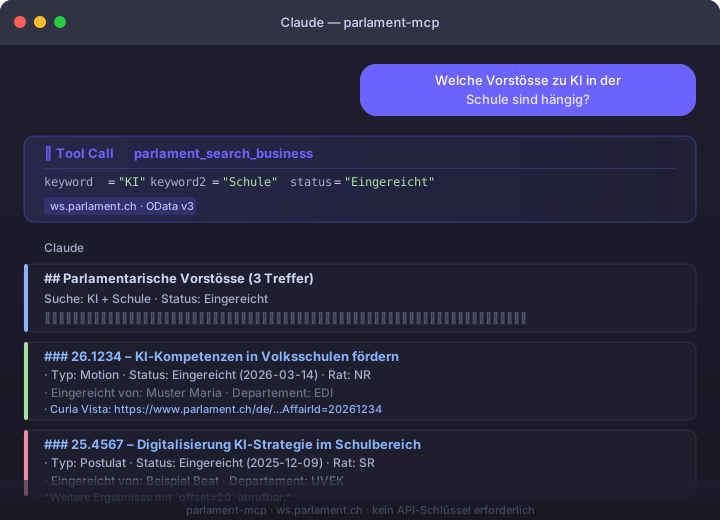
"Welche Vorstösse zu KI in der Schule sind hängig?" →
parlament_search_business(keyword="KI", keyword2="Schule", status="Eingereicht")
Verbatim transcripts (Amtliches Bulletin):
"What did National Councillor Munz say in the 2024 spring session about the Volksschule? Give me the exact wording with a correct AB citation." →
parlament_search_transcripts(speaker_name="Munz", session_id=5202, keyword="Volksschule")→ thenparlament_get_transcript(transcript_id=…)for the full wording.Returns short, citable excerpts (
AB 2024 N, 2024-03-13, Munz Martina) with a stable source URL; the verbatim text is fetched on demand, never in bulk.
Perfect for the KI-Fachgruppe Stadtverwaltung Zürich: find pending motions on AI in education, or quote what was actually said in the chamber – instantly.
🔧 Tools
| Tool | Description |
|---|---|
parlament_search_business | Search Vorstösse by keyword, type, status, council, date |
parlament_get_business | Full details of a single business (texts, FC response) |
parlament_search_members | Find councillors by canton (e.g. ZH), party, council |
parlament_get_votes | Parliamentary votes with Ja/Nein meaning |
parlament_get_sessions | List recent sessions with IDs for follow-up queries |
parlament_search_transcripts | Search debate transcripts → citable excerpts with AB citation + source URL (speaker / session / business / date filters) |
parlament_get_transcript | Fetch the verbatim full text of a single speech by ID (capped, paginated, is_excerpt flagged) |
🏗️ Architecture
🚀 Installation
Claude Desktop (stdio)
Add to ~/Library/Application Support/Claude/claude_desktop_config.json:
Local development
Cloud / Railway (SSE)
Network binding
By default the server binds to 127.0.0.1 (localhost only). Set
MCP_HOST=0.0.0.0 only inside a container/cloud context (Docker, Railway,
Render, Kubernetes). Never bind to 0.0.0.0 on a local dev machine – it exposes
the server to your local network (NeighborJack risk); the server logs a warning
if you do so outside a detected container.
Transport is selected via MCP_TRANSPORT (stdio default, or sse /
streamable-http); --http is kept as an alias for streamable-http.
Authentication (optional)
The HTTP transport is open by default (public read-only data). To require a
bearer token, serve via the CORS/auth app factory and set MCP_BEARER_TOKENS:
Each request then needs Authorization: Bearer <token>; identity comes from the
validated token, not a session header (see docs/security.md).
Docker
Kubernetes manifests (hardened securityContext, resource limits, egress
NetworkPolicy, Mcp-Session-Id sticky routing) live in deploy/k8s/;
an HAProxy stick-table example is in deploy/haproxy.cfg.
🔗 Synergies
| Partner Server | Combination |
|---|---|
openparldata-mcp | Federal ↔ subnational — same question across cantons & municipalities |
fedlex-mcp | Law text ↔ parliamentary debate that created it |
zurich-opendata-mcp | City policy ↔ cantonal/federal motions |
swiss-statistics-mcp | Data backing ↔ motions citing statistics |
Power query example:
📊 Data Source
- API: ws.parlament.ch/odata.svc
- Authentication: None (Phase 1 – No-Auth-First)
- Protocol: OData v3 / JSON
- Coverage: All parliamentary businesses since 1978; votes since ~2000. Structured verbatim transcripts (Amtliches Bulletin) from 1999-12-06 onward (earlier years 1891–1999 exist only as archive scans — see Known Limitations).
- Update cycle: Real-time (official government data)
Copyright — verbatim quotation is allowed
Official proceedings of Swiss authorities are excluded from copyright under Art. 5 para. 1 lit. a URG (Swiss Copyright Act). The verbatim wording of parliamentary debates in the Amtliches Bulletin may therefore be reproduced and quoted freely — which is exactly what the transcript tools return: the wording itself, never a summary standing in for it.
📜 Data sources & licenses
| Source | License | Attribution |
|---|---|---|
| Curia Vista (ws.parlament.ch) | CC BY 4.0 | © Schweizer Parlament, CC BY 4.0 |
Every tool returns a typed structured response (FastMCP exposes the output
schema) carrying source, license, provenance, match_type and count
alongside typed results. Data is passed through unmodified.
🧭 Phase
This server is in Phase 1 — Read-only Wrapper (all tools readOnlyHint: true,
no writes). The full phase model and transition criteria are in
docs/roadmap.md.
🔖 MCP Protocol Version
This server speaks two protocol eras over the same endpoint. The client's first request on a connection decides which one applies; a later claim from the other era is refused.
| Era | Revision | Who reaches it |
|---|---|---|
initialize handshake | 2024-11-05 … 2025-11-25 | What today's clients speak. The server answers with the revision asked for, or with the 2025-11-25 ceiling when the request asks for something newer. |
| Per-request envelope | 2026-07-28 | A request carrying the 2026-07-28 _meta envelope opens a modern connection. |
Both revisions are pinned in
tests/test_protocol_version.py and asserted
against the installed SDK, so a Dependabot bump of mcp cannot move either one
silently. This server builds no ASGI app to send an initialize through, so
the gate asserts the SDK constants rather than a measured response — the
weaker form, named rather than left unsaid.
Note that the SDK's LATEST_PROTOCOL_VERSION is an alias for the modern
era, not for the handshake era — pinning against it alone would leave the era
that current clients actually negotiate free to drift.
Update policy. When the gate fails, do not edit the constant blindly: read
the spec changelog between the two revisions, verify the server still behaves,
then move the constant, this section, README.de.md and
CHANGELOG.md together.
🧱 MCP primitives
Phase 1 uses Tools only — rationale and the Phase-2 Resources plan are in
docs/adr/ADR-003-mcp-primitives.md.
🏷️ Tool annotations
All tools declare explicit annotations consistent with their behaviour:
| Tool | readOnly | destructive | idempotent | openWorld |
|---|---|---|---|---|
parlament_search_business | ✅ | — | ✅ | ✅ |
parlament_get_business | ✅ | — | ✅ | ✅ |
parlament_search_members | ✅ | — | ✅ | ✅ |
parlament_get_votes | ✅ | — | ✅ | ✅ |
parlament_get_sessions | ✅ | — | ✅ | ✅ |
parlament_search_transcripts | ✅ | — | ✅ | ✅ |
parlament_get_transcript | ✅ | — | ✅ | ✅ |
📈 Observability
Structured JSON logs go to stderr (stdout stays reserved for the stdio
protocol). OpenTelemetry tracing wraps each tool call and auto-instruments
outgoing HTTP; set OTEL_EXPORTER_OTLP_ENDPOINT (with the otel-export extra)
to ship spans. See docs/security.md for the full security
posture (Lethal-Trifecta assessment, egress allow-list, gateway hardening).
🛡️ Safety & Limits
| Aspect | Details |
|---|---|
| Access | Read-only (readOnlyHint: true) — the server cannot modify or delete any data |
| Personal data | Parliamentary businesses are public record by law (BGÖ). No private data is accessed or stored. |
| Rate limits | Built-in per-query caps: max. 100 results (businesses/members), 50 (votes), 30 (transcript search), 10 (sessions). Transcript full text is capped per call and paginated — you never pull a whole session by accident. |
| Timeout | 20 seconds per metadata call; 45 seconds for transcript reads (verbatim search is heavier) |
| Authentication | No API keys required — Curia Vista is publicly accessible |
| Data source | Official Swiss federal government data (Schweizerische Parlamentsdienste) |
| Terms of Service | Subject to ToS of ws.parlament.ch — Schweizerische Parlamentsdienste |
Known Limitations
General
- OData
substringof()filter is case-sensitive for some fields. - Session names may be
nullin the API for very recent sessions – use session ID.
Transcripts (Amtliches Bulletin) — verified live 2026-07-19:
- Temporal coverage: from 1999-12-06 only. The structured
Transcriptentity reaches back to Dec 1999. Debates from 1891–1999 exist only as scanned archive documents (Bundesarchiv / Amtsdruckschriften) and are not connected here (no OCR in scope). A query whose whole date window predates coverage returns an explanatory error, not an empty result. - No page number in the source. The API carries no page/column field, so the
classic
AB <year> N <page>form cannot be built. We emit a stable, verifiable substitute —AB <year> <N|S>, <date>, <speaker>— plus the authoritativesource_url(SubjectId) and thetranscript_id. This is a documented, honest trade-off, not an omission. - Language behaviour (important).
Languageis the edition, not the spoken language. The tools filterLanguage eq 'DE'purely to deduplicate the three byte-identical editions (DE/FR/IT) down to one copy. Every speech is returned in its original wording; a French or Italian speech is not hidden — its real language is reported in thelanguagefield (de/fr/it). The response states this vialanguage_note. - Truncation is explicit, never silent. Search returns short excerpts
(
snippet, ~320 chars) withis_excerpt,total_length_charsand a hint to fetch the full text.parlament_get_transcriptcaps output atmax_chars; when it truncates it setsis_excerpt=Trueand returns anext_offsetto continue. - Verbatim only, never summarised. The wording is the product; the tools never substitute a summary for the actual text.
- Latency: a free-text
keywordcombined with aspeaker_nameis the slowest path (~40 s). Add asession_id,business_numberor date window to keep reads around 1–2 s.
🧪 Testing
HTTP is mocked with respx; network-dependent tests are marked
@pytest.mark.live and excluded from CI via -m "not live". Tool definitions are
pinned in tool-hashes.json (python -m parlament_mcp.tool_hashes --check).
Contributing
See CONTRIBUTING.md.
Security
See SECURITY.md for the security policy and posture (vulnerability reporting, Lethal-Trifecta assessment, accepted risks).
License
MIT © Hayal Oezkan — see LICENSE
Author
Hayal Oezkan · github.com/malkreide
Installation
Run via uv's uvx — no clone or manual install needed. Add to your MCP client config (mcpServers for Claude Desktop, Cursor and Windsurf; use a top-level servers key for VS Code in .vscode/mcp.json):