gostatic-analysisdeveloper-toolsmcpcodebase
AST-aware MCP server for Go repos providing structural graphs with type-checked enrichment for codebase context.
Quick Install
Automated & IDE SetupCopy the AI prompt to install this server into Claude Code, Cursor, or another agent — or use 1-click editor setup below.
One-click editor setup isn’t available for this listing yet — we don’t have a confirmed install command, and we’d rather show nothing than point your editor at the wrong package or host. Follow the project’s own setup instructions, linked above.
Manual Client & Custom JSON ConfigExpand JSON ▾
No confirmed setup config for this listing yet. We only publish a config block when the install details come from the project itself — its README, its docs, or a verified owner. We haven’t found those for ozgurcd/gograph, and we’d rather show nothing than a guess you’d paste into your client. Follow the project’s own setup instructions for the current steps.
Overview
Use cases
Trace function callers and callees in Go codebases
Analyze interface implementations and public API surfaces
Plan impact of code changes before refactoring
Enforce architectural constraints in Go projects
Generate repository-wide code complexity and hotspot reports
Key features
Builds precise structural graphs with optional type-checked enrichment
Supports Go struct embeds, SQL queries, and error mapping
Static analysis without executing target code
Integrates with local Go toolchain for build/module context
Produces detailed reports and supports MCP protocol for AI agents
Excludes non-regular files and respects .gitignore and Go build constraints
Capabilities & Tool Schemas
Inspect callable tools, capabilities, and parameters exposed to AI agents by Gograph.
Extracted Tool Capabilities
Builds precise structural graphs with optional type-checked enrichment
Supports Go struct embeds, SQL queries, and error mapping
Static analysis without executing target code
Integrates with local Go toolchain for build/module context
Produces detailed reports and supports MCP protocol for AI agents
Excludes non-regular files and respects .gitignore and Go build constraints
Documentation Overview
gograph




Give Go coding agents a compiler-aware map for safer refactors.
gograph builds a local structural graph of your Go repository, with optional
type-checked CHA/SSA enrichment. Its CLI and MCP workflows help coding agents
trace callers and interface implementations, plan change impact, and enforce
architecture without embeddings or a hosted code index.
Explore the interactive no-install demo · Review the reproducible benchmark
See CLI/MCP query contracts for bounded result pages, snapshot-bound cursors, exact/possible impact, and change-evaluation status.
Companion projects: Scrinium provides repository-owned, evidence-backed knowledge for coding agents, while Rulefloor protects repository-local invariants by binding them to concrete tests and detecting drift. They are independent, optional tools: Scrinium can keep Gograph structural observations and Rulefloor validation results as separate evidence without treating either as proof of unrelated behavior or global project correctness.
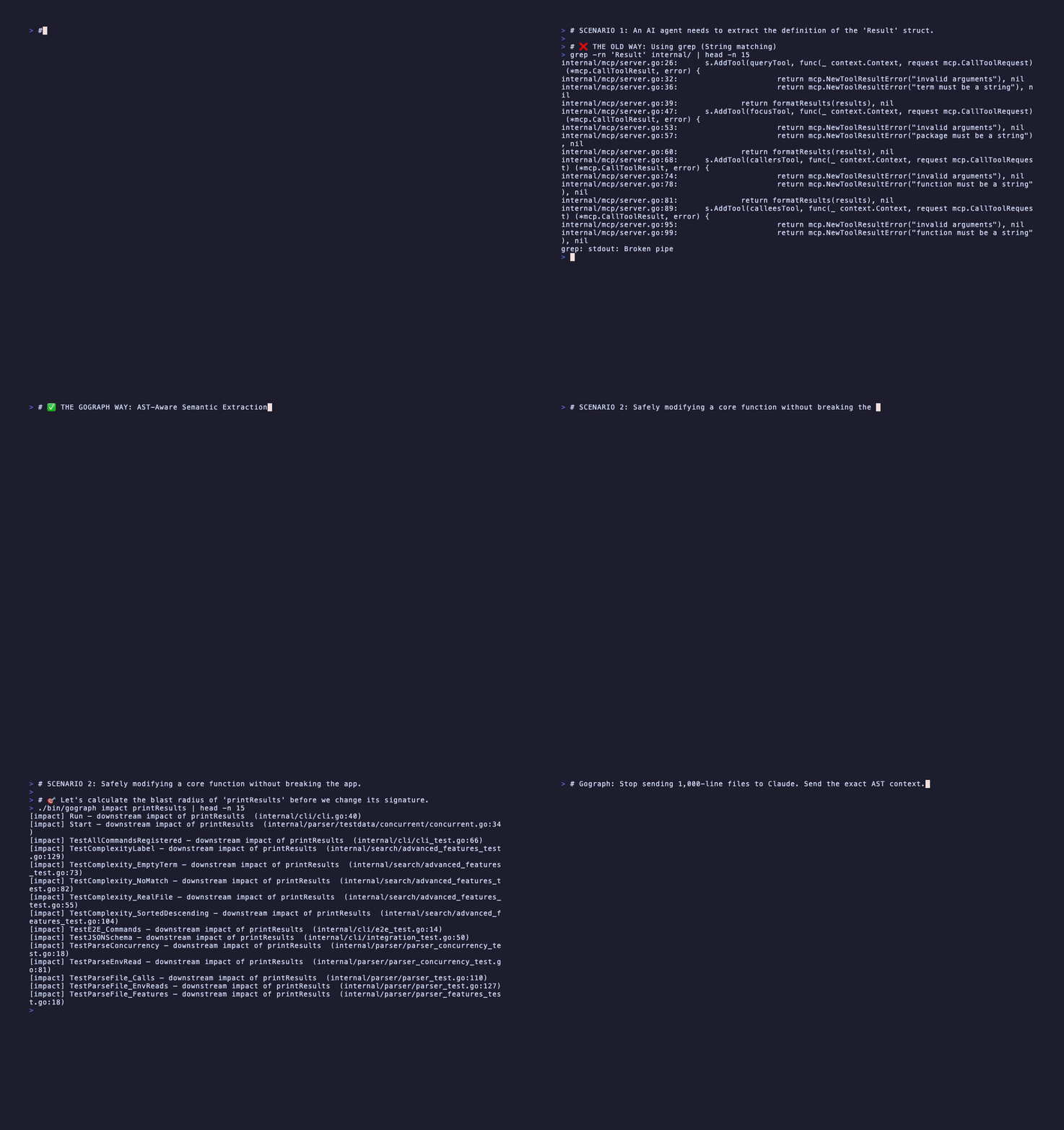
Static analysis; no target-code execution. Default indexing parses Go source locally and does not call application services. Linked directories and linked/special files for extensions recognized by
go/buildare excluded; unrelated regular-file or dangling links with non-Go extensions are not Go tool inputs and do not block precise analysis. Graph-directed source reads remain confined to regular files beneath the analyzed repository, and linked/non-regular Go tool metadata (go.mod,go.sum,go.work,go.work.sum, andvendor/modules.txt) is rejected before toolchain invocation; an explicitly symlinked repository root remains supported. Applicablego.work usemembers may be sibling modules beneath the nearest real Git checkout; without that boundary they remain confined beneath the workspace directory. Each member directory,go.mod, and optionalgo.sumis validated beforecmd/gostarts. Gograph also reads project metadata such as.gitignore, graph/config JSON, and Git state. Indexing asks the installed Go toolchain for the effective build/module context; precise mode additionally performs package type loading, anddocrunsgo doc. Those operations follow your configured module/cache/network policy. Before repository package loading orgo doc, applicable local module/workspace source trees are preflighted for links thatcmd/gomay inspect;.gitand.gographsubtrees are excluded. Session telemetry is local under.gograph/sessions/; nothing is sent to gograph services.
Quick Start
Homebrew and go install install the normal gograph CLI. MCP clients that
support MCP Bundles can instead discover the local stdio server in the
official MCP Registry as
io.github.ozgurcd/gograph. Registry/MCPB installation is a separate
distribution path; it does not install the Homebrew cask or configure the
Claude Code marketplace plugin. The Registry is currently in preview. See
Official MCP Registry and MCPB installation for client
support, target selection, and current limitations.
Choose a real function or method shown by summary, hotspot, or
gograph complexity, then substitute its name below:
Build artifacts are written under the target .gograph/ directory. gograph
adds .gograph/ to the enclosing Git repository root .gitignore when
available, falls back to the build target .gitignore outside Git, and exits
without replacing artifacts if no Go files are found or no source file parses
successfully. The update accepts only an absent or regular .gitignore; a
repository-provided link is refused and its target is not modified. Go build
constraints, explicit comma-separated --tags (or inherited GOFLAGS when
the flag is absent), cmd/go package-directory rules, generated
sources, module-mode ignore directives, and Git ignores use the same scanner
policy for building, freshness checks, and change detection. Linked .go
files, linked directories, and other non-regular recognized Go inputs are
reported and excluded. Unrelated regular-file and dangling links with non-Go
extensions (for example YAML configuration or TSV fixtures) are ignored by
Go-tool preflight;
linked/non-regular go.mod, go.sum, go.work, go.work.sum, and
vendor/modules.txt entries are rejected before gograph or the Go toolchain
reads them. Applicable go.work use members may be sibling modules beneath the
nearest real Git checkout. Non-Git layouts retain workspace-directory
confinement, nested Git boundaries are not crossed, and every member directory,
go.mod, and optional go.sum is validated before cmd/go starts.
.gograph itself must be a real directory, and graph.json must be a regular
repository-confined file. Graphs with a missing or unsupported confinement
policy marker must be rebuilt with the current binary before graph-backed
commands use them. Older binaries do not enforce this boundary and should not
be used to analyze untrusted repositories.
Each indexed source file stores a SHA-256 content digest. Rebuilds reparse all
selected files in a changed package together and reuse parser records for
unchanged packages; stats reports reused_files and rebuilt_packages.
Precise builds reuse that AST work but still recompute repository-wide
type/CHA/SSA enrichment so cross-package dispatch remains correct.
Low-memory mode preserves those graph semantics while using more aggressive
garbage collection, reclaiming memory between production and test analysis,
and avoiding a full JSON copy of the AST graph. --max-memory accepts integer
byte sizes such as 1GB or 1GiB and requires --memory-mode=low. It is a
soft Go-runtime memory target—not a hard RSS cap—so memory-mapped files,
the executable, and Go toolchain subprocesses can make process memory exceed
the requested value. Aggressive GC can increase CPU time, and a target that is
too low may make the build much slower or fail; Gograph never silently reduces
precision to meet it.
Precise fallback continues to exit zero by default for compatibility and is
recorded in graph metadata. Add --strict with --precise when fallback must
fail CI; Gograph still publishes or retains the diagnostic artifact before
returning non-zero.
For precise builds blocked by unrelated directories, see
directory exclusions. Use the same --exclude-dirs
selection on gograph mcp startup; imported dependencies must still type-check.
For symlinked skills, v1.7.2 supports --exclude-dirs=.claude/skills: directory
links beneath that real directory are hidden from Go loading, without following
their targets. Linked Go inputs and metadata remain protected. See the
Codex MCP setup guide for registration and verification.
Machine-readable structural validation
External consumers can validate one closed structural predicate without parsing human CLI output:
The version and result schemas are gograph.version.v1 and
gograph.validation.v1; bindings use gograph.binding.v1. V1 supports only
symbol_exists, package_imports, call_edge_exists, and type_implements.
Validation is read-only and never builds or refreshes the graph. Exit 0 means
pass, exit 1 means a conclusively evaluated fail, and exit 2 means
cannot_evaluate or an invalid request.
Related MCP Servers
Adoption & maintenance
Factual signals from GitHub, npm, and our automated checks — not a rating.
GitHub stars
213
Stargazers on the source repository.
Last commit
1mo ago
Most recent push to the default branch.
Directory activity
2 views
Config copies, upvotes, and views on AllMCPs.
Reviews
No reviews yet — be the first to share how this listing worked for you.
Frequently Asked Questions about Gograph
AllMCPs Directory Badge
Showcase your server listing on GitHub or your project documentation. Embed this dynamic SVG badge to highlight official listing status and live engagement.
Badge Style:
Live Dynamic SVG Preview
Markdown (GitHub README)
[](https://allmcps.com/mcp/ozgurcd-gograph)HTML Embed
<a href="https://allmcps.com/mcp/ozgurcd-gograph"><img src="https://allmcps.com/api/badge/ozgurcd-gograph?style=directory" alt="Gograph on AllMCPs" /></a>Technical Specs & Signals
CategoryDatabases
PricingFree
49Quality signal: Fair · 49/100How this signal is calculated ▾
Server availabilityNot measured
Not scored for repo-hosted servers — we can't reach the running server, only its GitHub page. Hosted MCP endpoints are health-checked live.
Verified ownership10/20
Documentation & tools20/30
Adoption & activity7/15
Community engagement0/10
A guidance signal from public completeness & health data — not a user rating. New listings start lower and rise as they add docs, get verified, and grow adoption. Signals we can't observe for a listing are skipped, not counted against it.
Own this project?
This directory is pre-filled from public sources. Claim via GitHub README, site badge, or DNS TXT to unlock edit access and the Official badge — proof is checked automatically, then reviewed by our team.
Free dofollow backlink: add your website and place the AllMCPs badge on it — no claim needed. We detect it automatically and keep it verified as long as the badge stays live.
Claim & get free dofollowShare & Embed
Add our SVG badge (dark/light directory styles) or embeddable widget to your site.