Manage OpenZiti zero-trust networks — through natural language
Quick Install
Automated & IDE SetupCopy the AI prompt to install this server into Claude Code, Cursor, or another agent — or use 1-click editor setup below.
%5D(https%3A%2F%2Fopensource.org%2Flicenses%2FApache-2.0%22%7D)
Manual Client & Custom JSON ConfigExpand JSON ▾
Client Config & Setup
Remote HTTPChoose your client or environment
Target File:
💡 Paste the JSON block into your client's configuration file under mcpServers, then restart the application.
Documentation Overview



🚀 Getting Started • 🕸️ Architecture • 🔐 Authentication • 🛠️ Supported Tools • 🔒 Security • 🩺 Troubleshooting • 📋 Debug Logs • 👨💻 Development
The Ziti MCP Server is sponsored by NetFoundry as part of its portfolio of solutions for secure workloads and agentic computing. NetFoundry is the creator of OpenZiti and zrok.
MCP (Model Context Protocol) is an open protocol introduced by Anthropic that standardizes how large language models communicate with external tools, resources or remote services.
The Ziti MCP Server integrates with LLMs and AI agents, allowing you to perform various Ziti network management operations using natural language. For instance, you could simply ask Claude Desktop to perform Ziti management operations:
-
List which identities exist
-
Tell me if there are any exposures in the network
-
Do you see potential misconfigurations?
-
Which identities have access to the Demo1 service?
-
Create a new Ziti identity named "Demo" and get its ID
-
Log into my prod Ziti network using UPDB
-
Switch to the staging network
-
etc.
🚀 Getting Started
Prerequisites:
- Claude Desktop or any other MCP Client
- OpenZiti network
- Go 1.24+ (only if building from source)
Install
Download a pre-built binary
Pre-built binaries are available for macOS, Linux, and Windows (amd64 and arm64) on the releases page.
macOS (Apple Silicon)
macOS (Intel)
Linux (amd64)
Linux (arm64)
Windows
Download the appropriate .zip from the releases page and add the extracted ziti-mcp-server.exe to your PATH.
Build from source
Register with your AI Client
Use install to register the Ziti MCP Server with your AI client. This only updates the client's configuration file — it does not authenticate. Use the runtime login tools or init for that.
After installing, restart your AI client and use the runtime login tools to authenticate (e.g., ask: "Log into my Ziti network at ctrl.example.com with username admin").
Start and Log In
The server can start with no prior configuration. The AI agent can log into networks at runtime using the built-in login tools:
Then in your AI client, simply ask:
Log into my Ziti network at 192.168.1.100:1280 with username admin and password admin
For non-interactive or automated setups, use init to pre-configure credentials before starting:
See Authentication for all supported modes (UPDB, device auth, client credentials, identity file).
Manual Client Configuration
The install command handles client configuration automatically. If you need to configure an MCP client manually, add this to its configuration and restart:
You can add --tools '<pattern>' and/or --read-only to the args array to control which tools are available. See Restricting Tool Access.
Verify your integration
Restart your MCP Client (Claude Desktop, Windsurf, Cursor, Warp, etc.) and ask it to help you manage your Ziti network.
🕸️ Architecture
The Ziti MCP Server implements the Model Context Protocol, allowing clients (like Claude) to:
- Request a list of available Ziti tools
- Call specific tools with parameters
- Receive structured responses from the Ziti Management API
The server handles authentication, request validation, and secure communication with the Ziti Management API.
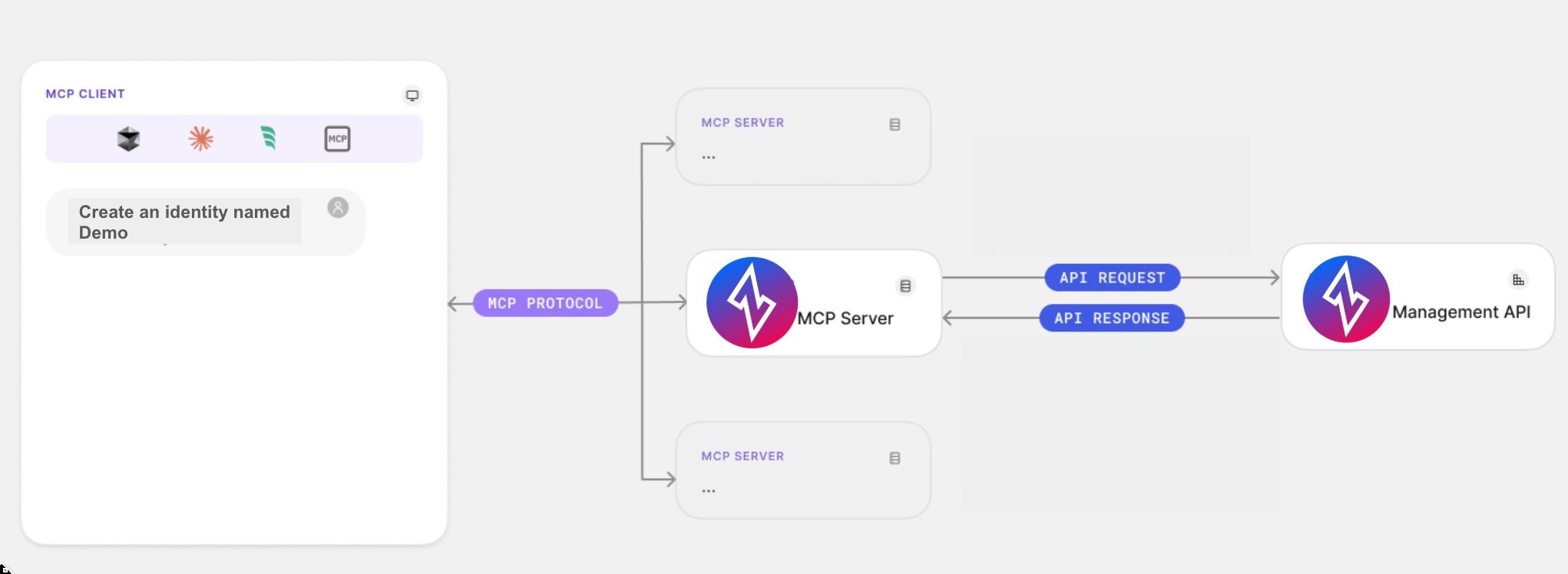
[!NOTE] The server operates as a local process that connects to Claude Desktop, enabling secure communication without exposing your Ziti credentials.
🔐 Authentication
The Ziti MCP Server uses the Ziti Management API and requires authentication to access your Ziti network.
Authentication Modes
The server supports four authentication modes:
UPDB Mode (Username/Password)
Use this mode for direct username/password authentication against the Ziti controller:
Or at runtime via the AI agent using the loginUpdb tool.
Device Auth Mode (Interactive Login)
Use this mode for interactive browser-based login. Recommended for development and user-facing scenarios:
Or at runtime via the loginDeviceAuth tool (returns a verification URL for the user, then completeLogin to finish).
Client Credentials Mode (Service Account)
Use this mode for service accounts and automation. Recommended for production environments:
[!NOTE] Keep the token lifetime as minimal as possible to reduce security risks. See more
Identity File Mode (mTLS Certificate)
Use this mode for certificate-based authentication with a Ziti identity JSON file. No IdP configuration is needed:
The identity file is a standard Ziti identity JSON file containing ztAPI, id.cert, id.key, and id.ca fields. The certificate material is extracted and stored in the config file. The identity file may be deleted after a successful init (for additional security, if desired).
[!IMPORTANT]
When using CLI
init, it needs to be run whenever:
- You're setting up the MCP Server for the first time
- You've logged out from a previous session
- You want to switch to a different Ziti network
- Your token has expired
Alternatively, use the runtime login tools (
loginUpdb, etc.) to authenticate without restarting the server.
Multi-Profile Support
The server supports multiple named network profiles, allowing you to manage several Ziti networks simultaneously:
At runtime, the AI agent can:
- Log into additional networks using
loginUpdb,loginIdentity, etc. - List all networks using
listNetworks - Switch between networks using
selectNetwork - Log out from a network using
logout
Credentials are stored in ~/.config/ziti-mcp-server/config.json with 0600 permissions.
Session Management
To see information about your current authentication session:
Logging Out
Or at runtime via the AI agent using the logout tool.
🛠️ Supported MCP Tools
Related MCP Servers
Adoption & maintenance
Factual signals from GitHub, npm, and our automated checks — not a rating.
GitHub stars
3
Stargazers on the source repository.
Last commit
2mo ago
Most recent push to the default branch.
Reviews
No reviews yet — be the first to share how this listing worked for you.
Frequently Asked Questions about OpenZiti Network Management
AllMCPs Directory Badge
Showcase your server listing on GitHub or your project documentation. Embed this dynamic SVG badge to highlight official listing status and live engagement.
Badge Style:
Live Dynamic SVG Preview
Markdown (GitHub README)
[](https://allmcps.com/mcp/openziti-network-management)HTML Embed
<a href="https://allmcps.com/mcp/openziti-network-management"><img src="https://allmcps.com/api/badge/openziti-network-management?style=directory" alt="OpenZiti Network Management on AllMCPs" /></a>Technical Specs & Signals
CategoryDeveloper Tools
37Quality signal: Fair · 37/100How this signal is calculated ▾
Server availabilityNot measured
Not scored for repo-hosted servers — we can't reach the running server, only its GitHub page. Hosted MCP endpoints are health-checked live.
Verified ownership10/20
Documentation & tools15/30
Adoption & activity3/15
Community engagement0/10
A guidance signal from public completeness & health data — not a user rating. New listings start lower and rise as they add docs, get verified, and grow adoption. Signals we can't observe for a listing are skipped, not counted against it.
Own this project?
This directory is pre-filled from public sources. Claim via GitHub README, site badge, or DNS TXT to unlock edit access and the Official badge and attach your website — proof is checked automatically, then reviewed by our team.
Free dofollow backlink: add your website and place the AllMCPs badge on it — no claim needed. We detect it automatically and keep it verified as long as the badge stays live.
Claim & get free dofollowShare & Embed
Add our SVG badge (dark/light directory styles) or embeddable widget to your site.