Open, source-cited knowledge base of Belgian insurance products: search, compare, find overlaps.
Quick Install
Automated & IDE SetupCopy the AI prompt to install this server into Claude Code, Cursor, or another agent — or use 1-click editor setup below.
Manual Client & Custom JSON ConfigExpand JSON ▾
Client Config & Setup
Choose your client or environment
Target File:
💡 Paste the JSON block into your client's configuration file under mcpServers, then restart the application.
Documentation Overview
openinsurance-wiki



A brain for a country's insurance market. A self-sufficient, open-source, country-agnostic framework that turns a nation's public insurance documents into a rich, interconnected, source-cited knowledge base that any AI agent can read.
Read it live: sluyasu.github.io/OpenInsurance - every page in this repo, browsable and searchable, no install.
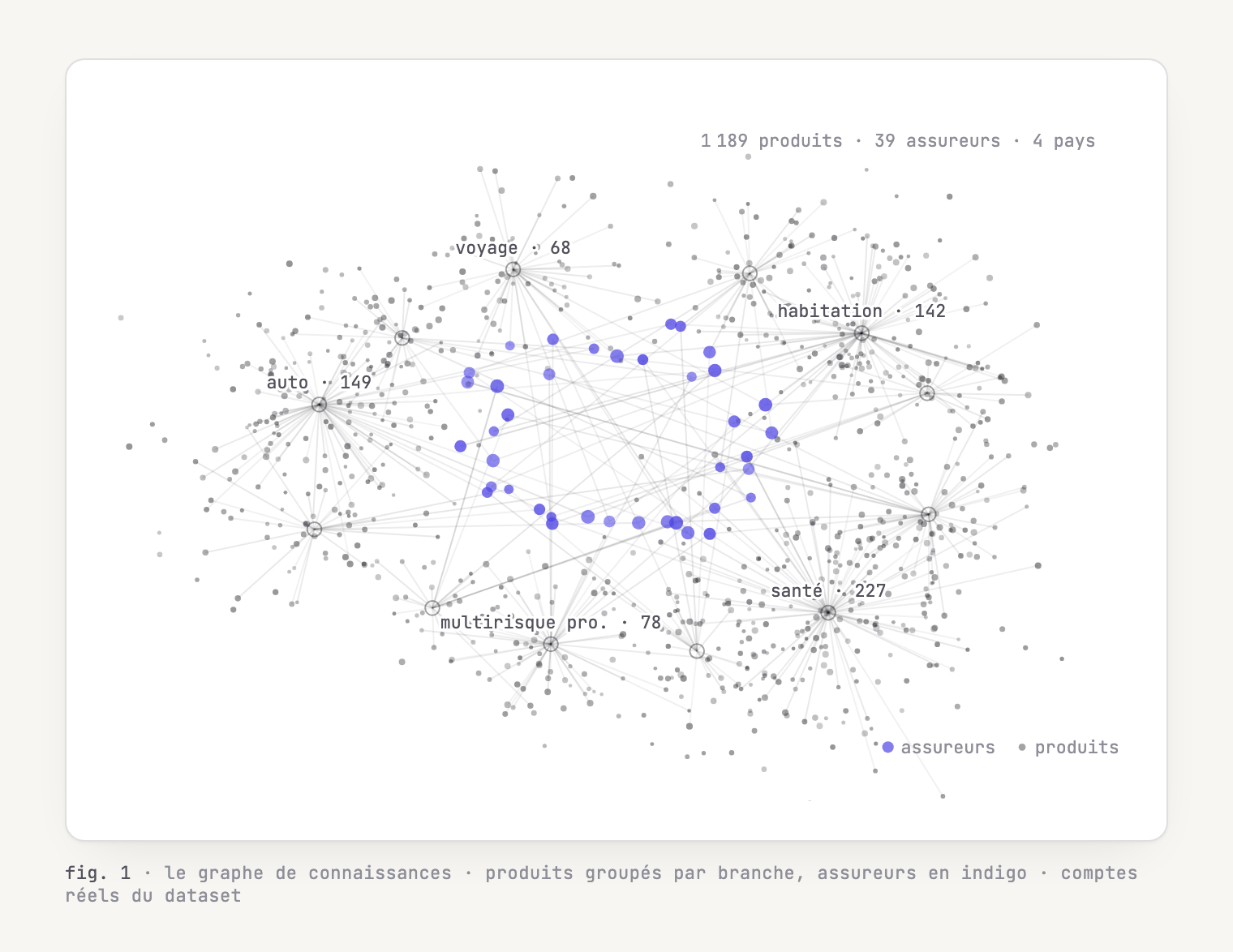
Not a chatbot. Not a RAG black box. A transparent, reproducible knowledge graph: the repo contains the whole chain - it finds insurers' public general-conditions PDFs, downloads them, and turns each one into a faithful Markdown page that preserves the maximum of what the PDF actually says, with a citation back to the source - all cross-linked into a navigable graph of products, insurers, branches, regulations and concepts.
As far as we know, this is the only open-source, machine-readable, source-cited database of insurance
products (the closest equivalents are commercial and closed). Point it at any country: the taxonomy is
data, not code, and adding a country is a documented recipe (_meta/BOOTSTRAP-COUNTRY.md).
The dataset covers four countries - Belgium, France, Luxembourg and Switzerland - for a total of 39 insurers and 1,189 product pages (auto, home, health, liability, travel, legal protection, ...), each page cited to its source document:
| Country | Insurers | Product pages | Branch pages | State |
|---|---|---|---|---|
Belgium (be) | 24 | 269 | 17 | Reference country: the only complete hand-authored layer - a branch page for every populated branch, 3 regulation pages, a country glossary |
France (fr) | 10 | 714 | 24 | Largest by volume; the enumerated market is far from exhausted |
Luxembourg (lu) | 4 | 194 | 15 | Core resident insurers ingested |
Switzerland (ch) | 1 | 12 | 0 | A first vertical slice, nothing more |
The recipe was proven on Belgium first and has since been run three more times, which is what turned
"country-agnostic" from a design claim into a tested one. Live counts are the generated coverage table in
AGENTS.md, rebuilt from the data on every index run.
Use it in 2 minutes - no API key needed
The dataset ships in the repo, already built: 1,189 product pages across four countries, insurer pages, glossary, plus the structured JSON behind them. You only need an LLM key to re-extract from scratch, never to use it.
1. Read it. Online at sluyasu.github.io/OpenInsurance, or open
the cloned repo as an Obsidian vault and the [[wikilinks]] become a navigable graph.
(github.com itself does not render [[wikilinks]] as links - the site or the vault is the comfortable way.)
2. Plug it into an agent (MCP). The MCP server is keyless and read-only:
Then register it with any MCP client, e.g. Claude Code:
(Or take the released server from PyPI - uvx openinsurance-wiki-mcp with INSURANCE_WIKI_REPO pointing at
the clone; the in-repo server above is always the one matching the committed dataset.)
You get search, get_product, get_coverage (only what's relevant to one question, with verbatim quotes),
compare_products, find_overlap (candidate duplicate cover when combining two policies), verify_claim
(verbatim evidence for a fact-check), get_branch_overview, ... See mcp/README.md.
3. Take the raw data. data/<cc>/extracted/ holds one structured JSON per source document, validated
against schema/; data/<cc>/index.json is the flat index (cc = be, fr, lu, ch).
AGENTS.md is a generated manifest (note types, counts, per-page path / source_url / freshness) so a
file-reading agent can navigate without guessing.
Why an MCP server (and not a chatbot, a RAG stack or a REST API)
The goal is that any AI agent can answer insurance questions from documents it can cite. That constraint picks the architecture:
Why MCP. The Model Context Protocol is the standard socket between AI
assistants and data: one server, and Claude, ChatGPT, Cursor or your own agent plugs in with three lines of
config instead of a custom integration. This server is keyless (no account, no API key, no quota),
read-only, and needs zero hosting: the dataset is the repo itself, so the data travels with a
git clone and works offline. When the wiki is re-extracted, git pull is the upgrade path.
Why not a RAG chatbot. A chatbot is a single interface; a knowledge base should serve many (a broker's comparison tool, a compliance check, a market-mapping agent). RAG adds an embedding index that is a black box: you cannot diff it, review it in a PR, or reproduce it, and its retrieval errors are invisible. Here the retrieval layer is deterministic matching over reviewed, committed files: the same query returns the same documents every time, and every answer carries the source PDF and page numbers. The LLM stays where it belongs, on the client side, reasoning over exact excerpts.
Why not a REST API. An API means a server running 24/7, uptime, keys, versioning, and one bespoke integration per consumer, for a dataset that changes a few times a year. MCP gives the same programmatic access at the cost of a local process.
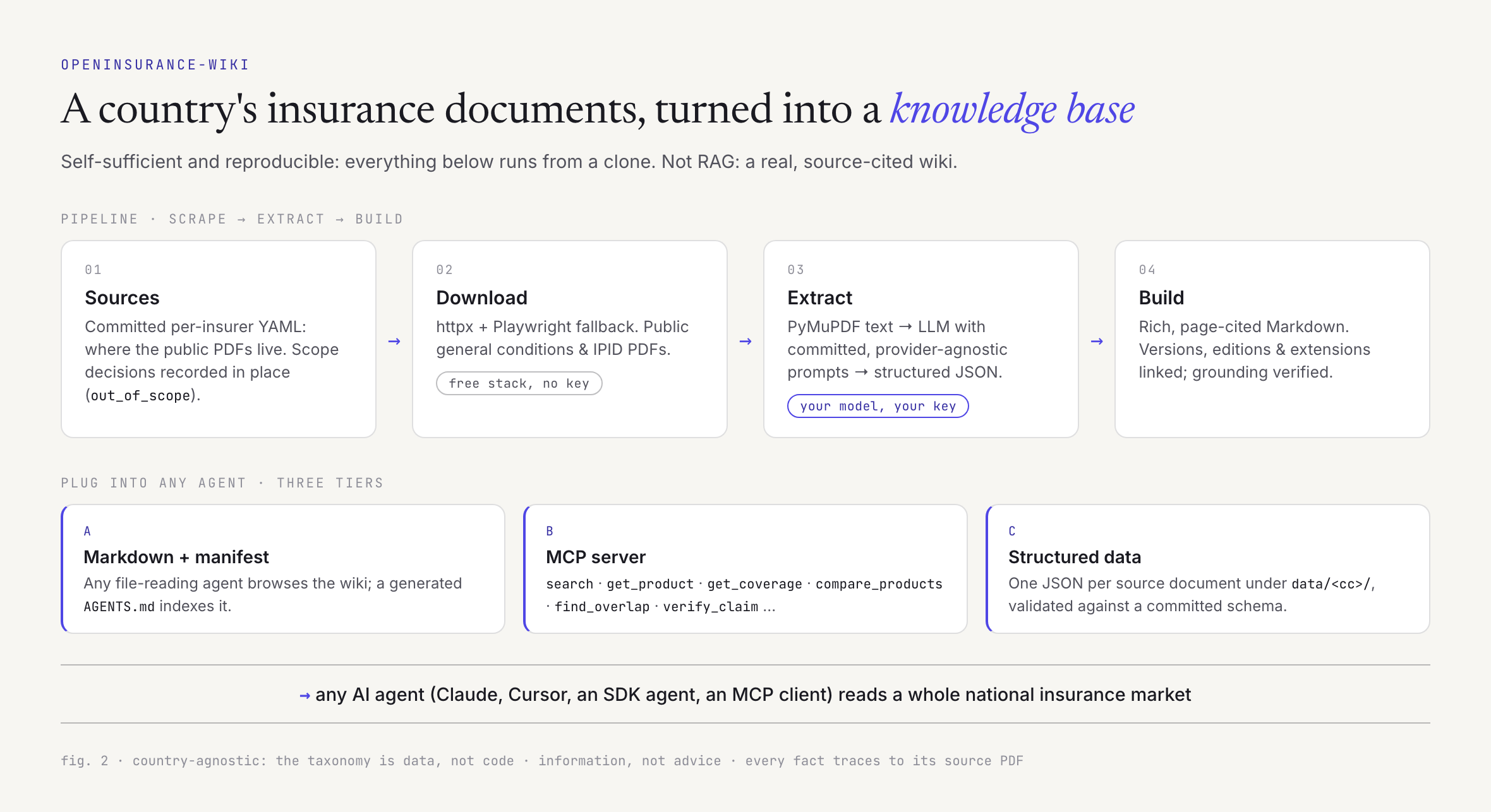
How it works, in four stages:
- Sources (
sources/): committed YAML saying where each insurer's public PDFs live. - Frozen extraction (
data/): each PDF turned once into structured JSON and cited Markdown, by a prompt that is itself committed. Nothing is generated at query time. - Deterministic MCP server (
mcp/): 10 read-only tools over those files. No LLM inside, no network, no state. Same input, same output. - A reasoning client: the agent on top (Claude, a broker chatbot, a script) does the semantic work, quoting what the tools return.
The trust boundary is explicit: everything below stage 4 is reproducible and auditable. Hallucination risk is
confined to the client, and the tool responses are shaped to keep that client honest: a grounding contract and
a front-loaded citation line in every single-product response, refusal of ambiguous product names (with the
candidates listed) instead of silent guessing, and a verify_claim tool so an agent can fact-check its own
draft against the document before answering. See the
response discipline notes in the server docs.
How fast. The server reads every file once and serves from memory: warm latencies run 0.01 to about 3 ms
per tool on this dataset (measured, reproducible: mcp/README.md). In a real
chatbot the time a user feels is the LLM's own inference, not these tools.
Why this exists
Insurance products are documented in dense PDFs scattered across dozens of insurer websites. There is no neutral, machine-readable, navigable map of what actually exists in a national market. This project builds one - as a public good, and in a form an AI agent can plug into.
It also plugs into a market that is standardizing around it: EU regulation 2017/1469 gives every non-life product a standardized summary (the IPID), EIOPA actively promotes product comparison and switching, and the open insurance agenda (OPIN, the EU FIDA proposal) pushes for machine-readable access to insurance data. This project is the missing public documents layer of that picture: what the products actually say, in the open.
Four things make it different:
- Self-sufficient & reproducible. Clone it, add your own LLM key, run
make all. It scrapes, downloads and extracts from scratch. No hidden datasets - every input is committed, every output is regenerable. - Transparent extraction. The exact prompt sent to the LLM is a file in this repo
(
extraction-agent/), not buried in code. You can read precisely what the model was asked, and run the identical extraction with your own model (Claude, Gemini, GPT, or a local model). - Grounded & cited. Every product page traces back to the source PDF and cites page numbers. Quotes are verified against the raw text. If it isn't in the document, it isn't on the page.
- Scoped. A page is a contractual or pre-contractual document of a specific insurance product - nothing
else. Insurers' download pages mix in company statutes, fund reports and promo riders; those are refused at
three gates (a recorded
out_of_scopemarker in the sources, the extraction agent's own verdict, and a CI-blocking check). See CONTRIBUTING.
What's in the wiki
Related MCP Servers
Reviews
No reviews yet — be the first to share how this listing worked for you.
Frequently Asked Questions about Openinsurance Wiki
AllMCPs Directory Badge
Showcase your server listing on GitHub or your project documentation. Embed this dynamic SVG badge to highlight official listing status and live engagement.
Badge Style:
Live Dynamic SVG Preview
Markdown (GitHub README)
[](https://allmcps.com/mcp/openinsurance-wiki)HTML Embed
<a href="https://allmcps.com/mcp/openinsurance-wiki"><img src="https://allmcps.com/api/badge/openinsurance-wiki?style=directory" alt="Openinsurance Wiki on AllMCPs" /></a>Technical Specs & Signals
CategoryDeveloper Tools
27Quality signal: Emerging · 27/100How this signal is calculated ▾
Server availabilityNot measured
Not scored for repo-hosted servers — we can't reach the running server, only its GitHub page. Hosted MCP endpoints are health-checked live.
Verified ownership8/20
Documentation & tools11/30
Adoption & activity1/15
Community engagement0/10
A guidance signal from public completeness & health data — not a user rating. New listings start lower and rise as they add docs, get verified, and grow adoption. Signals we can't observe for a listing are skipped, not counted against it.
Own this project?
This directory is pre-filled from public sources. Claim via GitHub README, site badge, or DNS TXT to unlock edit access and the Official badge — proof is checked automatically, then reviewed by our team.
Free dofollow backlink: add your website and place the AllMCPs badge on it — no claim needed. We detect it automatically and keep it verified as long as the badge stays live.
Claim & get free dofollowShare & Embed
Add our SVG badge (dark/light directory styles) or embeddable widget to your site.