open-mcp-apps


English | 简体中文
Give your AI a persistent, reusable UI. It builds the app once — you keep it forever.
open-mcp-apps is an open engine built on MCP Apps
(ui://, io.modelcontextprotocol/ui) — an extension to the core Model Context Protocol
specification, and the first official one,
live since 26 January 2026. It gives any MCP-Apps-capable host (Claude Desktop, claude.ai, Codex,
ChatGPT, …) three things the extension itself doesn't provide:
- An app registry the AI can write to. Ask for a UI that doesn't exist — the AI reads
the authoring guide, writes a single-file HTML app against a tiny
window.omaAPI, and saves it. From that moment you can open it by name, in this chat and every future one. - Persistent, versioned data — separate from the UI. Apps bind to generic
collections of items backed by SQLite plus an append-only
change_eventledger. Every mutation is an idempotent domain command (command_id) with optimistic concurrency (expected_version). The AI and the human edit the same store — the widget is just a view. - A shell runtime so AI-written apps actually work. Serving
ui://, the engine wraps the app with the official MCP App bridge, host theming (Claude's design tokens, light/dark), and thewindow.omadata API. What you write is a view; the protocol, persistence, idempotency and theming are the engine's problem.
Which of those hosts this engine reaches. It runs on your machine and binds 127.0.0.1, so it
serves the hosts on that same machine: Claude Desktop, Claude Code, Codex, plus its own browser
viewer. A browser host cannot reach a loopback server on your laptop, so claude.ai and ChatGPT web
need a remote deployment — today that means the hosted openmcp.app, which
runs this same engine for you. Running that remote shape yourself is on the roadmap and not done.
| Version | 0.9.0 (CHANGELOG.md) |
| License | MIT, whole repository (LICENSE · LICENSING.md) |
| npm | @2nd1st/open-mcp-apps — scoped; the unscoped name is an unrelated package |
| Command | npx -y @2nd1st/open-mcp-apps — the line your host's MCP config runs; a stdio server, not something to run by hand (typed into a terminal it just waits, and says so) |
| Requires | Node 22 or newer. git too, on the installer path |
| Surface | 33 tools · a built-in App Store · 3 system apps seeded |
| Platforms | macOS · Windows · Linux |
| Hosts | Claude Desktop · Claude Code · Codex · ChatGPT web — see Host support |
| Hosted | openmcp.app — the remote shape, and the way to reach browser hosts (claude.ai, ChatGPT) |
Install
open-mcp-apps runs as a local MCP server. First get it connected to your host (below); then onboarding happens inside the host, separately — that's where the AI builds your first app.
From npm — nothing to clone
If you are comfortable editing your host's config file, point it at the published package and
let npx fetch the engine. This path needs only Node 22 — no git, and no checkout for you to
keep updated. Paste this into your host's MCP server config:
The one thing the installer below adds is registering the server into every host it finds. Either
way the server seeds the system apps (settings, dashboard, App Store) when it starts, and your data
lives in the same fixed per-user store, so you can move between an npx server and a cloned one
without migrating anything.
A note on npm: this project publishes under the scoped name
@2nd1st/open-mcp-apps. The unscopedopen-mcp-appson the registry is not this project — that name is held by an unrelated package. Check for the@2nd1st/prefix; the scope is the only thing telling the two apart.
With the installer — one command
Installing needs a shell, so the chat apps (Claude Desktop, Codex) can't install themselves — use one of these instead:
It opens a short picker to choose which hosts to register into — Claude Desktop, Claude Code,
Codex — plus your permission preference. Skip it with -s -- --yes, or target one host with
-s -- --host codex.
Where it puts the clone, before you pipe anything into a shell: ~/open-mcp-apps. Set OMA_DIR
to put it somewhere else — curl -fsSL <url> | OMA_DIR=~/src/oma sh. Re-running the one-liner
updates that same clone in place instead of making a second one. Your apps and data are not in it
(they live in the per-user store under Configuration), so the folder is safe to
move or delete — and node uninstall.mjs does not delete it for you.
With a coding agent (Claude Code, Codex CLI — they have a shell), paste:
Read https://raw.githubusercontent.com/2nd1st/open-mcp-apps/main/install.md and follow it.
Either way, install.mjs registers the server into each host you pick, idempotently — it never
clobbers your other servers, pins a stable node launcher (native SQLite ABI), reports what
changed, and cleans up a pre-rename entry if one lingers. Your data lives in a fixed per-user
store (not inside the clone), so every host shares the same apps and data.
From a clone — for development
To wire a clone into a host by hand instead, point it at the checkout — this is the shape
install.mjs writes:
Hosted
openmcp.app runs the engine for you. The engine in this repository binds
127.0.0.1 by design, so a self-hosted remote deployment is not a supported shape yet — see
Status and roadmap.
Uninstall
node uninstall.mjs unregisters the server from every host it finds — but keeps your data:
the shared store stays put, so re-installing later restores every app and all data. It also leaves
the installer's clone (~/open-mcp-apps, or wherever OMA_DIR pointed) on disk — nothing here ever
deletes that folder, so remove it yourself when you want the checkout gone.
Requirements
- Node 22 or newer, on macOS, Windows or Linux.
git— only on the installer path. Thenpxpath above needs neithergitnor a checkout. The installer checks for both and stops with a message rather than half-installing if either is missing.- A host that renders
ui://if you want widgets in the conversation. Terminal hosts (Claude Code in a terminal, codex CLI) drive the same data by design and put the UI on a browser screen beside the terminal instead — one that can follow along, showing whatever the AI just opened. The per-host detail is in Host support. - After installing or updating, fully quit and reopen the host (Cmd-Q, not just closing the window) — it keeps its old server process on the old data until fully quit.
Configuration
Every setting is an environment variable, set in the env block of your host's MCP server entry:
| Variable | Default | What it does |
|---|---|---|
OMA_VIEWER | 1 | The browser viewer on loopback. 0 doesn't start it at all. |
PORT | 8787 | Where the viewer listens. |
OMA_DB | per-user store | Path to the SQLite store. Set it to isolate a store. |
OMA_APP_STORE_DIRS | — | Extra App Store sources: folders laid out like the store package's apps/ (one folder per app), separated by : (; on Windows). Searched before the installed @openmcp-app/oma-store package; the first source with a name wins. |
OMA_FUNCTIONS | on | 0 turns app functions (call_function) off. A function body runs on this machine and can make network requests. |
An app's own tool. Every app opens through open_app. To give one app its own open_<name>
tool as well, pin it: Settings → Installed → the app → Own tool. The tool list changes only
when you pin, unpin or delete a pinned app, and Claude.ai and ChatGPT show the new tool after you
refresh the connector's tool list.
Where your data lives. The whole store is one SQLite file, open-mcp-apps.db, in
~/Library/Application Support/open-mcp-apps/ (macOS), %APPDATA%\open-mcp-apps\ (Windows), or
$XDG_DATA_HOME else ~/.local/share/open-mcp-apps/ (Linux). It is outside any clone, which is
why every host shares the same apps and data.
First-run permissions. The first few tool calls each show an approval dialog — pick
"Always allow". The tool set is small and stable on purpose: read-only tools generally
skip approval, and the single open_app tool covers opening every app (including ones the AI
creates later) behind that one grant, so nothing new asks again. An OMA_DYNAMIC_TOOLS=1 left in
an older entry does nothing; node install.mjs --check reports it as stale, and re-running the
installer removes that one key.
You can also batch approvals in Settings → Connectors → open-mcp-apps → Tool permissions.
Usage
Start in your host. Restart it after installing. New here? The engine ships one MCP prompt,
get_started. A host that surfaces prompts lists it as Get started with open-mcp-apps; hosts
that render prompts as slash commands spell it /mcp__open-mcp-apps__get_started. Picking it hands
the AI the whole opening move. Not every host surfaces prompts — where yours doesn't, nothing is
lost, because the prompt is just a sentence you can say yourself: "I just installed open-mcp-apps
— show me how to use it with a couple of examples, and suggest a few apps that fit how I work."
Either way it looks at what you already have and what the App Store already offers, asks you a
couple of questions, and sets up a first app tailored to you. This step is separate from install and lives in the host. Or just ask directly:
- "make me a board for what I'm juggling right now" → the AI writes it, seeds it, and opens it (persistent)
- "make me a habit tracker" → watch it read the guide, write the app, save it, open it
- close the app, reopen, ask again → everything is still there
The loop
Apps accumulate. Each one is single-purpose and independent — a board, a tracker, a splitter — minted for the task in front of you and kept for the next time you need it.
What it looks like
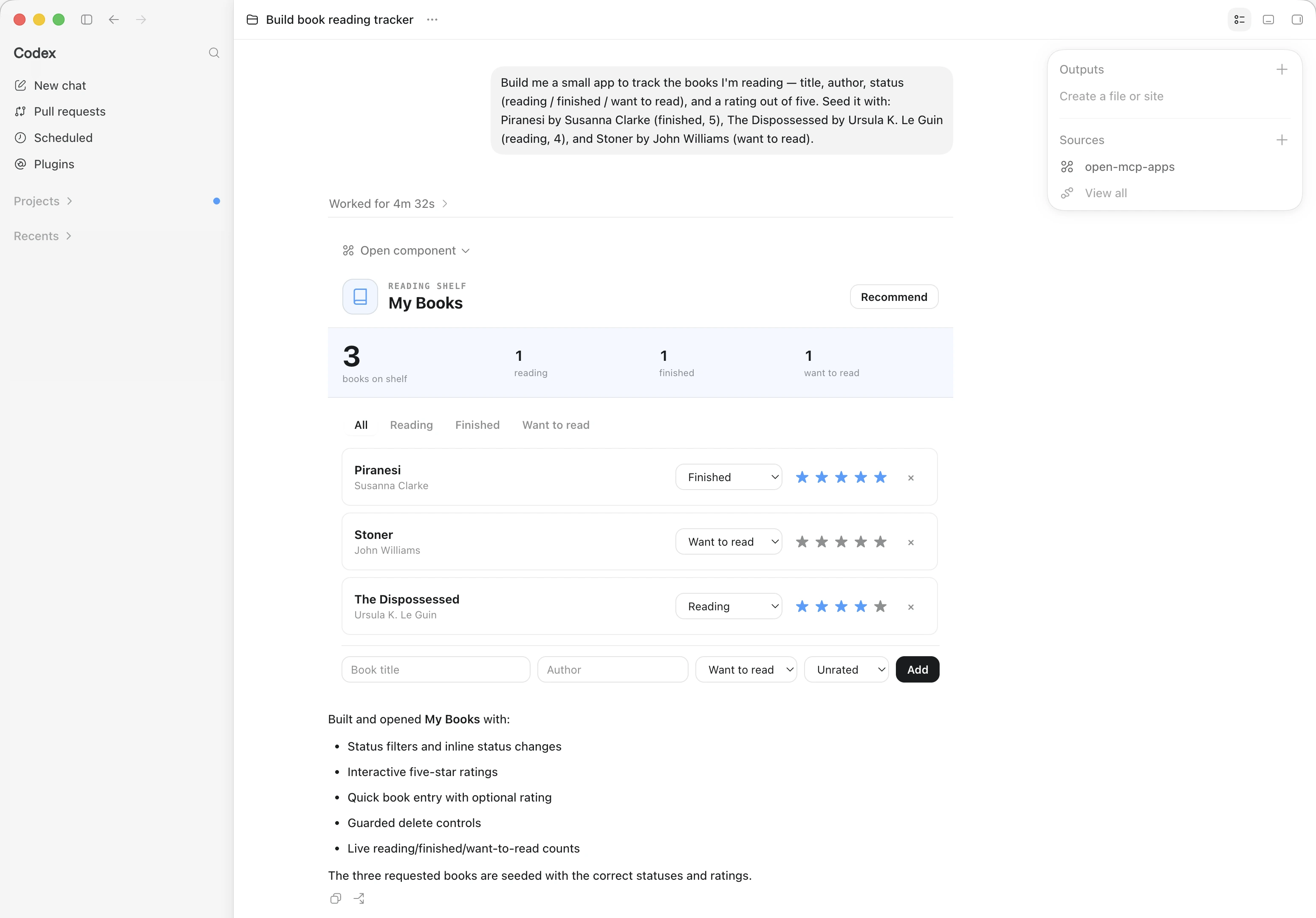
Apps render inline, in the chat you were already having. Ask for one and the AI writes it:
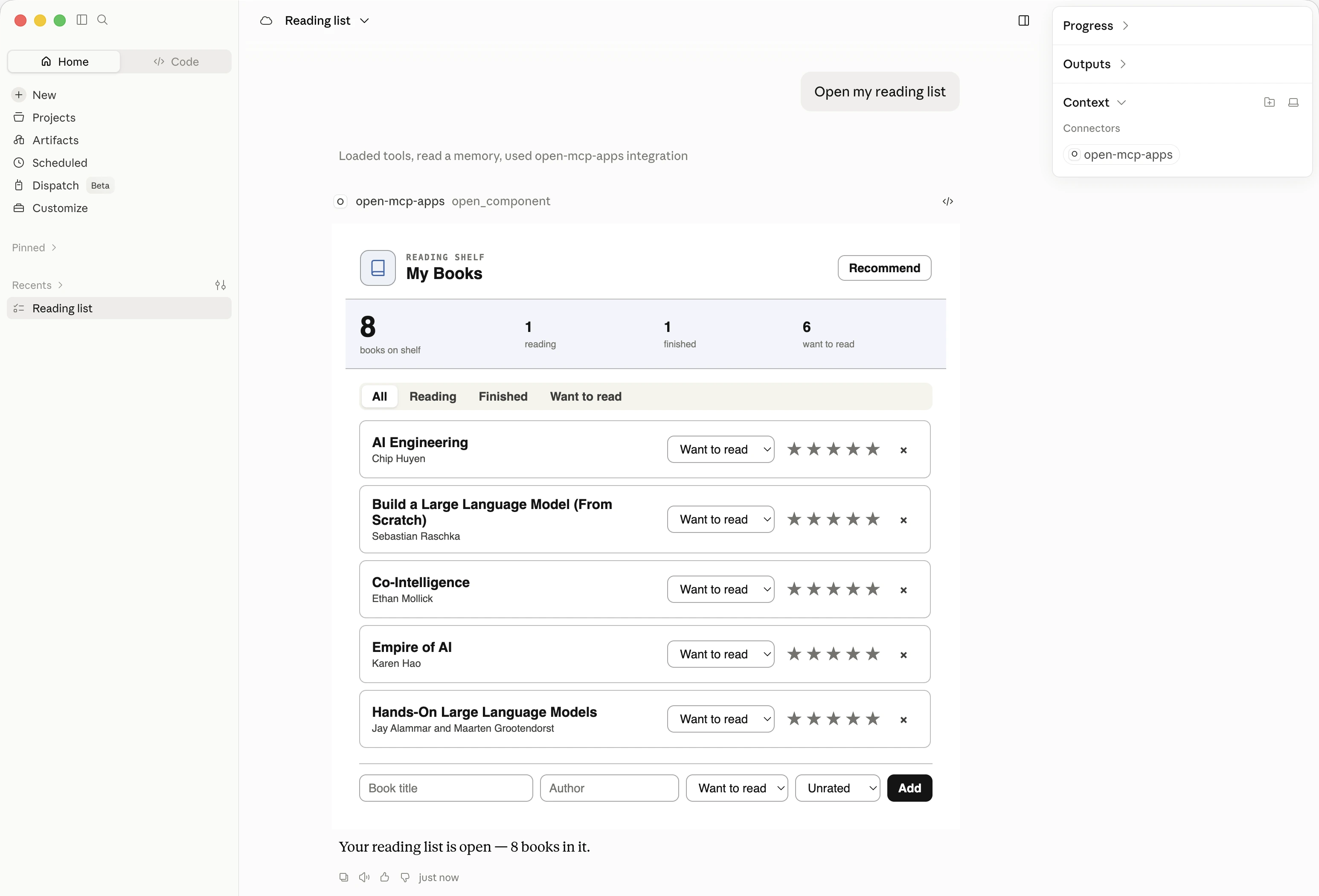
Come back in another chat — or another host — and it's still there, with your data in it:
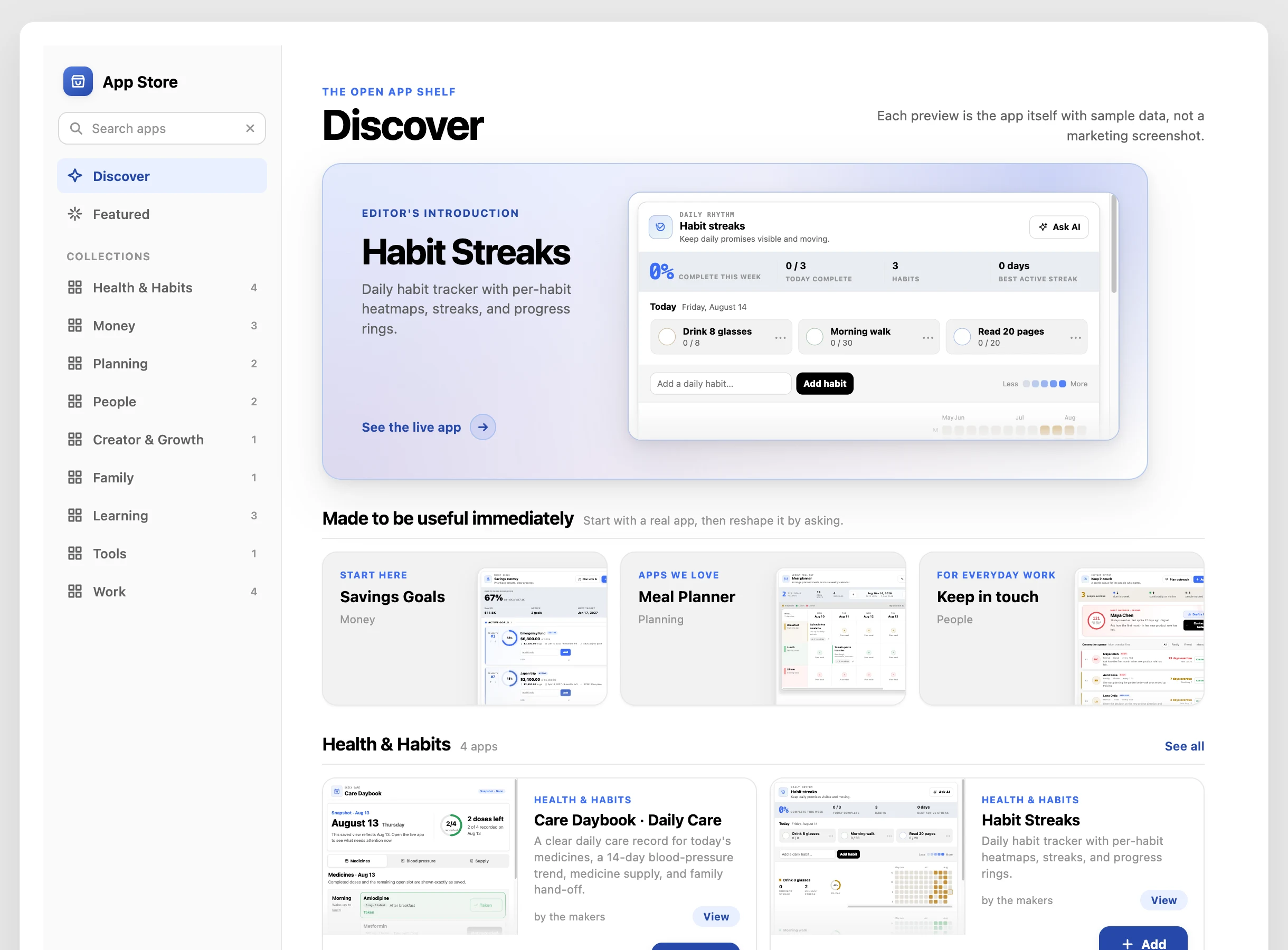
The App Store ships ready-made apps, with working previews and one-click install. They live in
their own package, @openmcp-app/oma-store, which the
engine installs as a dependency — new store apps are contributed there:
 | 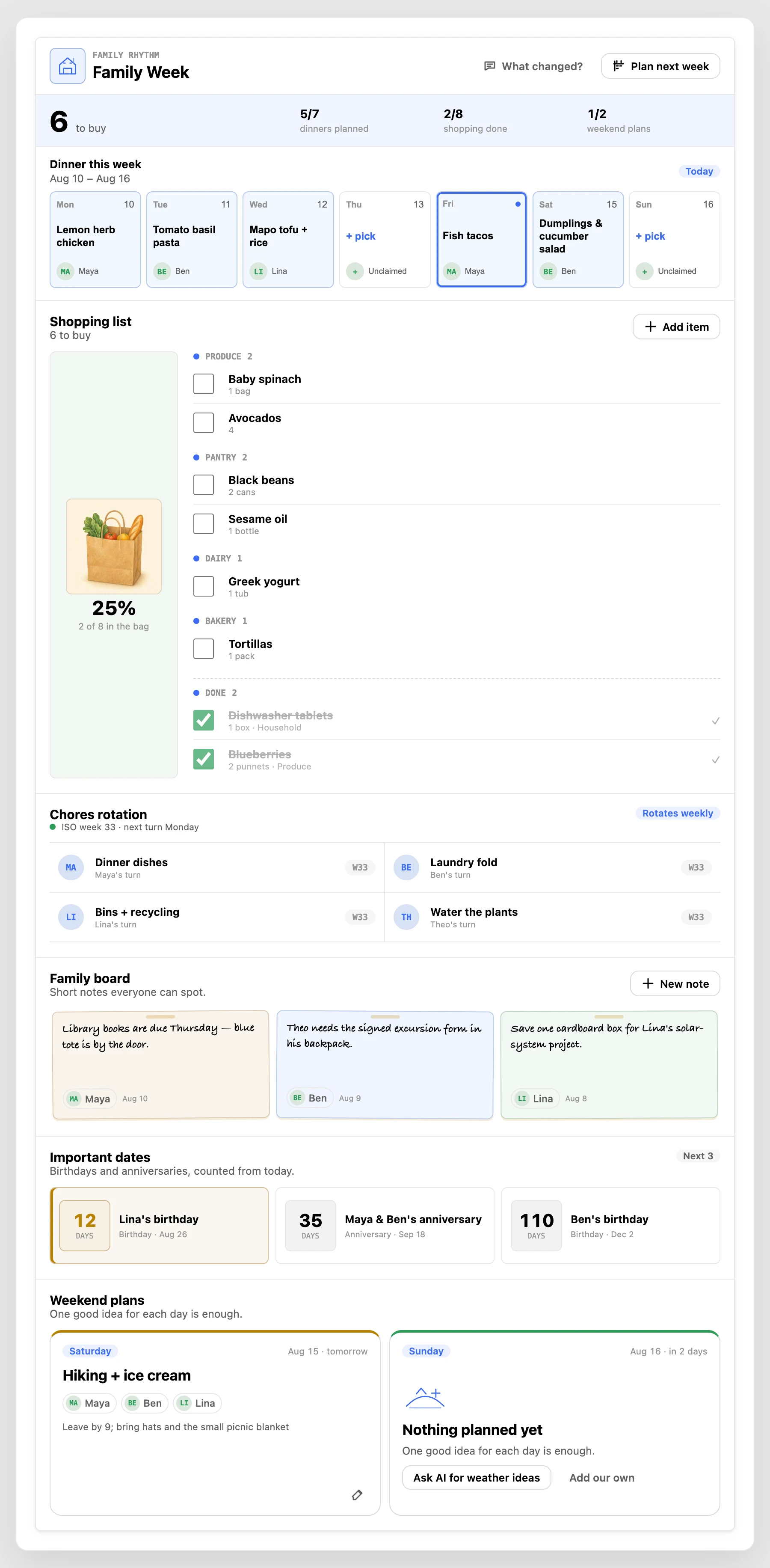 |
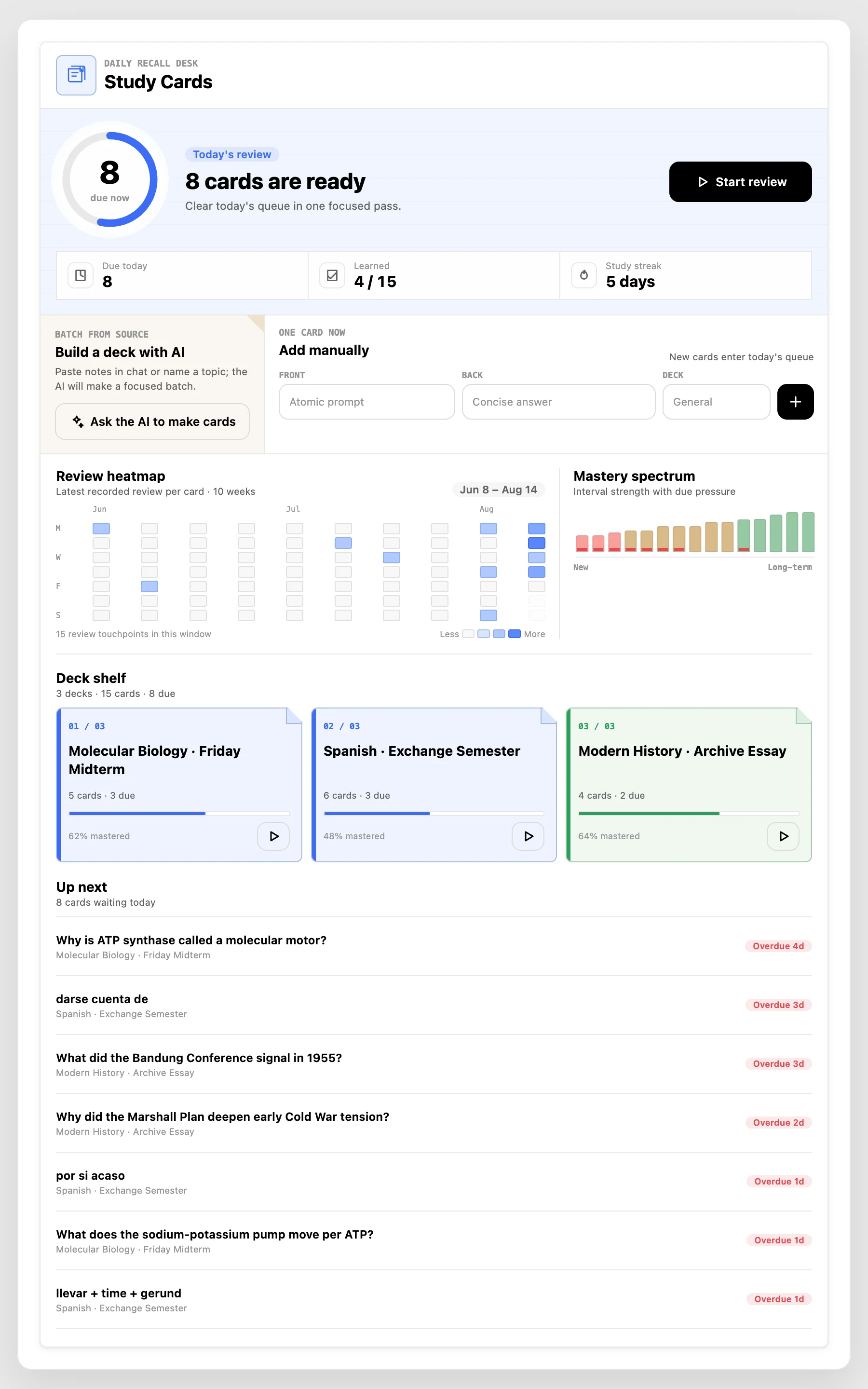 |  |
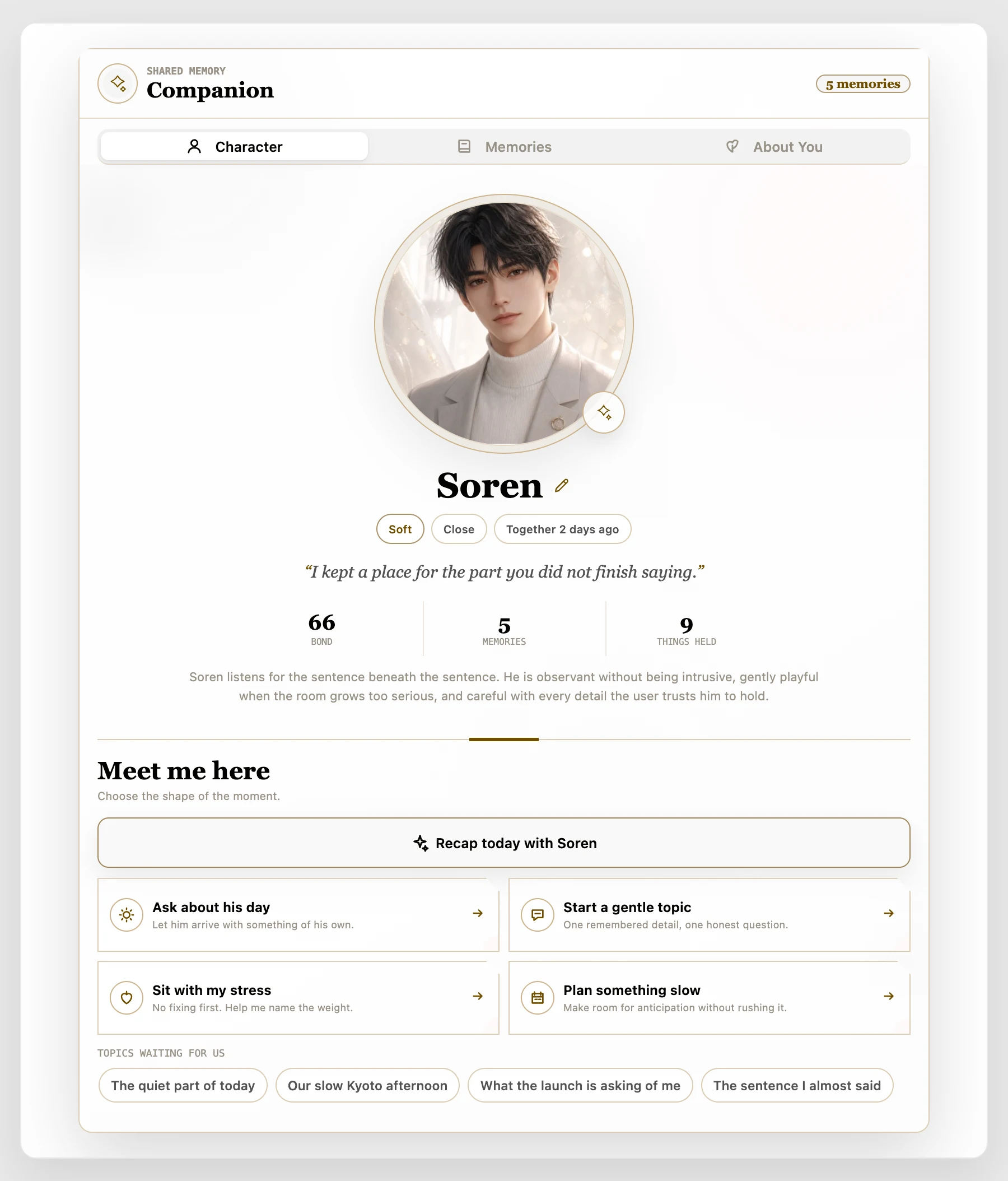
Every app above is a single HTML file bound to plain data collections — written with the same
window.oma API and authoring guide your AI will use for the apps it builds you.
Multiple widgets in one conversation work fine (habit-streaks + meal-planner side by side).
The browser viewer, and the port it binds
Every install runs a small local web server on http://127.0.0.1:8787. It is how you see your apps outside a chat window — one page per app, the same data your AI is reading — and in a terminal host it is the only way to see them at all, so the AI hands you the link when it builds or opens something.
It starts on its own; OMA_VIEWER and PORT above change that. If the port is already taken by
another open-mcp-apps process, that one is already serving the same data and this one just shares
its address; if it is taken by something else, you get no viewer and no links rather than a link
into a stranger's server.
There is no password on it, and that is deliberate. The listener is hard-wired to 127.0.0.1,
so there is no setting that makes it answer from another machine. Any program on your computer that
could reach the port can already open the SQLite file directly — a password would be a lock beside
an open wall. The one way this reaches the internet is a tunnel you start yourself, which is its own
deliberate decision; while a tunnel is up, treat its URL as a secret, because it is currently the
only thing standing between the internet and your data.
Host support
Live-tested 2026-07-22 (ChatGPT web 2026-07-28), except cells that carry their own date. A date says when a cell was true, not that it was checked again since.
| Host | Renders widgets | Human clicks widget | AI operates data | Same store |
|---|---|---|---|---|
| Claude Desktop (local stdio) | ✅ — re-checked 2026-08-16 on 1.30096.5: the universal open_app renders in chat without the OMA_DYNAMIC_TOOLS workaround that shipped for 1.24012.9 (see KNOWN-ISSUES) | ✅ full loop incl. sendMessage reply | ✅ | ✅ |
Browser viewer (/view/<name>) | ✅ | ✅ (no chat attached — sendMessage degrades to a notice) | via CLI AI | ✅ |
Codex desktop (ChatGPT app, enable_mcp_apps flag) — tested against a local engine; remote not established | ✅ experimental | ◐ updates/toggles from widget clicks work; adds were blocked host-side. The umbrella request openai/codex#28912 (an enhancement: "make MCP apps work end-to-end in the Codex GUI") closed as completed on 2026-08-05 — but #30092, the bug matching this exact failure and reproduced there by a third party, was still open on 2026-08-16. Not re-tested here either way, so the cell stays ◐. See KNOWN-ISSUES | ✅ | ✅ |
Claude Code — in a terminal (claude mcp) | — in the chat, by design (text fallback) — but see a screen beside the terminal | — in the chat | ✅ | ✅ |
| Claude Code — the Code surface inside the Claude app | ✅ live-tested 2026-08-16: an app opened with the universal open_app renders inline, the same shape the chat surface gives | not measured on this surface | ✅ | ✅ |
| codex CLI / IDE | — in the chat, by design (text fallback) — but see a screen beside the terminal | — in the chat | ✅ | ✅ |
| ChatGPT web (Work mode) | ✅ live-tested 2026-07-28 (remote HTTPS) — renders at full height, no clamping; a widget loses its data after a page refresh (mitigation shipped, awaiting live re-test here — see KNOWN-ISSUES) | ✅ a widget button added a row and it stuck | ✅ | ✅ |
Everything rides the MCP Apps bridge, so host fixes upstream (e.g. #28912) benefit this project with zero changes.
On Claude Code specifically: it is one product with two surfaces, and only one of them can
draw — which is why it takes two rows. In a terminal there is no inline widget surface at all: that
is architecture rather than a gap, and it is exactly what a screen beside the
terminal is for. The Code surface inside the Claude app has a UI and
renders inline; the 2026-08-16 reading there came through the universal open_app.
On Codex specifically: plugins are registered on the web side, so a locally-installed engine is reached as an MCP server, not as a plugin — which is the right path for a self-hosted install anyway. Widget rendering in the ChatGPT desktop app also appears to depend on how you are signed in (we have seen it work under an account sign-in; not yet established under an API key).
A screen beside the terminal
Those two — cells say the chat shows text. They do not say there is no UI. The
engine remembers which app was opened last and pushes that pointer to the viewer on the /events
frame, and an app can place a region — oma.embed("@live", {into}) — that mounts whatever the AI
opened last and swaps itself when the AI opens another. The App Store ships one: install live,
open http://127.0.0.1:8787/view/live in a window you then leave alone, and the terminal keeps the
conversation while that screen shows the app. The AI opens or writes from the CLI, the screen
follows, and you can click, edit and type into it there. Headless CLI use is what it was built for.
The cheapest form of "that screen" is a browser pane in the same tiled workspace — one column over from the agent, in the window you are already working in. Same machine, no tunnel, no second device; most modern terminal setups can put a browser next to a shell, and that is all this needs. A second monitor is the same idea with more desk, and a screen on another device is the same idea again with the caveat below.
The costs are real and worth stating plainly. There is still no widget in the transcript.
sendMessage degrades to a notice on a standalone page, exactly as in the Browser viewer row —
clicks change data, they do not talk back to the chat. The viewer has to be running (OMA_VIEWER,
on by default) with a browser pointed at it; this is not zero-config. And the listener is bound to
127.0.0.1, so "a spare tablet on the wall" means this machine's screen unless you put up the
tunnel described above and accept what that section says about it. Inside a chat host the same
region deliberately draws a placeholder instead of following anything.
Described from the code as built, not measured on a host — the live-test dates above cover the table, not this section.
Writing an app yourself
The AI is the usual author, but it isn't the only one — its context window shouldn't be the ceiling on what an app can be. Build one in your own editor, with your own bundler, and install it:
Two shapes are accepted. One self-contained HTML document — no size cap (keep it lean: data
lives in the collection, source is read in windows) — the engine injects a minimal base style, the
host's design tokens and window.oma. Or a template plus a bundle: the HTML is a readable mount
point that references its own build output (<script type="module" src="https://raw.githubusercontent.com/2nd1st/open-mcp-apps/HEAD/oma-asset:app.js">,
<link rel="stylesheet" href="https://github.com/2nd1st/open-mcp-apps/blob/HEAD/oma-asset:app.css">), --asset pushes those files into the app's
file plane, and the engine inlines them the moment the document leaves the store — a host iframe
cannot reach this machine.
The trade: the AI can no longer iterate on it — your files are the source of truth, you rebuild
and re-install. It can still read a single-document app's source; for a template + bundle app it
reads the template and the bundle stays yours (edit_app and the AI's save_app refuse with
built_outside; re-running the command above is the edit). Either way the app shares your data
like any other. Provenance is not overwritable in either direction, so an app installed
--sandboxed stays sandboxed until you delete it. What a widget may connect to is the app's own
declaration (manifest.csp, relayed to the host per the MCP Apps spec — nothing by default), and
an app's functions run engine-side and may fetch — see RUNTIME.md §5.1 and §6.1, and
the two type files for what an app sees — @2nd1st/open-mcp-apps/types/window-oma (the
window.oma API) and @2nd1st/open-mcp-apps/types/oma-function (the args/api a function body
gets) — both resolve through the package exports.
RUNTIME.md is the contract — the window.oma API in both modes, what a
sandboxed app can still do, and the traps that only bite authors who aren't the AI. It carries a
version, and test/runtime-contract.mjs pins it to the two runtimes' real surfaces, so it can't
drift from them silently.
Security model
Trust is tiered by where an app came from — SECURITY.md has the detail.
- Local, full trust: your apps, AI-built apps, the system apps, and everything installed from the
App Store — including
OMA_APP_STORE_DIRSfolders. They run in direct mode with the realwindow.oma. - Sandboxed: apps installed with
--sandboxed, and apps opened through a share, run behind the runner — a sandboxedsrcdociframe whose bridge reaches only the app's own collection unless granted more. - App functions run on your machine and can make network requests. On by default;
OMA_FUNCTIONS=0turns them off. - The AI can operate the open app (
screen_read/screen_act) the way you could, but it cannot confirm a deletion for you. - Reserved
security:*/policy:*config keys are out of reach of generic data writes; the HTTP transport binds to loopback.
Design positions (why it's built this way)
- UI and data persist separately, both versioned. Apps are views; collections are truth; the ledger is history. Swap either without losing the other.
- The AI talks domain commands, never SQL, never raw state. That's what makes human+AI concurrent editing safe (idempotency + optimistic concurrency at the command layer).
- Extension-first. Everything rides the MCP Apps bridge — no host-private APIs.
One codebase should serve every host that renders
ui://. - Single-purpose, not composite. Each app owns one scenario and its own collection; the engine mints a new one rather than cramming features into an old one. System apps (settings, dashboard) are the deliberate exception — engine-owned, privileged, allowed to see across collections.
Troubleshooting
| Symptom | What it is |
|---|---|
| Updated, but the host still shows the old behaviour | The host keeps its old server process on the old data until fully quit (Cmd-Q, not just closing the window). |
| Approval dialogs came back after a Claude Desktop auto-update | A Desktop auto-update occasionally resets these decisions (upstream #56954, closed 2026-06-23 as not planned) — no fix is coming from that issue, so just re-allow. |
| One approval prompt per app | Each app you pinned (Settings → Installed → the app → Own tool) has its own open_<name> tool, and a host asks once per tool. Unpin the ones you don't need. An OMA_DYNAMIC_TOOLS=1 left in your host entry from 2026-07-28–2026-08-16 does nothing any more; node install.mjs --check calls it stale and re-running the installer removes that one key. See Configuration. |
| No viewer link, or the viewer is somebody else's | The port is taken by a non-open-mcp-apps process. Set PORT to something free. |
| A widget loses its data after a page refresh (ChatGPT web) | Known, mitigation shipped, live re-test pending — KNOWN-ISSUES.md. |
| Widget clicks can update but not add (Codex desktop) | Blocked host-side. The umbrella request openai/codex#28912 closed as completed on 2026-08-05, but that one is an enhancement, not this defect: the matching bug, #30092, was still open on 2026-08-16. Update Codex and try, but expect it to still bite. |
| You want to start completely clean | Fully quit your host(s), delete open-mcp-apps.db (plus its -wal/-shm siblings) from the store directory under Configuration. All apps and data gone, irreversibly, while staying installed. |
pnpm install exits 1 with ERR_PNPM_IGNORED_BUILDS | pnpm 11 refuses third-party build scripts until you decide about them, and calls that an error. Nothing here needs building — better-sqlite3 loads a prebuilt binary it ships, and esbuild's binary comes from its platform package — so the tree it leaves behind is complete and working. Answer pnpm approve-builds however you like, or use npm. We do not declare those scripts as allowed, because that would make pnpm compile better-sqlite3 on machines with no toolchain (a container, most CI) and fail there for nothing. |
Development
src/server.mjs | stdio MCP server; single open_app path (plus an open_<name> tool for each app the user pins) |
src/http.mjs | /mcp (stateless Streamable HTTP) + /view/<name> browser viewer, bound to 127.0.0.1 |
src/store.mjs | SQLite: items + app registry + change_event ledger (idempotent, OCC) |
src/shell-runtime.js | browser runtime injected into every app (window.oma) |
src/shell.mjs | wraps stored HTML with runtime + design-token fallbacks at serve time |
src/guide.mjs | the authoring contract the AI reads before generating an app |
install-app.mjs | install an app you wrote yourself, from a file — the one door into the registry that doesn't go through the AI |
components/ | the 3 system apps, installed on seed (settings, dashboard, app-store). The App Store's apps are the @openmcp-app/oma-store dependency — not auto-installed; browse the app-store app for live previews with sample data and one-click install |
Contributions need nothing signed — MIT in, MIT out (CONTRIBUTING.md).
Status and roadmap
Early v0 — proven end-to-end on Claude Desktop; cross-vendor render + shared store proven on Codex desktop and the browser viewer.
Where it stands:
- engine: registry + shell + generic data commands + ledger
- system apps installed (settings, dashboard, app-store); App Store apps (the
@openmcp-app/oma-storepackage) with live previews, one-click install - AI app creation loop (guide → save → open)
- in-context onboarding (the
get_startedprompt → the AI builds a first app for how you work) - security foundation: trust tiers + sandboxed runner + reserved config keys
- multi-host discovery installer (Claude Desktop · Claude Code · Codex) + shared per-user store
-
npxone-command install (@2nd1st/open-mcp-appson npm) - self-hosted remote (Streamable HTTP) as a supported shape → claude.ai / ChatGPT / mobile
off an engine you run — the transport exists (
src/http.mjs) and has been live-tested over HTTPS; what's missing is the hosted story, since the engine binds127.0.0.1by design. Those browser hosts already work against the hosted openmcp.app; this box is about doing it yourself - one-click install with no shell
- app export/import → sharing → community App Store (review + runner sandbox activate here)
License
MIT, for the whole repository — the engine and the system apps in
components/ alike (the App Store package is MIT too) (LICENSE ·
LICENSING.md). Use it, fork it, modify it, embed it, run a
modified version as a hosted service; keep the copyright notice with substantial
portions you redistribute. That is the whole obligation. Up to v0.5.2 the engine
was AGPL-3.0-only under a directory split — see LICENSING.md
for what changed and why.
The names open-mcp-apps, openmcp.app, SecondFirst, and 2nd1st,
and their logos, are not granted by the license — see
TRADEMARKS.md. Fork the code freely; give your fork its own name.
Copyright © 2026 2nd1st.
© 2026 2nd1st