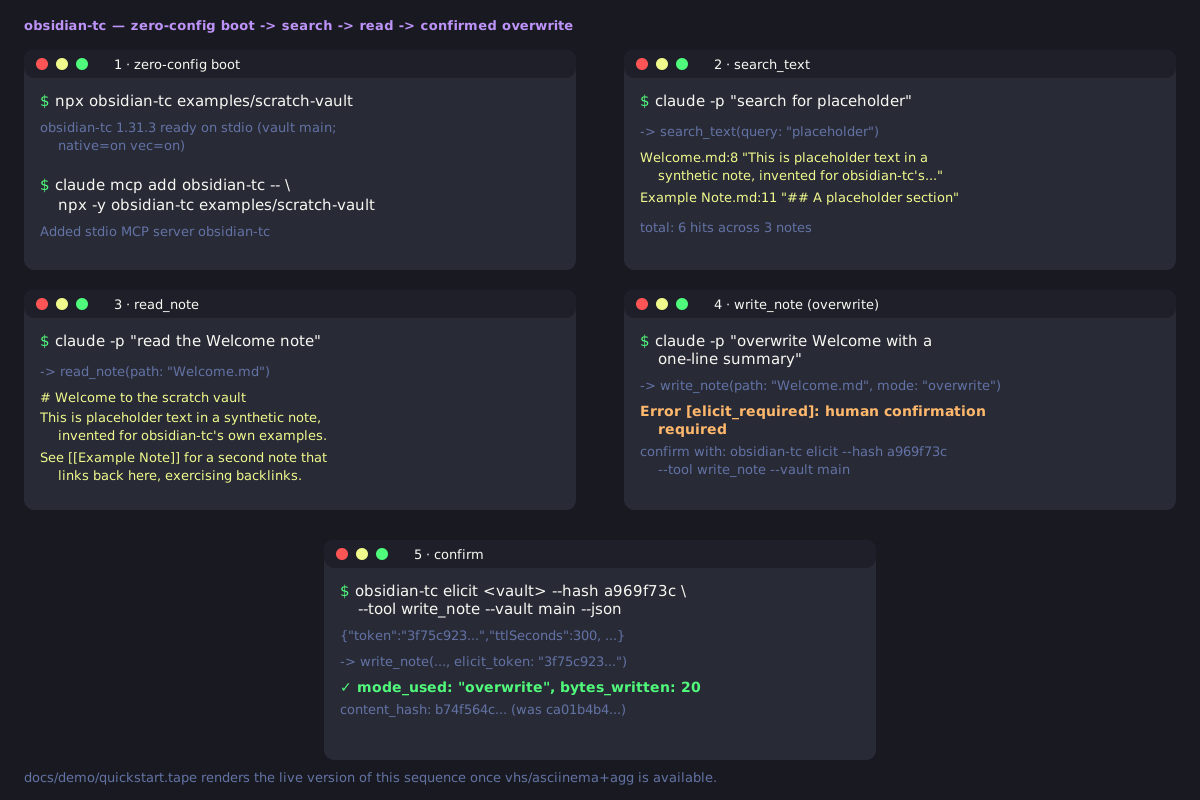
The full upstream README, mirrored here for reference. Install config, tool schemas, adoption signals, and an original overview live on the Obsidian Turbocharged listing page.
Obsidian Turbocharged — governed, agent-ready vault access over MCP.

Also ships as a Docker image (ghcr.io/the-40-thieves/obsidian-tc), a one-click .mcpb bundle, and standalone binaries.
Since v5.0 (2026-07-24), the Local REST API plugin ships its own built-in MCP server — 18
tools at https://127.0.0.1:27124/mcp/ for vault CRUD, search, and commands. obsidian-tc adds
three things it doesn't have: governed writes (folder ACLs, human-in-the-loop confirmation,
compare-and-swap, an audit log), fused retrieval (BM25 + vector + graph, RRF-fused and
reranked), and memory that lives in the vault — episodes, activation decay, and explicit
forgetting, under the same ACL as every other write.
The fastest way to try it, no install step and no config file:
Lexical search and every note tool work immediately; semantic and graph-seeded retrieval need an embeddings backend (Ollama by default), which is the upgrade a config file buys you.
If you arrived here from Obsidian's plugin browser, this section is the part about you. The directory listing for TC Bridge points at this repository because the plugin lives in it, but the plugin is a small optional bridge, not the server described on the rest of this page.
TC Bridge extends the Local REST API plugin with namespaced endpoints that the obsidian-tc server calls for features that only exist inside a running Obsidian: command-palette dispatch, Templater, Dataview and Datacore queries, Tasks, QuickAdd, Omnisearch, Excalidraw, Metadata Menu, MakeMD spaces, daily notes, OCR via Text Extractor, Obsidian Git, and Remotely Save. Every filesystem-level feature of the server (governed writes, search, memory) works without it.
restApiUrl and restApiKey; the walkthrough is
docs/QUICKSTART.md, step 6.obsidian-tc). That id is retired; settings migrate on
first load and the old id's final release only shows a pointer here. Details in
packages/plugin/README.md.An AI agent with raw filesystem access to your Obsidian vault can do real damage: overwrite years of notes, delete the wrong folder, read the journal you never meant to expose, or quietly leak plugin API keys sitting in .obsidian/. Most Obsidian MCP servers hand an agent that access with little more than an API key between it and everything you have written.
obsidian-tc gives agents governed access instead. Every tool call — no exceptions — runs through one dispatch pipeline: auth → scopes → folder ACL → read-only kill switch → idempotency → throttle → human-in-the-loop confirmation → handler → response governor → audit log. You decide which folders an agent can read, write, or delete (per vault, per caller); destructive operations fail closed until a human approves them; and every invocation is audited on a best-effort basis (an audit-store write failure surfaces in server_health and is never swallowed silently, but it does not block the call — observability must never break dispatch).
New here? Start with the 5-minute quickstart or the threat model and design rationale.
By default the server advertises just three meta-tools instead of a wall of 150:
find_capability — BM25 search over the caller-visible capability catalog ("how do I move a note?")describe_capability — one capability's schema, required scopes, and safety hintscall_capability — invoke the named capability; the call routes through the same auth/scope/ACL/HITL/idempotency/throttle pipeline as a direct call, and the target's own schema validates the argumentsThis keeps agent context lean while the full surface — 163 tools across 31 domains — stays reachable, and every tool remains directly callable by name. toolFacade.mode selects the shape: triad (default), domain (~a dozen domain meta-tools like notes, search, vault), or flat (the full advertised surface, the pre-facade behavior). The facade is boundary-only: no gate is ever bypassed, whichever mode you pick.
163 governed capabilities, grouped by access scope.
read (96) — audit_provenance, bundle_files, bundle_folder, diagnose_retrieval, episode_stats, eval_dataview_field, explain_answer, find_link_cycles, find_notes_by_property, find_notes_by_tag, find_orphans, find_unresolved_links, gap_report, generate_uri, get_attachment, get_backlinks, get_entity, get_index_status, get_link_strength, get_note_tags, get_outgoing_links, get_periodic_note, get_session_traces, get_vault, git_diff, git_log, git_status, graph_centrality, graph_communities, graph_path_between, knowledge_challenge, knowledge_get_critical, knowledge_search, list_attachments, list_bookmarks, list_capture_queue, list_commands, list_contradictions, list_goals, list_kanban_boards, list_notes, list_periodic_notes, list_properties, list_quickadd_actions, list_snapshots, list_tags, list_tasks, list_templates, list_vaults, list_workspaces, makemd_list_spaces, makemd_query, note_exists, note_quality_report, ocr_attachment, ocr_bulk, plur_get, plur_recall, plur_recall_hybrid, plur_similarity_search, query_base, query_canvas, query_datacore, query_entity_graph, read_base, read_canvas, read_excalidraw, read_frontmatter, read_kanban_board, read_metadata_fields, read_note, read_notes, read_property, read_snapshot, reflect, remotely_save_status, resolve_daily_note, search_dql, search_jsonlogic, search_omnisearch, search_regex, search_semantic, search_text, search_vault, server_health, session_bootstrap, snapshot_note, suggest_links, tasks_filter, validate_dql, vault_context, vault_graph_search, vault_health_score, work_episode_chain, work_episodes, work_search
write (46) — add_bookmark, add_kanban_card, add_observation, add_tag, append_note, append_to_periodic_note, close_goal, commit_capture, copy_note, create_base, create_canvas, create_entity, create_excalidraw, create_periodic_note, end_session, enqueue_capture, execute_template, find_or_create_periodic_note, format_table, git_stage, insert_table_column, insert_table_row, link_entities, move_kanban_card, open_workspace, patch_note, prune_hub_links, record_retrieval_feedback, remotely_save_trigger, remove_tag, rename_entity, restore_note, rewrite_link, save_workspace, set_goal, sort_table_by_column, start_session, unlink_entities, update_base, update_canvas, update_excalidraw, update_frontmatter, update_task, work_forget, work_result, write_note
delete (6) — delete_attachment, delete_entity, delete_note, move_attachment, move_note, remove_bookmark
bulk (3) — bulk_create_notes, bulk_move_notes, bulk_set_property
execute (3) — execute_command, git_commit, trigger_quickadd
admin (9) — add_vault, get_metrics, get_server_config, index_vault, inspect_acl, inspect_visibility, refresh_plugin_capabilities, reload_vault, reset_vault_cache
obsidian-tc is a comprehensive Model Context Protocol (MCP) server for Obsidian, designed for both humans and autonomous agents. Multi-vault native. Pluggable embeddings. Works with local Ollama or cloud models.
Three pillars:
.base) support with a real expression-DSL evaluator, GraphRAG retrieval, a quarantined work-memory tier, and composite context calls — the broadest open-source Obsidian MCP surface we know of (surveyed 2026-07).kid rotation), folder ACLs (per vault), read-only kill switch, human-in-the-loop elicit on destructive operations, compare-and-swap on writes, idempotency keys, bulk throttling.Beyond Tools, the server exposes your vault as MCP Resources (resources/list + resources/read over obsidian-tc://<vault>/<path> URIs, read-scope and folder-ACL enforced) and a set of built-in Prompts (prompts/list + prompts/get).
✅ Shipped — v1.28.4. Published to npm as provenance-signed packages, with a container image at ghcr.io/the-40-thieves/obsidian-tc:1.28.4. The surface is 163 tools across 31 domains, presented by default via the triad facade described above.
The v1.6–v1.7 line turned the server into a measured memory engine (full detail in the CHANGELOG):
vault_context (the one-call get_context(query, token_budget) primitive: budget-packed graph-reranked chunks, synthesis patterns, open contradictions, proactive lesson surfacing, opt-in work episodes; session bootstrap reads a _next-session.md signal note through a TTL-enforced prewarm cache) and reflect (grounded synthesis with source provenance, an adversarial challenge mode, and a versioned preference profile updated only by typed deltas).forget propagates a deletion through derived state, with tombstone-vs-erase modes and a hash-chained audit log where tampering with any entry breaks verification.metrics, gaps (calibrated coverage floor), prefetch, reflect, forget, citation-infer, contribution-report, activation-recompute, cluster.Earlier v1.3.x hardening (per-vault ACLs, symlink-canonical enforcement, trigram FTS5 substrate, vec0 KNN pushdown, Bases expression-DSL evaluator, compute-abuse budgets, asymmetric JWT via local JWKS, the sleep-time consolidation scheduler, AGPL-3.0 relicense) is recorded in the CHANGELOG.
| Milestone | Scope | Status |
|---|---|---|
| M0 | Walking skeleton: dispatch pipeline, folder ACL, HITL elicit, migrations | ✅ Merged |
| M1 | Core vault access — 30 tools (CRUD, frontmatter, tags, links) | ✅ Merged |
| M2 | Search + embeddings — 6 tools + retrieval substrate | ✅ Merged |
| M3 | Structured formats — 23 tools (Bases, Canvas, Periodic, Attachments, Bookmarks, Workspaces) | ✅ Merged |
| M4 | Plugin bridges + companion plugin — 20 tools across 9 domains | ✅ Merged |
| M5 | Memory + capture substrate — 15 tools (capture queue, memory entities + [[link]] graph, workspace sessions + JSONL traces, plur read proxy) | ✅ Merged |
| M6 | Bulk + admin + URI — 7 tools | ✅ Merged |
| M7 | Harden + ship: OpenTelemetry tracing, Prometheus /metrics, CloudEvents spool, rate limiter, 8-triple native prebuilds, release workflow | ✅ Shipped (v1.0.2) |
| M7+ | Knowledge domain: GraphRAG (vault_graph_search), knowledge_challenge, composite vault_context + reflect | ✅ Shipped (v1.4–v1.7) |
| M8 | Experiential work-memory tier: retrieval log, episode capture + poison defense, reader contract, preference profile, forget | ✅ Shipped (v1.6–v1.7) |
This repository is public under The-40-Thieves, licensed AGPL-3.0-only.
Polyglot monorepo:
| Package | Language | Purpose |
|---|---|---|
packages/server | TypeScript (Bun) | MCP protocol layer, auth, routing, tool implementations, plugin bridges |
packages/plugin | TypeScript | Companion Obsidian plugin extending Local REST API |
packages/shared | TypeScript | Shared Zod schemas and types |
packages/native | Rust (via napi-rs) | Optional acceleration with a numerically-identical pure-JS fallback — see below |
Where the native module actually matters: the main native win is batched cosine similarity (cosineBatch) on the brute-force vector path (used when the bundled sqlite-vec extension can't load) — the whole candidate set is scored in ONE crossing of the JS↔native boundary. The per-pair entry point is a pessimization and is not used there: it measured 13–22× SLOWER than the pure-JS fallback, because the N-API crossing and query marshaling dwarf the arithmetic. Boundary granularity, not language, decides the win — cross once per query, never once per vector (THE-420). The native tokenizer + BM25 scorer power the fallback lexical ranker (the exhaustive disk scan used for sub-trigram queries or when the FTS index is missing/unhealthy) and the find_capability catalog search — the primary lexical ranking for search_text is SQLite FTS5's own bm25() over the trigram notes_fts index. Everything works without a prebuild; the native module makes some cold paths faster.
obsidian-tc is the converged memory engine: vault read/write, search, and control, plus folded-in retrieval intelligence: GraphRAG graph-walk via vault_graph_search (vector seeds + wikilink expansion, fused with RRF), FTS5 BM25 text search and dense-vector search as separate retrieval modes, gateway-optional rerank, and a knowledge_challenge decision red-team. The RRF fuses GraphRAG's seed/expansion streams into a general hybrid retriever — enriched BM25 + dense-vector + hop-ordered wikilink expansion at k=10 — which shipped and closed THE-196 (search_vault remains the mode router: text, then semantic on zero hits). GraphRAG edges carry a per-vault partition key (THE-310). Ambient consolidation (weekly synthesis + decision audit) runs on the sleep-time plane when the inference gateway is configured; the GraphRAG ship-gate eval (recall@10 vs baseline) still requires an out-of-band run against a freshly built index — machinery present and scheduled, headline retrieval numbers pending (THE-748). This supersedes the earlier "access MCP, retrieval out of scope" framing (the 2026-06-25 single-converged-product decision; see ARCHITECTURE.md). The reserved "V2 ML sidecar" (and the native kmeansAssign / actrDecayScore hooks) was removed; the typed-atom MemIR substrate is a downstream engine-build phase, not this v1.x line.
Full walkthrough (Claude Desktop / Claude Code wiring, first queries, a governed write): docs/QUICKSTART.md. Prefer Docker over a local install? docker-compose.yml runs the server against a bind-mounted vault with no npm install needed.
Install, then point obsidian-tc at a JSON config — a vault id and path is the
minimum (every other field has a default):
obsidian-tc runs on Node (>= 24) or Bun (>= 1.1) — npm / npx
installs run under Node (which uses better-sqlite3, falling back to the built-in
node:sqlite); under Bun it uses bun:sqlite. The runtime is auto-detected, so the same
install works either way.
The fastest start is zero-config: point it at a vault folder and it boots a single
vault named main with sensible defaults.
For multi-vault, auth, ACLs, or custom embeddings, pass a config file instead:
obsidian-tc.config.json:
No cloud account or API key is required. With the defaults, everything runs on your
machine: embeddings via a local Ollama model (nomic-embed-text,
768-dim), vector search via the bundled sqlite-vec (with a pure-JS cosine fallback), and
a shared SQLite cache (one cache.db, row-scoped by vault). Pull the model once, then start:
The optional inference gateway (OBSIDIAN_TC_GATEWAY_URL) powers rerank and the
knowledge_challenge red-team; leave it unset and those degrade gracefully while
everything else keeps working. Cloud embedding providers (OpenAI, Voyage, Cohere, or any OpenAI-shaped endpoint via openai-compatible) are
opt-in via a config file.
Security posture in zero-config mode.
obsidian-tc /path/to/vaultboots with auth off and no folder ACL — any client that can reach the server has full read/write/delete over the vault (the same authority raw filesystem access would give). That is acceptable because the surface is local-only: the config fail-closes if you enable an HTTP transport on a non-loopback host while auth is off, and a DNS-rebinding/Origin guard protects the loopback bind. The governance layer this README leads with — JWT scopes, per-vault folder ACLs, the read-only kill switch, HITL — is opt-in and off by default; turn it on with a config file (auth.mode: "jwt"+jwtSecret, andacl.readPaths/writePaths/deletePaths) before exposing the server to partially-trusted, remote, or multi-agent callers. See docs/WHY.md and SECURITY.md.
Bridge tools (Dataview, Templater, QuickAdd, OCR, Excalidraw, Obsidian Git, the
command palette, …) talk to your running Obsidian through the companion plugin and
need two per-vault config keys: restApiUrl (Local REST API's non-encrypted loopback
server, http://127.0.0.1:27123) and restApiKey. Live/headless mode is resolved
once at server start; without the keys, bridge tools return the typed
requires_live_obsidian while every filesystem tool keeps working. Setup walkthrough:
docs/QUICKSTART.md step 6.
The companion plugin was renamed. It is now
tc-bridge("TC Bridge"), notobsidian-tc("Obsidian Turbocharged") — the community plugin directory bans "obsidian" in a plugin id. If you installed it before this rename, your settings migrate automatically on first load after upgrading; see docs/CUTOVER.md andpackages/plugin/README.md.
One-click install (launches via npx; after installing, set the config path to your
own obsidian-tc JSON config):
Or add it by hand. The server object is the same; only the wrapper key differs — Cursor
(~/.cursor/mcp.json) uses mcpServers, VS Code (.vscode/mcp.json) uses servers:
OBSIDIAN_TC_CONFIG is the absolute path to your obsidian-tc JSON config (vaults, ACL,
transports); it may also be passed as the first CLI argument. A prebuilt MCPB bundle
(bun run bundle → dist/obsidian-tc.mcpb) is also available for one-click install in
Claude Desktop and other MCPB hosts.
The ecosystem splits into three groups, and most projects sit squarely in one:
obsidian-tc is the only one we know of that is all three at once, and the combination is the point: the memory lives in the vault, under the same ACL and audit pipeline as every other write. Concretely, we are not aware of another Obsidian MCP server that pairs write governance (compare-and-swap, idempotency keys, snapshots with restore, a per-invocation audit trail) with a memory engine (episodes, activation decay, explicit forgetting with a hash-chained log, contradiction detection).
That is a narrow claim, deliberately. Several of the projects below do specific things as well as or better than we do, and the honest comparison says so.
Features as of 2026-09-03; these projects move quickly, so check their repos rather than trusting this table. Tool counts are omitted where a project's README and its code disagree.
| Tools | Group | Retrieval | Governance | Memory engine | |
|---|---|---|---|---|---|
| obsidian-tc | 163 (3-tool facade) | all three | BM25 (FTS5) · vector (vec0) · graph · RRF fusion · diversity | JWT (HS256/JWKS) · per-vault folder ACL · HITL elicit · CAS · idempotency · snapshots · audit log | episodes · activation · forgetting · contradictions |
| coddingtonbear/obsidian-local-rest-api (built-in MCP, v5.0+) | 18 | access | text (search_query/search_simple) | single REST API bearer key (full vault admin) | — |
| cyanheads/obsidian-mcp-server | ~14 | access | text / regex | JWT/OAuth · folder-scoped path policy · read-only mode · elicited delete confirmation showing blast radius | — |
| aaronsb/obsidian-mcp-plugin | 8 families | access | text · graph traversal · Dataview/Bases | path allow/block lists · read-only mode · per-operation controls · API key | — |
| bitbonsai/mcpvault | ~14 | access | BM25 | traversal + symlink protection · delete confirmation | — |
| MarkusPfundstein/mcp-obsidian | ~13 | access | text · JsonLogic / DQL | Local REST API key | — |
| jacksteamdev/obsidian-mcp-tools — archived (last push 2026-05-13) | — | access | DQL · JsonLogic · semantic (via Smart Connections) | Local REST API key | — |
| engraph | — | retrieval | 5-lane RRF: semantic · BM25 · graph · cross-encoder rerank · temporal, fully local | API keys with read/write levels · rate limit · operation log | — |
| basic-memory | ~35 | memory | semantic + keyword | path containment | entities · observations · relations, in a separate markdown KB |
Where the others win, plainly:
mcpvault is one npx line and engraph is one brew install
with local models bundled — no config file, no separate embeddings pull. obsidian-tc's
npx obsidian-tc /path/to/vault matches that for a single vault (lexical search and every
note tool work immediately); multi-vault, ACLs, and custom embeddings still want a config
file, and semantic/graph retrieval still wants an embeddings backend.aaronsb/obsidian-mcp-plugin runs inside the app — no
external process at all. obsidian-tc is a standalone server.engraph ships cross-encoder
reranking and a query orchestrator as core, on local models, everywhere it runs. obsidian-tc's
cross-encoder reranker is now also local and gateway-free — an optional npm package
(@the-40-thieves/obsidian-tc-reranker-local), auto-selected when no reranker block, no
embeddings.modelTier.full, and no gateway URL are configured, that fetches and
checksum-verifies its weights on first use — but it is opt-in machinery, not core: the
standalone compiled binaries, musl (Alpine) installs, and macOS x64 can't reach it.basic-memory keeps memory in its own markdown store that
syncs to any vault. If you want memory decoupled from one vault, that is the better fit.What we have not seen elsewhere: multi-vault in one process with per-vault ACLs, a retrieval change gated by a paired permutation test before it ships, and the memory tier above.
Honest guidance — obsidian-tc is deliberately a heavier product:
OBSIDIAN_READ_ONLY, or
aaronsb's read-only mode) is less machinery for a similar safety outcome.Migrating the other way — replacing an existing Obsidian MCP setup with obsidian-tc — is covered in docs/CUTOVER.md.
obsidian-tc is an independent, community-built open-source project. It is not affiliated with, endorsed by, or sponsored by Obsidian or its maker, Dynalist Inc. "Obsidian" is a trademark of Dynalist Inc.; it is used here only nominatively — to describe the application this MCP server interoperates with — including within the package and image names (obsidian-tc) and the companion plugin's retired former id, which denote compatibility, not origin or endorsement. For the official app, visit obsidian.md.
GNU Affero General Public License v3.0 (AGPL-3.0-only). See LICENSE. A commercial-exception license may also be available for use that cannot meet the AGPL's network-copyleft terms — open a discussion to enquire. Contributions are accepted under the Developer Certificate of Origin; see CONTRIBUTING.md for how to sign off your commits.
See CONTRIBUTING.md. All contributors agree to the Code of Conduct.
For security issues, see SECURITY.md.



