terminaltuiptyautomationcli
Manage persistent interactive terminal sessions for any TUI app with screenshots, text capture, and input control.
Quick Install
Automated & IDE SetupCopy the AI prompt to install this server into Claude Code, Cursor, or another agent — or use 1-click editor setup below.
Not yet automatically verified
We haven't yet run this listing's install command through our automated sandbox check. This isn't a red flag — we're steadily working through the catalog.
Manual Client & Custom JSON ConfigExpand JSON ▾
Client Config & Setup
Choose your client or environment
Target File:
💡 Paste the JSON block into your client's configuration file under mcpServers, then restart the application.
Overview
Use cases
Launch and control interactive terminal applications remotely
Capture screenshots or text snapshots of TUI apps
Automate multi-step terminal workflows with stateful sessions
Monitor logs or processes in real time via terminal output
Drive legacy or CLI tools without APIs through terminal emulation
Key features
Persistent pseudo-terminal sessions with state
Launch, resize, and kill terminal apps
Capture terminal output as PNG screenshots or plain text
Send keystrokes, text, and mouse events to apps
Wait for text patterns, idle state, or process exit
Read terminal buffer, scrollback, and cursor position
Capabilities & Tool Schemas (17)
Inspect callable tools, capabilities, and parameters exposed to AI agents by Tui MCP.
launchSpawn a TUI app in a managed pty
killTerminate a session
list_sessionsList sessions, including recently exited ones
statusGet one session's state and exit code
resizeResize the terminal
screenshotCapture terminal as PNG
Documentation Overview
tui-mcp
What Chrome DevTools MCP is for the browser, tui-mcp is for the terminal.
Launch any terminal app in a managed pty, take screenshots, read text, send keystrokes. The app thinks it's running in a real terminal. Works with any TUI framework or no framework at all - vim, htop, bubbletea, textual, ink, inquirer, trend, ncurses, whatever.
How is this different from a bash tool?
A bash tool runs discrete commands - each invocation is fire-and-forget. The process exits, the output comes back. tui-mcp maintains a persistent, interactive session. The pty stays alive between calls. This matters when:
- The tool has state - you're in a
mysqlshell, you'veUSEd a database, you're in a transaction. A bash tool can't hold that session open between calls. - The tool has UI - htop, vim, k9s, lazygit. A bash tool gets garbage back because these apps paint full-screen interfaces with ANSI escape codes. tui-mcp renders them into a readable screenshot or text snapshot through xterm emulation.
- The interaction is multi-step - SSH prompts for a password, then a 2FA code, then you're in. An interactive installer asks questions.
git rebase -idrops you into an editor. These are conversational flows that a stateless bash tool can't handle. - You need to watch something - tail a log, monitor a build, wait for a deploy to finish. The session stays open, the agent can snapshot whenever it wants to check progress.
- The tool requires a TTY - some CLIs behave differently (or refuse to run) without a real terminal. node-pty gives them a real pty with
xterm-256color, so everything works as expected.
A bash tool is exec(). tui-mcp is "sit down at a terminal and use it like a human." One runs commands, the other operates software.
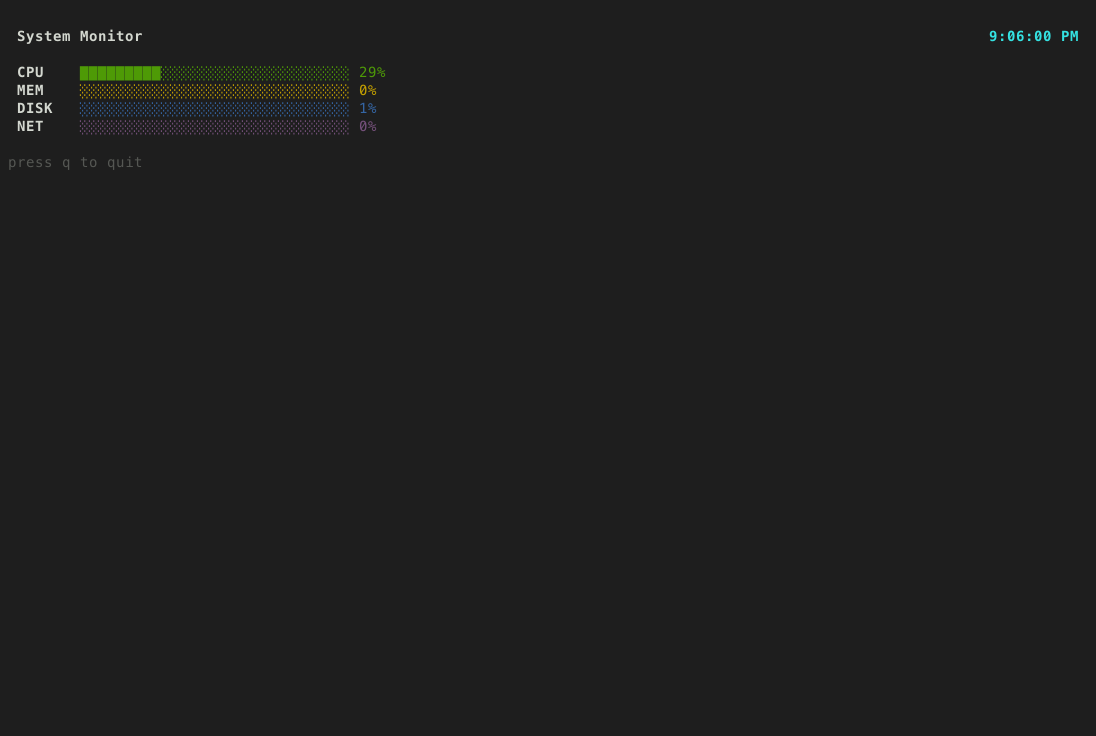
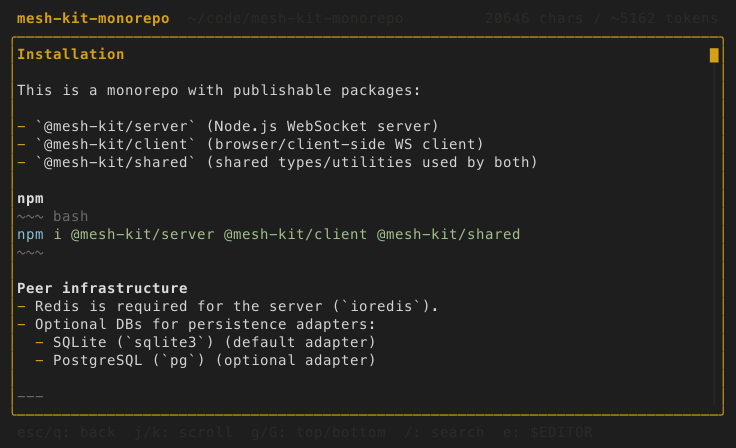
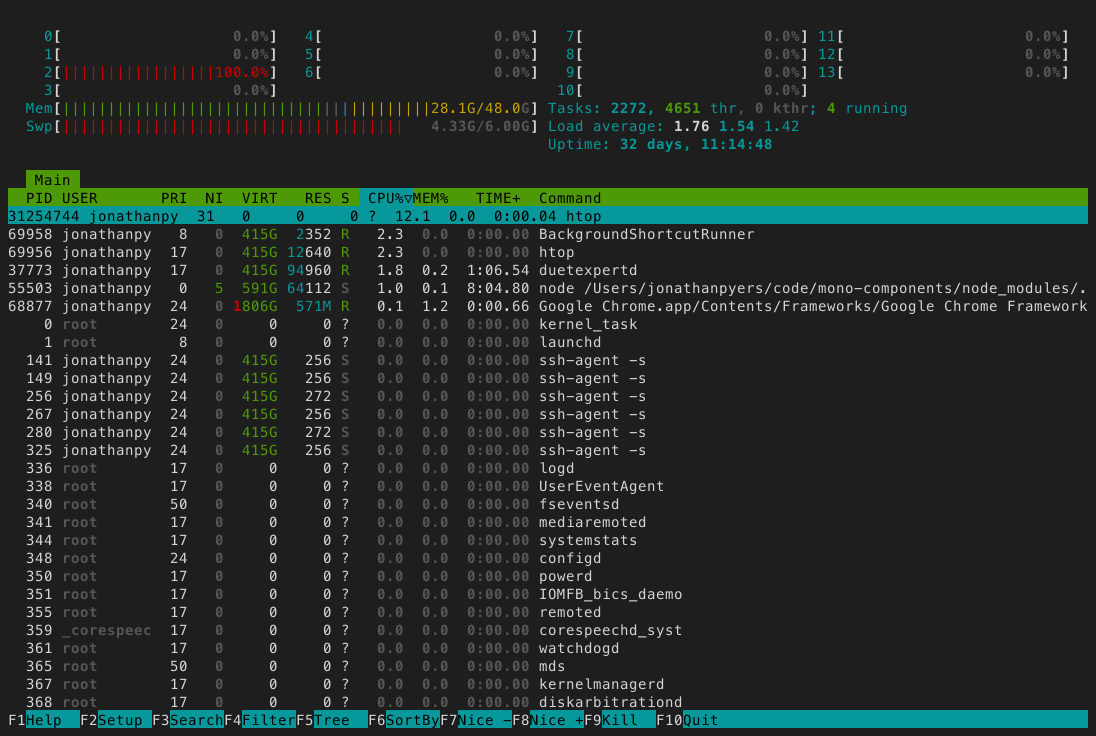
Some example outputs of the screenshot tool:
Setup
Tools
| Tool | Description |
|---|---|
| launch | Spawn a TUI app in a managed pty |
| kill | Terminate a session |
| list_sessions | List sessions, including recently exited ones |
| status | Get one session's state and exit code |
| resize | Resize the terminal |
| screenshot | Capture terminal as PNG |
| snapshot | Capture terminal as plain text |
| scrollback | Read the buffer including scrolled-off history |
| output | Read the raw pty byte stream (escape sequences included) |
| read_region | Read a rectangular area of the buffer |
| cursor | Get cursor position |
| send_keys | Send a keystroke or combo (Enter, Ctrl+C, Ctrl+Up, q) |
| send_text | Type a string of characters |
| send_mouse | Send mouse events |
| wait_for_text | Wait for a regex pattern to appear |
| wait_for_idle | Wait until the terminal stops changing |
| wait_for_exit | Wait for the process to exit and get its exit code |
Interesting use cases
- remote ops: agent SSHs into a production box, tails logs, greps for errors, restarts a service, watches it come back up. it's reading the same terminal output a human SRE would see. no custom APIs needed.
- legacy system interaction: ncurses admin panels, mysql cli, redis-cli, psql - the agent can drive all of these. stuff that will never get a REST API.
- multi-session orchestration: agent launches 3-4 sessions simultaneously. one running a dev server, one running tests, one tailing logs, one in a debugger. it's basically pair programming with an extra set of hands.
- interactive debuggers: gdb, lldb, pdb, node --inspect. the agent can set breakpoints, step through code, inspect variables.
- infrastructure as conversation: kubectl, terraform, docker, aws cli. agent doesn't need the kubernetes MCP server or the AWS MCP server. it just uses the CLIs directly, same as a human would.
Most MCP servers wrap one specific tool or API. tui-mcp wraps the terminal itself, which is the universal interface that all tools already speak. It's MCP's eval().
Monitor
Watch and control all active sessions from your terminal:
Session list on the left, live ANSI-rendered terminal preview on the right. The monitor discovers every running tui-mcp server on the machine and aggregates their sessions.
Keys:
j/kor arrows to move through servers and their sessions,g/Gfor top/bottom, mouse click and scroll also workenteron a session attaches - everything you type passes through to its pty,ctrl+\detachesenteron a server opens the launch panel targeting itsfetches the session's full scrollback into a scrollable view,escreturns to livellaunches a new session on the selected row's server (ctrl+scycles the target)xtwice within 3 seconds kills the selected sessionqquits
Attach, launch, kill, and scrollback need the server to be 1.2 or newer; sessions on older servers are marked ro (read-only) and can still be watched.
How it works
The app runs in a real pseudo-terminal via node-pty. Its output is parsed by xterm-headless (the same terminal emulator that powers VS Code's terminal, but without a DOM). The MCP tools read and interact with that parsed buffer.
Related MCP Servers
Adoption & maintenance
Factual signals from GitHub, npm, and our automated checks — not a rating.
GitHub stars
12
Stargazers on the source repository.
Last commit
1mo ago
Most recent push to the default branch.
Tools exposed
17
Callable tools this server registers over MCP.
Directory activity
2 views
Config copies, upvotes, and views on AllMCPs.
Reviews
No reviews yet — be the first to share how this listing worked for you.
Frequently Asked Questions about Tui MCP
AllMCPs Directory Badge
Showcase your server listing on GitHub or your project documentation. Embed this dynamic SVG badge to highlight official listing status and live engagement.
Badge Style:
Live Dynamic SVG Preview
Markdown (GitHub README)
[](https://allmcps.com/mcp/nvms-tui-mcp)HTML Embed
<a href="https://allmcps.com/mcp/nvms-tui-mcp"><img src="https://allmcps.com/api/badge/nvms-tui-mcp?style=directory" alt="Tui MCP on AllMCPs" /></a>Technical Specs & Signals
CategoryCommand Line
PricingFree
55Quality signal: Good · 55/100How this signal is calculated ▾
Server availabilityNot measured
Not scored for repo-hosted servers — we can't reach the running server, only its GitHub page. Hosted MCP endpoints are health-checked live.
Verified ownership10/20
Documentation & tools27/30
Adoption & activity4/15
Community engagement0/10
A guidance signal from public completeness & health data — not a user rating. New listings start lower and rise as they add docs, get verified, and grow adoption. Signals we can't observe for a listing are skipped, not counted against it.
Supply-chain signal
No high-severity advisories surfaced by our automated scan.
Critical 0High 0Medium 0Low 0
Scanned 22d ago via OSV.dev · tui-mcp (npm)
Own this project?
This directory is pre-filled from public sources. Claim via GitHub README, site badge, or DNS TXT to unlock edit access and the Official badge and attach your website — proof is checked automatically, then reviewed by our team.
Free dofollow backlink: add your website and place the AllMCPs badge on it — no claim needed. We detect it automatically and keep it verified as long as the badge stays live.
Claim & get free dofollowShare & Embed
Add our SVG badge (dark/light directory styles) or embeddable widget to your site.