Nora
Run OpenClaw and Hermes fleets on your own infrastructure — from one control plane.
OpenClaw + Hermes · Docker + Kubernetes GA · 69 provider connections · Apache-2.0



📚 Documentation · Self-Hosting · Architecture · How Nora Compares · Press Kit · Changelog
What Is Nora?
Nora is the self-hosted AI agent ops platform for running autonomous agent fleets on infrastructure you control — whether you standardize on OpenClaw, Hermes, or keep both available in the same operator surface.
Most teams running agents in production eventually rebuild the same layer around the runtime itself: deploy workflows, secrets, monitoring, logs, terminal, templates, and a separate admin surface. Nora exists so that layer doesn't have to be rewritten every time the runtime conversation changes. Operator workflows live under /app; platform-wide admin lives under /admin.
→ Why Nora · Runtime model · Deployment footprint
Features
- Deploy & operate runtimes — provision OpenClaw and Hermes agents to Docker or Kubernetes (both GA, official Helm chart) with full lifecycle controls: deploy, start/stop, restart, redeploy, and version history.
- Migrate existing runtimes — recreate agents from uploaded bundles, with privileged local-Docker Live Pull available to self-hosted platform admins.
- Live operator access — streaming logs, an interactive terminal into running containers, a file browser/editor, and the OpenClaw gateway & Hermes dashboard embedded in the operator UI.
- Persisted, searchable logs and traces — runtime container logs for every deploy target and runtime family, plus OpenClaw structured gateway logs and native OTLP trace ingest, are captured into durable, encrypted, retention-bounded storage (
localby default, or S3/R2), with search, export, per-workspace retention, a changeable storage destination, and a three-lens Runtime/Traces/Operator view on/app/logs— see the logging guide. - Monitoring & alerting — per-agent metrics and cost, a fleet needs-attention roll-up (errored, stuck, over-budget, stalled telemetry), and user-defined alert rules delivered to your channels.
- Budgets & scheduled runs — per-agent LLM budget hard caps with auto-pause, plus recurring cron schedules for agent runs with queue retries and sweep guards.
- Secrets that fail closed by default — provider keys are AES-256-GCM encrypted at rest and synced to running runtimes; production refuses to boot without a valid encryption key unless an operator deliberately enables the insecure plaintext override; SSH host-key pinning protects remote (BYOC) Docker hosts.
- Network isolation — baseline Kubernetes NetworkPolicy ingress isolation with admin-managed CIDR allow rules, and an experimental NemoClaw hardened sandbox for untrusted code.
- Agent Hub — installable, versioned starter templates to go from zero to a working agent fast.
- Integrations — a 69-entry credential/connectivity catalog (source control, chat, cloud, observability, vector DBs, automation) plus 17+ LLM providers. Executable behavior comes from runtime skills or MCP adapters; supported per-agent MCP servers are enabled explicitly.
- Experimental Proxmox LXC — deploy standard OpenClaw or a prepared Hermes image into unprivileged LXC with verified API TLS and pinned SSH. It is not VM-grade isolation and still requires the real-hardware smoke gate before production use.
- Automate everything — a public REST API (OpenAPI 3.1), the
@noraai/cli, and the@noraai/mcp-serverfor Claude Code, Gemini CLI, Claude Desktop, and Cursor. - Workspaces & RBAC — multi-tenant workspaces with ranked roles, a platform admin surface, account event history, and encrypted managed backups.
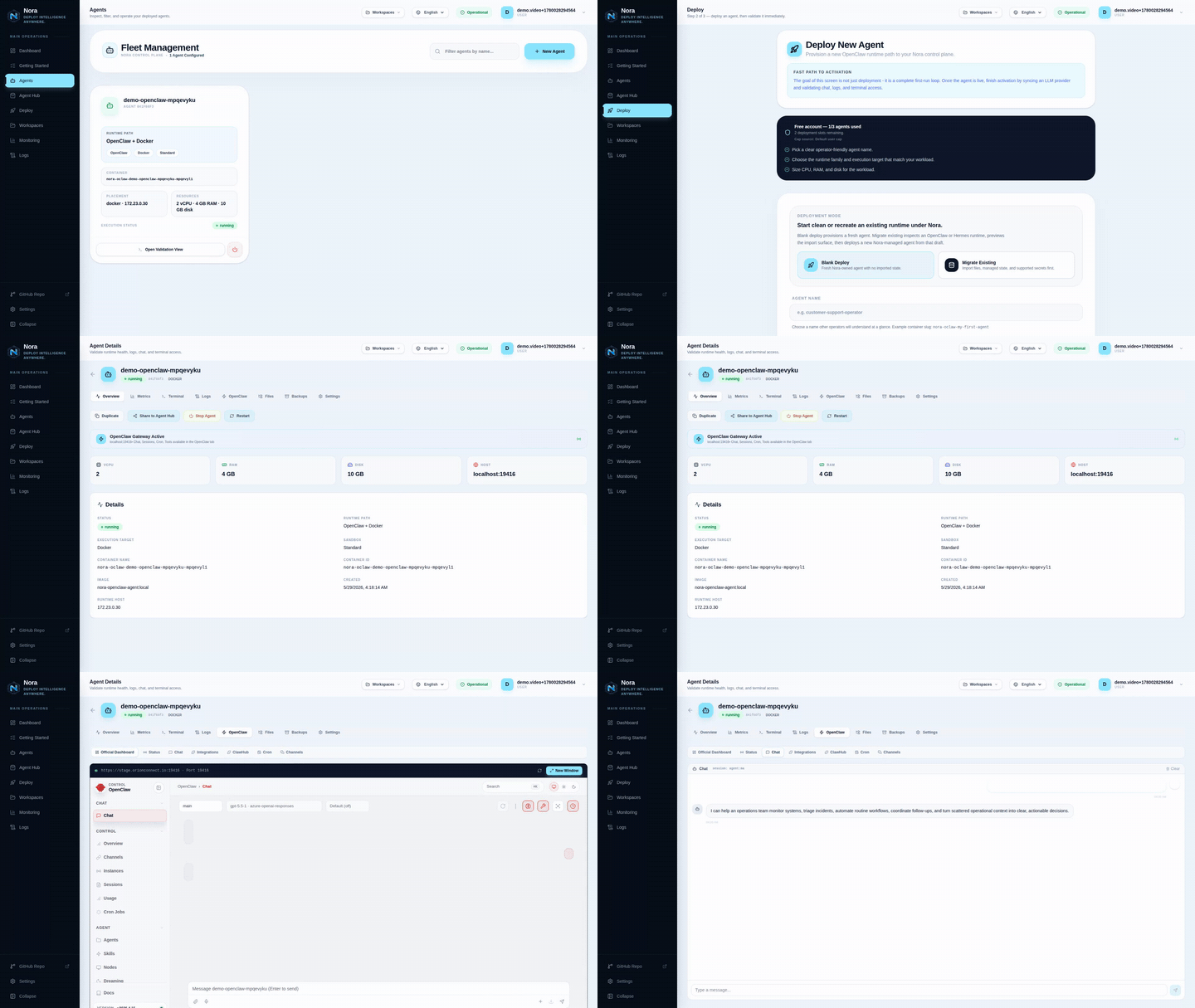
Screenshots
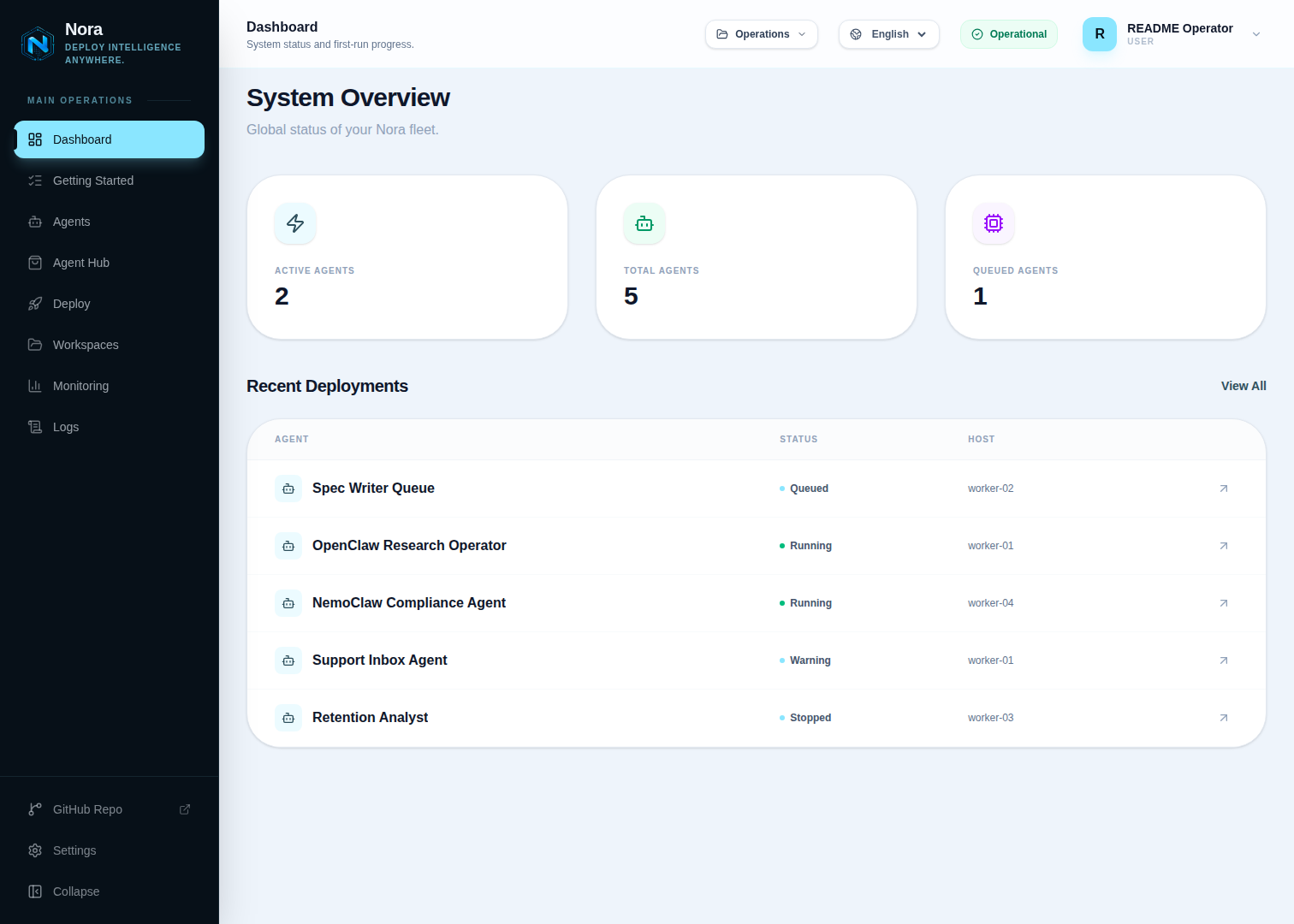 Operator dashboard |
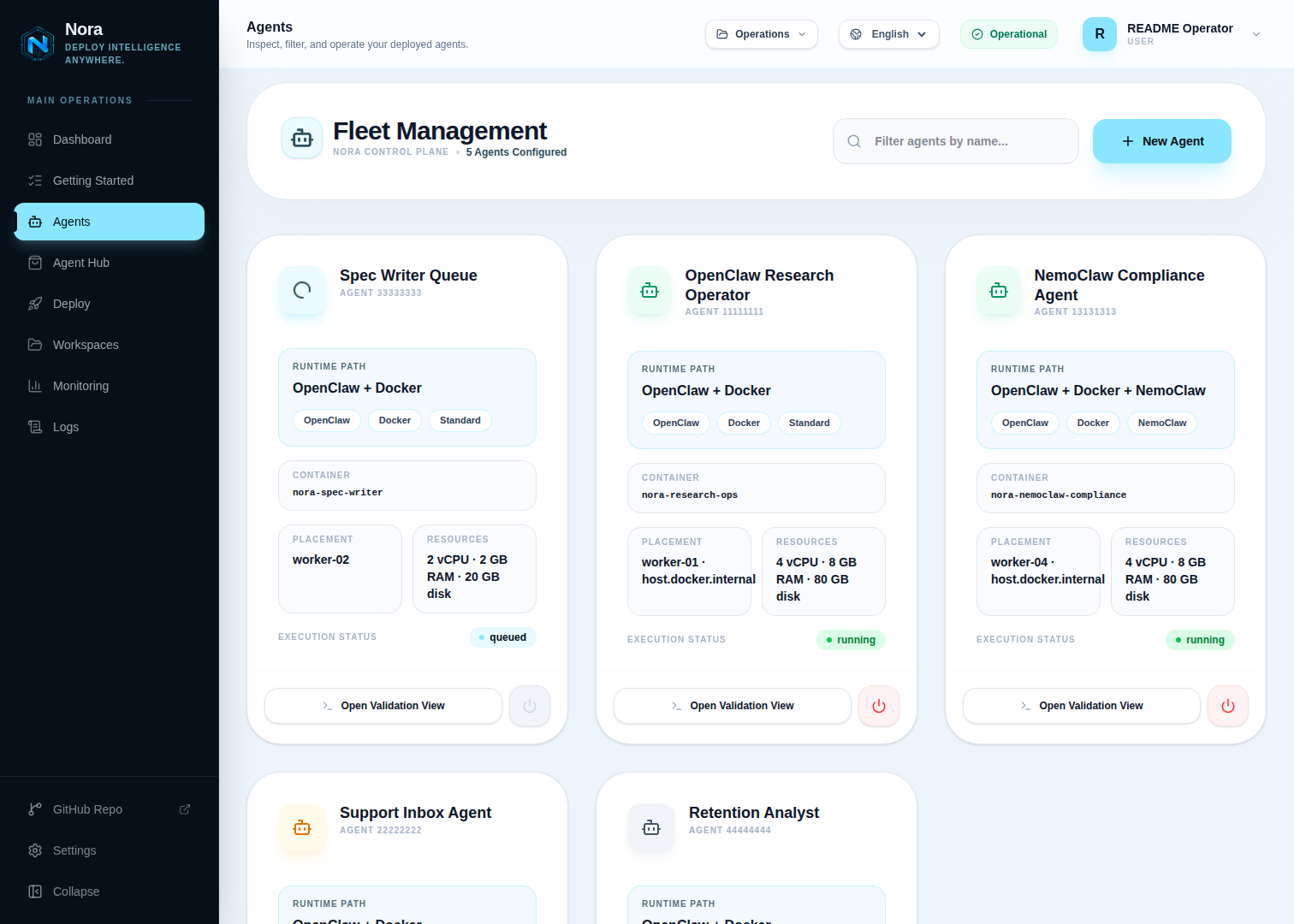 Fleet monitoring & needs-attention triage |
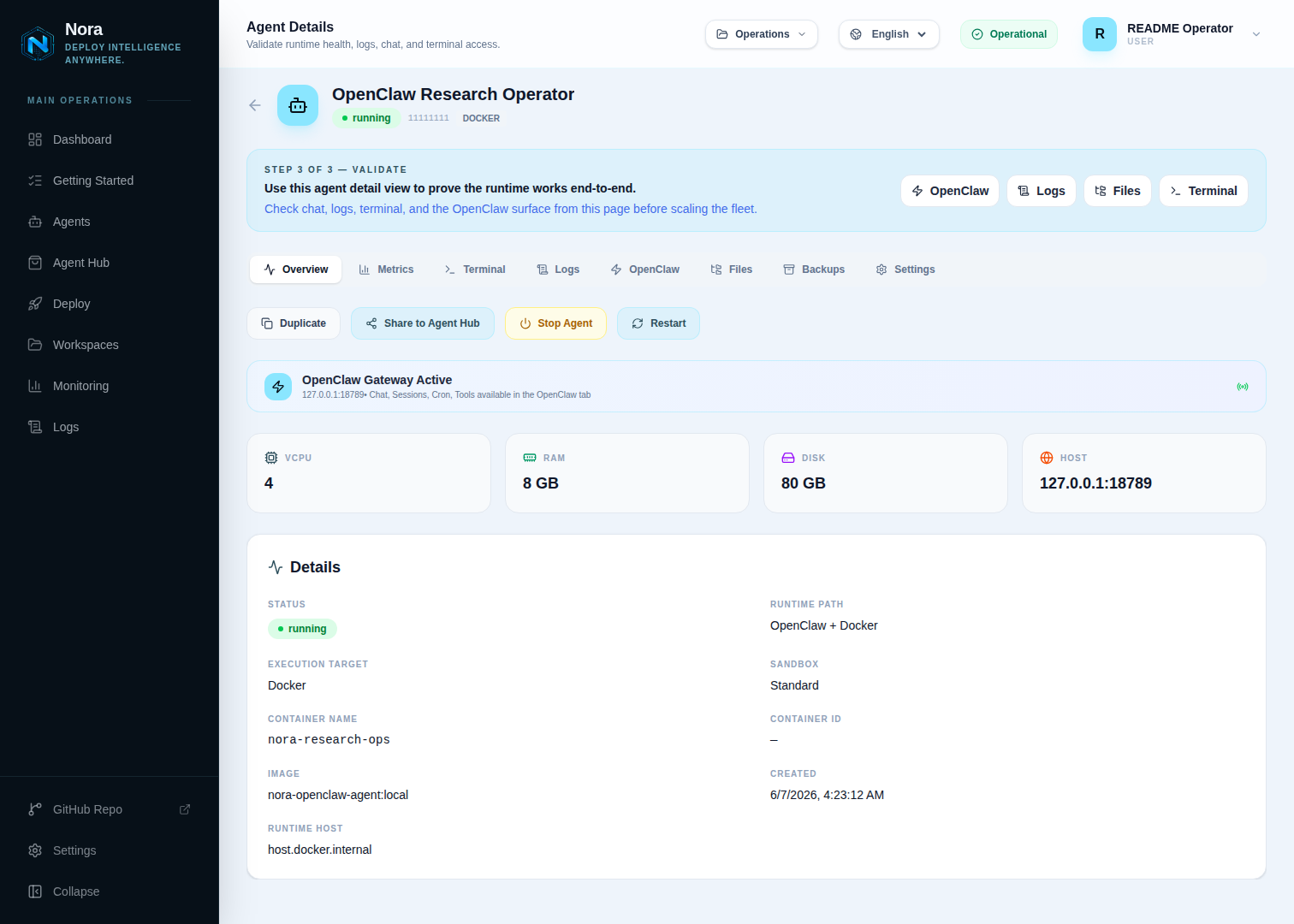 Agent detail & lifecycle operations |
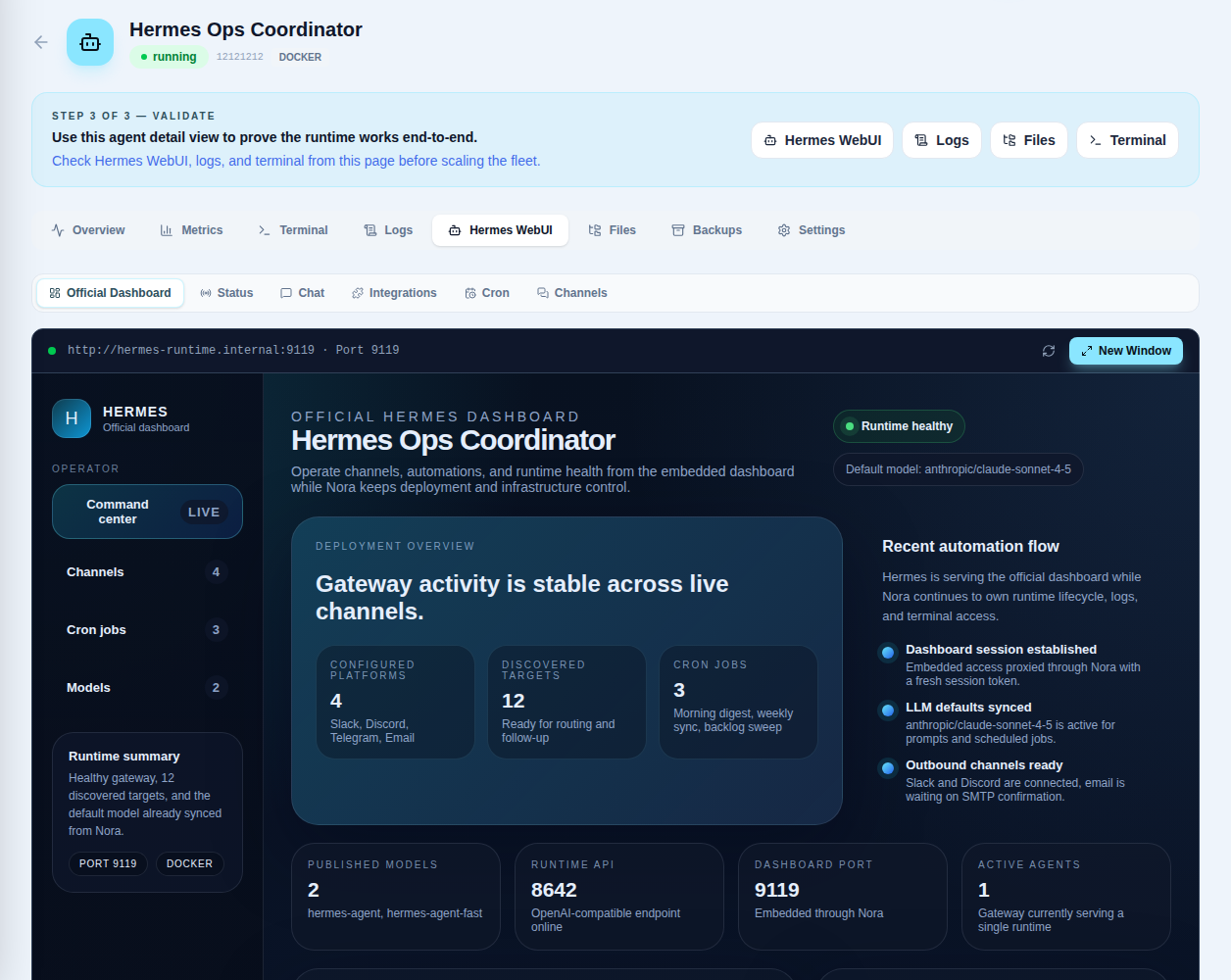 Hermes WebUI embedded in Nora |
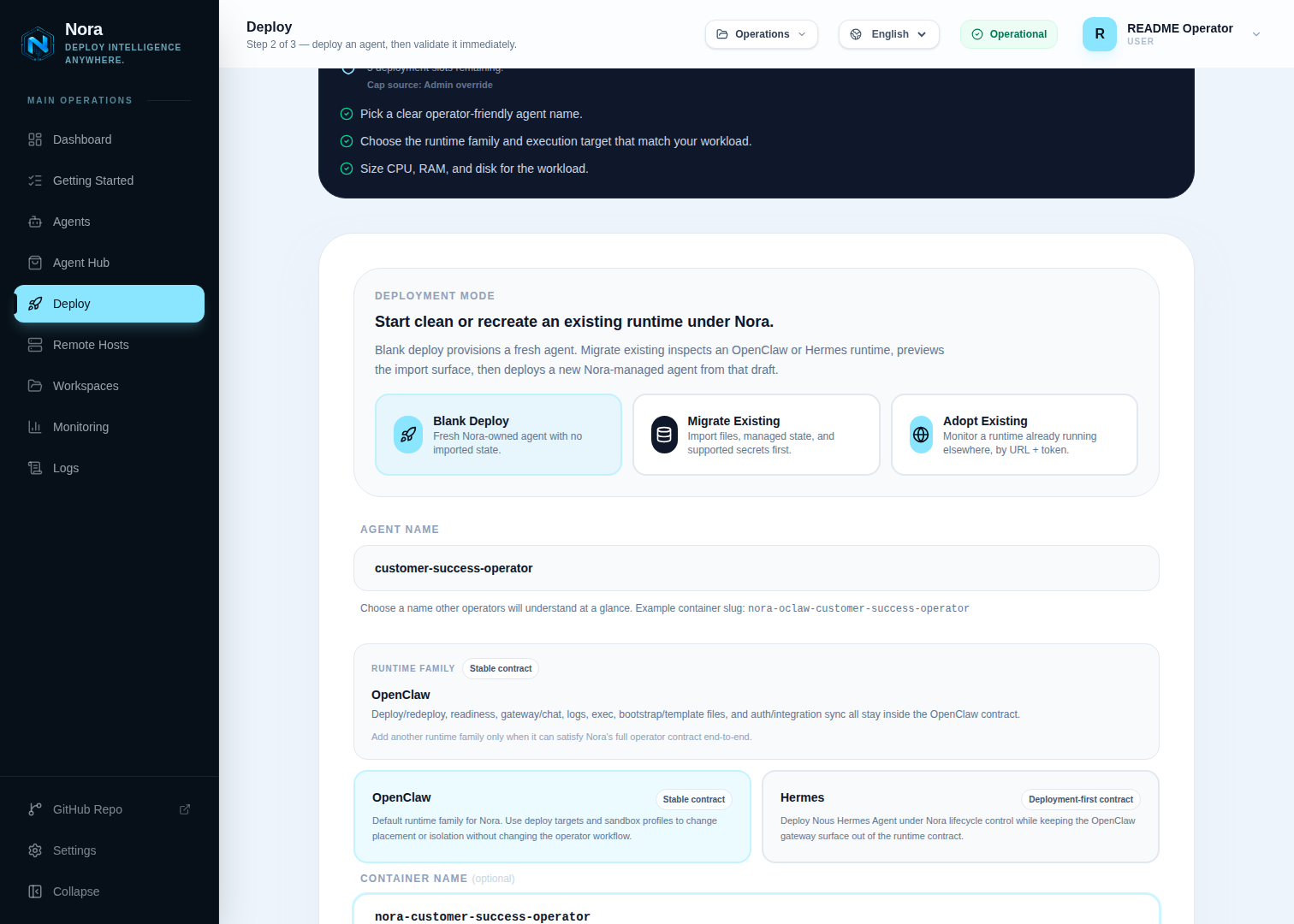 Agent deploy flow | |
Quick Start
Requirements: macOS 12+, Linux, or Windows 10+ (WSL2), with Docker Engine + Compose v2. The installer checks for Docker, Git, and OpenSSL and installs anything missing.
macOS / Linux / WSL2:
curl -fsSL https://raw.githubusercontent.com/solomon2773/nora/master/setup.sh | bash
Prefer to inspect the installer first?
git clone https://github.com/solomon2773/nora.git
cd nora
less setup.sh
bash setup.sh
Windows (PowerShell):
iwr -useb https://raw.githubusercontent.com/solomon2773/nora/master/setup.ps1 | iex
Windows requires PowerShell 7+. The default Windows PowerShell 5.1 is not supported — run the command above from a
pwsh7 session.
Kubernetes (Helm):
helm show chart oci://ghcr.io/solomon2773/nora
The command resolves the latest published chart; pin the reported version for reproducible production installs. The public OCI chart installs the full Nora control plane. See the Helm instructions for the required secrets and Ingress options.
The installer verifies prerequisites, generates or preserves secrets, optionally creates a bootstrap admin, picks free local ports when the defaults are busy, and starts the stack. Once it finishes, open the URL printed by setup. Local mode defaults to http://localhost:8080, but setup may select another port such as 8081 on a busy workstation. Then follow the first-15-minutes walkthrough.
No API key yet? On installations with the local Docker target enabled, choose Launch local Docker demo on the Getting Started page. Nora deploys a working agent against its built-in deterministic demo provider, so you can validate chat and the operator workflow with zero keys and zero model-usage cost. Kubernetes-only installations start by adding a model provider and deploying to an enabled cluster target.
For manual setup, environment variables, public-domain mode, TLS, Remote Docker, Kubernetes, NemoClaw, and experimental Proxmox LXC configuration, see the docs:
- Self-hosting guide
- Environment variables reference
- Provisioner backends (Docker and k3s/Kubernetes are GA; Remote Docker, NemoClaw, and Proxmox LXC are experimental)
- Remote Docker BYOC setup — SSH registration, private networking, validation, sharing, and recovery
- TLS and public domains
- Fronting a launch with Cloudflare — edge caching, rate limiting, and spike absorption for the single-host deploy
Documentation
Full docs live at docs.norafleet.ai. The MDX source is in docs/.
| Section | What's there |
|---|---|
| Quick Start | Install and validate your first agent in 15 minutes |
| Concepts | Architecture, agents, runtimes, workspaces, LLM providers, Agent Hub |
| Configuration | Platform modes, env vars, provisioner backends, TLS / public domains |
| Guides | Deploy agent, providers, integrations, channels, monitoring, alert rules, backups, Agent Hub, NemoClaw |
| API Reference | Auth, workspaces, agents, channels, integrations, providers, monitoring, alert rules |
| Support | FAQ, troubleshooting |
Architecture
Nginx
├── /           → frontend-marketing  (Next.js)
├── /app/*      → frontend-dashboard  (Next.js)
├── /admin/*    → admin-dashboard     (Next.js)
└── /api/*      → backend-api         (Express.js)
                       ├── PostgreSQL
                       ├── Redis + BullMQ  (deployments, clawhub-jobs, backups, alert-deliveries)
                       ├── worker-provisioner
                       ├── worker-backup
                       ├── deploy-target adapters  (Docker + k3s/k8s GA · Remote Docker + Proxmox experimental)
                       └── sandbox profiles        (standard · NemoClaw experimental)
Full architecture write-up — system map, queue/worker boundaries, RBAC, migration contract, deployment topologies — is in docs/concepts/architecture.
Tech Stack
| Layer | Technology |
|---|---|
| Reverse proxy | Nginx |
| Frontends | Next.js 16, React 19, Tailwind CSS |
| Backend API | Express.js 5, Node.js 24 LTS |
| Auth | JWT, HttpOnly cookies, bcryptjs, provider OAuth bridge |
| Database | PostgreSQL 15 |
| Queue | BullMQ + Redis 7 |
| Runtime families | OpenClaw, Hermes |
| Deployment targets | Docker and k3s/Kubernetes (GA); Remote Docker BYOC and Proxmox unprivileged LXC (experimental) |
| Sandbox profiles | Standard; NemoClaw (experimental, not available on Proxmox) |
| Secrets at rest | AES-256-GCM (provider keys, integrations, backups) |
Public REST API, CLI, and MCP
Workspace-scoped API keys (bearer-only, prefixed nora_, HMAC-hashed at rest, scope-based) drive a stable subset of the REST surface. Issue keys at /app/workspaces/<id>/api-keys.
export NORA_TOKEN="nora_..."
curl -H "Authorization: Bearer $NORA_TOKEN" https://your-nora.example.com/api/agents
A small CLI lives in cli/ (@noraai/cli): run nora login once to save your host and API token, then nora workspaces, nora agents, and nora monitoring wrap the same REST surface. nora doctor runs an admin-only control-plane health check, and nora mcp launches the MCP stdio server. See the API reference for the supported endpoints and scopes.
Operate Nora from Claude Code, Gemini CLI, Claude Desktop, or Cursor: the mcp-server/ package (@noraai/mcp-server) exposes the same API as Model Context Protocol tools — deploy agents, control their lifecycle, and read fleet metrics, events, and per-agent cost from any MCP client. Destructive deletion stays disabled unless explicitly opted in.
claude mcp add nora \
  --env NORA_API_URL=https://your-nora.example.com \
  --env NORA_API_KEY=nora_... \
  -- npx -y @noraai/mcp-server
Gemini CLI users can install the repository extension directly. The installer prompts for the Nora API URL and stores the workspace API key as a sensitive extension setting:
gemini extensions install https://github.com/solomon2773/nora
See the MCP guide for Gemini CLI, Claude Desktop, and Cursor configuration, the tool list, and security notes.
Standards & isolation
- MCP — shipped. A control-plane MCP server (
@noraai/mcp-server, published to the official MCP Registry) plus per-agent MCP server management — operate the fleet from Claude Code, Gemini CLI, Claude Desktop, or Cursor, and wire MCP tools into individual agents. - OpenTelemetry GenAI — available. OTLP + Prometheus export of runtime telemetry under the
gen_ai.*semantic conventions — per-exchange chat spans plus token/cost/resource metrics flow into the Grafana / Datadog / Langfuse stack you already run. (Per-tool-call sub-spans are a separate, OpenClaw-only capability — agents push real traces into Nora's own OTLP receiver, viewable in the Traces lens on/app/logs.) - A2A — on the roadmap. Agent Cards / Agent-to-Agent discovery for managed OpenClaw and Hermes agents.
- Isolation, per deploy target. Standard Docker runs use container namespaces plus operator-set CPU and RAM limits;
disk_gbis metadata and operators must monitor Docker storage. Kubernetes adds workload resource limits and provisioned storage requests. The experimental NemoClaw profile hardens untrusted code with a non-root user, all Linux capabilities dropped,no-new-privileges, Landlock + seccomp, and default-deny egress. Experimental Proxmox placement uses unprivileged LXC, which remains a shared-kernel boundary and is not presented as VM-grade isolation. See the isolation model.
Roadmap
- NemoClaw hardening (high priority) — mature the experimental secure-sandbox profile end to end: enablement, policy controls, approvals, telemetry, and validation.
- Proxmox hardware qualification — run the protected OpenClaw and prepared-Hermes lifecycle matrix on the exact node, storage, bridge, templates, and network before considering any beta label; until then the target remains Experimental.
- Hermes/OpenClaw parity — close runtime gaps across validation, logs, terminal access, monitoring, and failure reporting.
- First-run operator UX — a tighter path from install to the first deployed, validated agent.
- Account-scoped monitoring — account-level health roll-ups across workspaces, agents, cost, and alerts, with drill-downs.
- Auth & key-sync hardening — key rotation, audit trails, and recovery from partial sync failures.
- Agent Hub ergonomics — better template discovery, install/configure flows, and post-install validation.
- A2A support — Agent Cards / agent-to-agent discovery for managed runtimes.
Development
# Docker (recommended)
docker compose up -d
docker compose logs -f backend-api

# Tests
cd backend-api && npx jest --no-watchman
cd e2e && npm test
Start with CONTRIBUTING.md for contributor guidance. CLAUDE.md documents the repo layout, development commands, and subtree ownership for humans and AI coding agents alike.
Contributing
New here? Browse good first issues for small, self-contained starting points, then skim CONTRIBUTING.md.
Strong contribution areas: runtime adapter work · operator and admin UX · provisioning and lifecycle orchestration · integrations and channels · test and CI hardening · self-hosted deployment ergonomics.
Typical workflow: fork → branch (feature/...) → commit → pull request.
Community
If Nora is useful to you, a ⭐ on the repo helps other self-hosters find it.
License
This project is open source under the Apache License 2.0.