Traces which neurons and attention heads drive a language model's output via MCP tools.
Quick Install
Automated & IDE SetupCopy the AI prompt to install this server into Claude Code, Cursor, or another agent — or use 1-click editor setup below.
Manual Client & Custom JSON ConfigExpand JSON ▾
Client Config & Setup
Choose your client or environment
Target File:
💡 Paste the JSON block into your client's configuration file under mcpServers, then restart the application.
Documentation Overview
NeuronScope



Ask a language model "why did you say that" and get back the actual attention heads and neurons responsible, as JSON, from the command line or from an agent over MCP.

Install
That gets you the neuronscope command. To install from source instead (for development or to
track main):
[!NOTE] The first run of any command downloads the requested model from the HuggingFace Hub (
gpt2is about 500MB) and prints two lines to stderr that are expected, not errors: a CPU-fallback notice if you don't have a CUDA GPU, and an unauthenticated-HF-Hub rate-limit notice. Neither one means anything broke.
Quickstart
Real output from this exact command (stderr trimmed to the two expected warnings mentioned above):
gpt2 predicts Tokyo correctly, and head L9H8 is the single biggest contributor to that
prediction. Add --json to get the machine-readable version of the same result:
What it does
NeuronScope is a CLI and MCP server built on top of TransformerLens. TransformerLens does the actual model loading, hooking, and activation math; NeuronScope adds a stable CLI, a versioned JSON schema, and an MCP server around it, so a script or an agent can ask "which components drove this output" without writing TransformerLens code directly.
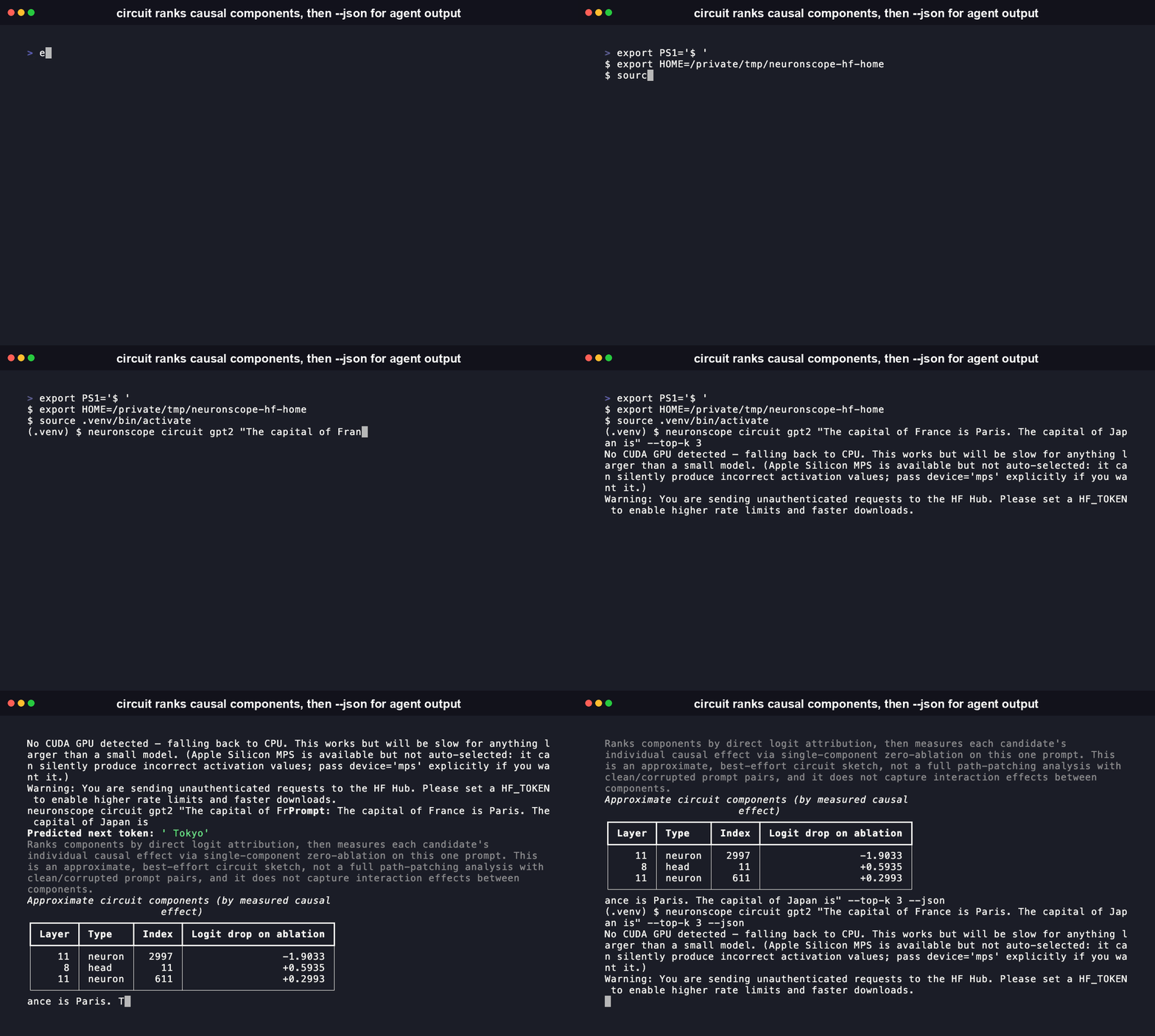
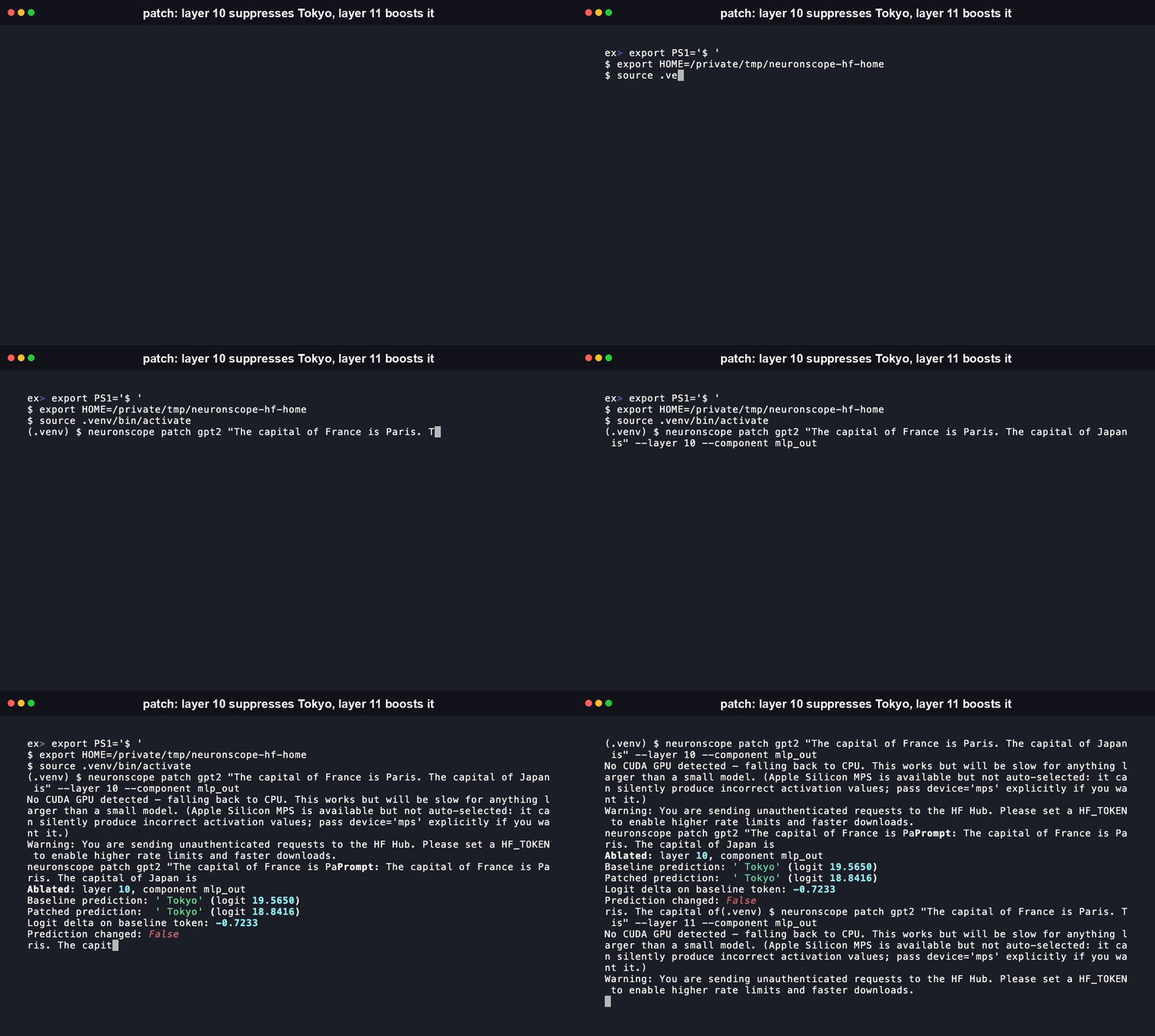
trace: runs a prompt through the model and ranks attention heads by direct logit attribution to the predicted token, and MLP neurons by activation magnitude at the final prompt position.activations: dumps shape, mean, std, min/max, and the max-activating sequence position for every layer's residual stream, MLP neuron activations, and attention pattern.patch: zero-ablates one component (resid_pre,resid_mid,resid_post,attn_out,mlp_out, ormlp_post) at a given layer and reports how the predicted token and its logit changed.circuit: a best-effort automated circuit sketch. Ranks candidate heads/neurons by logit attribution, then measures each one's individual causal effect via single-component ablation. This is not full path-patching with clean/corrupted prompt pairs and does not capture interaction effects between components. The--jsonoutput says so explicitly in itsmethodfield.- Every command supports
--jsonfor aschema_version-stamped document instead of a table, and the same four operations are exposed as MCP tools returning the identical shape via.model_dump(), so a CLI call and an MCP tool call produce the same document for the same input. - Model support is whatever
transformer_lens.HookedTransformer.from_pretrainedsupports. Installingneuronscope-clitoday pulls TransformerLens 3.6.0, which supports 249 pretrained checkpoints and aliases (OFFICIAL_MODEL_NAMES), covering GPT-2, Pythia, Llama, Gemma, Qwen, and more. Small models likegpt2run comfortably on CPU.
NeuronScope does not replace TransformerLens, nnsight, SAELens, Anthropic's circuit-tracer, or Neuronpedia. It wraps TransformerLens for one narrower job: fast, scriptable, agent-callable component tracing on a single prompt. It leaves deeper mechanistic work (SAE training, transcoder-based circuit graphs, hosted feature browsing) to those tools.
CLI reference
Every command takes MODEL (any name HookedTransformer.from_pretrained accepts, for
example gpt2 or EleutherAI/pythia-70m) and PROMPT as positional arguments.
| Command | Extra flags | What it does |
|---|---|---|
neuronscope trace MODEL PROMPT | --top-k INTEGER (default 10), --json | Ranks top attention heads (logit attribution) and MLP neurons (activation magnitude) for the predicted next token |
neuronscope activations MODEL PROMPT | --json | Dumps per-layer activation summary stats (residual stream, MLP, attention pattern) |
neuronscope patch MODEL PROMPT | --layer INTEGER (required), --component [resid_pre|resid_mid|resid_post|attn_out|mlp_out|mlp_post] (required), --json | Zero-ablates one component and reports the logit/prediction delta |
neuronscope circuit MODEL PROMPT | --top-k INTEGER (default 10), --json | Best-effort circuit sketch via ranked single-component ablation |
neuronscope mcp-server | none | Starts the MCP server over stdio |
Global: neuronscope --version, neuronscope <command> --help. Exit codes: 0 success,
1 a runtime error (prompt too long for the model's context window, --layer out of range,
etc.), 2 a Click usage error (bad flags), 3 an unsupported model name.
MCP Server
NeuronScope ships a Model Context Protocol server so an AI agent (Claude, Cursor, or any MCP-compatible client) can trace, inspect, ablate, and sketch circuits directly, without a human invoking the CLI by hand.
Install the extra:
Add it to your MCP client's config (for Claude Desktop, claude_desktop_config.json):
The server exposes four tools, trace, activations, patch, and circuit, each returning
the identical pydantic-model-shaped JSON the CLI's --json flag prints, via .model_dump(), so
an agent calling this server and a script calling the CLI get the same document for the same
input. A real trace call and its response:
Related MCP Servers
Reviews
No reviews yet — be the first to share how this listing worked for you.
Frequently Asked Questions about Neuronscope
AllMCPs Directory Badge
Showcase your server listing on GitHub or your project documentation. Embed this dynamic SVG badge to highlight official listing status and live engagement.
Badge Style:
Live Dynamic SVG Preview
Markdown (GitHub README)
[](https://allmcps.com/mcp/neuronscope)HTML Embed
<a href="https://allmcps.com/mcp/neuronscope"><img src="https://allmcps.com/api/badge/neuronscope?style=directory" alt="Neuronscope on AllMCPs" /></a>Technical Specs & Signals
CategoryDeveloper Tools
27Quality signal: Emerging · 27/100How this signal is calculated ▾
Server availabilityNot measured
Not scored for repo-hosted servers — we can't reach the running server, only its GitHub page. Hosted MCP endpoints are health-checked live.
Verified ownership8/20
Documentation & tools11/30
Adoption & activity1/15
Community engagement0/10
A guidance signal from public completeness & health data — not a user rating. New listings start lower and rise as they add docs, get verified, and grow adoption. Signals we can't observe for a listing are skipped, not counted against it.
Own this project?
This directory is pre-filled from public sources. Claim via GitHub README, site badge, or DNS TXT to unlock edit access and the Official badge and attach your website — proof is checked automatically, then reviewed by our team.
Free dofollow backlink: add your website and place the AllMCPs badge on it — no claim needed. We detect it automatically and keep it verified as long as the badge stays live.
Claim & get free dofollowShare & Embed
Add our SVG badge (dark/light directory styles) or embeddable widget to your site.