Trust-aware agent memory with evidence-backed recall, self-inspection, and audit history.
Quick Install
Automated & IDE SetupCopy the AI prompt to install this server into Claude Code, Cursor, or another agent — or use 1-click editor setup below.
One-click editor setup isn’t available for this listing yet — we don’t have a confirmed install command, and we’d rather show nothing than point your editor at the wrong package or host. Follow the project’s own setup instructions, linked above.
Manual Client & Custom JSON ConfigExpand JSON ▾
No confirmed setup config for this listing yet. We only publish a config block when the install details come from the project itself — its README, its docs, or a verified owner. We haven’t found those for Nahuali, and we’d rather show nothing than a guess you’d paste into your client. Follow the project’s own setup instructions for the current steps.
Documentation Overview
Nahuali
Memory an agent can inspect before it trusts.
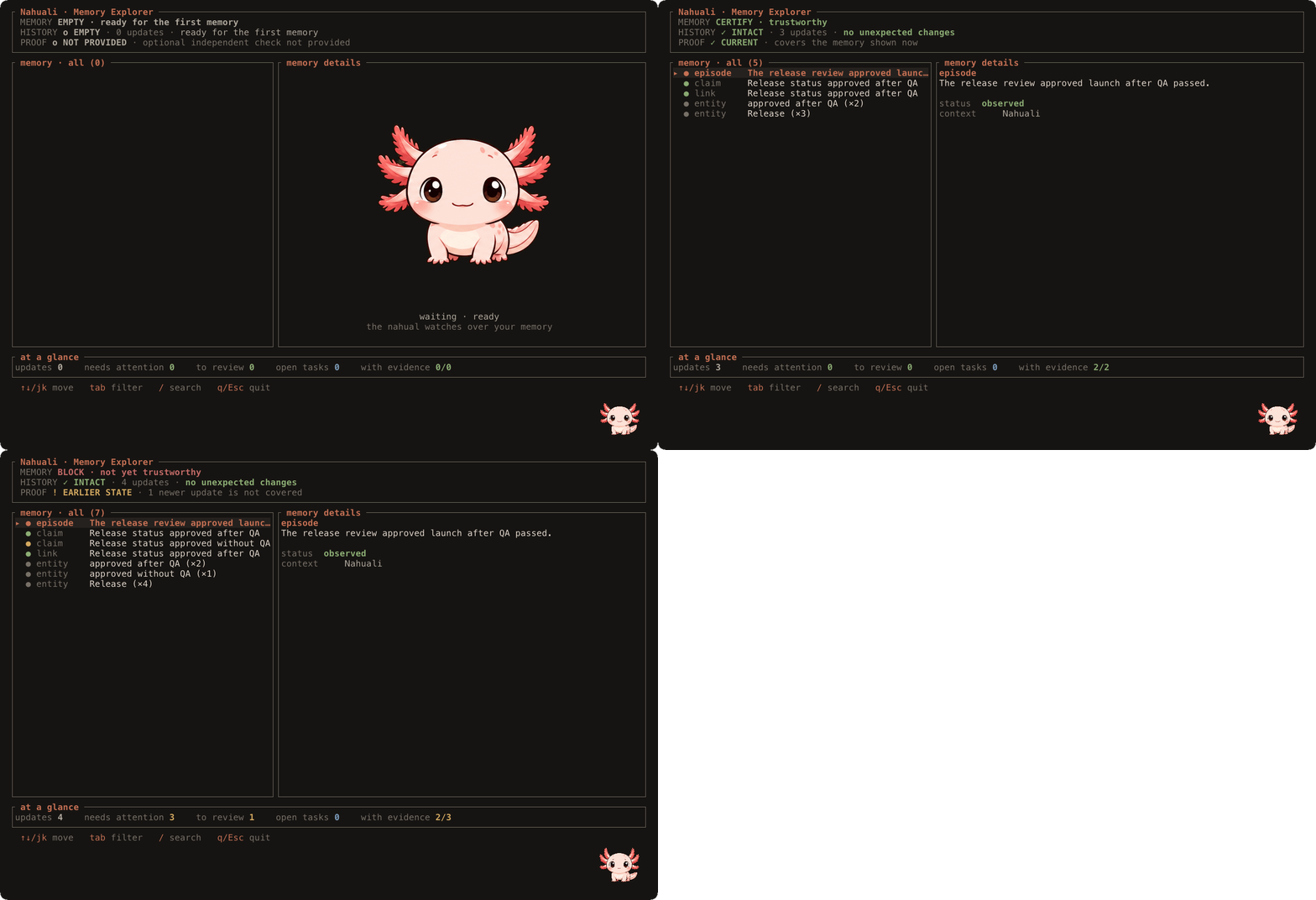
From an empty memory to evidence-backed recall: Nahuali shows what is ready to use and pauses what still needs review.




Memory retrieval usually begins with what context looks relevant? Nahuali also exposes four separate questions:
- What observation supports this memory?
- What conflicts with it or makes it stale?
- Do the current recorded-history checks pass?
- Do the available evidence and health checks support using this result?
The result is a local-first memory engine with deterministic trust verdicts, tamper-evident recorded history, and portable evidence. Its core does not need a model, account, API key, hosted service, or Docker.
A 60-second tour
Install the macOS or Linux binary. The installer requires the matching SHA-256 asset; the pinned path below can additionally require its Sigstore bundle.
Run nahuali --version in a terminal to see the real axolotl spritesheet come
alive beside the build identity. When the command is captured or redirected, it
emits the stable nahuali <semver> line expected by agents, install checks, and
benchmark tooling.
Record an observation, derive a claim from it, and require evidence at recall:
nahuali explore is not just a record browser. It keeps three independent
questions visible:
| Axis | What it answers |
|---|---|
MEMORY | Is this memory supported enough to use? |
HISTORY | Do this store's recorded-history checks pass? |
EXTERNAL | Was this state compared with an authorized reference kept outside this store? |
Press / to search every displayed memory-item field, Tab to filter by memory kind, and
j/k to inspect the evidence behind a result. The axolotl watches over the
memory and changes with its status. Rebuild the GIF above from real Ghostty
windows on macOS with scripts/render-readme-tui-gif.sh; the canonical README
asset is never replaced by the lower-fidelity text fallback.
Run nahuali demo for a narrated, non-mutating explanation of how Nahuali
detects a specific in-place record change and keeps unsupported memory from
driving action. The demo states which changes require an externally retained
reference rather than relying on the live store alone.
Where Nahuali fits
Choose Nahuali when an agent needs local or operator-controlled memory and the decision to use a result must carry evidence, health signals, and explicit integrity limits. It is especially useful as a reliability layer around consequential memory rather than as a replacement for every retrieval system.
Choose an established recall-first or managed memory platform when the main requirement is hosted operation, a broad framework ecosystem, or publicly disclosed LoCoMo/LongMemEval answer-quality results. Nahuali does not claim leadership on those axes today. An application can also pair another retrieval system with Nahuali's evidence and governance checks.
What Nahuali checks
Evidence is part of memory
Observations are first-class episodes. Claims, relationships, procedures, and intentions can point back to the episode that supports them. Recall can refuse results without that path instead of filling the gap with confidence language.
Verdicts stay separate from relevance
Authority-aware recall carries one of four deterministic verdicts:
| Verdict | Meaning |
|---|---|
certify | Available checks support use with the attached evidence. |
advisory | Useful as a lead, but not ready to repeat as fact without qualification. |
warn | Evidence, freshness, or store-health problems require verification. |
block | The memory must not drive action until the conflict is resolved. |
A certify verdict proves neither truth nor authorship. It means the available
evidence and content-health checks passed; inspect HISTORY and EXTERNAL
separately for internal history checks and an optional external comparison.
Nahuali keeps those limits machine-readable instead of hiding them in
documentation.
History is inspectable
The authoritative ledger is append-only and hash chained. Merkle inclusion and consistency proofs make verification compact; Ed25519 checkpoints bind a tree size, root, chain tip, origin, and ledger lineage to an external operator policy.
Nahuali is not a blockchain. It applies the transparency-log primitives standardized in RFC 9162 without publishing private memory to a public network or requiring consensus. Independent witness co-signing is a future step, not a capability claimed today.
One claim can travel with a receipt
Portable claim receipts contain only the selected claim, its evidence episode, an optional source envelope, their Merkle inclusion paths, and one signed checkpoint. Verification is offline and requires a policy held separately from the receipt:
The verifier reports receipt_integrity separately from content_authority.
Ledger commitment never becomes a claim that the remembered statement is true,
that its author is authentic, or that an external source still contains the
same bytes.
Offline receipt verification checks only the selected envelopes, their Merkle
paths, provenance links, and checkpoint authorization. It trusts the authorized
signers' commitment to that root; it does not replay or validate the complete
ledger prefix. Use checkpoint-verify with the ledger for that stronger check.
Receipts contain the selected memory verbatim and should be handled as sensitive
data, not published by default.
Built for agents, operable by humans
The CLI is canonical. The TUI, stdio MCP server, local HTTP API, and Rust crate all use the same deterministic engine:
| Interface | Use it for | Reference |
|---|---|---|
nahuali | Shell-capable agents, scripts, sustained ingestion, inspection, recovery, receipts, and the TUI | CLI |
nahuali-mcp | Hosts that expose MCP tools but cannot run local commands directly | MCP |
nahuali-api | Local HTTP integrations with an OpenAPI contract | HTTP API |
nahuali-core | Embedding the engine in Rust | Core |
Prefer the CLI for terminal-based agent workloads. It is the direct, scriptable interface, supports batch commands without an MCP tool-call round trip, and makes the exact database and JSON contract explicit in every invocation. MCP is an adapter for clients whose integration boundary is a tool protocol. Both interfaces have the same trust semantics; choosing the CLI does not bypass validation. An embedded database has one process owner, so do not point a running MCP server and CLI processes at the same embedded database simultaneously. Use remote SurrealDB when independent processes need shared access.
Run nahuali init to install the bundled agent skill where supported and print
a native MCP configuration. Nahuali is also published as
io.github.Arakiss/nahuali in the official MCP Registry. See
MCP onboarding for native and container
configurations.
The HTTP API is unauthenticated by design and must not be exposed to an untrusted network.
Storage and recovery
memory_record in SurrealDB is the source of truth. The current-memory view,
graph tables, snapshots, and semantic vectors are derived and rebuildable.
Related MCP Servers
Adoption & maintenance
Factual signals from GitHub, npm, and our automated checks — not a rating.
GitHub stars
3
Stargazers on the source repository.
Last commit
1mo ago
Most recent push to the default branch.
Reviews
No reviews yet — be the first to share how this listing worked for you.
Frequently Asked Questions about Nahuali
AllMCPs Directory Badge
Showcase your server listing on GitHub or your project documentation. Embed this dynamic SVG badge to highlight official listing status and live engagement.
Badge Style:
Live Dynamic SVG Preview
Markdown (GitHub README)
[](https://allmcps.com/mcp/nahuali)HTML Embed
<a href="https://allmcps.com/mcp/nahuali"><img src="https://allmcps.com/api/badge/nahuali?style=directory" alt="Nahuali on AllMCPs" /></a>Technical Specs & Signals
CategoryKnowledge & Memory
4/4 checks healthy over the last 39d
32Quality signal: Emerging · 32/100How this signal is calculated ▾
Server availabilityNot measured
Not scored for repo-hosted servers — we can't reach the running server, only its GitHub page. Hosted MCP endpoints are health-checked live.
Verified ownership10/20
Documentation & tools11/30
Adoption & activity3/15
Community engagement0/10
A guidance signal from public completeness & health data — not a user rating. New listings start lower and rise as they add docs, get verified, and grow adoption. Signals we can't observe for a listing are skipped, not counted against it.
Own this project?
This directory is pre-filled from public sources. Claim via GitHub README, site badge, or DNS TXT to unlock edit access and the Official badge — proof is checked automatically, then reviewed by our team.
Free dofollow backlink: add your website and place the AllMCPs badge on it — no claim needed. We detect it automatically and keep it verified as long as the badge stays live.
Claim & get free dofollowShare & Embed
Add our SVG badge (dark/light directory styles) or embeddable widget to your site.