Myco Brain README
The full upstream README, mirrored here for reference. Install config, tool schemas, adoption signals, and an original overview live on the Myco Brain listing page.

Persistent, source-traceable memory for AI agents — self-hosted on your own Postgres, with no API keys required to run.






- Source-traceable. Every fact traces to the document it came from (
brain_why) — no trust-me summaries. - Trust that compounds. Independent corroboration raises a fact's confidence; a contradiction supersedes it — kept and audited, never silently overwritten.
- Keyless & local-first. Full-text + semantic search and the knowledge graph all run with zero hosted dependency — add an Anthropic key only for the most accurate graph.
- Yours. Apache-2.0, plain Postgres tables, 13 MCP tools. Works with Claude, Cursor, Windsurf, Continue, Zed.
Who it's for: dev teams running agents that need one shared memory · agencies needing hard per-client isolation · anyone who wants their assistant to remember across sessions — import your ChatGPT / Claude history (from your data export) and your AI knows you on day one.
Built solo by a growth marketer — not a career engineer — directing AI coding agents over ~3 months. How it was built ↓
The usual fix for agent amnesia — letting an LLM maintain its own memory — fills it with duplicates, hallucinated summaries, and confident answers nobody can trace. Myco Brain is built on the opposite contract:
The LLM proposes. Deterministic rules decide what becomes a fact. You set the bar — from corroboration-gated auto-promotion (the default) to strict human review of every fact (
BRAIN_REQUIRE_HUMAN_REVIEW=1).
Claude, Cursor, Windsurf, Continue, Zed, and custom agents all share one memory backed by your own Postgres.
⭐ If the trust model resonates, a star helps others find it.
[!TIP] Zero API keys, all the way down. Full-text search, semantic search (local embeddings), and the knowledge graph (local extraction) all run with no hosted dependency. Add an Anthropic key only if you want the most accurate graph.
MCP-native by design — your agent knows when to use memory, not just how.
Most MCP servers expose tools and hope the model calls them. Myco ships a usage
contract over MCP's instructions channel: the moment it connects, your agent
knows to pull context before a task, save durable decisions, and cite sources
with brain_why — no per-project prompting. Tune the policy in one copy-paste
block: Teach your agent to use it well.
Quick links: 10-minute quickstart · Teach your agent to use it well · The trust engine · Benchmark — run it yourself · Run every proof · Who it's for · Environment variables · Architecture · Roadmap · Cloud waitlist
Memory that gets more trustworthy (compounding confidence)
Most agent memory overwrites facts silently. Myco Brain compounds them:

- An independent source agreeing with a fact raises its confidence (damped noisy-OR — ten chunks of one document corroborate nothing; only distinct sources count).
- A confident contradiction on a single-valued relationship (who you work for, where something is located) supersedes the old fact: it's closed and weakened — kept, never deleted — with the supersession recorded in an audited claims ledger.
- Ask
brain_whyabout any fact and you get its distinct source count (per relationship, not per mention), its confidence trend over time ("0.8 → 0.86"), and any superseded history. Contradictions stay visible. Your memory can't gaslight you.
Proof: npm run test:compounding — the full lifecycle runs against a live
database in seconds, no LLM required.
The schema evolves with your data (dynamic schema)
- The extraction worker notices entity kinds and relationship types your catalog
doesn't have yet and proposes them (
brain_stats: "Brain proposed 3 new types from your data"). - Promotion is yours by default — or opt into auto-promotion for types
corroborated across enough distinct source documents
(
BRAIN_SCHEMA_AUTO_PROMOTE=1), counted per document, not per mention, so two documents passed back and forth can't manufacture consensus. One chatty document can never promote anything. - A promoted type stays scoped to the workspace that earned it — one client's vocabulary never leaks into another's catalog (see per-client isolation).
Proofs: npm run test:dynamic-schema, npm run test:schema-promotion.
You pick the trust dial:
| Mode | Behavior |
|---|---|
| Default | Confident facts auto-promote; novel types wait for review |
BRAIN_REQUIRE_HUMAN_REVIEW=1 | Strict curation — nothing the LLM proposes touches the canonical graph without a human decision |
BRAIN_SCHEMA_AUTO_PROMOTE=1 | Corroborated new types promote themselves, audited |
When something is waiting on you — novel types in default mode, or everything in strict mode — review it from the command line:
Proof: npm run test:review — approving actually lands the entity / edge /
type in the canonical graph; rejecting never does.
Private memories, shared knowledge
Multi-agent teams get real isolation: documents marked private are readable
only by the agent that created them — enforced in every read tool, on top
of workspace row-level security. Workspace memory stays shared. Proof:
npm run test:sharing (a two-agent visibility matrix). Like workspace
isolation, it binds only under the least-privilege brain_app role
(security note).
One isolated workspace per client — built for agencies
Put each client in their own workspace, share one agency-wide playbook, and
the guarantee you sell is Postgres row-level security — a session scoped
to Client A cannot return Client B's rows. The
agency starter kit provisions it (one command) and ships
the least-privilege DB role that makes the isolation actually bind. Proof:
npm run test:agency — Client A sees zero of Client B's facts.
[!IMPORTANT] Isolation binds only under the least-privilege role. RLS does not constrain a Postgres superuser, and the zero-config quickstart's default
brainrole is a superuser (fine for a single-workspace self-host — there's nothing to isolate). Before you put more than one client in one database, run the app as theNOSUPERUSERbrain_approle the agency kit ships;mycobrain-doctorflags a superuser connection. Multi-tenant isolation is a guarantee ofbrain_app, not of the default quickstart role.
Advanced — multi-tenant gateways: who is the caller? (BRAIN_TRUST_REQUEST_IDENTITY)
RLS decides which rows a tenant can read; this setting decides which tenant a
request is — the step before RLS. On the stdio server, identity is taken
only from the server's environment by default: a workspace_id, agent_id,
or api_key supplied in tool-call arguments is ignored, so even a
prompt-injected agent can't pass workspace_id: "<someone-else>" to reach
another workspace. (For brain_ keys, identity comes from the key string and
nothing else.)
Set BRAIN_TRUST_REQUEST_IDENTITY=1 only when you front the server with a
real multi-tenant gateway that authenticates each request and maps it to a
tenant itself — then per-request identity is honored (and a service-role JWT
must equal BRAIN_SERVICE_ROLE_KEY, not merely look like one). Single-tenant
self-hosts need none of this — their identity is already environment-derived.
Query over HTTP (read-only)
Not everything speaks MCP. For a web app, an automation, or a partner backend,
mycobrain-rest puts a small read-only API in front of the brain — exactly two
tools, search and why, plus health:
- Scoping: the key scopes every query to its workspace (same RLS as MCP), and
there are no write routes. Like MCP, this binds only under the least-privilege
brain_approle (security note) — never expose REST as the defaultbrainsuperuser (mycobrain-doctorflags it). - Key verification: installs migrated to
…_agent_api_key_verification.sqlverify each key's<secret>againstagent_api_keysonce a secret is registered (register/rotate viabrain_set_agent_api_key_secret(...)). Until then the key acts as a bearer token; setBRAIN_REQUIRE_API_KEY_SECRET=1to require a registered secret before exposing REST. - Binding: loopback by default — set
BRAIN_REST_HOST=0.0.0.0behind your own TLS/proxy only when you mean to expose it, and treat the key like a password.
Proof: npm run test:rest.
Five Verified Demos
1. Cross-session recall
Save a fact in one conversation:
Start a fresh conversation and ask:
Expected result: the new session retrieves the stored fact instead of relying on chat history.
2. Cross-agent shared memory
Write from one client:
Read from another client:
Expected result: both clients read the same shared memory because the source of truth is Postgres, not a single chat thread.
3. Provenance for answers
Ask brain_why about any fact and get the source chain — not a trust-me summary.
Real output for an entity built from the demo corpus:
Every accepted fact traces to the document(s) it came from and how it was extracted.
4. Document ingestion with sources
Ingest a file or URL:
Expected result: the document is chunked, indexed, and cited back through retrieval.
5. Graph relationships
Ask:
Expected result: relationship queries surface connected people, documents, and entities — and the entity-to-entity edges the extraction worker builds (e.g. Mara Quinn —manages→ Northwind Coffee) — instead of flat vector matches. Build this graph locally with Ollama, no API key required.
All demos are code, not screen recordings —
demos/re-renders them deterministically against a fresh stack (npm run demo:render -- all).
How Myco compares
Different tools make different tradeoffs; this compares architectural approaches, not benchmarked head-to-heads — when retrieval recall is high the answer model becomes the bottleneck, so cross-system score comparisons mislead (see the benchmark section).
| Typical LLM-maintained memory | Framework memory (e.g. LangChain) | Myco Brain | |
|---|---|---|---|
| Reproducible benchmark | Self-reported | — | Harness ships in-repo — reproduce the number yourself |
| Fact extraction | LLM-based | LLM-based | Deterministic write path; LLM output enters only via gated proposal queues |
| Contradicting facts | Coexist as independent records | Possible | Superseded, never overwritten — audited claims ledger |
| Fact confidence | Static | — | Compounds with independent evidence, falls on contradiction |
| Hallucinated facts | Possible | Possible | Constrained out of the write path |
| Provenance | Partial | Partial | First-class via brain_why (source + audit trail + confidence trend) |
| Shared memory | Depends on app wiring | Depends on app wiring | Native Postgres source of truth, multi-agent with per-object privacy |
| Data portability | Vendor / framework shaped | Framework shaped | Plain Postgres tables |
Get Started In Under 10 Minutes
Verified local path: Docker Compose from a fresh clone.
What starts:
- Postgres 16 + pgvector
- MCP server
- Extraction worker
No API keys required to boot — here's what each capability needs:
| Capability | Out of the box? | To enable |
|---|---|---|
| Full-text (BM25) search | ✅ immediately | nothing |
| Semantic search | needs embeddings | BRAIN_EMBED_PROVIDER=ollama (local, keyless) |
| Knowledge graph | needs an extractor | Ollama locally (keyless) or BRAIN_ANTHROPIC_API_KEY (most accurate) |
Confirm it's healthy in one command. mycobrain-doctor doesn't just check that
env vars are set — for the local Ollama path it live-verifies the setup (pings
Ollama, confirms the embed/extraction models are pulled, and runs a real embed +
generation), then checks the extraction backlog and review queue. It exits
non-zero only on a real failure (a red line), so green means it works:
Add --fix to have it offer to pull any missing Ollama models for you:
Connect your client
Recommended — guided setup. One command walks you through connecting an agent, with consent at every step:
It runs pre-flight checks (each with an offered fix), verifies pgvector and a
real write to your database, wires up your MCP client (Claude Code, Claude
Desktop, Cursor, Codex, Windsurf), and offers a one-tap import of your ChatGPT
or Claude data export if the zip is already in ~/Downloads. Each connected
client gets its own agent identity, so later recalls show which tool a memory
came from. Prefer to drive it yourself? The manual paths are below.
Claude Code — by hand (uses the quickstart stack's seeded, public localdev credentials):
Restart Claude Code and the brain_* tools are live — the server hands every
connected agent its usage contract automatically (when to recall, save, and
cite), so it works well out of the box.
Claude Desktop — add this to
~/Library/Application Support/Claude/claude_desktop_config.json
(Cursor and Windsurf take the same mcpServers block in
.cursor/mcp.json / their MCP settings):
Note:
BRAIN_WORKSPACE_IDis derived from yourbrain_API key, so it is optional — the Claude Code one-liner above omits it and works the same.
Then test the happy path:
Open a new session and ask:
Full setup guide: docs/quickstart.md
First run — the fastest path to your magic moment
Myco ships empty. The "whoa" lands hardest on your own data, so the recommended first step is to bring your history in:
Prefer to skip it? Just start using it — Brain remembers as you work. Or take a 60-second live tour on sample data that cleans up after itself (your workspace is left untouched):
See it work with the demo corpus (optional sandbox)
Want a richer guided example? Load the included demo corpus — a small set of interconnected documents for a fictional agency and its client:
Then ask any connected agent:
- "When does Northwind's rebrand launch, and who owns the account?"
- "What pricing model did we choose for Northwind, and why?"
- "Show me the source for that." — provenance via
brain_why - "Show my Myco memory stats." — health snapshot via
brain_stats
Every answer traces back to the document it came from. No API key required.
The finale: the corpus contains a deliberate contradiction — one document says Devin Osei works for Lumen, a later one says he left for Harbor & Co. With the keyless local graph running, ask:
- "Who does Devin Osei work for? What changed, and how do you know?"
The old fact comes back superseded — kept, not deleted — with both source documents cited. That's the trust engine working on your data, not a demo script.
Done exploring? Clear only the bundled sample data (your own imports and memories are never touched) with:
Bulk-ingest a folder or repo
Point Brain at a directory or a GitHub repo and it indexes every text file — searchable across sessions, with each answer traceable to its source file.
No env needed against the quickstart stack — the CLI defaults to it. For your
own Postgres or workspace, set the same env vars the MCP server uses
(DATABASE_URL, BRAIN_WORKSPACE_ID, BRAIN_API_KEY).
Then ask any connected agent: "search my ingested files for the auth flow" or
"show my Myco memory stats". Set GITHUB_TOKEN for private repos.
Build the knowledge graph — locally, no API keys
What separates Myco from a vector store is the graph. The extraction worker reads your ingested documents and:
- pulls out the entities — people, companies, projects, places;
- collapses duplicates so "Priya" and "Priya Raman" become one node;
- connects them with directed relationships — Mara Quinn —works for→ Northwind Coffee, never the reverse (the shipped prompt is direction-aware, and endpoints the model forgets to list are recovered automatically);
- and proposes new types it observes, so the schema grows with your domain.
You choose which model does the extraction. Nothing leaves your machine with Ollama; Anthropic produces the most accurate graph.
Two distinct, often-conflated quality measures on the 14-edge gold fixture
(proof: npm run test:direction):
| Metric | What it measures | Score |
|---|---|---|
| Directed accuracy | edges point the right way | 86% (12/14, llama3.2:3b) |
| Edge survival | endpoints recovered, not dropped | ~80% (11–12/14, gated ≥75%) |
Option A — Local & free (Ollama, no API key)
Option B — Most accurate (Anthropic, bring your key)
If both are configured, Anthropic is used automatically (it's more accurate);
force a choice with BRAIN_EXTRACTION_PROVIDER=ollama|anthropic.
Try it
Ingest a few documents, give the worker a moment, then ask a connected agent:
- "What entities are in my Northwind documents?" —
brain_neighbors - "How does Mara Quinn connect to Northwind?" — entity-to-entity relationships
- "Show my Myco memory stats." — watch the graph grow (
brain_stats)
Either way, the canonical graph lives in your Postgres — the model only proposes; the database decides what becomes a durable fact.
Benchmark — run it yourself
The point here is reproducibility, not a single score — the LongMemEval harness ships in this repo, so you run the numbers yourself; we don't assert them.
| Metric | Subset (500q) | Config | Score |
|---|---|---|---|
| End-to-end QA | oracle | reader gpt-4o-mini · judge gpt-4o | 73.6% |
| End-to-end QA | oracle | strong reader (gpt-4o) | 71.8% |
Evidence recall@5 (Ev@5) | longmemeval_s | hybrid (vector + BM25) | 89.2% |
Evidence recall@5 (Ev@5) | longmemeval_s | keyless recency reranker | 91.6% |
| Evidence recall@10 | longmemeval_s | hybrid → recency | 90.2% → 93.2% |
End-to-end QA uses the oracle subset, which hands the reader only the gold
evidence sessions — so it isolates reasoning, not retrieval (that's Ev@5,
below). The strong-reader config scores lower (gpt-4o, 71.8%): with the evidence
already in context the memory layer is saturated, so the reader isn't the binding
constraint — exactly why single-headline comparisons across systems mislead.
Numbers others quote in the ~90% range are typically a different subset, reader,
and judge; we're not claiming a head-to-head win, just handing you the harness to
score any system on the same footing.
Retrieval quality (Ev@5 in the table) is the real retrieval metric — the
oracle subset above doesn't test it — measured on the full longmemeval_s
subset with distractors. The recency reranker (brain_search(reranker: 'recency')) is deterministic: no API key, no network call. Hybrid retrieval needs
an embedding provider (keyless via local Ollama, or OpenAI); stock BM25-only
search scores lower. Reproduce (embeddings only, no judge):
python -m evals.longmemeval.run --subset longmemeval_s -n 500 --no-qa.
Methodology, both configs, per-category breakdown (including the categories that are hard for us — reported, not hidden), and cheaper sample commands: evals/longmemeval/README.md.
Every claim has a check
Nothing on this page asks for your trust — each capability names the runnable
proof that gates it in development. (Run the npm run and node test/ checks
from mcp-server/ after npm install; node examples/ and evals/ paths are
relative to the repo root.)
| Claim | Check |
|---|---|
| Quickstart works end-to-end | node test/quickstart-e2e.mjs (also runs in CI against the real Docker stack) |
| Duplicates can't happen; provenance is total | node examples/benchmark/run.mjs |
| Keyless semantic search finds meaning, not words | npm run test:local-embeddings |
| Relationships are direction-aware; edges survive | npm run test:direction |
| Confidence rises with evidence, contradiction supersedes | npm run test:compounding |
| New types are proposed (and auto-promote only when corroborated + opted-in) | npm run test:dynamic-schema · npm run test:schema-promotion |
| Strict curation mode blocks all auto-promotion | npm run test:strict-mode |
| Private documents are private | npm run test:sharing |
| All 13 tools fit in your context (~2.5K tokens, not bloat) | npm run audit:tokens |
| Agency: Client A can't read Client B (workspace RLS) | npm run test:agency |
| Reviewing a proposal actually promotes/rejects it | npm run test:review |
| Read-only REST API: auth, read-only, DoS-capped | npm run test:rest |
| The benchmark number | evals/longmemeval/ (full harness in-repo) |
Who it's for
Myco is the memory layer for any team whose AI agents need to remember, with receipts. Each page below reframes it for your audience and walks the same use cases across industries (FinTech, Healthcare, Legal, Accounting, Insurance, SaaS, customer support, e-commerce).
- Developers building agents for production: one MCP server, a deterministic write path, and provenance you own.
- Vibecoders shipping fast: persistent memory in one line, keyless and free, with no infra to build.
- Teams putting AI in a product: customer memory, isolated per tenant, on Postgres you own.
- Agencies: every client in an isolated, auditable workspace.
Architecture
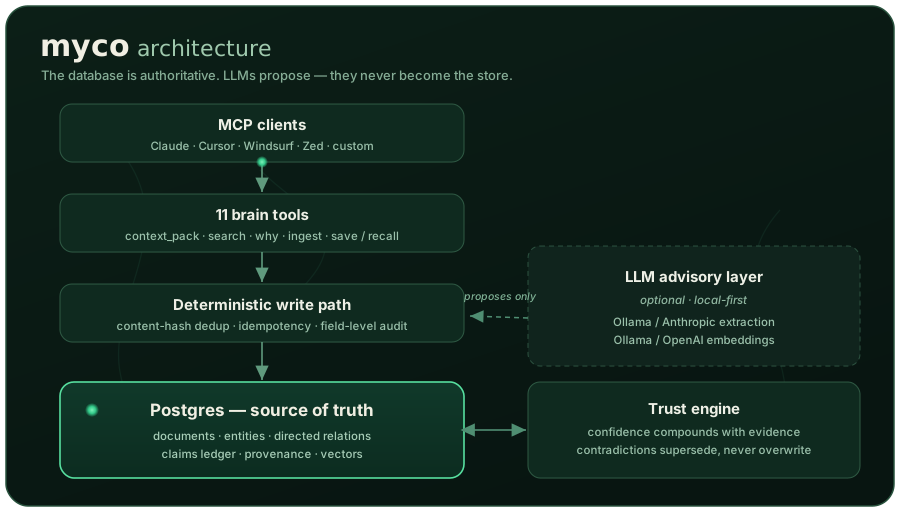
The design is simple on purpose: the database is authoritative, the write path is programmatic, and LLMs assist without becoming the memory store.
Tool Surface
Myco Brain exposes 13 MCP tools:
brain_context_packbrain_searchbrain_whybrain_neighborsbrain_ingestbrain_propose_factbrain_annotatebrain_save_memorybrain_recall_memorybrain_get_relatedbrain_statsbrain_set_modebrain_self_check
Full inputs, outputs, and examples for each tool: docs/api-reference.md.
Environment variables
The Docker quickstart needs none of these — it ships with seeded local
credentials and BM25 search works immediately. This is the reference for your
own deployment. Full annotated list with tuning thresholds:
.env.example. Not sure what's active? Run mycobrain-doctor.
Required
| Variable | Default | What it does |
|---|---|---|
DATABASE_URL | — | Postgres connection string. The only hard requirement. |
BRAIN_API_KEY | seeded | brain_<workspace>_<agent>_<secret> key; the quickstart ships a localdev key. |
BRAIN_WORKSPACE_ID | from key | Derived from BRAIN_API_KEY; set explicitly only for service-role auth. |
Semantic search (optional — without it, BM25 full-text still works)
| Variable | Default | What it does |
|---|---|---|
BRAIN_EMBED_PROVIDER | auto | ollama or openai; auto-selects by which credential is set. |
BRAIN_OLLAMA_EMBED_MODEL | nomic-embed-text | Local embedding model (no key, nothing leaves your machine). |
BRAIN_OPENAI_API_KEY | — | Use OpenAI embeddings instead of local. |
Knowledge graph (optional)
| Variable | Default | What it does |
|---|---|---|
BRAIN_OLLAMA_BASE_URL | — | Local extraction/embeddings endpoint (e.g. http://localhost:11434). |
BRAIN_OLLAMA_MODEL | llama3.2:3b | Local extraction model. |
BRAIN_ANTHROPIC_API_KEY | — | Most accurate graph; used automatically if set. |
BRAIN_EXTRACTION_PROVIDER | auto | Force ollama or anthropic. |
Trust dial (governance)
| Variable | Default | What it does |
|---|---|---|
BRAIN_REQUIRE_HUMAN_REVIEW | 0 | Strict curation — nothing the LLM proposes enters the graph without a human decision. |
BRAIN_SCHEMA_AUTO_PROMOTE | 0 | Let corroborated new types promote themselves, audited and workspace-scoped. |
Serving
| Variable | Default | What it does |
|---|---|---|
BRAIN_REST_HOST | 127.0.0.1 | Bind host for mycobrain-rest. Use 0.0.0.0 only behind your own TLS/proxy. |
BRAIN_REST_PORT | 8787 | Read-only REST port. |
BRAIN_HEALTH_PORT | 8080 | Health-check port. |
Identity & security
| Variable | Default | What it does |
|---|---|---|
BRAIN_REQUIRE_API_KEY_SECRET | 0 | Require a registered <secret> for every agent key before auth succeeds. |
BRAIN_TRUST_REQUEST_IDENTITY | 0 | Stdio, multi-tenant gateways only. Off: identity comes solely from env, so a caller-supplied workspace_id/api_key is ignored (prompt-injection-resistant). Set 1 only behind a gateway that authenticates each request. Details ↑ |
BRAIN_AGENT_ID | from key | Agent identity for service-role auth; derived from BRAIN_API_KEY otherwise. |
BRAIN_SERVICE_ROLE_KEY | — | Supabase service-role JWT for trusted service callers (alternative to a brain_ key). |
Tuning thresholds (
BRAIN_SCHEMA_PROMOTE_MIN_SEEN,BRAIN_EXTRACTION_LEASE_MS,BRAIN_FUNCTIONAL_PREDICATES, …) live in.env.example.
Repository Layout
Import your ChatGPT / Claude history
Months of assistant conversations become provenance-tracked, deduplicated, searchable memory — one document per conversation:
- Re-importing never duplicates — each conversation is one content-hash-keyed document, so a re-run is a no-op. Continue a conversation and re-export, and the longer transcript imports as a new version alongside the old.
- Branched ChatGPT threads import the ACTIVE branch — the transcript you actually kept, not rejected regenerations.
- Full provenance —
brain_whytraces every imported fact back to its export file.
Proof: npm run test:export-import.
Hands-free — watch your Downloads. Request your export, then let Myco import it the moment it lands, with no path to copy and nothing leaving your machine:
Opt-in and deduplicated like any other import; point it at a different folder
with BRAIN_WATCH_DIR (needs unzip on your PATH).
Cloud Waitlist
Self-hosting is the default. If you want managed hosting instead, join the waitlist:
That page is the canonical waitlist entrypoint. This README intentionally does not embed a form.
OSS Files
Resources
Who built this
Myco Brain was built by Nick Taylor — a growth marketer, not a career engineer — directing a team of AI coding agents. Roughly three months and about $6k in model spend, built with AI-assisted engineering. The point isn't the price tag; it's that a clear product vision plus modern agent tooling can now ship production-grade infrastructure — and this repo is the result: every claim on this page names a runnable check (see Every claim has a check), so you can judge it yourself rather than take the origin story on faith.
Like this? A ⭐ helps others find it, and Watch → Releases (top of the page) will ping you when new capabilities ship — see the roadmap for what's next.
Want this for your team? If your company wants someone who can build agent systems, automation, and growth engineering like this, that's what The Good Guys does — email nick@thegoodguys.la or book a call.