Microsoft Graph MCP server — 85 tools for mail, calendar, Teams, files, SharePoint, and Entra ID
Quick Install
Automated & IDE SetupCopy the AI prompt to install this server into Claude Code, Cursor, or another agent — or use 1-click editor setup below.
Not yet automatically verified
We haven't yet run this listing's install command through our automated sandbox check. This isn't a red flag — we're steadily working through the catalog.
Manual Client & Custom JSON ConfigExpand JSON ▾
Client Config & Setup
Choose your client or environment
Target File:
💡 Paste the JSON block into your client's configuration file under mcpServers, then restart the application.
Documentation Overview
ms-graph-mcp








A Model Context Protocol server for Microsoft Graph — 85 tools across mail, calendar, meetings (including transcripts), Teams chat, files, SharePoint, search, people, contacts, directory, tasks and OneNote, over stdio or Streamable HTTP.
Signs you in with your own Microsoft account — browser SSO, no token to paste, no client secret.
- No
msgraph-sdk, noazure-identity— the Graph client is rawhttpx, so the dependency tree stays small and the wire behaviour is inspectable. - Read/write separation is enforced, not advisory — write tools are hidden and refused unless the caller explicitly opts in.
- Auth-agnostic by default — tools receive an already-acquired Graph token via the request context. The server can also perform its own on-behalf-of exchange when you want it to act as a proper OAuth resource server.
Status: early. Extracted from a production agent platform where it has been running against a real tenant. The code is battle-tested; the packaging and public API surface are newer. Expect the config surface to move before 1.0.
Install
Requires Python 3.12+. Two paths — pick the one that matches what you want to do.
A. Use the package
Nothing to clone. uv runs it straight from PyPI:
or install it into an environment:
Release candidates are published too. pip skips them unless you ask:
A container image is on GHCR for the HTTP transport — see docs/hosting.md.
Also listed on the official MCP registry as
io.github.nitin27may/ms-graph-mcp.
TestPyPI is not a distribution channel. Every release is published there first, but that is a rehearsal of the publishing process: it can be wiped without notice and does not mirror PyPI, so installing from it needs
--extra-index-url https://pypi.org/simple/just to resolve ordinary dependencies. Use PyPI, or--pre.
B. Run from source
For hacking on it, forking it, or running an unreleased change:
uv sync is the only setup step. See
CONTRIBUTING.md before
opening a pull request — the tool allowlists and the tier separation have invariants that are
enforced rather than advisory.
To point an MCP client at your clone, you need its absolute path — clients do not inherit your
working directory and most do not expand ~:
Then use the source form of the config in Configure your MCP client below.
Set up the Entra app
You need an Entra ID app registration — about two minutes. Do not create a client secret: this registers as a public client, which signs you in through your browser using PKCE. A secret on a program running on your own machine would be readable by anyone with the config file, which is why the flow is designed not to need one. Nothing goes into a config file except two ids, neither of which is sensitive.
In the Entra portal → App registrations → New registration:
- Name: anything, e.g.
ms-graph-mcp - Supported account types: Accounts in this organizational directory only
- Redirect URI: select Public client/native, value
http://localhost
Leave Certificates & secrets alone — you do not need anything from it.
Then, on the new app:
-
Authentication → enable Allow public client flows
-
API permissions → Add a permission → Microsoft Graph → Delegated permissions, and add what you want the agent to reach. A sensible read-only starting set:
The complete copy-paste consent sets — and which permission each individual tool needs — are in docs/permissions.md.
Copy the Application (client) ID and Directory (tenant) ID from the Overview page. That is everything you need.
Configure your MCP client
Every MCP client that speaks stdio takes the same three things — a command, its arguments, and an environment block:
Where that block goes, and what the surrounding key is called, differs:
| Client | Config file | Key |
|---|---|---|
| VS Code | .vscode/mcp.json (workspace), or MCP: Open User Configuration | servers |
| Claude Code | claude mcp add … — no file to edit | — |
| Claude Desktop | macOS ~/Library/Application Support/Claude/claude_desktop_config.json · Windows %APPDATA%\Claude\claude_desktop_config.json | mcpServers |
| Cursor | .cursor/mcp.json (project) or ~/.cursor/mcp.json (global) | mcpServers |
| Windsurf | ~/.codeium/windsurf/mcp_config.json | mcpServers |
| MCP Inspector | command line, -e flags | — |
The first sign-in opens your browser for normal Microsoft 365 SSO — including MFA and conditional
access. The result is cached in ~/.ms-graph-mcp/token_cache.json, owner-readable only, so it does
not prompt again.
VS Code
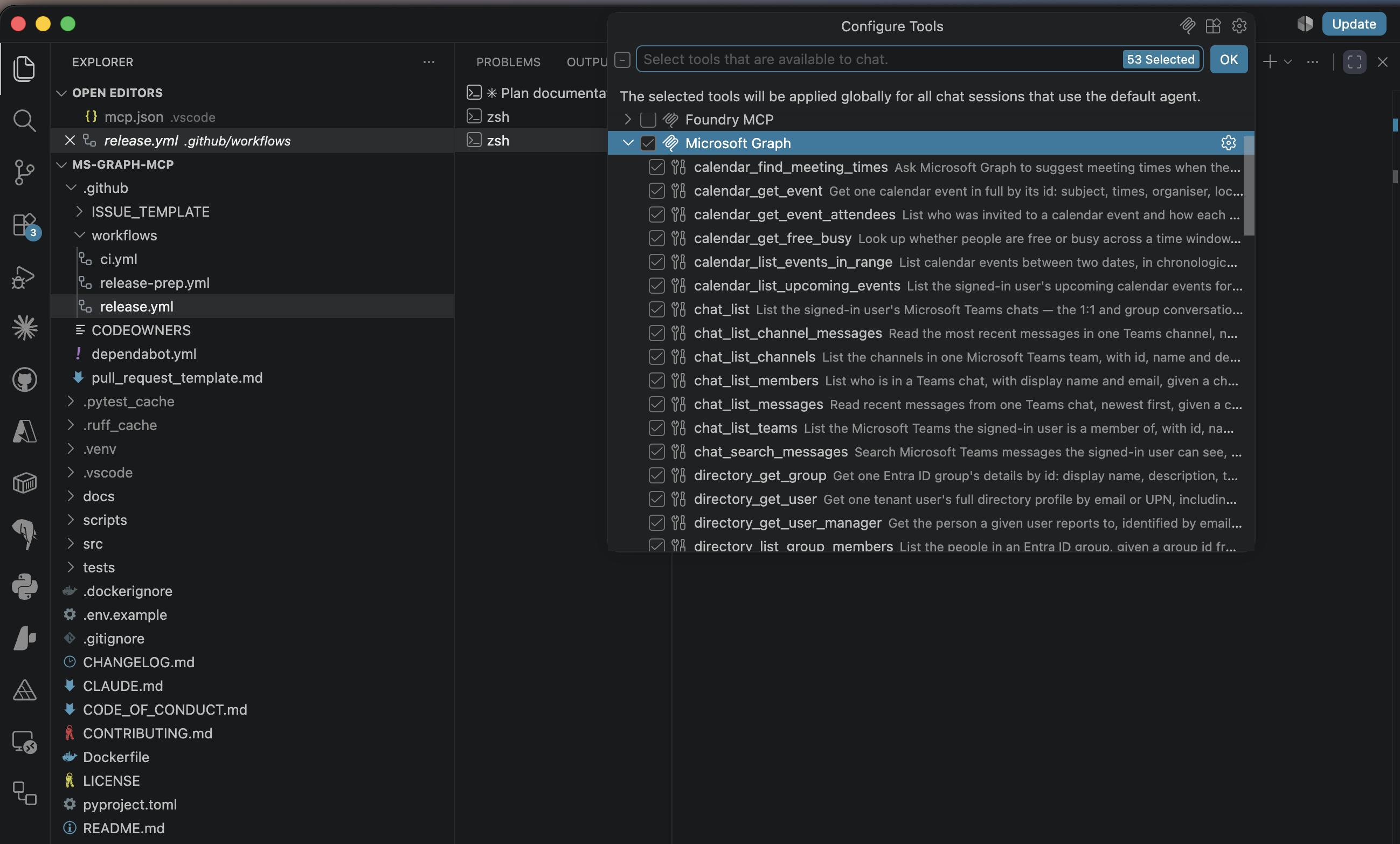
Reload the window. VS Code prompts once for the two ids and remembers them, so this file is safe to
commit. Open the Chat view, switch to Agent mode, and the tools appear under the tools picker —
that is the panel in the screenshot above. Confirm with MCP: List Servers, which shows status
and output if it does not connect.
Claude Code
Confirm with /mcp inside Claude Code — it lists the server and its tools.
Claude Desktop
Confirm by quitting Claude Desktop fully — not just closing the window — reopening it, and looking for the tools icon in the composer.
Cursor and Windsurf
Both use the same mcpServers shape as Claude Desktop, in the file named in the table above.
MCP Inspector
The quickest way to check the server independently of any client:
Needs Node 22.19+. It opens a browser UI where you can list tools and call them by hand — worth
doing before blaming your client. There is a scriptable --cli mode too; see
docs/testing.md.
Pass variables with
-e, not from your shell. Inspector does not give the server it spawns your environment, soGRAPH_MCP_CLIENT_ID=… npx @modelcontextprotocol/inspector …starts the server with no client id. The-eflags go after the server command.
Running from source instead
Same blocks as above — swap the command and args for your clone's absolute path:
Related MCP Servers
Reviews
No reviews yet — be the first to share how this listing worked for you.
Frequently Asked Questions about Ms Graph MCP
AllMCPs Directory Badge
Showcase your server listing on GitHub or your project documentation. Embed this dynamic SVG badge to highlight official listing status and live engagement.
Badge Style:
Live Dynamic SVG Preview
Markdown (GitHub README)
[](https://allmcps.com/mcp/ms-graph-mcp)HTML Embed
<a href="https://allmcps.com/mcp/ms-graph-mcp"><img src="https://allmcps.com/api/badge/ms-graph-mcp?style=directory" alt="Ms Graph MCP on AllMCPs" /></a>Technical Specs & Signals
CategoryCommunication
36Quality signal: Fair · 36/100How this signal is calculated ▾
Server availabilityNot measured
Not scored for repo-hosted servers — we can't reach the running server, only its GitHub page. Hosted MCP endpoints are health-checked live.
Verified ownership10/20
Documentation & tools16/30
Adoption & activity1/15
Community engagement0/10
A guidance signal from public completeness & health data — not a user rating. New listings start lower and rise as they add docs, get verified, and grow adoption. Signals we can't observe for a listing are skipped, not counted against it.
Own this project?
This directory is pre-filled from public sources. Claim via GitHub README, site badge, or DNS TXT to unlock edit access and the Official badge — proof is checked automatically, then reviewed by our team.
Free dofollow backlink: add your website and place the AllMCPs badge on it — no claim needed. We detect it automatically and keep it verified as long as the badge stays live.
Claim & get free dofollowShare & Embed
Add our SVG badge (dark/light directory styles) or embeddable widget to your site.