Openapi MCP Gateway README
The full upstream README, mirrored here for reference. Install config, tool schemas, adoption signals, and an original overview live on the Openapi MCP Gateway listing page.
OpenAPI MCP Gateway





Mount any OpenAPI (Swagger) spec as a Model Context Protocol (MCP) server, or expose an existing FastAPI app the same way. Multiple APIs in one process, each with its own mount path and auth.
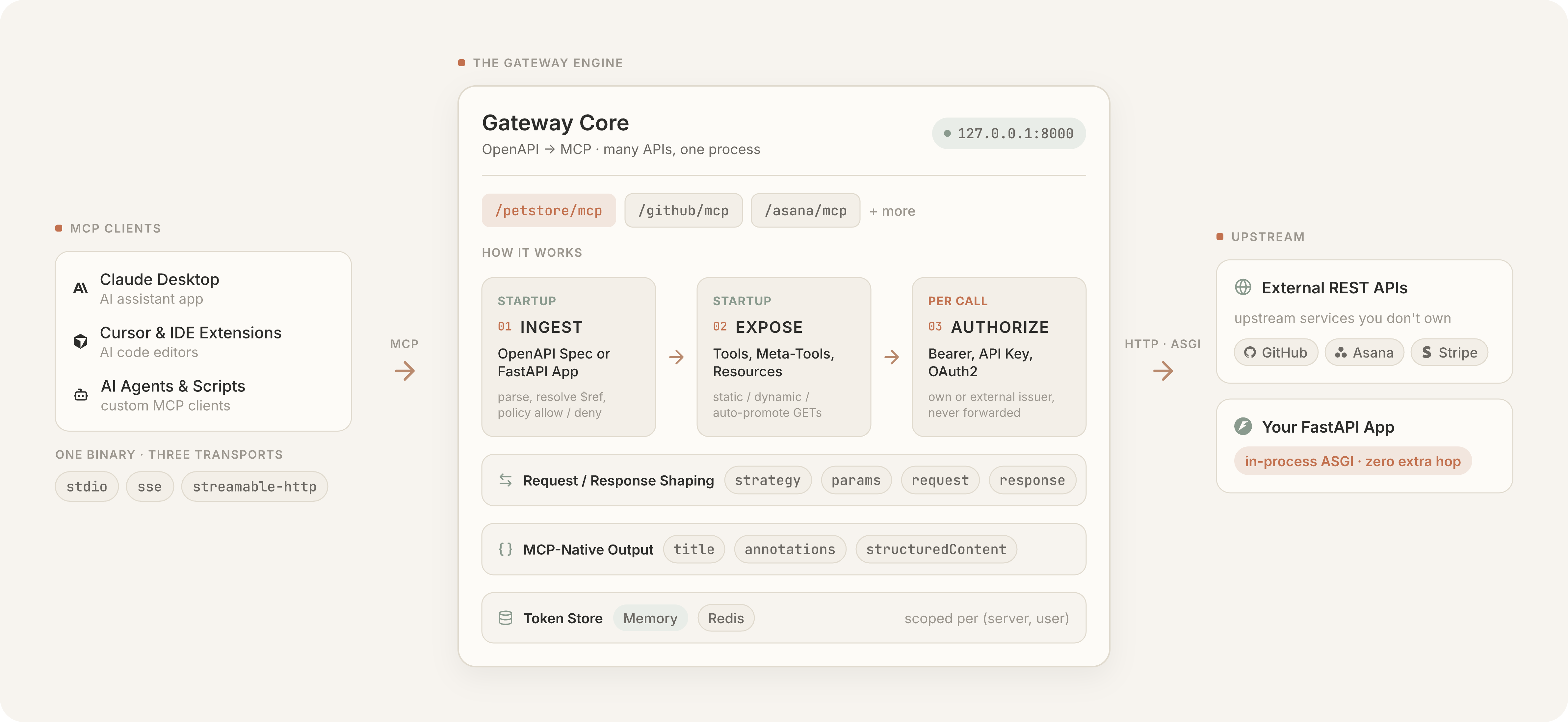
- Multi-Spec, Multi-Auth. Mount GitHub, an OAuth2 SaaS, and your internal API side by side, each with its own auth and token namespace.
- Spec-Compliant Authorization. The gateway runs its own OAuth server and mints audience-bound upstream tokens, so the MCP client's credential is never replayed against a third party.
- Tool Shaping. Rename ugly
operationIds, hide knobs the model should never touch, and rewrite requests and responses with JSONata, all in YAML with no fork required. - Dynamic Exposure. Front a 1,200-operation spec with three
list → get → callmeta-tools, so connecting to it does not spend the LLM's whole context window on tool schemas. - Resources, Not Just Tools. Eligible read-only GETs register as MCP resources instead, addressable by URI and surfaced by the client rather than guessed at by the model.
- FastAPI-Native. Decorate routes with
@mcp_toolto expose them in-process over ASGI, no extra hop and no second spec to maintain.
Installation
Requires Python 3.11+. To skip the install entirely, uvx openapi-mcp-gateway runs the published package directly.
Quick Start
Every example below uses uv run, which assumes the install above.
1. Public API, No Auth
Connect an MCP client to http://127.0.0.1:8000/petstore/mcp.
2. Bearer Token or API Key
API-Key Header instead of a Bearer Token
Use a config file so the header name is explicit:
3. OAuth2
Rather than asking you to paste an upstream token into config, the gateway obtains one per caller. authorization_code runs the gateway as the authorization server and mints each end-user their own upstream token. client_credentials shares a single service token across every client. token_exchange hands issuance to an identity provider you already run. See Authorization for how each pairs a check on the MCP endpoint with a credential for the API.
For the service-token flow, add --auth-flow client_credentials. Those two are what the CLI reaches. token_exchange needs an issuer and an audience, so it is configured per server under auth: in YAML, described in Authorization.
4. Multiple APIs at Once
Mix public, bearer, and OAuth2 services in a single config. Each server is mounted at /{name}/mcp:
That one file serves 13 tools with 3 concrete resources and 3 resource templates at /petstore/mcp, three meta-tools fronting ~1,200 endpoints at /github/mcp, and per-user OAuth2 against Asana's IdP at /asana/mcp. No spec edits anywhere. Run it with uv run openapi-mcp-gateway --config servers.yml.
5. Local Desktop Client (stdio)
For Claude Desktop, IDE integrations, or any MCP client that prefers stdio:
More Examples
Runnable configs for every scenario above live in examples/, each with its prerequisites documented at the top.
Authorization
Every request crosses two boundaries, and one auth: block settles both of them. One is who may call the MCP endpoint, the other is what credential reaches the API behind it. Setting auth.type, plus auth.flow under oauth2, picks a pairing of the two. Everything the gateway sends upstream lives under auth.upstream, so the indentation separates the two directions.
auth.type / auth.flow | MCP Endpoint | Credential Sent Upstream |
|---|---|---|
none | open | none |
bearer, api_key | open | a fixed one from config, shared by every caller |
passthrough | open | the caller's own header, forwarded unchanged |
oauth2 + client_credentials | open | one service token, shared by every caller |
oauth2 + authorization_code | the gateway is the authorization server | a per-user token the gateway obtained on their behalf |
oauth2 + token_exchange | an external issuer is the authorization server | a per-user token exchanged from the caller's |
Only the last two put a check in front of the MCP endpoint. The others suit a gateway on localhost or inside a private network, and leave it open to anyone who can reach the port.
token_exchange verifies JWT signatures, so it needs the oidc extra. Run the gateway as uvx --from "openapi-mcp-gateway[oidc]" openapi-mcp-gateway. Without it the gateway refuses to start and says so.
Token Forwarding Policy
The MCP spec requires a server to accept only tokens minted for itself, and forbids relaying one to an upstream API. So under both protected flows the upstream is reached with a second, separately obtained credential rather than the one the caller presented. See Access Token Privilege Restriction.
passthrough is the one exception, and it exists for the FastAPI integration, where the gateway runs in-process as part of the app it exposes. There is no separate upstream to be confused about. Setting it against a genuinely separate API is the confused-deputy pattern the spec forbids, which is why nothing selects it automatically.
An Upstream behind a Separate Identity Provider
An API with no authorization server of its own, which accepts tokens from a provider the deployment already runs, needs the gateway to say which API its upstream token is for. Point the OAuth URLs at that provider and name the API:
Without it the provider mints for its own default audience and the API refuses the result. The parameter rides on the authorization request and on every token request, refreshes included, so a rotated token stays usable.
Authorization servers disagree on the spelling. upstream.audience is what Auth0 expects, upstream.resource is the RFC 8707 parameter.
Set the one yours reads, or set both. A server that does not recognise a parameter ignores it silently rather than refusing, so Keycloak given only upstream.resource returns a perfectly ordinary token whose audience is wrong, and the upstream then rejects it for reasons that look unrelated. Sending both is legal, since RFC 8707 §2.1 defines both names, and it is the portable choice.
MCP clients still authorize against the gateway and receive a gateway-issued token, while the provider-issued one is a second credential held on their behalf. End users see whatever login the provider federates to, so this works on any plan and needs nothing of the upstream but that it accept what the provider issues.
The Auth0 Management API is a worked example of exactly this shape, since its own audience differs from the tenant that issues for it. See examples/auth0-management.yml.
Full Delegation with token_exchange
authorization_code leaves the gateway issuing credentials of its own, so revoking someone at the provider has no effect until the gateway's token expires. token_exchange removes that second issuer. The provider mints tokens for the MCP endpoint directly, the gateway validates them, and each call exchanges one under RFC 8693 for a second token naming the upstream:
The gateway serves no /authorize or /token here. Its protected resource metadata names the issuer, clients authorize there, and the JWKS comes from the issuer's own metadata so key rotation needs no restart.
The endpoint identifies itself as {url}{mount_path}/mcp, built from the gateway's url and the server's mount path, so the example above is https://gw.example.com/internal/mcp. That exact string is what an inbound token's aud must contain, so you need it when creating the matching client and audience mapping at the issuer.
Two things to check before committing to this mode. Token exchange support varies:
| Authorization Server | Token Exchange |
|---|---|
| Keycloak | generally available, enabled by default |
| authentik | 2026.8 and later |
| Zitadel | can only narrow an audience the token already carries |
| Auth0 | Custom Token Exchange, on Professional and Enterprise plans, with an Action to write |
| Logto | not implemented |
Keycloak is generally available in the sense that the feature flag is on, but a working realm still needs three things that its documentation does not connect to this use case:
- The inbound
audcomes from an audience mapper, added to a client scope. Keycloak ignoresresourceandaudienceon the authorization and token endpoints, so without a mapper the token's audience is justaccountand the gateway rejects it. - The client performing the exchange must itself be in the subject token's audience, or the exchange fails with
access_denied: Client is not within the token audience. The tidiest arrangement is to make the MCP endpoint a client whoseclientIdis its canonical URI, so it is both the audience target and the exchanging client. - The exchange target must exist as a client and be reachable from the exchanging client's scopes, or the exchange fails with
invalid_request: Requested audience not available.
And because the issuer is the authorization server for this endpoint, MCP clients register there rather than with the gateway. Check whether yours supports dynamic client registration, or whether each client needs pre-registering. If it does support it, set required_scopes so the advertised scopes_supported tells a registering client what to ask for. Leave it empty and a client may register with a minimal scope set whose tokens then carry neither the audience nor the claims the upstream needs.
Token Lifetimes
Under authorization_code the gateway's own access token lives 1 hour and its refresh token 24 hours. Each refresh issues a fresh refresh token, so the refresh TTL is the practical re-authorization cadence. A client refreshing within it never signs in again, while one idle past it must re-authorize. Tune both with auth.mcp_access_token_ttl and auth.mcp_refresh_token_ttl.
token_exchange mints nothing, so neither applies. Lifetimes are the issuer's to set.
Tool Results
Every registered tool carries a protocol-native title and annotations (readOnlyHint, destructiveHint, idempotentHint), so an agent can judge a tool before calling it. Results carry structuredContent, so a client reads a typed body and structured error payloads without re-parsing text. None of this needs configuration.
Configuration
Run uv run openapi-mcp-gateway --help for the CLI reference. The Quick Start covers most setups, and the full field reference is below.
Configuration merges in this order, with each layer overriding the previous one. Defaults → YAML (--config) → CLI flags → Gateway.run(...) kwargs. A layer only overrides the fields it actually sets, so --log-level=DEBUG won't reset logging.format from your YAML. Nested objects like logging and per-server auth merge field-by-field. The servers list is the exception, replaced wholesale rather than merged entry-by-entry.
${ENV_VAR} and ${ENV_VAR:-default} work in any string field, resolved at request time. An unrecognised key is refused at startup rather than ignored, so a typo in a field that narrows access fails closed. For OAuth2, authorizationUrl / tokenUrl / scopes are auto-detected from the spec's securitySchemes, and the auth.* fields below override them when the spec is incomplete.
Top-Level Fields
| Field | Type | Default | Description |
|---|---|---|---|
host | string | 0.0.0.0 | Bind address (0.0.0.0 = all interfaces). Clients on the same machine usually open http://localhost:{port} or http://127.0.0.1:{port}. |
port | int | 8000 | Bind port |
url | string | (empty) | Public base URL for OAuth redirects and discovery. When unset: http://localhost:{port} if host is 0.0.0.0, otherwise http://{host}:{port}. Override when your registered redirect URI uses another host (tunnel, reverse proxy, etc.). |
transport | string | streamable-http | streamable-http, stdio, or sse (deprecated) |
store.type | string | memory | memory or redis. Redis shares OAuth credential state across replicas. It holds OAuth tokens and client registrations, never MCP protocol sessions, so single-replica or non-OAuth deployments can stay on memory. |
store.redis_url | string | redis://localhost:6379 | Redis URL when store.type: redis |
logging.level | string | INFO | DEBUG, INFO, WARNING, ERROR, CRITICAL |
logging.format | string | text | text or json |
logging.file | string | Mirror logs to this file | |
servers | list | required | List of per-server config entries |
Per-Server Fields
| Field | Type | Default | Description |
|---|---|---|---|
name | string | required | Unique identifier. Mount path defaults to /{name} |
spec | string | required | Path or URL to OpenAPI document (JSON or YAML) |
base_url | string | from spec | Override the upstream base URL |
auth.type | string | none | none, bearer, api_key, oauth2, or passthrough. Says where the upstream credential comes from: a fixed one, one the gateway obtains, or the caller's own forwarded |
auth.token | string | Required for bearer / api_key | |
auth.api_key_header | string | X-API-Key | Header name for api_key |
auth.flow | string | from spec | authorization_code for per-user delegation, client_credentials for a shared service token, token_exchange to delegate this endpoint's authorization to an external issuer. When unset the gateway prefers the spec's declared authorizationCode flow, falling back to whatever else it declares. |
auth.issuer | string | Required for token_exchange. The authorization server that mints tokens for this MCP endpoint | |
auth.required_scopes | list | For token_exchange, what an inbound token must already carry. Advertised as scopes_supported, so a client doing dynamic registration knows what to ask for | |
auth.upstream.client_id, auth.upstream.client_secret | string | Required for oauth2. The gateway's own credential at the upstream authorization server | |
auth.upstream.scopes, auth.upstream.authorization_url, auth.upstream.token_url | from spec | What the gateway requests from the upstream authorization server, and where. The URLs override an incomplete securitySchemes | |
auth.upstream.resource, auth.upstream.audience | string | Names the API the upstream token is for, when the API and its authorization server are different parties. resource is the RFC 8707 parameter, audience is the spelling Auth0 uses. Only what you set is sent | |
auth.mcp_access_token_ttl | int | 3600 | Lifetime in seconds of the MCP access token the gateway mints for authorization_code |
auth.mcp_refresh_token_ttl | int | 86400 | Lifetime in seconds of the MCP refresh token. This is the practical re-authorization cadence, since each refresh slides the window forward |
policy.allow | list | Only expose matching operations | |
policy.deny | list | Exclude matching operations | |
timeout | float | 90 | HTTP timeout in seconds |
exposure | string | static | static registers one MCP tool per operation. dynamic registers three meta-tools (list_operations, get_operation, call_operation) for the LLM to walk on demand. |
mode | string | tool_only | tool_only forces every operation to a tool and ignores any resource declaration. auto promotes eligible GETs (no required non-path parameter) to MCP resources, and spec-side resource opt-ins still apply as explicit overrides. |
operations | map | {} | YAML-side x-mcp-integration overrides, keyed by operationId. Fully replaces (does not merge) the spec-side x-mcp-integration on that operation. Useful when you do not control the upstream spec. |
Filtering Operations
Use policy.allow and policy.deny with fnmatch syntax against operation IDs (getUsers, create*) or method + path (GET /users/*).
Filter Syntax and Ordering
Operations can also be opted in from the spec side with x-mcp-integration: {tool: {}} plus policy.annotated_only: true. Filters apply in the order annotated_only, then allow, then deny.
Resource Exposure
Read-only GET operations are a better fit for the MCP resource primitive than for a tool. Tools are model-controlled, so the LLM decides when to call one. Resources are application-controlled, surfaced by the client or picked by the user. A GET that is fully identified by its URL is a thing that exists at an address, which is what a URI is for.
Set exposure.promote_resources: true and every eligible GET promotes automatically. Eligible means no required query, header, or body parameter. Required path parameters are fine and turn the operation into a resource template. Against the vanilla Petstore3 spec that yields 13 tools, 3 concrete resources, and 3 resource templates with zero spec edits.
Keeping those endpoints off the tool list also saves context, since most clients do not auto-load resources. Resource support is uneven across the ecosystem, though, and an agent framework that ignores resources entirely will not reach a promoted operation at all. Stay on the default mode: tool_only when that is your target.
Per-Operation Control, from YAML or from the Spec
To rename a resource, set a custom URI template, or set a non-JSON MIME type, use the operations map keyed by operationId:
If you own the upstream spec, write the same opt-in inline instead:
Declaring both tool and resource registers the operation on both surfaces. Each entry fully replaces (does not merge with) the spec-side x-mcp-integration. A runnable demo lives at examples/petstore-override.yml.
An unknown operationId raises at startup so typos do not silently no-op. Resource declarations are validated there too, so non-GET methods, required non-path parameters, and uri_template values that do not start with <server>:// abort Gateway.from_config with a concrete error. Subscriptions are not implemented because REST has no native push.
Tool Shaping
A raw operation rarely makes a good tool. Its operationId is ugly (GitHub's actions/list-jobs-for-workflow-run-attempt), its description is empty (most of gists/*), it takes a cryptic filter DSL alongside a dozen knobs the model should never touch, and it wraps the few useful fields in a large envelope. x-mcp-integration.tool fixes all of that without forking the spec. name and description fix how the tool presents itself, while params, params_strategy, request, and response reshape the interface behind it.
Renaming a GitHub Operation
If you own the upstream spec, write the same block inline as x-mcp-integration.tool on the operation.
Reshaping the Interface with params, params_strategy, request, and response
The input layer is declarative and the value transforms are JSONata expressions.
params and params_strategy shape what the model sees. Each params entry is a JSON Schema fragment (type, enum, default, description, format, minimum, items, and so on) plus two flags. required lifts the parameter into the schema's required list, and hidden removes a spec parameter from the surface. params_strategy is mandatory whenever params is set:
merge: tweaks the operation's existing parameters and keeps the rest visible, so declaring a parameter the spec does not define is an error.replace: makes the declared entries the whole schema and drops every spec parameter, so it always needs arequestto route the friendly arguments upstream.
request and response transform the values. Both are optional and independent of each other. request builds the entire upstream request, and response reshapes a successful body before it reaches the client.
- Routing: a key that names a path placeholder fills the path, and the rest become query parameters for a body-less method or the JSON body otherwise.
- Passthrough:
$merge([$, { ... }])forwards the incoming arguments and overrides only the keys you name, as above. - Lists: wrapping a mapping in
[ ... ]keeps the result an array even when a single item matches. - Errors: a broken expression is rejected at startup, and a runtime failure returns an
isErrorresult naming the side that broke.
For a full replace example, where the declared params are the entire surface and request maps a friendly enum onto the raw query with $lookup, see examples/movie-shaping.yml.
Dynamic Exposure
For APIs with hundreds of operations (GitHub, Stripe, etc.), registering each as its own tool can blow the LLM's context window before the agent does anything. Set exposure.style: dynamic and the client sees three meta-tools instead, which the LLM walks as list → get → call to discover and invoke operations on demand. It is per-server, so /github/mcp can run dynamic while /petstore/mcp runs static in the same process.
The Three Meta-Tools
list_operations()returns[{name, description}, ...]for every operation on this server.get_operation(name)returns one operation's JSON Schema for input arguments.call_operation(name, arguments)invokes that operation against the upstream.
Auth, path templating, and per-operation request shape match static mode, so only the surfacing changes. See examples/github-dynamic.yml for a runnable config.
Logging
Configure via the logging.* YAML keys or via CLI flags (--log-level, --log-format, --log-file). -v and -q are shortcuts for DEBUG and WARNING. CLI flags override YAML field-by-field, following the precedence rule above.
Authoring Configs with AI
generate-config is a companion Claude Code skill that writes a config.yml from a plain-language request, deriving the operations, auth, and shaping for you. This repo doubles as its plugin marketplace:
Python API
The gateway works as a library, either standalone or wrapped around an app you already run.
FastAPI Integration
If you already run FastAPI, decorate the routes you want exposed with @mcp_tool and the gateway picks them up. No second spec, no separate process, and no extra network hop, since calls go in-process through httpx.ASGITransport. Auth is auto-detected from the app's securitySchemes, and passing an explicit auth=AuthConfig(...) to Gateway.from_fastapi overrides it.
Decorating Routes with @mcp_tool
Auth in the FastAPI Integration
Because the gateway runs in-process and routes through httpx.ASGITransport, gateway and upstream share the same OAuth audience, so the MCP client's Authorization header passes through verbatim (auth.type: passthrough, set automatically for this integration only). For client_credentials schemes the gateway mints upstream tokens from its own credentials instead.
Mounting into an Existing App
To serve MCP alongside your own routes, build a Gateway and mount it onto your app. mount attaches every MCP sub-app at its configured path and also registers the OAuth authorization-server and .well-known discovery routes those servers own, so an OAuth flow works end to end.
Mounting onto Your Own FastAPI App
Set GatewayConfig.url to the host app's public URL so discovery documents and OAuth redirect URLs point at the right origin. The upstream OAuth callback for a server named <server> is fixed at /<server>/auth/callback, so keep it clear of your app's own callback paths.