Mosta Net README
The full upstream README, mirrored here for reference. Install config, tool schemas, adoption signals, and an original overview live on the Mosta Net listing page.
@mostajs/net — Octonet
One schema, 11 transports, 13 databases, multi-tenant auth — out of the box. Schema-driven multi-protocol API server for the @mostajs ecosystem. Built with TypeScript on Fastify, designed for polyglot consumption (14 native NetClients).



Author : Dr Hamid MADANI <drmdh@msn.com> Homepage : octonet.amia.fr · mcp.amia.fr
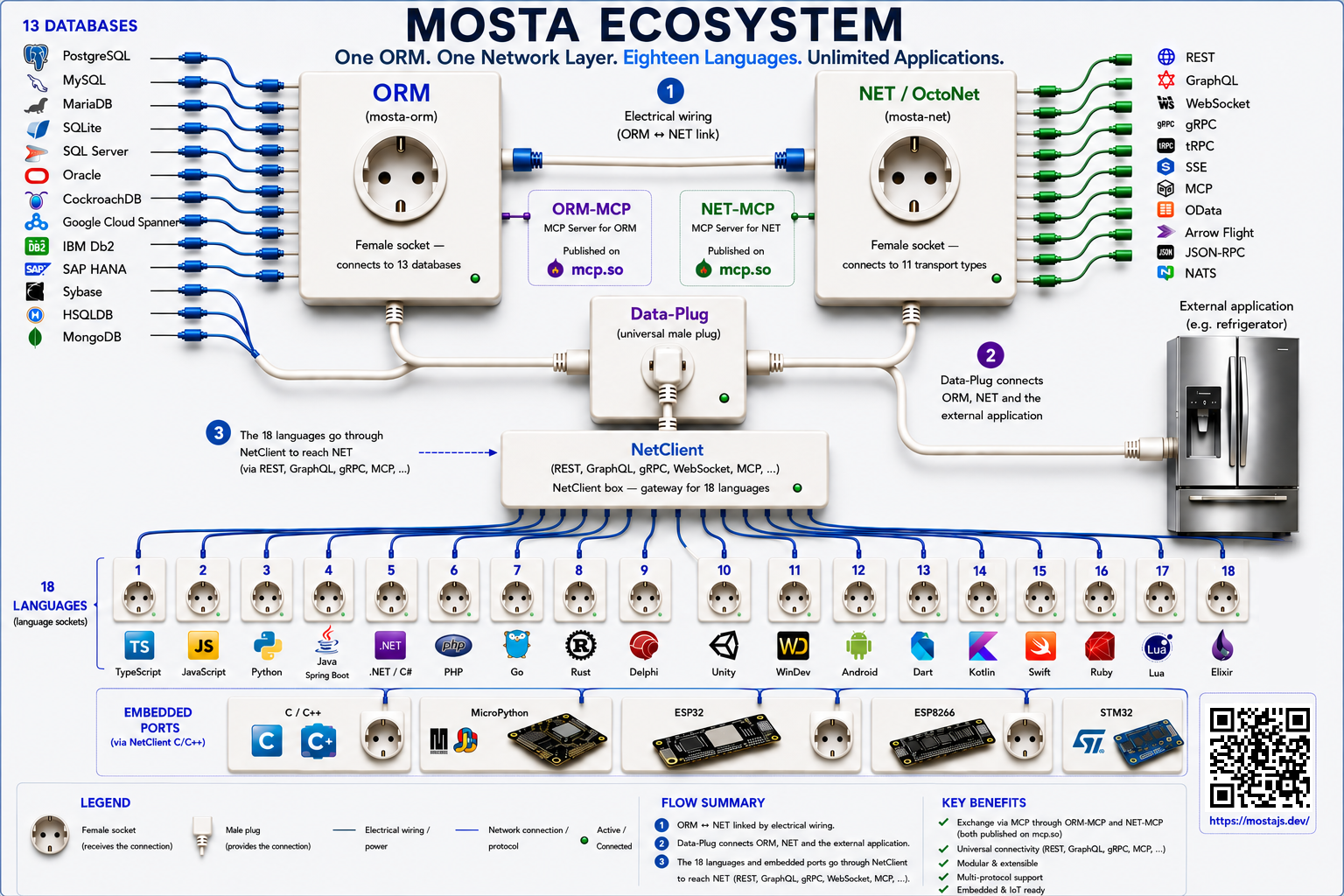
The socket board.
@mostajs/ormconnects to 13 databases; Octonet (@mostajs/net) re-exposes the same entities over 11 transports (REST, WebSocket, gRPC, MQTT, AMQP…); NetClient then fans out to 18 language clients — so any external app plugs into your data, in any runtime.
Table of Contents
- What is Octonet
- Try in 2 clicks (T1 sandbox)
- 3-tier onboarding model
- 11 transports
- 13 databases
- Multi-tenant authentication
- Generic scope registry
- Multi-project support
- Quick start (self-host)
- Configuration (.env)
- API endpoints reference
- Architecture
- Boot sequence
- 14 polyglot NetClients
- Production deploy (amia.fr)
- License
What is Octonet
Octonet (@mostajs/net) is a Node.js multi-transport server that exposes a single @mostajs/orm schema as 11 different network protocols simultaneously : REST, GraphQL, WebSocket, SSE, JSON-RPC, MCP, gRPC, tRPC, OData, NATS, Arrow Flight.
The same User entity is reachable as :
Backed by @mostajs/orm (13 SGBD dialects). Backed by @mostajs/rbac + @mostajs/auth + @mostajs/api-keys for multi-tenant identity. Backed by @mostajs/mproject for multi-project routing.
Octonet is the second cerebral lobe of the @mostajs trilogy :
- #1 —
@mostajs/orm: data persistence (13 databases) - #2 — Octonet : multi-protocol transport (11 wire protocols)
- #3 — NetClients polyglottes : 14 native client libraries (Java, .NET, Python, Go, Swift, Kotlin, Dart, Rust, PHP, Ruby, Elixir, Lua, Delphi, Unity)
Try in 2 clicks (T1 sandbox)
The fastest way to test Octonet from any of the 14 runtimes :
- Open https://octonet.amia.fr/try
- Pick an alias (e.g.
alice-42) - Get an apikey scoped to your sandbox
Your sandbox is :
- A private SQLite file (isolated from other aliases)
- Pre-seeded with
User,Product,Orderentities - Read+write CRUD via REST and MCP
- 500 requests/day quota
- TTL 7 days (auto-deleted if idle)
- Free, no email required, anti-abuse rate-limited (10 sandboxes/h/IP)
Use the apikey in any of the 14 NetClients :
3-tier onboarding model
| Tier | Cible | Auth | Quota | Use case |
|---|---|---|---|---|
T1 — Sandbox publique /try | "I want to test in 10 minutes" | alias seul (pas d'email) | 500 req/jour, TTL 7j | démo NetClients, intégration tests |
| T2 — Compte enregistré octocloud.amia.fr | "j'utilise vraiment, gratuit" | email + mot de passe | 10 000 req/jour | apps personnelles, side-projects |
T3 — Self-host npx @mostajs/net init | "tes données chez toi" | admin local | aucune | enterprise, on-premise, AGPL |
11 transports
Auto-generated from your registered schemas. Toggle each via env var (default : all enabled).
| # | Transport | Endpoint | Use case | Notes |
|---|---|---|---|---|
| 1 | REST | /api/v1/{Entity} · /api/v1/{project}/{Entity} | universel | 15 routes par entité (CRUD + count + search + aggregate + bulk + relations) |
| 2 | GraphQL | /graphql (POST) | front-end riches | schéma + GraphiQL IDE auto-générés via mercurius |
| 3 | WebSocket | wss://…/ws | temps réel | events entity.created/updated/deleted/upserted broadcast |
| 4 | SSE | /events (GET stream) | mobile / browser-friendly | server-sent events |
| 5 | JSON-RPC | /rpc (POST) | EVM-adjacent, classic | JSON-RPC 2.0 + method discovery |
| 6 | MCP | /mcp (POST/GET SSE) | agents IA (Claude, ChatGPT) | 15 tools/entité auto-générés (listed on mcp.so) |
| 7 | gRPC | :50051 | inter-services low-latency | .proto auto-généré, 6 RPCs/entité |
| 8 | tRPC | /trpc/{Entity}.{op} | TypeScript fullstack | type generation côté client |
| 9 | OData | /odata/{Collection} (+ $metadata) | SAP/Microsoft Dynamics | OData v4 ($filter, $select, $orderby) |
| 10 | NATS | mostajs.{Entity}.{op} | pub/sub edge | request-reply messaging |
| 11 | Arrow Flight | /arrow/* | analytics columnaire | streaming zero-copy |
Le même schéma, 11 portes d'entrée différentes, 0 codegen.
13 databases
Persistence dialects fournis par @mostajs/orm :
| Catégorie | Bases | Dialect ID |
|---|---|---|
| SQL mainstream | PostgreSQL, MySQL, MariaDB, SQLite | postgres, mysql, mariadb, sqlite |
| SQL enterprise | Oracle, SQL Server, DB2, SAP HANA, HSQLDB, Sybase | oracle, mssql, db2, hana, hsqldb, sybase |
| NewSQL / Cloud | CockroachDB, Google Cloud Spanner | cockroachdb, spanner |
| NoSQL | MongoDB | mongodb |
Switch dialect = changer 1 ligne d'env :
Multi-tenant authentication
Octonet utilise un middleware d'authentification basé sur API keys avec scopes (orienté machine-to-machine) + RBAC pour la gestion humaine. L'orchestrateur agnostique vit dans @mostajs/auth/lib/check-request.ts.
Flux d'auth d'une requête
Scope-based permissions (generic, extensible)
Une apikey a la shape :
@mostajs/api-keys ne connaît PAS les noms projects/operations/transports — c'est volontaire. Chaque module enregistre ses scopes au boot via registerScope(dialect, {name, label, …}). Le check est générique : isScopeAuthorized(perms, scope, value).
HTTP status mapping
| Cas | HTTP code | Body |
|---|---|---|
| Pas d'apikey | 401 | {error: {code:'UNAUTHORIZED', message:'API key required…'}} |
| Apikey invalide / révoquée | 401 | {error: {code:'UNAUTHORIZED', message:'Invalid or revoked API key'}} |
| Apikey valide hors scope | 403 | {error: {code:'FORBIDDEN', message:'API key not authorized for X="Y"'}} |
| Apikey OK | 200/201 | {status:'ok', data: …} (sanitized — no password/hash) |
MCP fallback (compat mcp.so)
L'endpoint /mcp autorise un fallback automatique sur l'apikey labelée public-default quand aucune clé n'est présentée — préserve la compat avec mcp.so / Claude Desktop. La clé publique est read-only sur le projet default uniquement → écritures bloquées.
Sanitizer
Les champs password, hash, verifyToken, resetToken, apiKeyHash, secret, privateKey sont automatiquement strippés de toutes les réponses JSON par un middleware global. Aucun risque de leak à travers /api/v1/User?limit=1.
Generic scope registry
Le catalogue des scopes vit en base de données du projet accueillant (pas de fichier JSON, pas de constantes hardcodées) :
Chaque module enregistre ses scopes au boot :
L'admin UI charge le catalogue dynamique via GET /api/api-keys/scopes et rend une matrice (composant React ApiKeyScopeMatrix dans @mostajs/api-keys/components/).
Multi-project support
Via @mostajs/mproject — N bases de données isolées sur le même serveur.
Routes path-prefix
Ajouter un projet à l'exécution
Persisté dans projects-tree.json (chemin : MOSTA_PROJECTS env var).
Quick start (self-host)
Install
Run with SQLite (zero infra)
Console output :
Test
Configuration (.env)
Database (mandatory)
System dialect (recommandé prod, optionnel) — v2.7.5+
Sépare la base système (apikeys, RBAC users, audit, plans, payments, project-life metadata) du dialect métier mutable. Sans ces variables, alias transparent vers le singleton métier (rétro-compat mono-base).
Voir section System dialect ci-dessous pour la motivation et les how-to.
Server
Transports (toggle each)
RBAC bootstrap (lus via @mostajs/config — supports profile cascade MOSTA_ENV=DEV)
T1 sandbox (optional)
Cloud middleware (optional, futur — partage DB méta avec Octocloud)
API endpoints reference
Public
| Endpoint | Méthode | Auth | Description |
|---|---|---|---|
/health | GET | open | server status + transports + entities |
/try | GET | open | T1 sandbox provisioning HTML form |
/try | POST | open (rate-limit 10/h/IP) | crée sandbox + retourne apikey one-shot |
/api/v1/health | GET | open | health under api-versioned path |
Project / entity CRUD (requires apikey)
| Endpoint | Méthode | Op | Description |
|---|---|---|---|
/api/v1/{Entity} | GET | findAll | list entities of default project |
/api/v1/{Entity}/:id | GET | findById | get one |
/api/v1/{Entity}/count | GET | count | count |
/api/v1/{Entity}/one | GET | findOne | first match |
/api/v1/{Entity}/search | GET | search | text search |
/api/v1/{Entity} | POST | create | insert |
/api/v1/{Entity}/:id | PUT | update | replace |
/api/v1/{Entity}/:id | DELETE | delete | remove |
/api/v1/{Entity}/:id/addToSet | POST | addToSet | add to array |
/api/v1/{Entity}/:id/pull | POST | pull | remove from array |
/api/v1/{Entity}/:id/increment | POST | increment | numeric add |
/api/v1/{Entity}/upsert | POST | upsert | insert or update |
/api/v1/{Entity}/aggregate | POST | aggregate | pipeline |
/api/v1/{Entity}/updateMany | POST | updateMany | bulk update |
/api/v1/{Entity}/deleteMany | POST | deleteMany | bulk delete |
/api/v1/{project}/{Entity}/… | * | * | same routes scoped to a project |
Schema management (requires admin apikey)
| Endpoint | Méthode | Description |
|---|---|---|
/api/upload-schemas-json | POST | push schemas at runtime (triggers reload) |
/api/apply-schema | POST | apply schema diff |
/api/compare-schema | POST | dry-run schema diff |
/api/schemas-config | GET | current registered schemas |
Auth & API keys (requires admin)
| Endpoint | Méthode | Description |
|---|---|---|
/api/api-keys | GET / POST | list / issue keys |
/api/api-keys/:id | PUT / DELETE | update / revoke |
/api/api-keys/scopes | GET | list registered scopes + values (for admin matrix UI) |
/api/api-keys/scopes | POST | register a new scope (admin) |
/api/api-keys/scopes/:name/values | PUT / DELETE | manage scope values |
Transports natifs
| Endpoint | Description |
|---|---|
/graphql | GraphQL endpoint + GraphiQL IDE |
/ws | WebSocket connection (entity events) |
/events | SSE stream |
/rpc | JSON-RPC 2.0 |
/mcp | Model Context Protocol (Claude/Smithery/etc.) |
/trpc/{Entity}.{op} | tRPC procedure |
/odata/{Collection} · /odata/$metadata | OData v4 |
Multi-project management
| Endpoint | Méthode | Description |
|---|---|---|
/api/projects | GET | list projects |
/api/projects | POST | add project |
/api/projects/:name | PUT / DELETE | edit / remove |
Observability
| Endpoint | Description |
|---|---|
/api/performance | live metrics (req/s, p50, p99) |
/api/config-tree | configuration tree (interactive) |
/api/live-log | streaming log feed |
Architecture
Modules de l'écosystème consommés
| Module | Rôle dans Octonet |
|---|---|
@mostajs/orm | persistance (13 dialects) |
@mostajs/mproject | gestion multi-projet (default + sandbox + abonnés) |
@mostajs/rbac | identité (User, Role, Permission, Account) + AccountSchema + OCTONET_RBAC_SEED |
@mostajs/auth | checkRequest orchestrateur framework-agnostic, hashPassword |
@mostajs/api-keys | apikey CRUD + scopes (Scope/ScopeValue schemas) + checkApiKey + ApiKeyScopeMatrix admin UI |
@mostajs/config | env var helper avec cascade MOSTA_ENV |
@mostajs/cloud-middleware | quota / abonnement (optionnel — actif si Octocloud connecté) |
@mostajs/replicator | CQRS multi-replica (optionnel) |
@mostajs/project-life | persistence schemas Project (optionnel — si stockage SGBD vs JSON) |
System dialect (séparé du singleton métier)
Disponible depuis v2.7.5 — résout le bug « apikeys introuvables après
/api/change-dialect» observé en prod.
Pourquoi deux dialects distincts ?
Octonet expose des routes admin qui mutent la connexion DB au runtime (/api/change-dialect, /api/reload-config, /api/reconnect) — légitime côté métier (les entités userland du projet courant peuvent migrer postgres → sqlite → mongodb selon les besoins de l'admin).
Mais les modules système (apikeys, RBAC users, audit, plans de souscription, payments, project-life metadata) doivent vivre dans une base stable qui ne suit pas ces mutations. Sinon : un changement de dialect métier rend les apikeys introuvables, l'admin se trouve verrouillé hors de l'IHM.
| Rôle | Variable env | Mutable au runtime ? | Lu par |
|---|---|---|---|
| Métier (entités userland) | DB_DIALECT + SGBD_URI | Oui (IHM admin) | EntityService, transports, routes data |
| Système (infra Octonet) | MOSTA_SYSTEM_DIALECT + MOSTA_SYSTEM_URI | Non (stable) | RBAC, apikey-middleware, account-scope, auth guards, sandbox /try |
Configuration recommandée (prod multi-base)
Configuration mono-base (dev / déploiement simple)
Laisser MOSTA_SYSTEM_* vides → alias automatique vers le singleton métier (rétro-compat 100 %, comportement identique au pré-v2.7.5).
How-to
1. Migrer un déploiement existant vers le mode multi-base
2. Vérifier que le système est bien isolé du métier
Avant v2.7.5, le 2ᵉ curl retournait 503 metadata DB unavailable ou 401 PostgreSQL not connected. Call connect() first.
3. Lire le system dialect depuis du code applicatif
4. Inspecter le bootstrap au démarrage
Au boot d'octonet-mcp, deux logs apparaissent :
Sites système dans src/server.ts (pour référence)
18 callers tirent désormais leur dialect via getSystemDialect() au lieu du singleton métier :
| Bloc | Sites | Caller |
|---|---|---|
| RBAC bootstrap | 1 | bootstrapRbac(systemDialect, …) |
| Scopes register | 4 | registerScope(systemDialect, …) × 3 + systemDialect.initSchema(scopeTables) |
| Middlewares globaux | 2 | createApiKeyMiddleware(() => systemDialect, …) + createAccountScopeMiddleware(() => systemDialect) |
| Middlewares per-transport | 2 | idem appliqués sur chaque transport.use(…) |
| Auth guards transports | 6 | authGuard(systemDialect, …) × 6 (SSE, GraphQL, JSON-RPC, gRPC, tRPC, OData) |
Custom /api/auth/verify | 2 | checkApiKey(systemDialect, …) + new UserRepository(systemDialect) |
Sandbox /try | 2 | registerTryRoutes({ dialect: systemDialect, … }) + startTrialCleanupJob({ dialect: systemDialect, … }) |
Le dialect métier (dialect) reste utilisé légitimement pour :
- Bootstrap initial du singleton métier (
L98) +pm.setDefault('default', dialect, …)(L126,L240) - Routes admin
/api/reconnect,/api/change-dialect,/api/reload-config,/api/test-connection,/api/truncate-tables,/api/drop-tables— toutes opérations explicitement métier EntityServicequi sert les entités userland (opérations CRUD via les transports protégés)
Étapes du chantier (historique)
| Étape | Repo | Livré |
|---|---|---|
| 1 | @mostajs/data-plug v1.2.2-1.2.4 (API getSystemDialect + façade ORM) | npm |
| 2 | @mostajs/net v2.7.5 (bootstrapSystemDialect au démarrage) | git |
| 3 | @mostajs/api-keys 0.2.3, @mostajs/payment 0.4.1, @mostajs/project-life 0.1.3, @mostajs/subscriptions-plan 0.3.5 (WeakMap repos + façade) | npm |
| 4 | @mostajs/net v2.7.5 (consumers basculent sur getSystemDialect() — 18 sites) | git |
| 5 | Tests d'intégration scénario /api/change-dialect postgres → sqlite | ⏳ |
| 6 | Déploiement amia + smoke test MOSTA_SYSTEM_URI | ⏳ |
Boot sequence
- Load
.envvia@mostajs/config(profile cascadeMOSTA_ENV) - Connect main dialect (
SGBD_URI) - Load schemas (priority :
getAllSchemas()registry →schemas.json→SCHEMAS_PATHdirectory scan) dialect.initSchema(schemas)with strategyupdate/create- Bootstrap RBAC (
octonet-rbac-bootstrap.ts) :- register UserSchema/RoleSchema/PermissionSchema/PermissionCategorySchema/AccountSchema/ApiKeySchema
seedRBAC(OCTONET_RBAC_SEED)— 6 categories, 25 permissions, 4 roles (admin/subscriber/trial/public)createAdmin()fromOCTONET_ADMIN_EMAIL/PASSWORD- create Account
trial-playground(type='trial') - create User
public-demo(role=public) - create Account
public-system(type='system') - generate ApiKey
public-defaultscoped todefaultproject (read-only, REST + MCP) — emitted ONCE in clear
- Register canonical scopes :
projects(dynamic,Project.slug),operations(static : read/write/admin),transports(static : 11 values) - Push default project to
projects-tree.json(ownerId=admin, visibility=public) - Load additional projects from
projects-tree.json - Wrap ormHandler with
composeMiddleware([sanitizer, apikey], ormHandler)→protectedOrmHandler - Start each enabled transport :
transport.use(loggingMiddleware)transport.use(sanitizerMiddleware)transport.use(apiKeyMiddleware)transport.setHandler(ormHandler)transport.start(config)
- Register Fastify routes :
registerDynamicRestRoutes(app, protectedOrmHandler, pm)—/api/v1/...registerProjectRoutes(app, pm, protectedOrmHandler)—/:project/*registerTryRoutes(app, {dialect, pm})—/tryPOSTregisterTryPage(app)—/tryGET (HTML)startTrialCleanupJob({dialect, pm})— cron horaire TTL 7j
- Listen on port (
MOSTA_NET_PORT)
14 polyglot NetClients
Octonet est consommable depuis 14 runtimes natifs, avec la même apikey, la même URL :
| Runtime | Package | Registre |
|---|---|---|
| Node/TS | @mostajs/net/client (built-in) | npm |
| Java | com.mostajs:mostajs-net-client | Maven Central |
| Java + Spring Boot | com.mostajs:mostajs-net-client-spring-boot-starter | Maven Central |
| .NET | MostaJs.Net.Client | NuGet |
| Python | mostajs-net-client | PyPI |
| Go | github.com/apolocine/mosta-net-client-go | pkg.go.dev |
| Swift | mosta-net-client-swift | Swift Package Index |
| Kotlin | io.github.apolocine:mostajs-net-client-kt | Maven Central |
| Dart / Flutter | mostajs_net_client | pub.dev |
| Rust | mostajs-net-client | crates.io |
| PHP | mostajs/net-client | Packagist |
| Ruby | mostajs-net-client | RubyGems |
| Elixir | mostajs_net_client | Hex.pm |
| Lua | mostajs-net-client | LuaRocks |
| Delphi | MostaJsNetClient | GetIt |
| Unity (C#) | com.mostajs.net-client | OpenUPM |
Monorepo : github.com/apolocine/mosta-net-clients
Chaque NetClient suit le même contrat d'API :
Production deploy (amia.fr)
Le déploiement de référence tourne sur octonet.amia.fr + mcp.amia.fr (alias compat) en backend PostgreSQL :
| URL | Rôle |
|---|---|
https://octonet.amia.fr | Octonet server (REST, MCP, GraphQL, WS, SSE, tRPC, OData, JSON-RPC) |
https://mcp.amia.fr | alias DNS de compatibilité — historique mcp.so |
https://octocloud.amia.fr | Octocloud — portail SaaS Next.js (subscriptions, admin UI) |
Le kit de déploiement complet est dans Entreprise/octonet-mcp/ :
apache/mcp.amia.fr.conf— vhost Apache2 (proxy SSE, WS upgrade, certs Let's Encrypt SAN)ecosystem.config.cjs— config PM2deploy.sh/install.sh/update.sh— scripts d'orchestrationtests/smoke-all.sh— suite de smoke tests (DNS, TLS, /health, SSE MCP, REST, /try, NetClient Java)
CLI
License
AGPL-3.0-or-later — usage libre tant que le code dérivé reste open-source.
Licence commerciale disponible : drmdh@msn.com. Pricing par projet, pas par seat.
— (c) 2026 Dr Hamid MADANI <drmdh@msn.com>