Memtomem README
The full upstream README, mirrored here for reference. Install config, tool schemas, adoption signals, and an original overview live on the Memtomem listing page.
memtomem
Markdown-first long-term memory for AI coding agents — your files stay yours, and core usage is hook-free by default.







🚧 Alpha — APIs, defaults, and on-disk config surfaces may still change between
0.xreleases. Feedback and issue reports are especially welcome: Issues · Discussions.
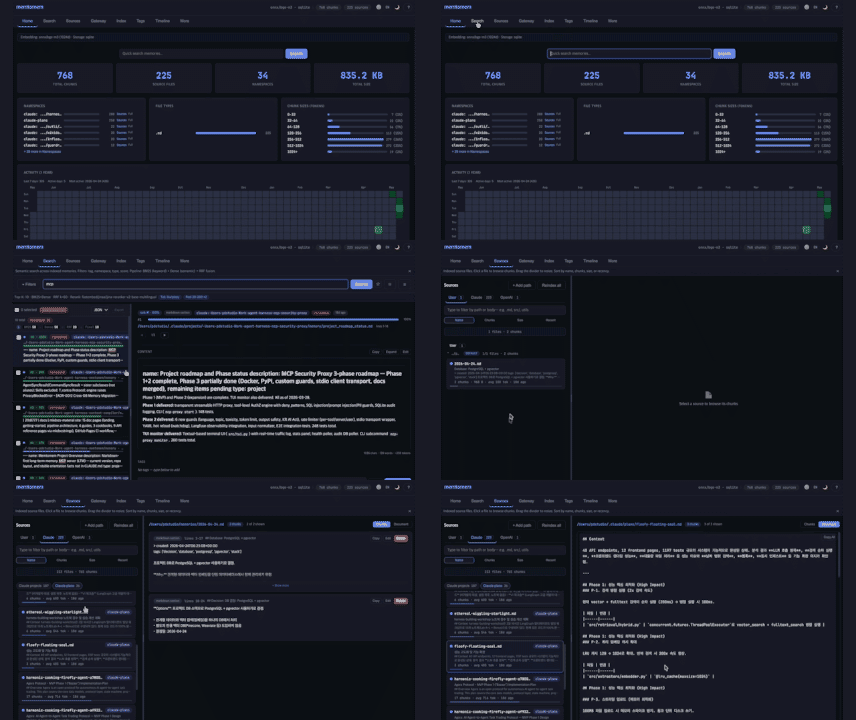
memtomem turns your markdown notes, documents, and code into a searchable knowledge base that any AI coding agent can use. Write notes as plain .md files — memtomem indexes them and makes them searchable by both keywords and meaning.
First time here? Follow the Getting Started guide — you'll have a working setup in under 5 minutes. Claude Code or Codex CLI user? See the Korean vibe-coding quickstart.
Why memtomem?
| Problem | How memtomem solves it |
|---|---|
| AI forgets everything between sessions | Index your notes once, search them in every session |
| Keyword search misses related content | Hybrid search: exact keywords + meaning-based similarity |
| Notes scattered across tools | One searchable index for markdown, JSON, YAML, Python, JS/TS |
| Vendor lock-in | Your .md files are the source of truth. The DB is a rebuildable cache |
| Hidden automation is hard to reason about | Core memory operations run only when you call them; optional client hooks are explicit, removable integrations |
Quick Start
1. Install
[all] bundles the features the sections below describe — ONNX dense embeddings, Korean tokenizer, Ollama / OpenAI providers, code chunker, and the Web UI. For a BM25-only install without those downloads (~40 MB vs ~250 MB), see the minimal install option in the Getting Started guide.
If
mm --versionshows an older version than the latest release right after installing,uvis likely serving cached PyPI metadata — re-run withuv tool install 'memtomem[all]' --refresh, or clear the cache first:uv cache clean memtomem. To upgrade an existing uv tool install, usemm upgraderather than re-runninguv tool install; see the CLI reference for what it preserves and stops.
mm: command not found?uv tool installdrops the shim into~/.local/bin, which isn't on$PATHin fresh shells on macOS/Linux. Runuv tool update-shell, then open a new shell and re-runmm --version.
2. Setup
After upgrading the Claude plugin: re-check
/mcpafter reloading. The plugin launchesmemtomem[onnx]==0.6.5. A manual registration whose launch differs — base-onlymemtomem, or the ONNX launch pinned to an earlier release — no longer matches for deduplication and may expose duplicate tools. Confirm the manual entry's name and scope, then align its launch command with the plugin or remove that redundant registration.
The interactive picker starts with three presets — Minimal (BM25, no downloads), English (Recommended) (ONNX multilingual-e5-small + English reranker + auto-discover providers), Korean-optimized (ONNX multilingual-e5-small + kiwipiepy tokenizer + multilingual reranker) — plus an Advanced entry that opens the full 10-step wizard. Preset paths only ask about the memory directory and MCP registration; everything else is set from the preset.
Choose Minimal for the fastest no-download first proof; rerun mm init
later when you are ready to add semantic search.
Indexing vs. discovery (Claude Code): provider memory folders that setup auto-discovers (e.g.
~/.claude/projects/*/memory/) are added to the search index. That is separate from the Web UI's opt-in Context Gateway scan of~/.claude/projects/, which discovers project roots for Skills, Custom Commands, and Subagents — see Configuration → Context Gateway for the distinction and the lossy-slug caveats.
For automation / CI:
See Embeddings for the full model/provider matrix.
3. Verify a complete memory round trip
The first success path does not require an existing notes directory or a connected editor:
mm add writes to your configured user memory directory and indexes the entry immediately. The final command should return the sentence you just added.
Then verify the editor connection:
To bring existing notes into the same index, point mm index at a directory that already exists:
mm status --json (or --format json) provides the same status as machine-readable output for scripts and CI.
4. Open the Web UI (optional)
mm web shows the polished page set by default. Pass --dev (or set
MEMTOMEM_WEB__MODE=dev in your shell profile) to expose maintainer pages
like Namespaces, Sessions, Working Memory, and Health Report.
Other install options
Opt in later per-feature: uv tool install --reinstall 'memtomem[onnx,web]' (see the extras table).
Project-scoped (per-project isolation):
No install (uvx on demand):
See MCP Client Setup for OpenCode / Codex / Cursor / Windsurf / Claude Desktop / Gemini CLI / Kimi Code.
Key Features
- Hybrid search — BM25 keyword + dense vector + RRF fusion in one query
- Semantic chunking — heading-aware Markdown, AST-based Python, tree-sitter JS/TS, structure-aware JSON/YAML/TOML
- Incremental indexing — chunk-level SHA-256 diff; only changed chunks get re-embedded
- Namespaces — organize memories into scoped groups with auto-derivation from folder names; review and label them (colour, description) from Settings → Namespaces in the Web UI
- Maintenance — near-duplicate detection, time-based decay, TTL expiration, auto-tagging
- Web UI — visual dashboard for search, sources, tags, timeline, dedup, and more (
mm web --devfor the full maintainer surface) - Context Gateway — keep canonical Skills, Commands, and Subagents in a project or user Store, optionally install reusable assets from a separate Wiki, then push them to supported AI runtimes. See Context Gateway.
- MCP tools —
mem_dometa-tool routes all non-core actions incoremode for minimal context usage - Predictable core — memory operations run on explicit CLI/MCP calls (
mm add,mem_add,mem_index, etc.). Optional client hooks are installed and removed separately rather than being a hidden runtime default. - Scriptable CLI —
--jsonoutput onmm statusand write commands (mm add/mm reset/mm purge);mm warmuppre-loads local models so the first query skips the cold-start cost - Scheduled jobs —
mm schedule add/list/run-now/delete(ormem_do(action="schedule_*")) for cron-driven compaction, importance decay, dead-link cleanup, and dedup scans - Pinned Context — keep small user/project/agent Markdown blocks ahead of retrieved results with
mm pinned compose - LangGraph Store — optional
MemtomemBaseStoreimplements LangGraph's tuple-namespace long-term-memory contract - Hybrid LangGraph Store —
MemtomemHybridStoreadds dedicated SQLite persistence, BM25/dense/RRF retrieval, TTL, and diagnostics
Ecosystem
| Package | Description |
|---|---|
| memtomem | Core — MCP server, CLI, Web UI, hybrid search, storage |
| opencode-memtomem | OpenCode — exact-pinned MCP, commands, read skills, safe permissions |
| memtomem-stm | STM proxy — proactive memory surfacing via tool interception |
Documentation
Hosted at memtomem.com — also available as Markdown in this repo. New to memtomem? The guides have a suggested reading order. The table below follows it:
| Guide | Description |
|---|---|
| Getting Started | Install, configure, save and find your first memory |
| 한국어 바이브코딩 빠른 시작 | Claude Code·Codex CLI에서 10~15분 안에 기억 저장·검색 |
| Example notebooks | Start with 00: recover decisions, code, and settings across 150 synthetic files without a model (Korean); 01–04 teach APIs, 05–06 teach LangGraph |
| Coding-agent sample | Recover a decision and its ADR source across sessions; isolated CLI proof and copyable prompts |
| 프로젝트 업무별 체험 | 개발 작업 인계·제품 의사결정·온보딩: 모델 없는 체험, 기록 양식, 2주 파일럿 |
| MCP Client Setup | Editor-specific configuration |
| Cross-runtime handoff | Claude Code·Codex CLI·Kimi Code 순차 공동 개발 |
| Core memory tools | Index existing notes, search, and manage memories |
| Configuration | Supported config files, precedence, and MEMTOMEM_* variables |
| Embeddings | ONNX, Ollama, and OpenAI embedding providers |
| LLM Providers | Ollama, OpenAI, Anthropic, and compatible endpoints |
| Context Gateway | Share Skills, Commands, and Subagents across your AI tools from one Store |
| Multi-device sync | Sync markdown memories across personal devices via a private git repo |
| Operations & troubleshooting | Web UI, privacy audits, diagnostics, and recovery |
| Reference | Complete tool and workflow reference |
| Uninstalling memtomem | Clean removal steps |
Contributing
See CONTRIBUTING.md for setup instructions and the contributor guide.
License
Apache License 2.0. Contributions are accepted under the terms of the Contributor License Agreement.