Portable AI memory as MCP tools: recall, read-only views, and one safe write.
Quick Install
Automated & IDE SetupCopy the AI prompt to install this server into Claude Code, Cursor, or another agent — or use 1-click editor setup below.
Manual Client & Custom JSON ConfigExpand JSON ▾
Client Config & Setup
Choose your client or environment
Target File:
💡 Paste the JSON block into your client's configuration file under mcpServers, then restart the application.
Documentation Overview

MemoWeft
Give your AI a memory—without turning its guesses into your facts.
MemoWeft is an open-source long-term memory engine for TypeScript AI applications. It keeps what users said, what systems observed, what models inferred, and what remains conflicted as distinct records—so memory can be inspected, corrected, managed, and moved between hosts in SQLite controlled by your application.




Why · Offline demo · Quickstart · Integrations · Trust · Docs
English · 简体中文
[!IMPORTANT] MemoWeft is a library your application imports—not a chat product, hosted memory service, persona framework, vector database, or agent framework.
Why AI memory needs a paper trail
AI can already hold a convincing conversation. What it often lacks is reliable continuity.
Across conversations, important context can disappear. New information may quietly replace old information. A model's guess may return later as if the user had stated it. Move to another model or host, and the accumulated memory may be left behind.
MemoWeft does not ask a model to declare the truth. It preserves where information came from, when it appeared, what contradicts it, and why a memory was formed—so applications and users can inspect the path from evidence to recall.
|
Evidence stays evidence User statements, observations, tool results, and model inferences keep distinct provenance. |
Conflict stays visible Corrections retain history. Unresolved contradictions are exposed instead of silently overwritten. |
Memory stays yours Hosts can inspect, manage, export, validate, and import versioned memory bundles. |
Confidence is computed by rule rather than copied from a model's self-assessment. Transient states can age faster than durable facts and preferences. Built-in ingestion paths do not turn an assistant's own reply into user evidence simply because the assistant said it.
Explore the six memory-discipline rules · Read the architecture
Try it without an API key
With Node 24 installed:
After dependencies are installed, this deterministic demo needs no API key, makes no network calls, uses an in-memory database, and writes nothing to disk.
This proves MemoWeft's memory rules; it is not a model-quality benchmark. For correction history and typed decay as well, run npm run demo.
Read the four-scene walkthrough · Inspect the demo source
What it looks like in a product
WeftMate is a desktop product built on MemoWeft. It turns the Core memory model into a visible profile, source trail, conflict view, and user-facing controls.
The screenshots below show WeftMate's UI, not UI bundled with MemoWeft Core. MemoWeft provides the memory layer and portable data contract; product experience remains the host application's responsibility.
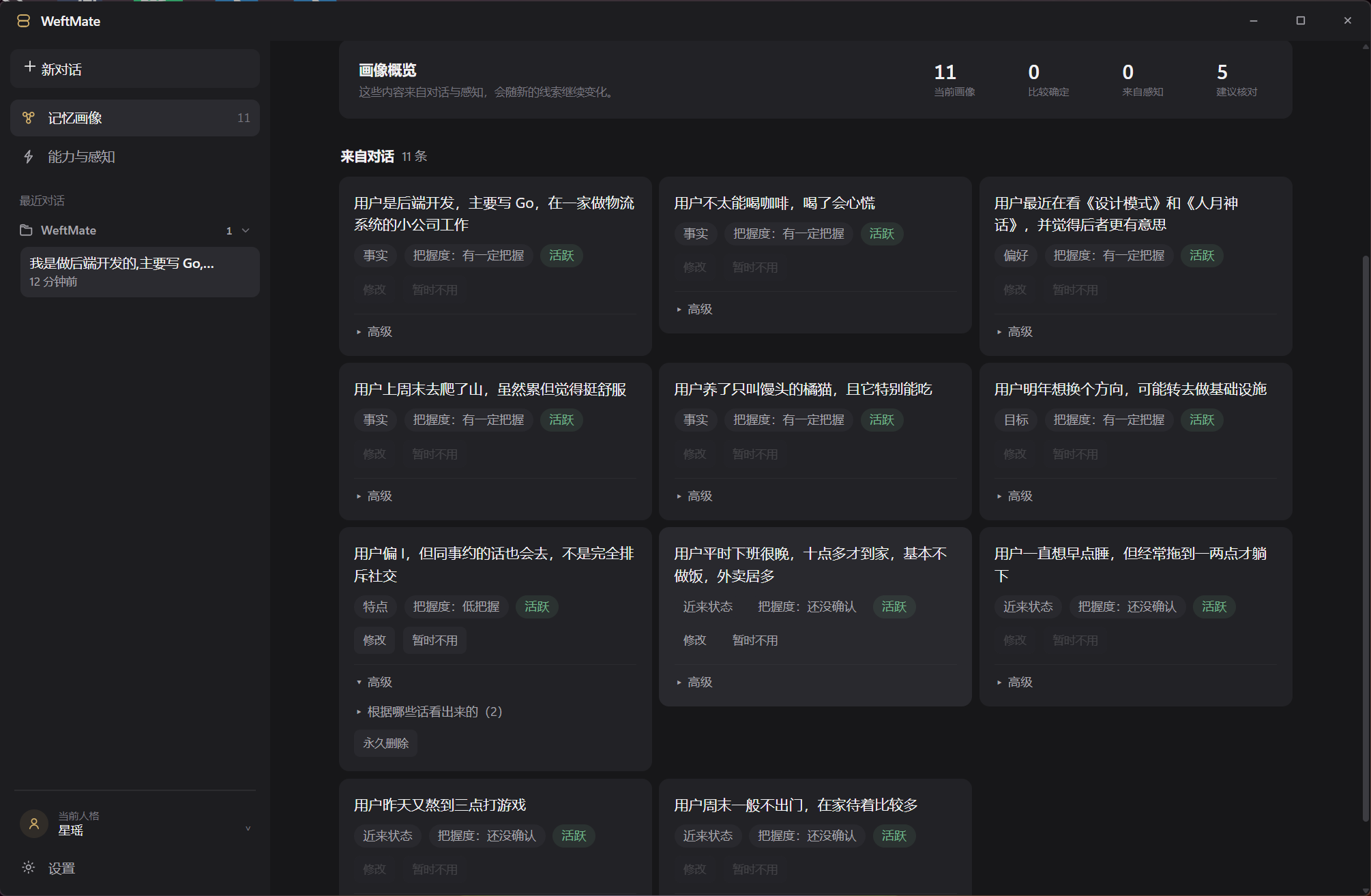
|
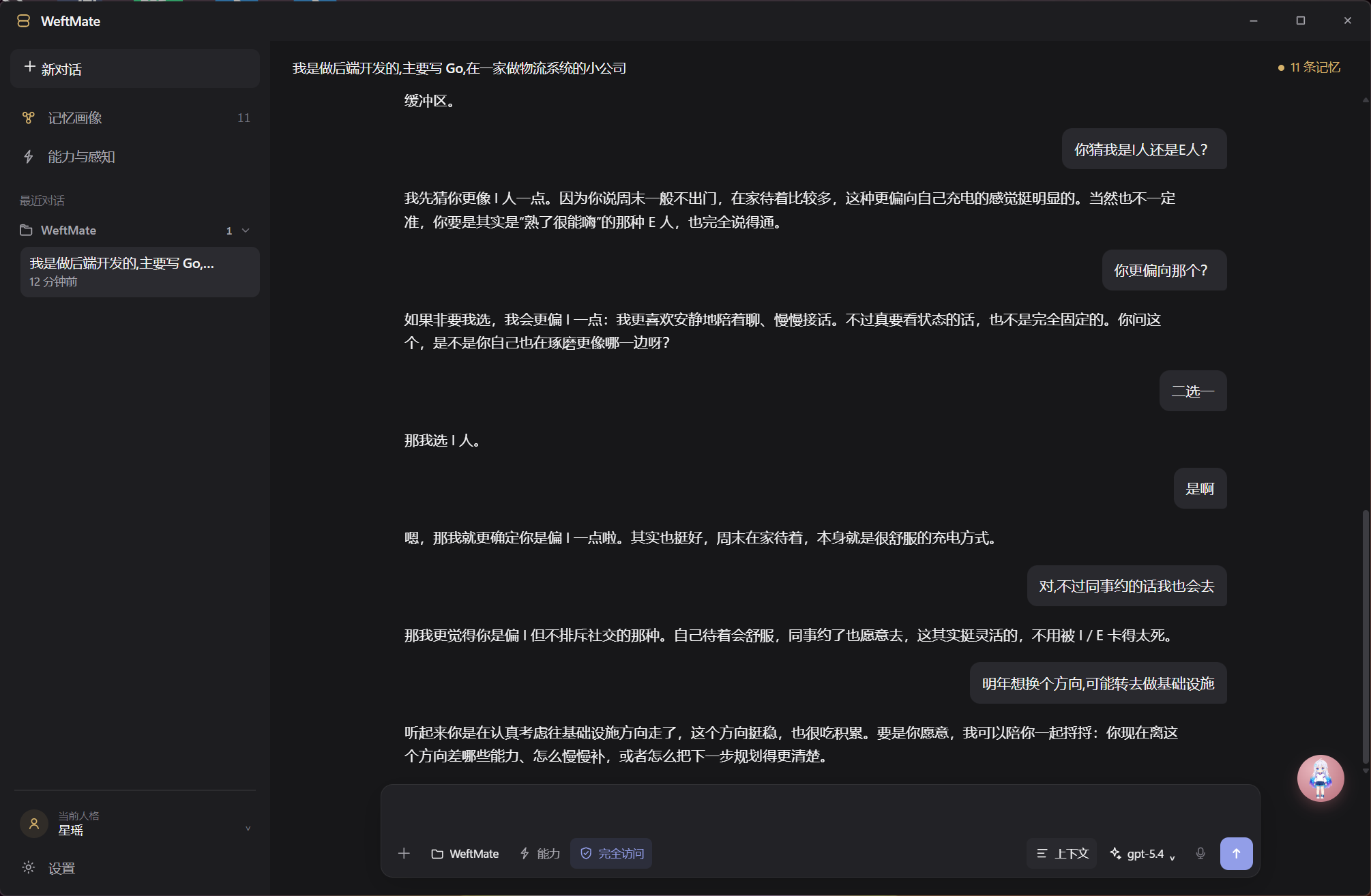
|
| Know what a memory came from. Each item can expose its type, confidence tier, and source trail. | Resolve short replies before storing them. A brief confirmation does not promote the assistant's proposal into user evidence. |
See the evidence graph · See portable-data controls · Run the reference host
Quickstart
Node 24+ is the simplest path:
On Node 20 or 22, also install the optional SQLite driver:
Save as quickstart.mjs:
Run it:
Storing and reading raw evidence needs no model or network. Turning evidence into a profile, separating guesses from stated facts, and recalling it into later conversations requires a chat model. Embeddings are optional; without them, Core normally uses local FTS5 keyword recall.
Continue with the five-minute guide
How it works
MemoWeft keeps the journey from source material to recalled context explicit:
The supported application path is the createMemoWeftCore() facade. Lower-level exports exist for advanced composition and carry documented stable, experimental, or internal support tiers.
API surface and tiers · Memory surface contract
Is MemoWeft a fit?
| Choose MemoWeft when you need… | Choose another layer when you need… |
|---|---|
| Long-term user memory across conversations, models, or hosts | Only short-term chat history or general document RAG |
| Provenance, correction history, conflict visibility, and controlled recall | A ready-made chat UI, persona, or consumer application |
| An embedded TypeScript library backed by SQLite | A hosted multi-tenant memory API or managed synchronization service |
| Memory the host can inspect, manage, export, and import | PostgreSQL or a replaceable production storage backend out of the box |
| Explicit controls over built-in model read paths | A library that supplies authentication, consent UI, compliance, or encryption at rest |
Your host remains responsible for product UX, authentication, authorization, consent, encryption, backups, logging policy, and deployment.
Integrations
Related MCP Servers
Reviews
No reviews yet — be the first to share how this listing worked for you.
Frequently Asked Questions about Memoweft
AllMCPs Directory Badge
Showcase your server listing on GitHub or your project documentation. Embed this dynamic SVG badge to highlight official listing status and live engagement.
Badge Style:
Live Dynamic SVG Preview
Markdown (GitHub README)
[](https://allmcps.com/mcp/memoweft)HTML Embed
<a href="https://allmcps.com/mcp/memoweft"><img src="https://allmcps.com/api/badge/memoweft?style=directory" alt="Memoweft on AllMCPs" /></a>Technical Specs & Signals
CategoryKnowledge & Memory
31Quality signal: Emerging · 31/100How this signal is calculated ▾
Server availabilityNot measured
Not scored for repo-hosted servers — we can't reach the running server, only its GitHub page. Hosted MCP endpoints are health-checked live.
Verified ownership10/20
Documentation & tools11/30
Adoption & activity2/15
Community engagement0/10
A guidance signal from public completeness & health data — not a user rating. New listings start lower and rise as they add docs, get verified, and grow adoption. Signals we can't observe for a listing are skipped, not counted against it.
Own this project?
This directory is pre-filled from public sources. Claim via GitHub README, site badge, or DNS TXT to unlock edit access and the Official badge — proof is checked automatically, then reviewed by our team.
Free dofollow backlink: add your website and place the AllMCPs badge on it — no claim needed. We detect it automatically and keep it verified as long as the badge stays live.
Claim & get free dofollowShare & Embed
Add our SVG badge (dark/light directory styles) or embeddable widget to your site.