Local-first governed MCP memory backend for coding agents.
Quick Install
Automated & IDE SetupCopy the AI prompt to install this server into Claude Code, Cursor, or another agent — or use 1-click editor setup below.
Not yet automatically verified
We haven't yet run this listing's install command through our automated sandbox check. This isn't a red flag — we're steadily working through the catalog.
Manual Client & Custom JSON ConfigExpand JSON ▾
Client Config & Setup
Choose your client or environment
Target File:
💡 Paste the JSON block into your client's configuration file under mcpServers, then restart the application.
Documentation Overview
MemoryGuard
Governed shared memory for coding agents.
Local-first MCP memory with automatic organization, scoped rules, evidence, and rollback.




Let agents write without turning shared memory into an unreviewed pile. MemoryGuard organizes each write, preserves the evidence behind changes, and keeps governance decisions reversible.
No account. No remote server. No remote telemetry. Local-only usage telemetry is optional and stores bounded, privacy-preserving aggregates locally.
Quick start · Upgrade · Knowledge Library · Architecture · Supported hosts · Privacy and safety
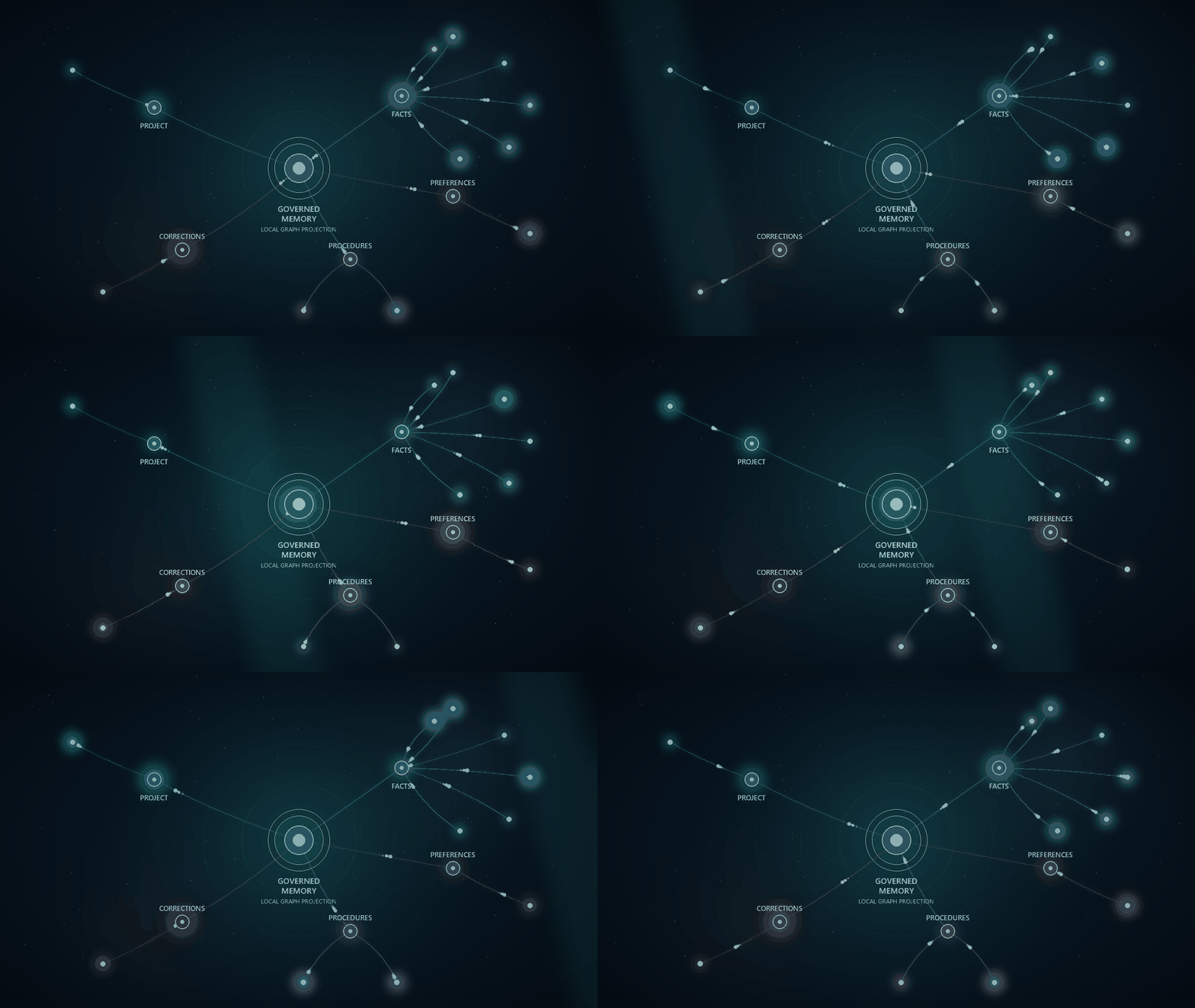
A synthetic governed projection: signals move through memory categories while raw conversation text remains outside the graph.
What's New in v0.7.11
v0.7.11 is a public documentation and discovery consistency release. Runtime behavior summarized here originates in v0.7.9:
- Canonical memory and rule governance: related rules, habits, and memories converge through one canonical read/write path while evidence, source links, graph branches, supersede history, conflict review, and settlement remain auditable and reversible.
- Readable multi-agent governance: verified program identities, readable labels, safe family icons, shared-group scope, risk explanations, stale-conflict closure, seven governance pages, and a separate Token usage-and-savings entry keep daily governance understandable.
- Local usage and savings view: the Token page shows local MCP conversion events and seven-/thirty-day estimated baseline-versus-delivered units. Provider token measurements are used only when reported (currently Codex and Grok); Claude, Cursor, and Trae remain explicitly unsupported. No conversation body, account, path, or instance identifier is stored.
- Codex lifecycle and runtime alignment: terminal-thread evidence gates reclamation of Codex-owned leaked cohorts; ordinary turns remain resumable. Installed repair aligns MCP and lifecycle Hooks to the current interpreter while preserving Agent/shared-group identity and fail-closed boundaries.
- Evidence and discovery:
scripts/benchmark_usage_telemetry.pydocuments reproducible seven-/thirty-day local measurements with explicit coverage and no-sample semantics. Releases are published through GitHub OIDC to GitHub Releases, PyPI, and the official MCP Registry. Verify current package and registry status through those live records. No Glama score or third-party directory listing is implied.
See the v0.7.11 release note and release history.
Earlier release details are kept in the Changelog and GitHub release records.
Token evidence and demo
Run the benchmark only against an authorized local workspace:
Read the benchmark guide for measured, estimated, derived, and unsupported semantics. Use the demo recording checklist for a sanitized walkthrough. The repository's synthetic graph artwork is not a live product capture; it is not evidence of usage or savings.
Major V2 refactor in v0.6.0
v0.6.0 was a production data-plane refactor, not a storage-only upgrade:
- Authoritative V2 domains: Memory, Rules, Evidence, Content, Runtime, Projection, Assets, CodeGraph, Skills, and System state are separated into explicit SQLite domains with governed boundaries.
- Explicit cutover:
V1_ACTIVE → V2_BUILDING → V2_READY → V2_ACTIVEis fail-closed; V2 never silently falls back to legacy stores or dual-writes after READY/ACTIVE. - Lossless migration: frozen-source preparation uses coherent SQLite online backups, validates source/target evidence, rechecks live-source drift, and preserves V1 data plus migration backups for rollback.
- Native routing: MCP, CLI, GUI, and Hook surfaces are classified explicitly; the release closed the 233-surface cutover with 138 implemented routes, 95 retired routes, and zero neutral/blocker routes.
- Governed intelligence: Rule lifecycle and RuleMerge, extraction/enrichment, External MCP import, provider control-plane, conversation history, Knowledge Library, and GUI governance all use the V2 evidence and decision paths.
- Operational evidence: Reference Audit, per-domain SQLite health, guarded maintenance, rollback evidence, and safe unbound diagnostics are part of readiness and operations.
Why MemoryGuard
Persistent memory solves storage. It does not solve governance.
When several coding agents write into the same context, records become duplicated, stale, contradictory, over-broad, or unsafe to reuse. MemoryGuard sits between coding agents and their shared memory to keep that context usable.
| Without governance | With MemoryGuard |
|---|---|
| Notes accumulate without a canonical state | Writes are classified, deduplicated, superseded, or surfaced as conflicts |
| A correction silently destroys the old value | Evidence and supersede chains preserve what changed and why |
| Tokens and credentials can remain active | Sensitive-looking content is quarantined from active memory |
| Every write needs manual approval | Agents write normally; people review exceptions and outcomes |
| Raw chat logs leak into future context | Conversation history remains a separate, explicitly read evidence archive |
System architecture
Related MCP Servers
Reviews
No reviews yet — be the first to share how this listing worked for you.
Frequently Asked Questions about MemoryGuard
AllMCPs Directory Badge
Showcase your server listing on GitHub or your project documentation. Embed this dynamic SVG badge to highlight official listing status and live engagement.
Badge Style:
Live Dynamic SVG Preview
Markdown (GitHub README)
[](https://allmcps.com/mcp/memoryguard)HTML Embed
<a href="https://allmcps.com/mcp/memoryguard"><img src="https://allmcps.com/api/badge/memoryguard?style=directory" alt="MemoryGuard on AllMCPs" /></a>Technical Specs & Signals
CategoryKnowledge & Memory
36Quality signal: Fair · 36/100How this signal is calculated ▾
Server availabilityNot measured
Not scored for repo-hosted servers — we can't reach the running server, only its GitHub page. Hosted MCP endpoints are health-checked live.
Verified ownership10/20
Documentation & tools15/30
Adoption & activity2/15
Community engagement0/10
A guidance signal from public completeness & health data — not a user rating. New listings start lower and rise as they add docs, get verified, and grow adoption. Signals we can't observe for a listing are skipped, not counted against it.
Own this project?
This directory is pre-filled from public sources. Claim via GitHub README, site badge, or DNS TXT to unlock edit access and the Official badge — proof is checked automatically, then reviewed by our team.
Free dofollow backlink: add your website and place the AllMCPs badge on it — no claim needed. We detect it automatically and keep it verified as long as the badge stays live.
Claim & get free dofollowShare & Embed
Add our SVG badge (dark/light directory styles) or embeddable widget to your site.