File-first, local-first MCP memory for AI coding assistants: Markdown + YAML, no vector DB.
Quick Install
Automated & IDE SetupCopy the AI prompt to install this server into Claude Code, Cursor, or another agent — or use 1-click editor setup below.
Not yet automatically verified
We haven't yet run this listing's install command through our automated sandbox check. This isn't a red flag — we're steadily working through the catalog.
Manual Client & Custom JSON ConfigExpand JSON ▾
Client Config & Setup
Choose your client or environment
Target File:
💡 Paste the JSON block into your client's configuration file under mcpServers, then restart the application.
Documentation Overview
Memory Fabric

File-first, local-first memory layer for MCP-compatible AI coding assistants.
Memory Fabric gives AI tools like Claude Code, Cursor, and GitHub Copilot a consistent, project-aware context layer without locking you into one model, editor, cloud provider, or operating system.
Memory is stored as human-readable Markdown with YAML frontmatter. No vector database. No cloud account. No embeddings required.
Features
- MCP-native: exposes memory tools through the standard Model Context Protocol
- File-first: Markdown files are the source of truth, inspectable and commit-ready
- Local-first: core reads and writes work offline
- Store-first: facts live in
memory-store/, one per file; root maps (architecture.md,decisions.md, ...) are generated views rebuilt by Dreaming, never hand-written - Captures itself: every git commit is recorded as episodic memory automatically — no agent cooperation required — via an opt-in post-commit hook
- Git-native merge: an optional custom merge driver lets two branches' memory merge as cleanly as their code, instead of conflicting on a shared timestamp line
- Self-verifying: memories can cite the file/line/commit they depend on;
ai-memory verifyflags citations that rotted - Learns from failure:
write_failure_memory_tooldeduplicates repeat occurrences of the same error into one growing record instead of scattering near-duplicates - Secret-safe: API keys and credentials are redacted before writing
- Token-budget aware: assembles context within limits; never slices files mid-document
- Quality eval: scores memory usefulness and Dreaming before/after results locally
- Unicode-safe: works with any human language
- Graceful degradation: works without
rg, git hooks, or Dreaming configured
Status
v1.4.1 — field-store write/read hygiene (live handoffs, query packs, doctor
smells) on top of the local field diary. Live on PyPI.
Core CLI and MCP tools work end-to-end. See ROADMAP.md for what
shipped, what's in progress, and what's next.
Demo
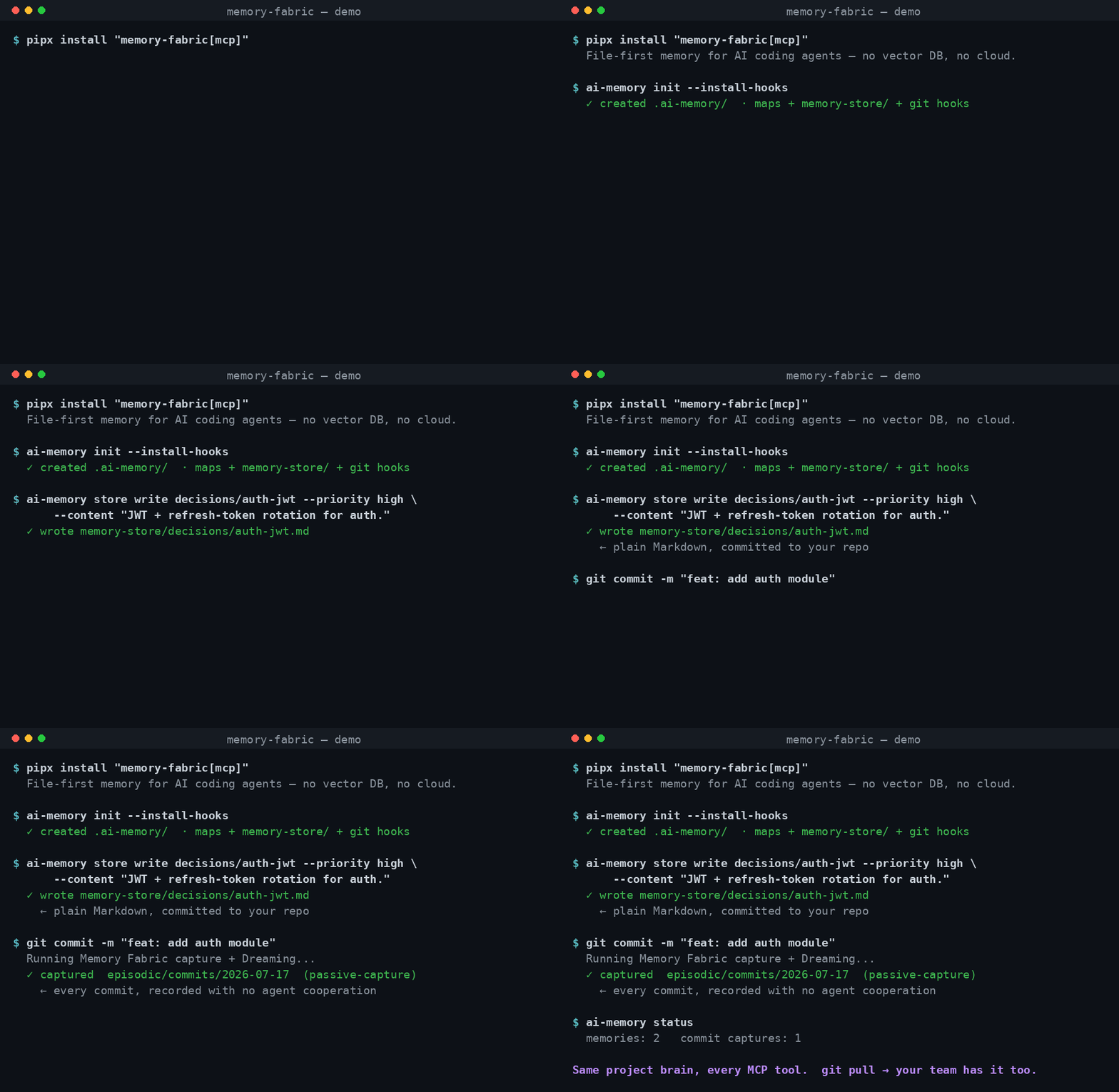
The CLI and self-capture flow: initialize a project, write a memory as a plain
Markdown file in your repo, and watch a git commit record itself as episodic
memory with no agent cooperation. The cross-tool moment — an agent writes memory
in one tool and a different tool reads it back — is storyboarded in
DEMO.md for the full video.
Privacy — no telemetry
Memory Fabric never sends data anywhere. There is no account, no cloud, no
analytics, no phone-home. The core read and write paths make no network calls at
all; the only optional network requests are a PyPI version-drift check and an
LLM-provider preflight, both of which you can turn off with --offline. Your
memory is plain Markdown in your own git history — it never leaves your machine
unless you push it.
An optional, off-by-default field diary can record operational counts on
your machine after you run ai-memory diary approve. That is not the session
journal, and it is not telemetry: nothing is transmitted. MEMORY_FABRIC_DIARY=0
is a kill switch. This is a deliberate guarantee, not a default we might change.
Installation
From PyPI (recommended)
Requires Python ≥ 3.11.
Or with plain pip (inside a virtual environment):
Zero-install one-off run (requires uv):
From GitHub (latest, pre-release)
Or with plain pip (inside a virtual environment):
Upgrading
Because Memory Fabric is in active development, we recommend upgrading regularly:
-
Upgrade the Package:
-
Refresh the MCP client config (uvx installs): If your client config launches the server via
uvx(the default written by olderai-memory installruns), uv serves the build it cached the first time and never re-resolves an unpinned spec — restarting the client is not enough and can leave the server several releases behind without any signal. After upgrading, either:ai-memory doctorwarns when the local version drifts from the latest on PyPI or when a differentai-memoryinstallation shadows this one on PATH. -
Restart MCP Clients: After upgrading, restart your IDE (Cursor, VS Code) or assistant process (Claude Code) to ensure the client reloads the updated
memory-fabric-mcpserver. -
Refresh Local Projects (Optional): If you have projects initialized with older versions of Memory Fabric, navigate to the project directory and run:
This will safely refresh starter templates and local git hook integration to the latest format without overwriting your existing memory markdown files.
Windows terminals: the CLI emits UTF-8 (memory content legitimately contains em-dashes and bullets). Windows Terminal and PowerShell 7 render it out of the box; on legacy consoles (PowerShell 5.1 with an OEM code page) set
chcp 65001orPYTHONUTF8=1if you see replacement characters.
Or clone and install in editable mode for local development:
Quick Start
1. Initialize a project
Creates .ai-memory/ in the current directory with starter sections and a .gitignore.
2. Check health
3. Evaluate memory quality
eval scores whether memories are useful for coding assistants. It checks section coverage, starter-template content, summary quality, metadata, retrieval readiness, and likely secrets.
If .ai-memory/ exists, reports are saved under ignored local files:
If .ai-memory/ does not exist yet, eval prints a pre-init report only and creates no files.
4. Query memory
5. Run maintenance (Dreaming)
Dreaming creates a snapshot before maintenance. You can evaluate whether a Dreaming run improved memory quality:
Dream eval compares the pre-dream snapshot to current memory and reports score delta, changed files, improvements, and regressions.
MCP Server — Install
One command per client. Safe to re-run: merges with your existing config, never overwrites it, and backs up the original file if it can't be parsed.
One-click install



These call uvx --from "memory-fabric[mcp]" memory-fabric-mcp under the hood — same
canonical invocation as ai-memory install, just without the CLI step. Requires
uv.
Related MCP Servers
Reviews
No reviews yet — be the first to share how this listing worked for you.
Frequently Asked Questions about Memory Fabric
AllMCPs Directory Badge
Showcase your server listing on GitHub or your project documentation. Embed this dynamic SVG badge to highlight official listing status and live engagement.
Badge Style:
Live Dynamic SVG Preview
Markdown (GitHub README)
[](https://allmcps.com/mcp/memory-fabric)HTML Embed
<a href="https://allmcps.com/mcp/memory-fabric"><img src="https://allmcps.com/api/badge/memory-fabric?style=directory" alt="Memory Fabric on AllMCPs" /></a>Technical Specs & Signals
CategoryKnowledge & Memory
37Quality signal: Fair · 37/100How this signal is calculated ▾
Server availabilityNot measured
Not scored for repo-hosted servers — we can't reach the running server, only its GitHub page. Hosted MCP endpoints are health-checked live.
Verified ownership10/20
Documentation & tools16/30
Adoption & activity2/15
Community engagement0/10
A guidance signal from public completeness & health data — not a user rating. New listings start lower and rise as they add docs, get verified, and grow adoption. Signals we can't observe for a listing are skipped, not counted against it.
Own this project?
This directory is pre-filled from public sources. Claim via GitHub README, site badge, or DNS TXT to unlock edit access and the Official badge — proof is checked automatically, then reviewed by our team.
Free dofollow backlink: add your website and place the AllMCPs badge on it — no claim needed. We detect it automatically and keep it verified as long as the badge stays live.
Claim & get free dofollowShare & Embed
Add our SVG badge (dark/light directory styles) or embeddable widget to your site.