Memory Boost README
The full upstream README, mirrored here for reference. Install config, tool schemas, adoption signals, and an original overview live on the Memory Boost listing page.
memory-boost
Memory for coding agents that reviews itself.



drift, mine and lessons on the bundled example data · everything runs locally
Try it · What it answers · Connect your agent · How it works · vs. alternatives
Your agents write everything down. Nobody reads it back.
Every memory tool for coding agents helps them remember more. None of them mention that half of what they remember expired in July. memory-boost keeps a plain-markdown memory your agents read and write over MCP, and then does the unglamorous part: it audits that memory and your own sessions, and tells you what drifted. Politely, with numbers.
Think of it as a code review for what your agents remember and a fitness tracker for how you work
with them. Mostly the fitness tracker: mine told me my most-failed command was cd. Sixty-nine
times.
What it answers
| You wonder… | memory-boost answers |
|---|---|
| Which decisions quietly expired while we were busy shipping? | drift: review_by 2026-07-08, 78 days ago |
| Which "active" projects actually died months ago? | drift: last session 161 days ago; still listed as live |
| We fixed this exact bug in another repo. How? | lessons: the fix follows you to every project with the same stack |
| Why does my agent keep re-reading the same file? | mine: one file, read 18 times |
| Is my agent spawning 20 subagents behind my back? | mine: yes, and in which session |
Where was I before /compact ate my context? | The session-start hook puts your checkpoint back |
Try it in 30 seconds
No install needed; the wiki lands in ~/.local/share/memory-boost:
To keep it in Claude Code, install the plugin. It brings the MCP server, the session-start brief and the skills in one step; it only needs uv on your PATH.
Other agents, or the CLI on its own: uv tool install memory-boost (or pipx install memory-boost).
On a real machine
Five weeks of the author's own daily use: 29 decisions, 24 projects, 657 Claude Code transcripts. Output as produced; only project and file names are replaced.
Every line is a habit to change, a decision to revisit, or a rule worth writing down. None of it needed a new tool: the data was already on disk. It needed a reader.
What it is
- A wiki you own.
projects/*.md,decisions/*.md,concepts/*.md,log.md. Plain markdown; edit by hand, keep it in git. SQLite FTS5 index as a disposable cache. Eight MCP tools for any harness:memory_brief,memory_recall,memory_page,memory_save,memory_checkpoint,memory_resume,memory_drift,memory_lesson. - Freshness as data. Decisions carry
status:andreview_by:. Search results are taggedcurrent / unclassified / review / historic / superseded, current first. - Session checkpoints that survive
/compact, with one line per other active session on the same project so parallel agents don't collide. driftreads the wiki and reports what expired, what went silent, what was never written down and what was left half-done. The current project's top findings go into every session brief.minereads your local Claude Code transcripts and reports tool usage, failed commands, re-reads, subagent fan-out and checkpoint discipline. Aggregates only: no prompt, command or file content is stored or printed, so the digest is safe to paste anywhere.lessons:concepts/pages withapplies_when: [tags]. A project page that lists matchingtags:gets those lessons in its brief, so what worked in one repo reaches the next. The/retroskill writes them at session end.
Connect your harness
MCP server (all harnesses): command memory-boost, args ["serve"].
| Harness | MCP registration | Context at session start |
|---|---|---|
| Claude Code (plugin) | /plugin install memory-boost@memory-boost | Included: hook, MCP server, skills |
| Claude Code (manual) | claude mcp add memory -s user -- memory-boost serve | Hook below (startup, resume, compact); mine reads its transcripts |
| Codex CLI | codex mcp add memory -- memory-boost serve | AGENTS.md: "call memory_brief first" |
| Cursor / VS Code / Gemini CLI | stdio entry in their mcp.json / settings.json | Same line in rules (hook adapters: roadmap) |
Manual Claude Code hook (~/.claude/settings.json), not needed with the plugin:
On startup/resume it injects ~1k tokens: catalog, the project's context and last sessions,
its drift, lessons from other projects, your open checkpoint. On compact only this session's
checkpoint. It never blocks session start: on any error it prints nothing.
Skills: /memory-boost (router: when to run what), /save-session, /restore-session,
/retro. The plugin installs them as /memory-boost:retro and so on; without it, copy
skills/* into ~/.claude/skills/. The first session after installing the plugin takes a few
extra seconds while uv fetches the package; later sessions start in about 0.2 s.
CLI contract for agents: data on stdout, errors on stderr with a fix: line, --json on every
reading command (with a version field), exit 0 = trust stdout, 1 = not found, 2 = bad input.
Reports end with a next: line naming the exact command to run.
How it works
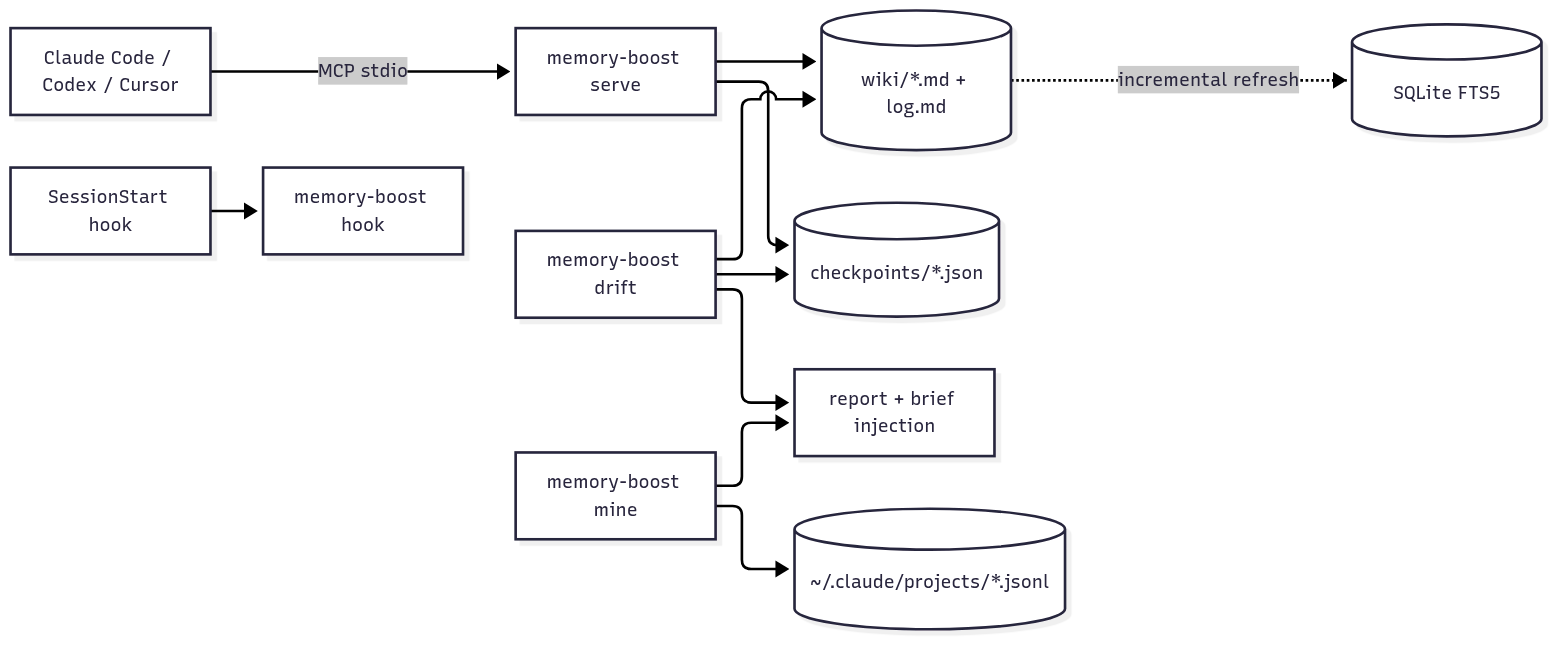
Source: docs/architecture.mmd
The project is resolved from the working directory name (~/work/acme-api → projects/acme-api.md);
map other names in aliases.json. Under 1,600 lines of Python, one dependency (mcp), no
embeddings, no daemon.
Configuration
| Variable | Default | Purpose |
|---|---|---|
MEMORY_BOOST_HOME | $XDG_DATA_HOME/memory-boost | Wiki, events, checkpoints, aliases.json |
MEMORY_BOOST_WIKI | $MEMORY_BOOST_HOME/wiki | Point at an existing wiki (e.g. a git repo) |
MEMORY_BOOST_INDEX | $XDG_CACHE_HOME/memory-boost/index-<hash>.db | Search index |
MEMORY_BOOST_CHECKPOINTS | $MEMORY_BOOST_HOME/checkpoints | Checkpoint directory |
MEMORY_BOOST_TRANSCRIPTS | ~/.claude/projects | Where mine looks (several dirs: a:b) |
MEMORY_BOOST_TODAY | today (UTC) | Pin the date for reproducible reports |
vs. alternatives
| memory-boost | basic-memory | claude-mem | agent-retro | |
|---|---|---|---|---|
| Store | Markdown wiki you edit | Markdown | Captured observations | None (prompt skill) |
| Search | FTS5 | FTS + vectors | FTS + vectors | — |
| Freshness / review dates | Yes | No | No | — |
| Drift report over memory | Yes | No | No | No |
| Session analytics | Yes (aggregates, local) | No | No | LLM reads the conversation |
| Parallel-session awareness | Yes | No | No | — |
| License | MIT | AGPL-3.0 | Apache-2.0 | ? |
Want better search, more integrations and a community? Use basic-memory. Want everything captured automatically? claude-mem. Use memory-boost if you want to learn from what your agents already wrote down.
Limits / non-goals
- Keyword search only; no embeddings.
mineunderstands Claude Code transcripts today. Codex is on the roadmap.- Reports are as good as the wiki: an empty wiki yields an empty
drift. - Single user, local files. Linux and macOS; Windows untested.
- The wiki is read by your agents as instructions. Only use a wiki you trust; see SECURITY.md.
License
MIT