Review-gated declarative long-term memory with bounded read-only MCP access.
Quick Install
Automated & IDE SetupCopy the AI prompt to install this server into Claude Code, Cursor, or another agent — or use 1-click editor setup below.
Manual Client & Custom JSON ConfigExpand JSON ▾
Client Config & Setup
Choose your client or environment
Target File:
💡 Paste the JSON block into your client's configuration file under mcpServers, then restart the application.
Documentation Overview
memdsl
English
Agent memory as source code the agent reads itself.
0.9 release line with experimental Edges
Version 0.9.0 adds an opt-in memdsl.workspace.v3 first-class explicit Edge
experiment. It does not rewrite the frozen 0.8 contract: legacy relations and
authority remain compatible, explicit Edge proposals always require a human,
and explicit supersedes is graph-only. Source remains runtime authority;
review/audit is a workflow contract, not a non-bypassable grant ledger. See
the Phase 6 design and risk matrix and
the release-scope evidence freeze.
Stable 0.8 compatibility contract
The 0.8 contract combines the previously unpublished navigation and View work
now shipped by 0.9.0; neither 0.7.0 nor 0.8.0 was released separately. Stable
public contracts include the v1 compatibility/authority surfaces, Catalog v1,
Trace v1, indexed
query/search trace, report diagnostics, public rebuildable CompiledWorkspace
/ compile_workspace, memdsl.workspace.v2, exact use, the generic
dialect_mapping capability, ViewContext/ResolvedView, and the explicit
opt-in v2 read schemas. Map v1 remains supported throughout the 0.8 line and
will not be reconsidered for removal before 1.0.
The software release is 0.9.2, anchored by tag v0.9.2. It adds official
MCP Registry metadata and a UV-based MCPB installer for the default-read-only
memdsl-mcp server. Parser, schema, review, query, authority, and MCP tool
contracts are unchanged from 0.9.1. Neither patch nor package-level release
promotes the opt-in Edge surface to stable or makes automatic Edge generation
authoritative.
The real-world rollout quality of quarantine/strict, dialect-candidate
learning, and host-attested principal integration is still experimental and
opt-in. Their safety invariants are not experimental: authorization happens
before aggregation, incomplete hard-rule evaluation never becomes ALLOW,
non-authoritative edges never gain authority, and repair paths remain open.
CompiledWorkspace is a public rebuildable handle; its cache/index layout,
compiler contract strings, and synthetic timing constants remain implementation
details. Workspace-v3 first-class Edges are experimental. Automatic dialect
learning, automatic Edge candidates, inferred authority, and cold-history/
incremental compilation are not shipped. Host extraction/sanitization and
private schemas/policies/samples remain outside memdsl and are not release
gates.
memdsl started with a retrieval failure. A memory system built on RAG failed to recall a memory it certainly had; a coding agent pointed at the same raw memory files traced it down in a few steps. Same model — the difference was the context contract. The agent knew the memory existed and could keep reading toward it; the retriever got exactly one similarity guess, and a miss looked identical to absence.
memdsl turns that difference into the product. Long-term memory lives in
readable, lintable, reviewable .mem source files, and every runtime
surface is built for an agent that reads memory itself:
- A bounded memory Catalog (
memdsl catalog, MCPmemory_catalog/memdsl://catalog, Pythonbuild_memory_catalog): paged module/type/subject/ status navigation with item and byte budgets, revision-bound cursors, and no duplicated structured/text representation. It is the recommended session-start surface for large workspaces. - A compatible memory map (
memdsl map, MCPmemory_map/memdsl://map): the existing v1 full index remains available for older clients and is not silently changed into Catalog. - Indexed queries that explain their misses (
search_tracein every serialized pack): deterministic lexical postings preserve the v1 EvidencePack ordering and authority lanes while exposing View/source identity, candidate-pool counts, filter-hidden matches, bounded vocabulary suggestions, and safe retry queries. Suggestions never write aliases or let candidate symbols redirect retrieval. - A bounded relation Trace (
memdsl trace, MCPmemory_trace, Pythontrace_memory): deterministic incoming/outgoing/both BFS navigation with relation filters, explicit cycle/back/cross edges, hard depth/node/edge/byte budgets, and revision-bound cursors. Connectivity is navigation, not proof. - Report-only link diagnostics (
memdsl lint, MCPmemory_lintandmemdsl://status): duplicate ids, ambiguous/wrong-prefix/dangling targets, unknown relations, revision cycles, and supersede forks are explicit. Cycle edges cannot make every participant disappear, forks never select a winner, and default Map/query authority remains v1-compatible. - Raw source as the floor (
memdsl://file/{file_id}): the agent can always drop down and read the actual declarations, the way a coding agent reads code.
The failure mode that started the project now fails loud — the memory exists, a filter hid it, and the trace says exactly that:
Try it with Claude Code in two minutes
The core library and CLI support Python 3.9+. The MCP extra and
memdsl-mcp server require Python 3.10+ because the upstream MCP SDK does.
The server instructs the agent to read memory_catalog first, continue only
with a cursor bound to the same Source/View and filters, treat no_match as a
retry signal, use memory_trace only for bounded explicit-relation navigation,
and preflight consequential drafts against MUST constraints with
memory_check. Legacy memory_map remains registered for compatible clients.
DeepSeek Harness
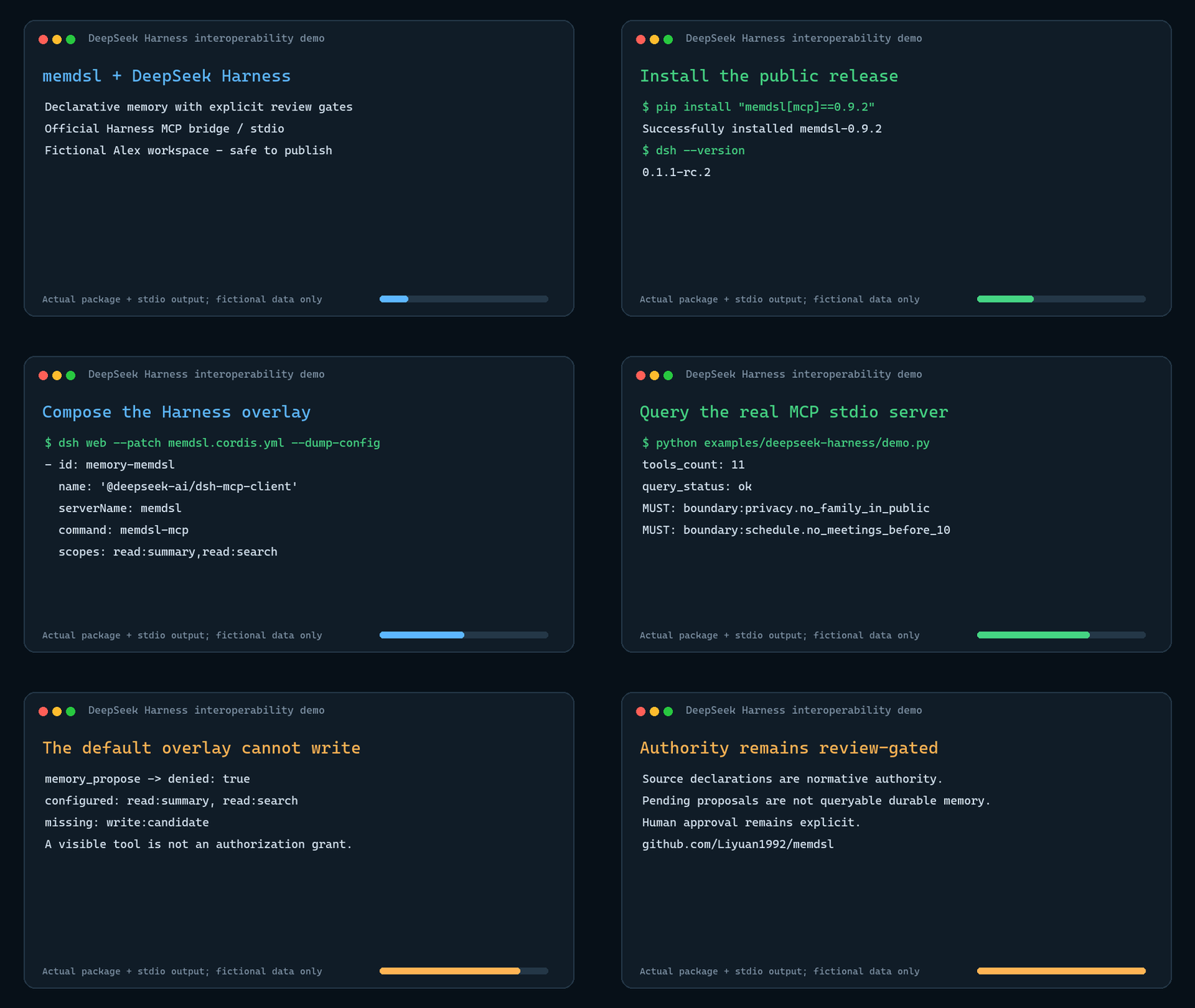
DeepSeek Harness can mount the same stdio MCP server through its official MCP
client. The recommended overlay grants only read:summary,read:search, so the
model can catalog, query, trace, explain, and check approved source memory but
cannot create proposals. See the tested overlay and verification steps in
the DeepSeek Harness integration guide.
Governed, typed memory
The second pillar: memory you can review like code, without forcing one author's ontology on every user. Version 0.8 preserves the two-layer type architecture introduced in 0.5 and the lifecycle-safe review contract from 0.6, then adds bounded compiled navigation and explicit workspace-v2 Views:
The core owns the stable behavioral contract. A workspace owns its vocabulary.
A coding agent, personal assistant, and writing system should not have to call
the same thing a preference, boundary, or fact just because memdsl's
author chose those words.
Two layers
The core layer provides universal fields and five stable runtime roles:
| Runtime role | EvidencePack behavior |
|---|---|
symbol | Defines a subject that other memories can reference |
constraint | Active declarations surface in MUST and participate in compliance |
guidance | Active declarations surface in SHOULD |
assertion | Active declarations surface in CONTEXT when relevant |
question | Active declarations surface in MISSING rather than as fact |
Every searchable non-active hit is isolated under PROVISIONAL, regardless of runtime role. Candidate symbols cannot redirect queries, and candidate constraints cannot enter MUST or compliance.
The same authority boundary applies to relations. A supersedes relation can
hide a target only when its source is active and its full-id or unique bare
target resolves exactly. Candidate, retracted, archived, ambiguous, duplicate,
or wrongly prefixed superseders cannot change query, MUST, or compliance. This
is the v1 compatibility authority rule retained by 0.8. The opt-in
ResolvedView path uses the same fail-safe base and adds only explicit v2
quarantine enforcement.
The core also understands capabilities such as requires_evidence,
searchable, temporal, enforceable, guardable,
exceptions_recommended, and the explicit review opt-in
auto_approvable.
The domain layer defines meaningful memory types and compiles each one to a runtime role. The shipped examples include:
- coding:
coding.project_rule,coding.bug_pattern,coding.tool_preference - personal assistant:
assistant.routine,assistant.commitment,assistant.relationship_context - writing:
writing.voice_preference,writing.taboo_topic,writing.style_example
The built-in memdsl.standard@1 pack keeps existing entity, fact,
preference, boundary, principle, decision, state, and open_issue
workspaces working. Those names are compatibility defaults, not the universal
ontology of human memory.
Define a domain vocabulary
A workspace opts into schemas with memdsl.json:
Related MCP Servers
Reviews
No reviews yet — be the first to share how this listing worked for you.
Frequently Asked Questions about Memdsl
AllMCPs Directory Badge
Showcase your server listing on GitHub or your project documentation. Embed this dynamic SVG badge to highlight official listing status and live engagement.
Badge Style:
Live Dynamic SVG Preview
Markdown (GitHub README)
[](https://allmcps.com/mcp/memdsl)HTML Embed
<a href="https://allmcps.com/mcp/memdsl"><img src="https://allmcps.com/api/badge/memdsl?style=directory" alt="Memdsl on AllMCPs" /></a>Technical Specs & Signals
CategoryKnowledge & Memory
27Quality signal: Emerging · 27/100How this signal is calculated ▾
Server availabilityNot measured
Not scored for repo-hosted servers — we can't reach the running server, only its GitHub page. Hosted MCP endpoints are health-checked live.
Verified ownership8/20
Documentation & tools11/30
Adoption & activity1/15
Community engagement0/10
A guidance signal from public completeness & health data — not a user rating. New listings start lower and rise as they add docs, get verified, and grow adoption. Signals we can't observe for a listing are skipped, not counted against it.
Own this project?
This directory is pre-filled from public sources. Claim via GitHub README, site badge, or DNS TXT to unlock edit access and the Official badge and attach your website — proof is checked automatically, then reviewed by our team.
Free dofollow backlink: add your website and place the AllMCPs badge on it — no claim needed. We detect it automatically and keep it verified as long as the badge stays live.
Claim & get free dofollowShare & Embed
Add our SVG badge (dark/light directory styles) or embeddable widget to your site.