Your own agent inside a live Google Meet or Zoom call. Local-first, no hosted service.
Quick Install
Automated & IDE SetupCopy the AI prompt to install this server into Claude Code, Cursor, or another agent — or use 1-click editor setup below.
Not yet automatically verified
We haven't yet run this listing's install command through our automated sandbox check. This isn't a red flag — we're steadily working through the catalog.
Manual Client & Custom JSON ConfigExpand JSON ▾
Client Config & Setup
Choose your client or environment
Target File:
💡 Paste the JSON block into your client's configuration file under mcpServers, then restart the application.
Documentation Overview
Meet Live Assist
Your own agent session, in the call with you. It reads the Meet or Zoom transcript as it happens and answers in a side panel while the call is still going: what was decided, who owns what, the risk you just agreed to, and the sentence to say next, in the meeting's language.
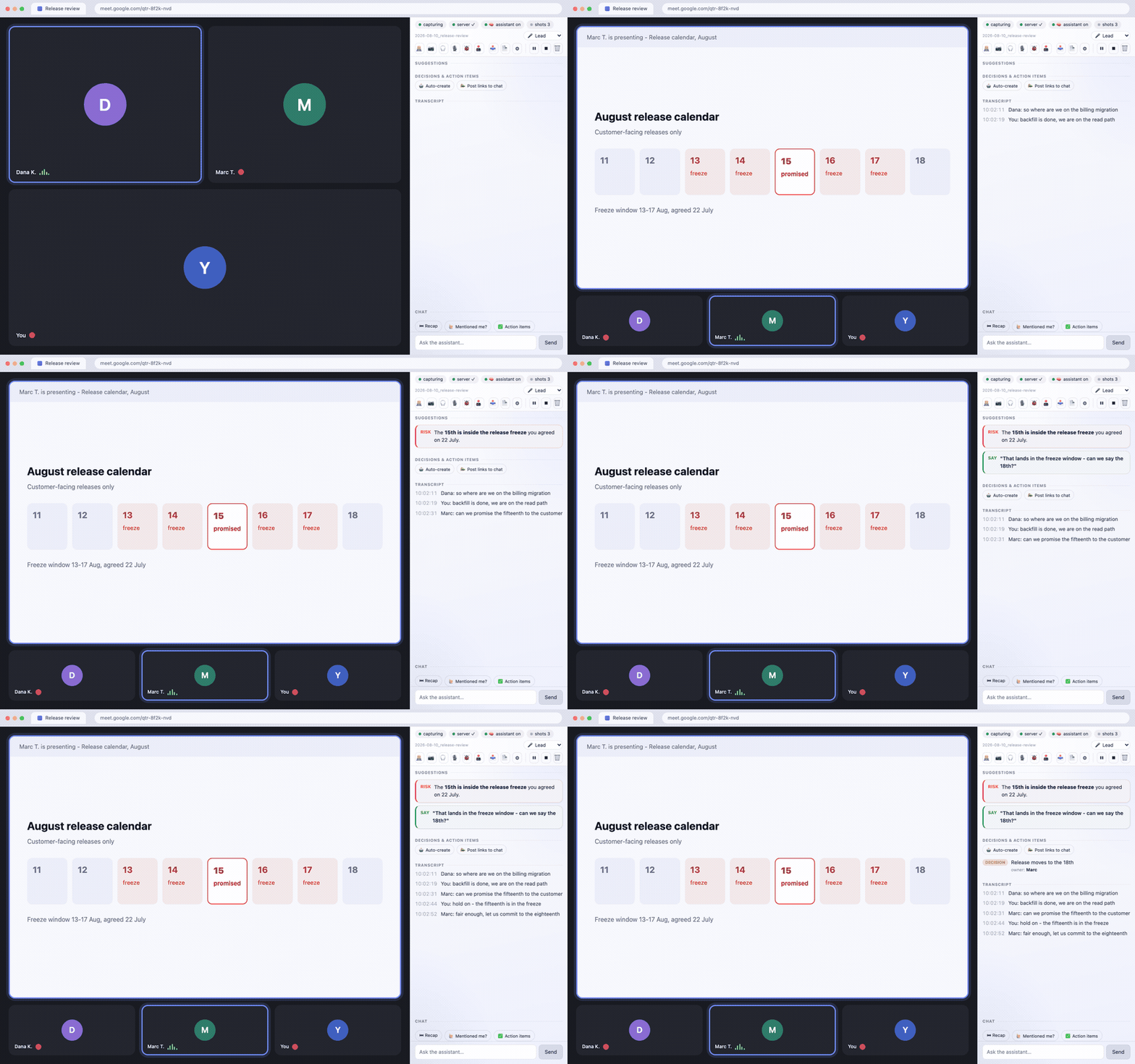
A release review, fourteen seconds, panel docked beside the call. The conversation is invented and the
cameras are off, as they are on most working calls. The interface is the shipping one.
Install from the Chrome Web Store · the site ·
one command for the server: npx meet-live-assist-server
The store link is one click and updates itself; the repo works loaded unpacked and never does. Either way the server and the skill below are still yours to run, and without an agent attached the advice pane stays empty by design.
During a Google Meet or Zoom call this captures the transcript, shows it in a side panel, and hands it to an assistant running on your own computer. The assistant answers back in the panel while the call is still going: what to say, what was decided, who owns what, what you just agreed to that you should not have.
Transcripts, screenshots and chat are written to a folder on your disk and served by a server on
127.0.0.1 that only you can reach. There is no account, no telemetry, and no server of ours anywhere.
Where the words actually go, stated once and plainly. The brain is your own Claude Code session, so whatever you route to it - the transcript batches, your questions - leaves your machine for Anthropic under your account, exactly as any other Claude Code session does. What never leaves is the stored record: the files, the screenshots, the chat history. If a page tells you a live meeting assistant runs entirely on your machine, it is either using a local model or it is not telling you the truth; this one borrows a brain you already pay for, and that is the trade. See Data flow for the three-line version.
Read this before you install
You need an AI coding agent that speaks MCP - Claude Code is the one this is tested with. This ships the eyes, ears and hands - the capture, the panel, the local bridge - but not the brain. The brain is an agent session on your own machine, reading the call through MCP tools. Without one you get a working transcript recorder and an empty advice pane, which is not what the screenshots promise.
The adapter is plain JSON-RPC over stdio with nothing vendor-specific in it, so other MCP clients (Cursor,
Cline, Continue, Zed, Codex) can drive it - Codex CLI was checked and completes tool calls against the bridge.
One requirement is genuinely harder to meet elsewhere: the client has to hold a persistent background
loop, because MCP is client-pull and nothing on the server can
ever start a turn. MCP-CLIENTS.md explains what to check and what is unverified.
Your meeting is other people's conversation too. Turning on captions is invisible to everyone else,
unlike recording, which Meet badges. So by default this posts one line into the meeting chat when capture
starts, saying an assistant is transcribing locally. You can edit that line or turn it off in Options.
Some jurisdictions require everyone's consent before a conversation may be recorded or transcribed; that
is your call to make, and PRIVACY.md says so plainly.
Requirements: Node 20+, Chrome 116+, Claude Code. Speaking into the call is macOS-only (it uses say
and afplay); elsewhere advice still appears in the panel and the server says why it cannot speak. Local
speech-to-text works anywhere ffmpeg and whisper.cpp do, and the panel's setup row names which of the
two is missing instead of failing quietly.
Install (three steps)
Then:
- Start the bridge server, leave it running:
node server/transcript-server.js --pair - Load the extension:
chrome://extensions→ Developer mode → Load unpacked → pick this folder. Pin it, click the icon. The panel collects its token from the pairing window on its own; there is nothing to copy. (Window expired? Run step 1's command again - it works against a running server too.) - Open Claude Code and ask it to assist your meeting.
./install.sh takes MLA_USER, MLA_LANGUAGE, MLA_DOMAIN and MLA_TRANSCRIPTS_DIR so the assistant
addresses you by name, in your language, and knows roughly what your meetings are about.
Pick a profile
MLA_PROFILE decides which meeting types the assistant knows about and what it leads with. Everything else -
the markers, the modes, the board - is the same, because those turned out to be domain-neutral.
| Profile | For | It leads with |
|---|---|---|
engineering (default) | standups, incidents, refinement, QA | decisions, scope creep, risk, action items |
second-language | any meeting not in your first language | 🟢 SAY - the sentence, ready to speak, in the meeting's language |
research | user interviews, usability sessions | silence, leading-question warnings, guide coverage |
generic | anything else | responding well in real time |
They are plain files in skill/profiles/ - about a dozen lines each. Write your own and
pass its name; the installer refuses a profile it cannot find; it never falls back to the default.
What it stores, and how to get rid of it
Everything lives in one folder - ./transcripts unless you set MLA_TRANSCRIPTS_DIR:
| File | What it is |
|---|---|
<date>_<meeting-code>.txt | the transcript |
<...>.chat.txt, <...>.summary.md | your chat with the assistant, and the post-call summary |
snapshots/<session>/*.jpg | screenshots taken during screen-share |
.state/ | live meeting state, so restarting the server mid-call loses nothing |
.mla-token | the shared secret the extension and the assistant authenticate with |
Files are owner-only (0600), the directory is 0700, and anything older than 14 days is purged
automatically (RETENTION_DAYS, 0 keeps everything forever). The 🗑 button in the panel wipes a single
meeting - transcript, chat, summary, snapshots and state - immediately. To remove the whole thing: delete
that folder, delete ~/.claude/skills/meet-live-assist, run claude mcp remove meet-live-assist, and
remove the extension from Chrome.
Data flow
| What | Where it goes |
|---|---|
| Transcript, screenshots, panel chat, summaries | Your disk, nowhere else. Owner-only files, one folder, served by a process bound to 127.0.0.1. |
| The call content you route to the assistant, and your questions | Anthropic, via your own Claude Code session - same path as anything else you do in Claude Code, your account, your terms. |
| Anything else | Nothing. There is no third party here. |
On Free / Pro / Max, whether your sessions improve the model is a setting you control and it changes the retention period; Anthropic's consumer terms cover it and say explicitly that it includes Claude Code. Work and API accounts are on different terms. Worth knowing before you point this at a conversation that is not only yours.
What it does during a call
- Live transcript - captions scraped, streamed to the panel instantly, de-duplicated + monologue forced-flush before hitting the file/brain, with a conservative ASR glossary.
- Colour-coded advice from the brain (🟢SAY/🔵INFO/🟡SUMMARY/🟣EXPLAIN/🔴RISK/🟠ACTION), rich (links/images/diagrams/lists), each copyable; RISK fires an audible + notification cue.
- Brain-liveness pill (is a Claude session actually attached?), capture watchdog (warns if captions break).
- Decisions & action-items board with a one-click Draft (whatever you named in Options, or a plain note if you named nothing); recap quick-asks; two-way chat.
- Autopilot - flip 🤖 Auto-create and it stops proposing and starts doing: the ticket or the note is created as the action item comes up, no per-item confirm. 📣 Post links to chat shares the link with the room. Both are off until you turn them on.
- Snapshots (auto on screen-share + on demand), TTS into the call, local STT (whisper), meeting modes + type-awareness, live presentation edits + debug of the shared tab.
- Talk-time, muted-mic + personal-mention alerts; post-call summary export.
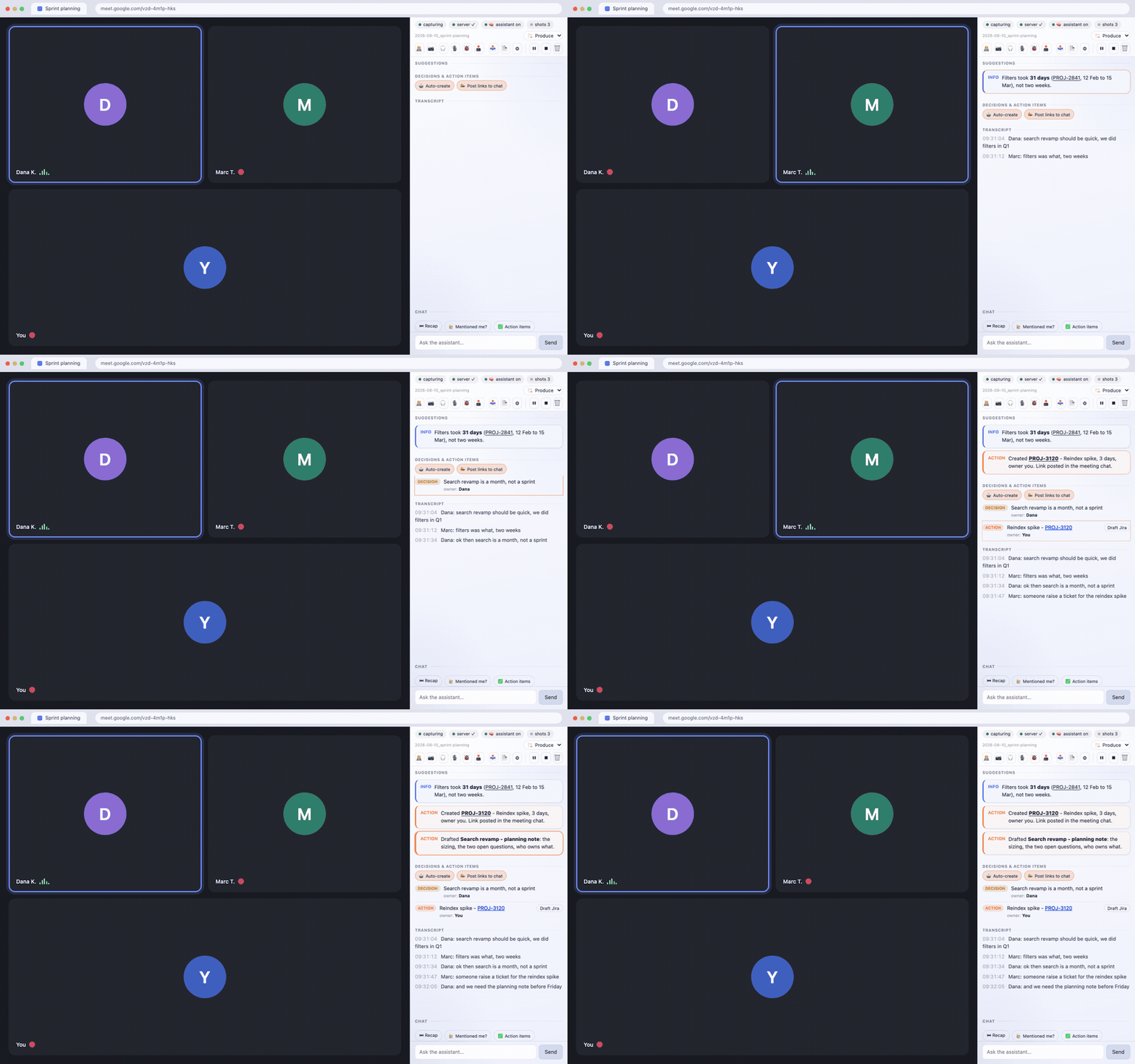
Sprint planning with autopilot on. Nobody typed anything into the panel: the correction, the decision,
the ticket and the note all arrive while the meeting carries on.
Related MCP Servers
Reviews
No reviews yet — be the first to share how this listing worked for you.
Frequently Asked Questions about Meet Live Assist
AllMCPs Directory Badge
Showcase your server listing on GitHub or your project documentation. Embed this dynamic SVG badge to highlight official listing status and live engagement.
Badge Style:
Live Dynamic SVG Preview
Markdown (GitHub README)
[](https://allmcps.com/mcp/meet-live-assist)HTML Embed
<a href="https://allmcps.com/mcp/meet-live-assist"><img src="https://allmcps.com/api/badge/meet-live-assist?style=directory" alt="Meet Live Assist on AllMCPs" /></a>Technical Specs & Signals
CategoryDeveloper Tools
36Quality signal: Fair · 36/100How this signal is calculated ▾
Server availabilityNot measured
Not scored for repo-hosted servers — we can't reach the running server, only its GitHub page. Hosted MCP endpoints are health-checked live.
Verified ownership10/20
Documentation & tools16/30
Adoption & activity1/15
Community engagement0/10
A guidance signal from public completeness & health data — not a user rating. New listings start lower and rise as they add docs, get verified, and grow adoption. Signals we can't observe for a listing are skipped, not counted against it.
Own this project?
This directory is pre-filled from public sources. Claim via GitHub README, site badge, or DNS TXT to unlock edit access and the Official badge — proof is checked automatically, then reviewed by our team.
Free dofollow backlink: add your website and place the AllMCPs badge on it — no claim needed. We detect it automatically and keep it verified as long as the badge stays live.
Claim & get free dofollowShare & Embed
Add our SVG badge (dark/light directory styles) or embeddable widget to your site.