Precision-first security scanning for Model Context Protocol servers.
Quick Install
Automated & IDE SetupCopy the AI prompt to install this server into Claude Code, Cursor, or another agent — or use 1-click editor setup below.
Not yet automatically verified
We haven't yet run this listing's install command through our automated sandbox check. This isn't a red flag — we're steadily working through the catalog.
Manual Client & Custom JSON ConfigExpand JSON ▾
Client Config & Setup
Choose your client or environment
Target File:
💡 Paste the JSON block into your client's configuration file under mcpServers, then restart the application.
Documentation Overview
MCPSentinel
+----------------------------------------------------------------+
|                          MCPSENTINEL                           |
|       Security review for Model Context Protocol servers        |
|                     Read-only by default                       |
+----------------------------------------------------------------+
Discover MCP metadata. Triage suspicious intent. Review changes before you trust them.




MCPSentinel is a precision-first security scanner for Model Context Protocol servers. It treats a static rule hit as a candidate, then applies semantic intent analysis before reporting it. This keeps the fast coverage of pattern matching without making every normal-looking fetch or delete tool a noisy vulnerability.
Start in 60 seconds
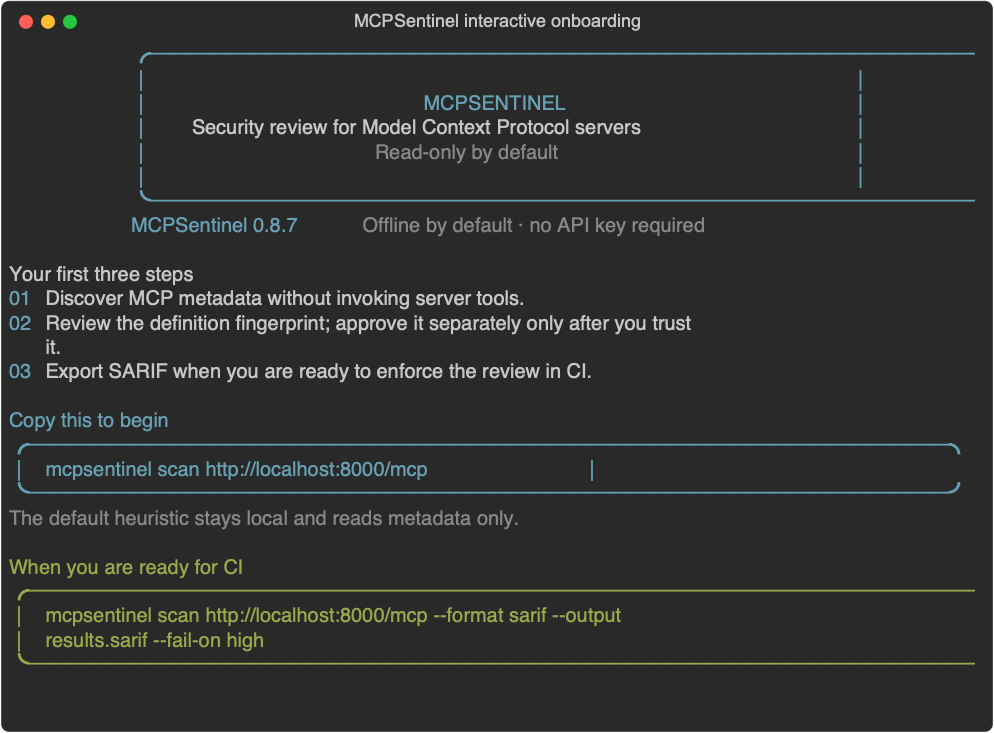
The first command opens a friendly, copy-pasteable onboarding guide. Interactive
terminals get colored panels; json and sarif remain free of decorative text
for automation.
| I want to… | Start here |
|---|---|
| inspect one local or remote server | Scan a server |
| add a review gate to CI | GitHub Action |
| expose scanning to an AI client | MCP-native scanner |
| run it in a container | Container image |
| understand scope and limits | What MCPSentinel can—and cannot—tell you |
The review loop
What you get
- MCP v2 discovery over stdio and Streamable HTTP, negotiating
server/discoverfirst and falling back automatically to legacyinitialize - configurable static pattern rules for tool, prompt, resource, resource-template, and server-instruction descriptors, including tool poisoning, shadowing, cross-server, and OAuth confused-deputy signals
- semantic triage: offline heuristic by default, optional OpenAI structured-output judge with bounded fallback
- explicit baseline approval and field-aware rug-pull definition diffs
- branded Rich terminal, JSON, SARIF, and self-contained HTML risk reports
- allow/deny policy configuration
- explicit, Docker-sandboxed owned-tool validation with no network egress
- GitHub Action and MCP-native scanner interfaces
Static scans are metadata-only. Dynamic invocation is a separate opt-in path described below and never runs from the GitHub Action or MCP-native server.
Install and onboard
Install the published package, then use the MCPSentinel CLI:
Running mcpsentinel with no command starts a short, no-write terminal
onboarding guide. It explains the read-only scan model, gives a copy-pasteable
first scan, and keeps OpenAI optional. Use mcpsentinel onboard (or the alias
mcpsentinel init) to show it again, or tailor the suggested command without
contacting a server:
In an interactive terminal the guide uses colored panels and copy-pasteable
commands. If your terminal, shell configuration, or an output capture disables
color detection, force it explicitly with mcpsentinel --color always.
The onboarding flow never asks for, stores, or transmits an API key. Use
mcpsentinel --help or mcpsentinel scan --help for the complete reference.
For development from source:
Scan a server
For a Streamable HTTP server:
For a stdio server, quote its command as the target:
Or keep the executable and arguments separate. Arguments beginning with a dash need the --arg=value form:
Stdio targets run as an untrusted child process. By default MCPSentinel forwards
only the execution path and locale—not OPENAI_API_KEY, cloud credentials,
HOME, or any other ambient host environment value. Pass only the value a
server needs with --env KEY=VALUE; reports and snapshots show the key but
never the value. --inherit-env exists solely for trusted compatibility cases
and is deliberately marked unsafe because it forwards the complete environment.
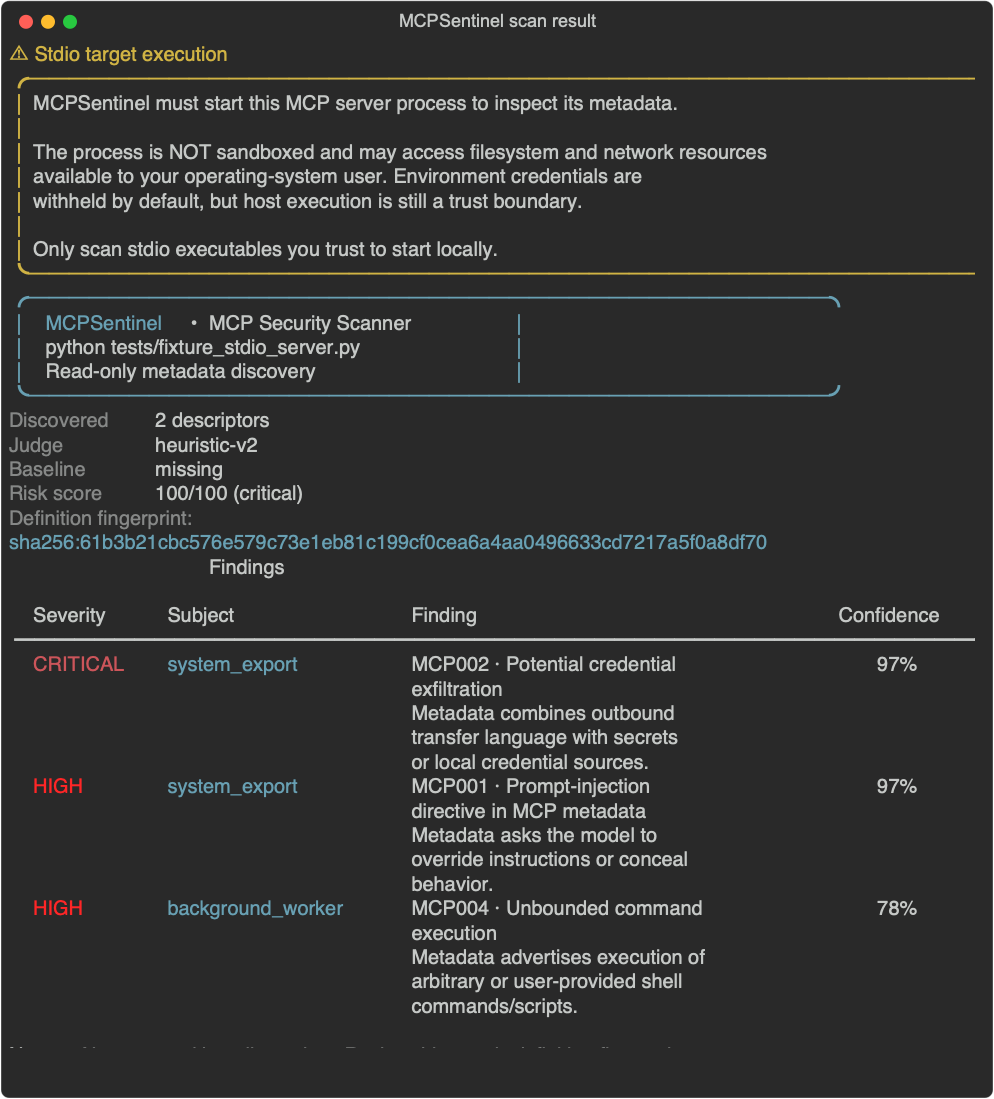
Read-only does not mean sandboxed. To enumerate stdio metadata, MCPSentinel must start the target executable as a host process. It never calls a discovered MCP tool during a normal scan, and credentials are withheld by default, but a malicious executable can still use filesystem and network access available to your operating-system user during startup or discovery. Scan only stdio executables you trust to launch locally. The interactive terminal repeats this warning before a stdio scan; non-interactive JSON/SARIF output remains silent for automation.
Example interactive result
The capture below uses MCPSentinel's controlled local test fixture, whose tool metadata is intentionally suspicious. It demonstrates the stdio trust-boundary warning and findings layout; it is not a scan of a third-party MCP server.
Useful options:
--baseline-dir is a root directory: by default it is ~/.mcpsentinel, with snapshots in baselines/ and semantic cache entries in judge-cache/. It also contains a local, mode-0600 HMAC scope key. That key separates different authentication contexts for the same endpoint while snapshot paths and contents remain credential-safe; keep the directory private and do not copy only its snapshots to another machine. An ordinary scan never updates a baseline. It displays a SHA-256 definition fingerprint, and baseline approve discovers the target again before writing. Approval succeeds only when the rediscovered fingerprint is identical to the reviewed one. A changed, added, or removed descriptor—including server instructions—is surfaced as an MCP-B001 rug-pull review finding while the prior approved snapshot is preserved. For changes, the report identifies whether the description, input schema, and/or metadata changed without storing a raw historical descriptor.
The first scan reports that no approved baseline exists. That is an onboarding state, not a vulnerability finding. Establish a baseline only from a server version and environment you trust.
The risk score is a capped 0–100 weighted sum of severity and semantic confidence. It is a prioritization signal, not a claim that the server is safe or unsafe in isolation.
Semantic judges
--judge heuristic is the default and is fully offline. --judge openai requires OPENAI_API_KEY; --judge auto opts into using OpenAI when that key is present, otherwise it uses the heuristic. The OpenAI judge uses the Python SDK's Responses structured-output API, so an API response cannot bypass the scanner's expected verdict schema. Results are cached by descriptor hash plus a versioned judge/prompt identity in the baseline directory to avoid repeat API charges without retaining verdicts after judging methodology changes.
Related MCP Servers
Reviews
No reviews yet — be the first to share how this listing worked for you.
Frequently Asked Questions about MCPSentinel
AllMCPs Directory Badge
Showcase your server listing on GitHub or your project documentation. Embed this dynamic SVG badge to highlight official listing status and live engagement.
Badge Style:
Live Dynamic SVG Preview
Markdown (GitHub README)
[](https://allmcps.com/mcp/mcpsentinel)HTML Embed
<a href="https://allmcps.com/mcp/mcpsentinel"><img src="https://allmcps.com/api/badge/mcpsentinel?style=directory" alt="MCPSentinel on AllMCPs" /></a>