Route one agent through one MCP server to many, with progressive tool discovery to shrink context.
Quick Install
Automated & IDE SetupCopy the AI prompt to install this server into Claude Code, Cursor, or another agent — or use 1-click editor setup below.
Not yet automatically verified
We haven't yet run this listing's install command through our automated sandbox check. This isn't a red flag — we're steadily working through the catalog.
Manual Client & Custom JSON ConfigExpand JSON ▾
Client Config & Setup
Choose your client or environment
Target File:
💡 Paste the JSON block into your client's configuration file under mcpServers, then restart the application.
Documentation Overview
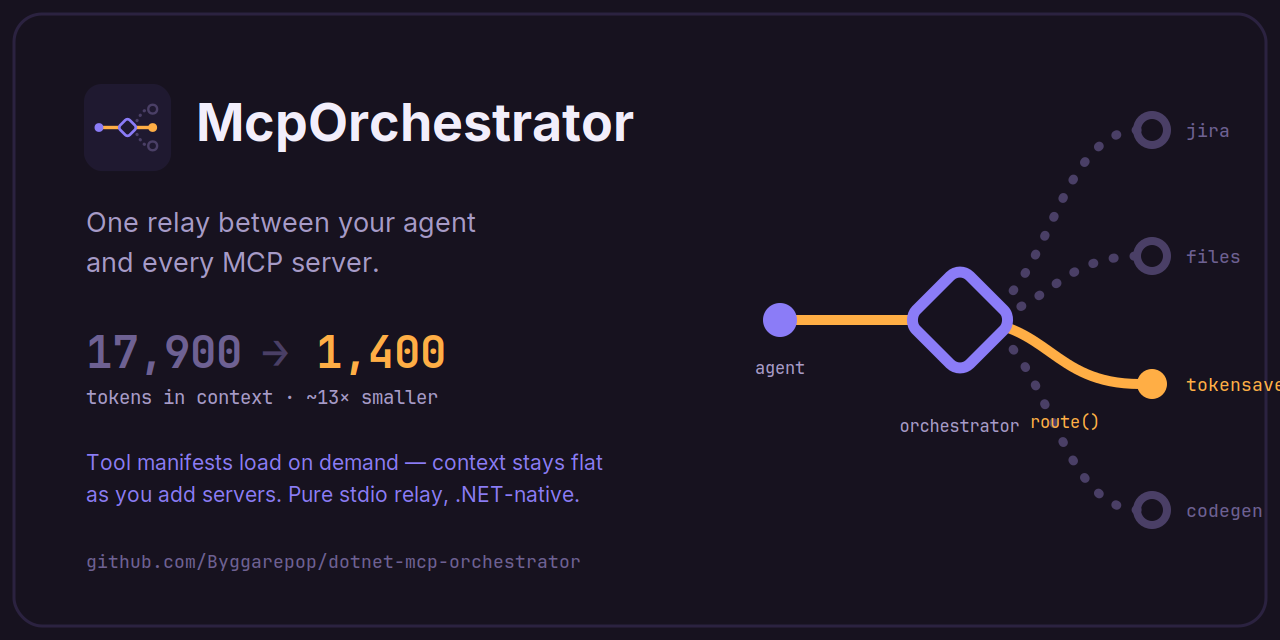
McpOrchestrator — a .NET-native MCP orchestrator



Every MCP server you connect costs context before the agent does anything — its tool manifests sit in the prompt on every turn. McpOrchestrator puts one server between your agent and all the others and loads downstream tool manifests on demand, so the agent's always-on context stays flat no matter how many servers you add. The agent sees three meta-tools — list_capabilities → discover_tools → route — and the orchestrator is a pure relay: it forwards exactly what the agent sends, never interpreting it. It can also serve Agent Skills with the same on-demand discipline.
See it in 70 seconds
https://github.com/user-attachments/assets/741c1afa-4bef-4870-9b84-e2c245b8117e
Measured impact
Against a real workplace MCP setup, measured with the Copilot CLI's /usage:
| Tokens in context | |
|---|---|
| MCP connected directly (manifests loaded upfront) | 17,900 |
| Same MCP behind McpOrchestrator | 1,400 |
| Reduction | ~13x |
The savings scale with the number of servers. Measure your own setup first — one command, nothing installed, not a single file changed (needs the .NET SDK):
Quick start
From an existing MCP setup, cd to the folder holding your host config (.mcp.json, .vscode/mcp.json, or a Cursor config) and run:
It lifts your stdio servers into a generated orchestrator.config.json, backs up the host config, and rewrites it to launch only the orchestrator. The generated catalog looks like this — one entry per downstream server:
The summary line is what the agent routes on — refine any that read poorly. Restart your MCP host and you're done: the agent discovers everything on its own through list_capabilities → discover_tools → route, and every later edit to this file hot-reloads without a restart.
Add a skill
A skill is a folder with a SKILL.md — instructions the agent discovers and follows by itself when a task matches. Create one:
Point the orchestrator at the folder in orchestrator.config.json:
Save — it hot-reloads. The agent now sees the skill's name + one-line description via list_skills and loads the full instructions only when a task calls for it. Skills can also come from a shared git repo or an HTTP index, with allow/deny lists and integrity pinning — see docs/skills.md.
Note: these skills are for the agent only — the model discovers and follows them through tools. They do not become host-native skills (no
/skillslisting or slash command in Claude Code, no IDE skill picker entry).
Documentation
Everything else lives in McpOrchestrator/README.md and docs/:
- How it works & the three tools — architecture and token scaling
- Profiling token economics — the
profilecommand in depth, trace mode, CI gating - CLI reference — every command and flag: the server,
init, andprofile, plus all environment variables - Manual setup — the two config files
initgenerates, written by hand - Configuration reference — every field, placeholders, proactive capabilities, hot reload, central (team) configuration
- Agent Skills — sources (directory/git/HTTP), governance, delivery modes, how it works
- Packaging & Native AOT — install as a .NET tool or a self-contained binary from Releases
- How it compares — vs. mcp-aggregator and gateways, and when not to use this
- Troubleshooting
License
Related MCP Servers
Adoption & maintenance
Factual signals from GitHub, npm, and our automated checks — not a rating.
GitHub stars
2
Stargazers on the source repository.
Last commit
1mo ago
Most recent push to the default branch.
Directory activity
1 views
Config copies, upvotes, and views on AllMCPs.
Reviews
No reviews yet — be the first to share how this listing worked for you.
Frequently Asked Questions about McpOrchestrator
AllMCPs Directory Badge
Showcase your server listing on GitHub or your project documentation. Embed this dynamic SVG badge to highlight official listing status and live engagement.
Badge Style:
Live Dynamic SVG Preview
Markdown (GitHub README)
[](https://allmcps.com/mcp/mcporchestrator)HTML Embed
<a href="https://allmcps.com/mcp/mcporchestrator"><img src="https://allmcps.com/api/badge/mcporchestrator?style=directory" alt="McpOrchestrator on AllMCPs" /></a>Technical Specs & Signals
CategoryDeveloper Tools
10/12 checks healthy over the last 46d
35Quality signal: Fair · 35/100How this signal is calculated ▾
Server availabilityNot measured
Not scored for repo-hosted servers — we can't reach the running server, only its GitHub page. Hosted MCP endpoints are health-checked live.
Verified ownership7/20
Documentation & tools16/30
Adoption & activity3/15
Community engagement0/10
A guidance signal from public completeness & health data — not a user rating. New listings start lower and rise as they add docs, get verified, and grow adoption. Signals we can't observe for a listing are skipped, not counted against it.
Supply-chain signal
2 high-severity advisories on record for this package. Most advisories affect transitive dependencies and may not be exploitable in this server's actual usage — this is a directional signal, not a security audit.
Critical 0High 2Medium 0Low 0
Scanned 3d ago via OSV.dev · @modelcontextprotocol/server-filesystem (npm)
Own this project?
This directory is pre-filled from public sources. Claim via GitHub README, site badge, or DNS TXT to unlock edit access and the Official badge — proof is checked automatically, then reviewed by our team.
Free dofollow backlink: add your website and place the AllMCPs badge on it — no claim needed. We detect it automatically and keep it verified as long as the badge stays live.
Claim & get free dofollowShare & Embed
Add our SVG badge (dark/light directory styles) or embeddable widget to your site.