A Model Context Protocol (MCP) server for Uptime Kuma version 2.
Quick Install
Automated & IDE SetupCopy the AI prompt to install this server into Claude Code, Cursor, or another agent — or use 1-click editor setup below.
Not yet automatically verified
We haven't yet run this listing's install command through our automated sandbox check. This isn't a red flag — we're steadily working through the catalog.
Manual Client & Custom JSON ConfigExpand JSON ▾
Client Config & Setup
Choose your client or environment
Target File:
💡 Paste the JSON block into your client's configuration file under mcpServers, then restart the application.
Capabilities & Tool Schemas (22)
Inspect callable tools, capabilities, and parameters exposed to AI agents by MCP Uptime Kuma.
getMonitorSummaryGet a quick overview of all monitors with their current status. Supports filtering.
listMonitorsGet the full list of all monitors with configurations. Supports filtering.
listMonitorTypesGet all available monitor types supported by Uptime Kuma.
getMonitorGet detailed configuration for a specific monitor by ID.
createMonitorCreate a new monitor (requires name and type at minimum).
updateMonitorUpdate an existing monitor's configuration.
Documentation Overview
mcp-uptime-kuma
A Model Context Protocol (MCP) server for Uptime Kuma version 2. Supports stdio and streamable HTTP transports.









Features
- Real-time Monitoring: Access monitors, heartbeats, uptime, and responsiveness metrics via Socket.IO with instant status change notifications.
- Context-Friendly: Returns only essential data by default to avoid overwhelming LLM context windows.
- Multiple Transports: Supports stdio (local) and streamable HTTP (remote) transports.
Quick Start
Using npx (stdio transport)
Add this to your MCP client configuration:
Using Docker (streamable HTTP transport)
Option 1: Docker Run
Option 2: Docker Compose
A docker-compose.yml file is provided in the repository. Download it, configure your environment variables, and run:
Then configure your MCP client to connect to the endpoint:
See Authentication Methods for JWT token and anonymous authentication options.
The endpoint above is unauthenticated. Anyone who can reach port 3000 gets full read/write control of your Uptime Kuma instance. See Securing the HTTP Endpoint before exposing it beyond localhost.
Example Conversation
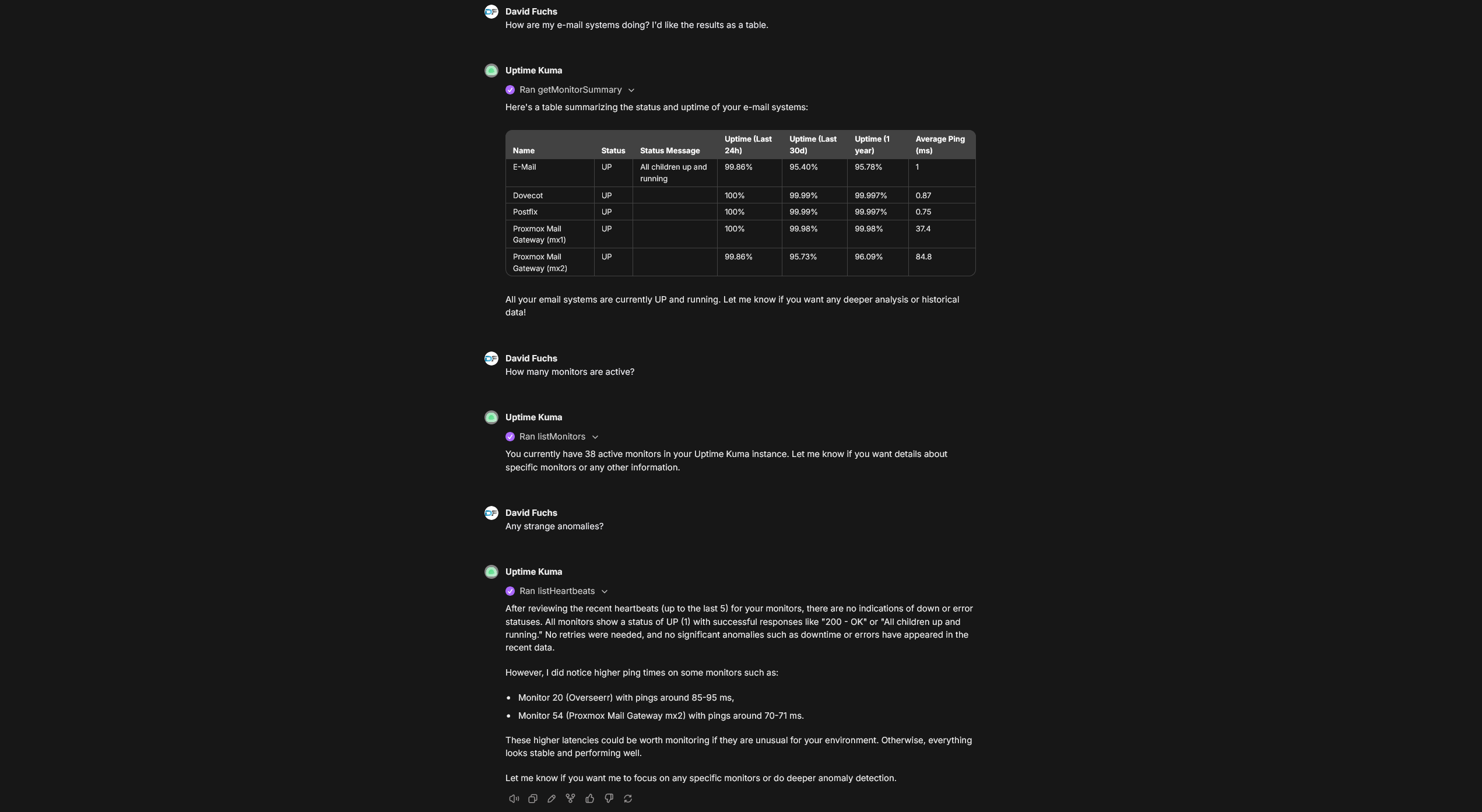 Conversation in LibreChat where the
 mcp-uptime-kuma server is providing real-time information from Uptime Kuma.
Available Tools
Monitors
| Tool | Purpose |
|---|---|
getMonitorSummary | Get a quick overview of all monitors with their current status. Supports filtering. |
listMonitors | Get the full list of all monitors with configurations. Supports filtering. |
listMonitorTypes | Get all available monitor types supported by Uptime Kuma. |
getMonitor | Get detailed configuration for a specific monitor by ID. |
createMonitor | Create a new monitor (requires name and type at minimum). |
updateMonitor | Update an existing monitor's configuration. |
deleteMonitor | Permanently delete a monitor and all its heartbeat history. |
pauseMonitor | Pause a monitor to stop performing checks. |
resumeMonitor | Resume a paused monitor to restart checks. |
Heartbeats
| Tool | Purpose |
|---|---|
listHeartbeats | Get status check history for all monitors. |
getHeartbeats | Get status check history for a specific monitor. |
Notifications
| Tool | Purpose |
|---|---|
listNotifications | List all configured notification channels (Slack, Discord, email, webhooks, etc.). |
addNotification | Create a new notification channel. |
updateNotification | Update an existing notification channel. |
deleteNotification | Permanently delete a notification channel. |
Tags
| Tool | Purpose |
|---|---|
listTags | List all tags defined in Uptime Kuma. |
addTag | Create a new tag that can be assigned to monitors. |
deleteTag | Permanently delete a tag (removes it from all monitors). |
Maintenance
| Tool | Purpose |
|---|---|
getMaintenanceWindows | List all scheduled maintenance windows. |
createMaintenance | Schedule a new maintenance window. |
Status Pages & Settings
| Tool | Purpose |
|---|---|
listStatusPages | List all configured status pages. |
getSettings | Get Uptime Kuma server settings. |
Filtering
getMonitorSummary and listMonitors support filtering by:
- keywords: Space-separated keywords for fuzzy matching against monitor pathNames
- type: Monitor type(s), comma-separated (e.g.,
"http","http,ping,dns") - active: Filter by active (
true) or inactive (false) monitors - maintenance: Filter by maintenance mode status
- tags: Tag name and optional value, comma-separated (e.g.,
"production","env=staging") - parentId: Group monitor ID, returning that group's direct children. Pass
nullfor top-level monitors (those with no parent). Not recursive — to walk deeper, use each child group's ownchildrenIDs. - status (getMonitorSummary only): Heartbeat status (
"0"=DOWN,"1"=UP,"2"=PENDING,"3"=MAINTENANCE)
Examples:
Authentication Methods
Anonymous Authentication
If authentication is disabled on your Uptime Kuma instance, only UPTIME_KUMA_URL is required.
Username/Password Authentication
JWT Token Authentication
Recommended for 2FA users. Takes precedence over username/password if both are provided.
Obtaining Your JWT Token
Using the CLI utility (recommended):
Using Docker:
From browser: Open Developer Tools → Storage/Application → Local Storage → find token key.
Behind an Authenticating Proxy (Cloudflare Access, etc.)
If Uptime Kuma sits behind a proxy that demands its own credentials — a Cloudflare Zero Trust
Access application, oauth2-proxy, an API gateway — set UPTIME_KUMA_HEADERS to a JSON object of
headers to send on every request. It combines with any of the methods above, which still handle
logging in to Uptime Kuma itself.
For Cloudflare Access, create a service token, add a Service Auth policy to the application that allows it, then:
In an MCP client's JSON config the value is a string, so the inner quotes need escaping:
mcp-uptime-kuma-get-jwt reads the same variable. A malformed value stops the server at startup
with an error naming the offending header; header values are never logged.
Securing the HTTP Endpoint
Applies to -t streamable-http only. The stdio transport has no listener to protect and
takes its credentials from the environment, as the MCP specification prescribes.
Anyone who can reach /mcp has full read/write control of your Uptime Kuma instance,
including deleting monitors. Two settings guard it, and both default to permissive so that
upgrading cannot break an existing deployment - the server warns at startup in that state.
Related MCP Servers
Adoption & maintenance
Factual signals from GitHub, npm, and our automated checks — not a rating.
GitHub stars
50
Stargazers on the source repository.
Last commit
11d ago
Most recent push to the default branch.
Tools exposed
22
Callable tools this server registers over MCP.
Directory activity
1 views
Config copies, upvotes, and views on AllMCPs.
Reviews
No reviews yet — be the first to share how this listing worked for you.
Frequently Asked Questions about MCP Uptime Kuma
AllMCPs Directory Badge
Showcase your server listing on GitHub or your project documentation. Embed this dynamic SVG badge to highlight official listing status and live engagement.
Badge Style:
Live Dynamic SVG Preview
Markdown (GitHub README)
[](https://allmcps.com/mcp/mcp-uptime-kuma)HTML Embed
<a href="https://allmcps.com/mcp/mcp-uptime-kuma"><img src="https://allmcps.com/api/badge/mcp-uptime-kuma?style=directory" alt="MCP Uptime Kuma on AllMCPs" /></a>