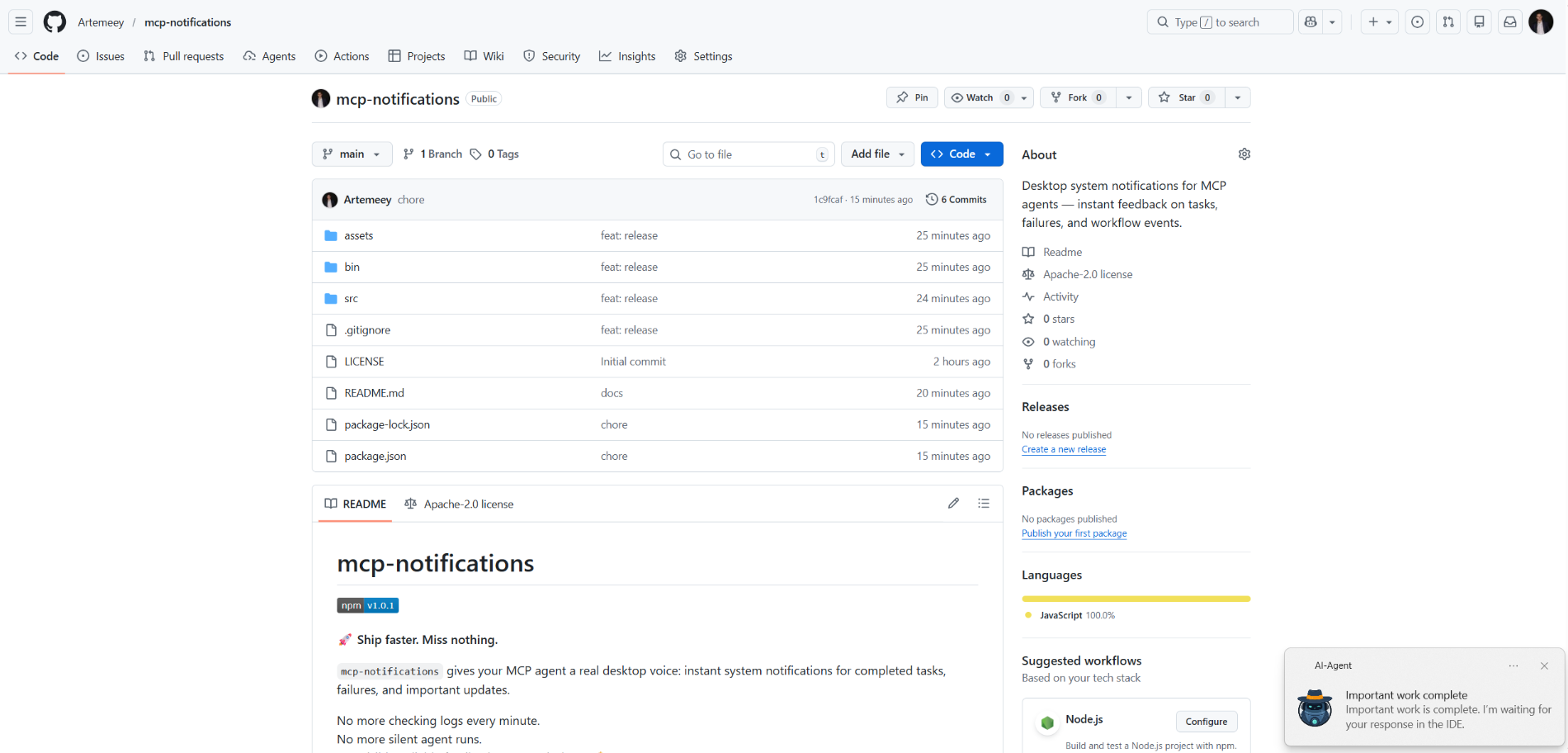
MCP Notifications README
The full upstream README, mirrored here for reference. Install config, tool schemas, adoption signals, and an original overview live on the MCP Notifications listing page.
mcp-notifications

🚀 Ship faster. Miss nothing.
mcp-notifications lets your MCP agent send desktop notifications for completed tasks, failures, and important updates.
This is especially useful for console AI agents, because they usually have no built-in notifications by default.
No more checking chats every minute.
No more silent agent responses.
Just visible, reliable feedback on your desktop. 🔔
Common problem this solves
You give tasks to several AI agents, then wait and keep checking who already replied.
With mcp-notifications, this gets simpler: the agent can notify you on desktop when it needs your input or when work
is done.
Why teams install this
- ⚡ Immediate feedback from your MCP workflows.
- 🧠 Better focus: let the agent work while you stay on your main task.
- 🖥️ Native OS notifications via
node-notifier. - 🧵 Non-blocking behavior: notification sending is queued in background.
Install globally
Requirements:
- Node.js
>=20 - npm
>=10
Executable name (use this in MCP config):
mcp-notifications is an MCP server entrypoint (stdio), not a one-shot notification command.
Setup: Codex
Add this to ~/.codex/config.toml:
Restart Codex after config update.
Setup: Claude Agent
Add MCP server config to your Claude client config file:
Then restart Claude client.
AI Agent Notification Instructions
There are two approaches to notifications: manual and automatic.
Choose the one that works better for your workflow.
Manual
In a task where you want to be notified, explicitly ask the agent. Example:
You can also define sound, topic, and frequency rules inside a specific chat. Example:
Automatic
Automatic notifications can be configured globally or per project.
Example instruction to enable automatic notifications for agent replies:
Time is a rough threshold and depends on model behavior, so adjust this instruction to your own preferences.
In Skills
You can also enable notifications in specific skills. Example for a Review skill:
Tool
send_notification
Input:
titlestring(required)messagestring(required)play_soundboolean(optional, default:false)iconstring(optional, absolute or relative path to image file)app_idstring(optional, Windows App User Model ID for toast source)
Example:
app_id (Windows)
app_idcontrols the source shown in Windows toast notifications.- If
app_idis not set, Windows may showSnoreToastas the source. - You can pass
app_idin each tool call, or setMCP_NOTIFICATIONS_APP_IDas an environment variable for the server.
Backend selection
You can select notification transport via env MCP_NOTIFICATIONS_BACKEND:
auto(default): usespowershellin WSL if available, otherwisenode-notifierpowershell: forcepowershell.exeWindows toast transport (recommended for WSL)node-notifier: forcenode-notifierpackage
Chat Prompts To Test In Codex
Use these messages directly in chat:
Expected tool result in logs/response:
Behavior
- ✅ Uses standard system notification channels.
- 🔊 Uses the standard system notification sound when
play_sound: true. - 🤖 Uses bundled Topvisor robot image as default notification icon.
- 🧰 Returns quickly while notifications are delivered in background queue.
Example
The AI agent is waiting for you: