MCP Failure Lab README
The full upstream README, mirrored here for reference. Install config, tool schemas, adoption signals, and an original overview live on the MCP Failure Lab listing page.
MCP Failure Lab





A chaos-engineering and resilience-testing toolkit for Model Context Protocol servers.
Quick start
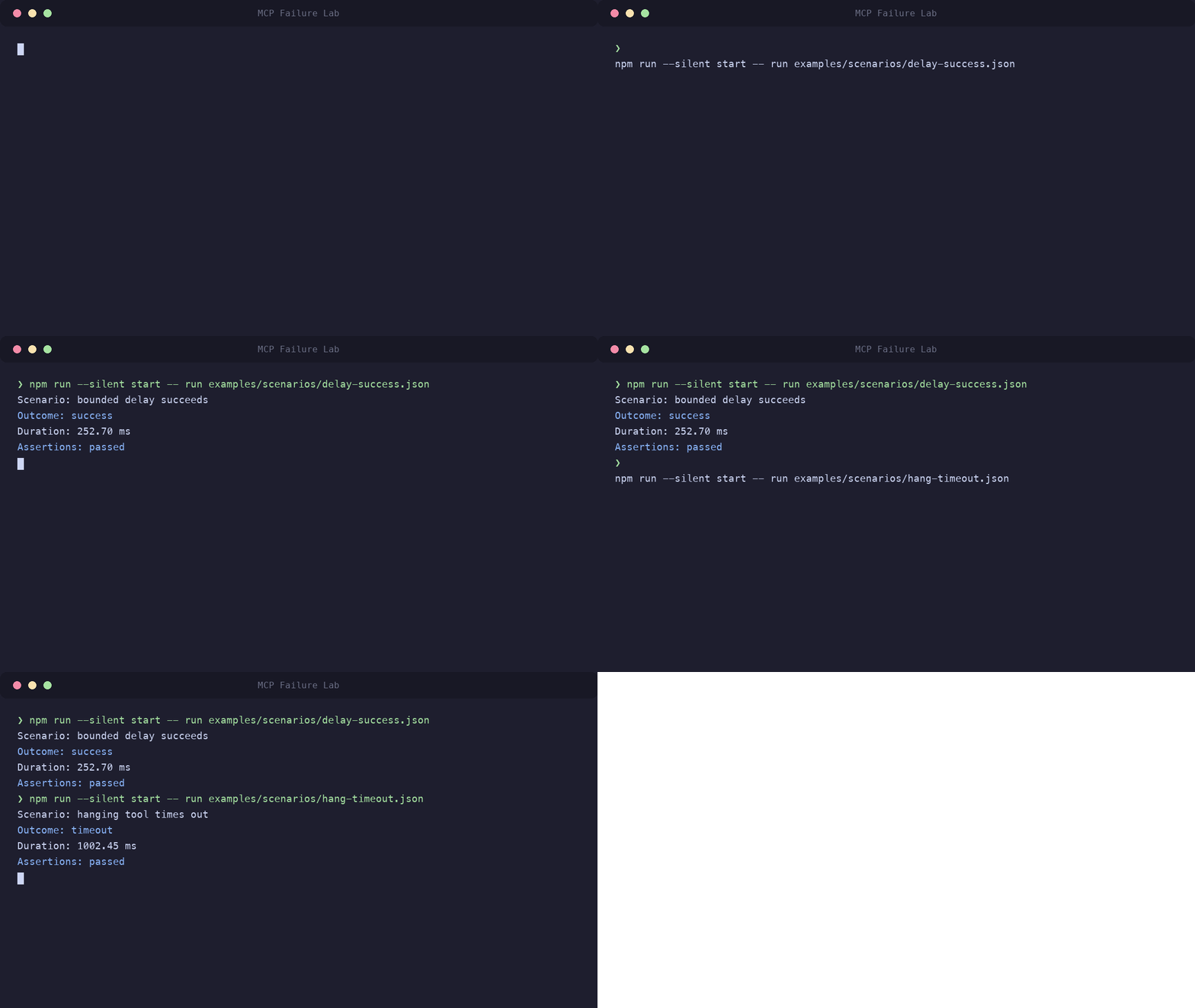
Run a real deterministic delay scenario without cloning the repository or installing the package globally:
Example output:
The exact duration may vary slightly between runs. No API key or external MCP server is required.
Display the available commands:
Start the built-in MCP server over stdio:
Or start a local Streamable HTTP endpoint:
Purpose
MCP Failure Lab helps server authors reproduce delays, hanging tools, cancellation, and transport loss in a deterministic way.
It provides controlled failure behavior for testing timeout handling, cancellation cleanup, transport-loss recovery, assertions, and CI outcomes.
Current scope
MCP Failure Lab runs deterministic JSON scenarios against its built-in server or a configured external HTTP or stdio MCP target from the command line.
Available now:
ping,delay,hang, anddisconnecttools- MCP communication over stdio and Streamable HTTP
- Code-first and JSON scenario definitions
- Outcome and maximum-duration assertions
- MCP result assertions
- Sequential observer calls for post-condition verification
- External MCP target orchestration through a validated adapter registry
- Streamable HTTP and stdio target configurations
- Bounded adapter setup, execution, observation, cancellation, and cleanup
- Separate scenario-assertion and adapter-lifecycle diagnostics
- Console and JSON reporting
- Machine-readable command errors
- CI-friendly exit codes
- Unit, integration, and end-to-end tests
Not implemented:
- Provider-specific adapters and recovery policies
- JUnit reporting
- Malformed-message, duplicate-response, and session-loss faults
MCP Failure Lab is not a general-purpose proxy. External targets are exercised through the same scenario calls and expectations as the built-in server.
Run against another MCP server
Pass a target configuration to execute the same scenario against a Streamable HTTP or stdio MCP server:
See the external MCP targets guide for complete HTTP and stdio configuration, verified GitHub and GitLab workflows, browser-based MCP Inspector validation, lifecycle diagnostics, credential handling, and troubleshooting.
The repository also includes a safe, read-only GitHub MCP example using the official remote server:
GitLab is available through its OAuth-capable stdio bridge:
The first connection can open a browser for GitLab authorization. See the external-target guide for GitLab prerequisites and the difference between GitLab OAuth and GitHub token authentication.
Target-client adapter contract
The generic adapter contract drives external-target orchestration, and the deterministic test adapter verifies its lifecycle without external I/O. See the architecture documentation for lifecycle, ownership, timeout, and observation details.
How it works
MCP Failure Lab runs deterministic scenarios through its built-in MCP client and server or through
a configured external HTTP or stdio target. A scenario invokes a tool, records the observed outcome
and duration, and evaluates the declared expectations. Built-in scenarios use ping, delay,
hang, or disconnect; external scenarios use tools exposed by their target server.
Optional observer calls run sequentially on the same MCP client connection to verify post-conditions through a separate tool path.
See the architecture documentation for diagrams, responsibilities, and implementation boundaries.
Documentation
Full guides and references are available at mcplab.dev/docs.
- Getting started
- Scenarios
- External MCP targets
- Fault tools
- CLI reference
- Reporting
- Architecture
- Examples
- Troubleshooting
Requirements
- Node.js 22.19.0 or newer
- npm
Protocol compatibility
MCP Failure Lab targets MCP 2026-07-28 and accepts the 2025-11-25 initialization flow for
compatibility. See Streamable HTTP for protocol and
session details.
Installation
Run the package directly with npx:
No global installation is required.
To install the command globally:
CLI
The serve process waits for an MCP client. Press Ctrl+C to shut it down gracefully.
Streamable HTTP listens on http://127.0.0.1:3000/mcp by default. The server validates
the request path plus Host and Origin headers. Binding another host is an explicit
choice; this mode does not provide authentication or TLS, so do not expose it to an
untrusted network. Put authentication and TLS termination in a trusted front end if
remote access is required.
Run a scenario
Scenario files use JSON:
From a repository checkout, run the included scenario:
Generate machine-readable output:
The command exits with:
| Code | Meaning |
|---|---|
0 | All expectations passed |
1 | The scenario could not be loaded or executed |
2 | One or more assertions failed |
For result assertions, observer calls, reporting formats, and timeout behavior, see the scenario and reporting documentation.
Fault tools
| Tool | Behavior |
|---|---|
ping | Returns a deterministic health response |
delay | Waits for a bounded duration before returning |
hang | Remains pending until the client cancels |
disconnect | Interrupts the active transport while a request is in flight |
See the fault tools reference for arguments and behavior.
Inspect the server
Launch the official MCP Inspector web UI against the published package:
See External MCP targets for the complete browser-testing workflow and credential guidance.
External integration validation
See the Future AGI example for an
independent Python-client validation of the hang fault. It is an external validation example,
not an official integration or endorsement.
Development
Clone the repository and install its dependencies:
Run the development CLI:
Before opening a pull request, run:
See CONTRIBUTING.md for the contribution workflow.
Roadmap
Planned work is tracked in GitHub Issues.
Roadmap items are not part of the current implementation unless explicitly documented as available.