Scan, enumerate, and risk-score every MCP server configured on your machine.
Quick Install
Automated & IDE SetupCopy the AI prompt to install this server into Claude Code, Cursor, or another agent — or use 1-click editor setup below.
Manual Client & Custom JSON ConfigExpand JSON ▾
Client Config & Setup
Choose your client or environment
Target File:
💡 Paste the JSON block into your client's configuration file under mcpServers, then restart the application.
Documentation Overview
mcp-audit





Audit what your AI agents can actually touch.
Every MCP server wired into your editor is a process that can read your files, reach the network, or run shell commands on your behalf — frequently launched from a remote npx/uvx package that can change underneath you. mcp-audit reads the MCP configs already on your machine and tells you what each server can do, how risky it is, whether its tool descriptions hide adversarial instructions, and whether anything changed since you last looked.
Read-only by default: it never edits a config and reports env-var key names only (never values). Use --skip-connect for a zero-touch config-only pass that does not spawn MCP servers or contact remote endpoints; connected scans, package verification, downloads, and LLM analysis make their extra reach explicit in the command.
For pre-run behavioral evidence, MCPAudit also includes Proof Before Action: a local-only CLI that runs a synthetic command in a disposable no-network container, compares observed effects with a declaration, joins repository MCP dependencies to local mcp-trust evidence, and exports verifiable JSON plus offline HTML.
For MCP 2026-07-28 cache behavior, the experimental
Cache Contract Auditor runs a bounded
logical-clock simulator over program-owned JSON traces. It checks required
ttlMs/cacheScope, private authorization partitions, exact request keys,
expiry/refresh and validated change-event behavior, linked page scope, and
deterministic tools ordering without running a client, server, or proxy.
For the experimental MCP Tasks extension, the MCP Task Time Machine runs seed-free synthetic lifecycles on a virtual clock. It explains creation, polling, input, retry, cooperative cancellation races, expiry, success, failure, duplicates, stale observations, and forbidden terminal transitions without discovering or contacting an MCP server or reading credentials.
🌐 Try it in your browser, no install: paste any MCP client config at mcp-audit.saagarpatel.dev for an instant config-only trust report. It runs this exact engine, never launches configured servers, never contacts configured endpoints, and stores nothing. The CLI below adds the connected deep checks (prompt-injection, SSRF, the lethal trifecta, schema drift, SARIF).
⚡ 60-second start
No install required — uv runs it in a throwaway environment. This reads the MCP configs already on your machine, connects to each configured server to read its real tool schemas, and flags SSRF-shaped tools:
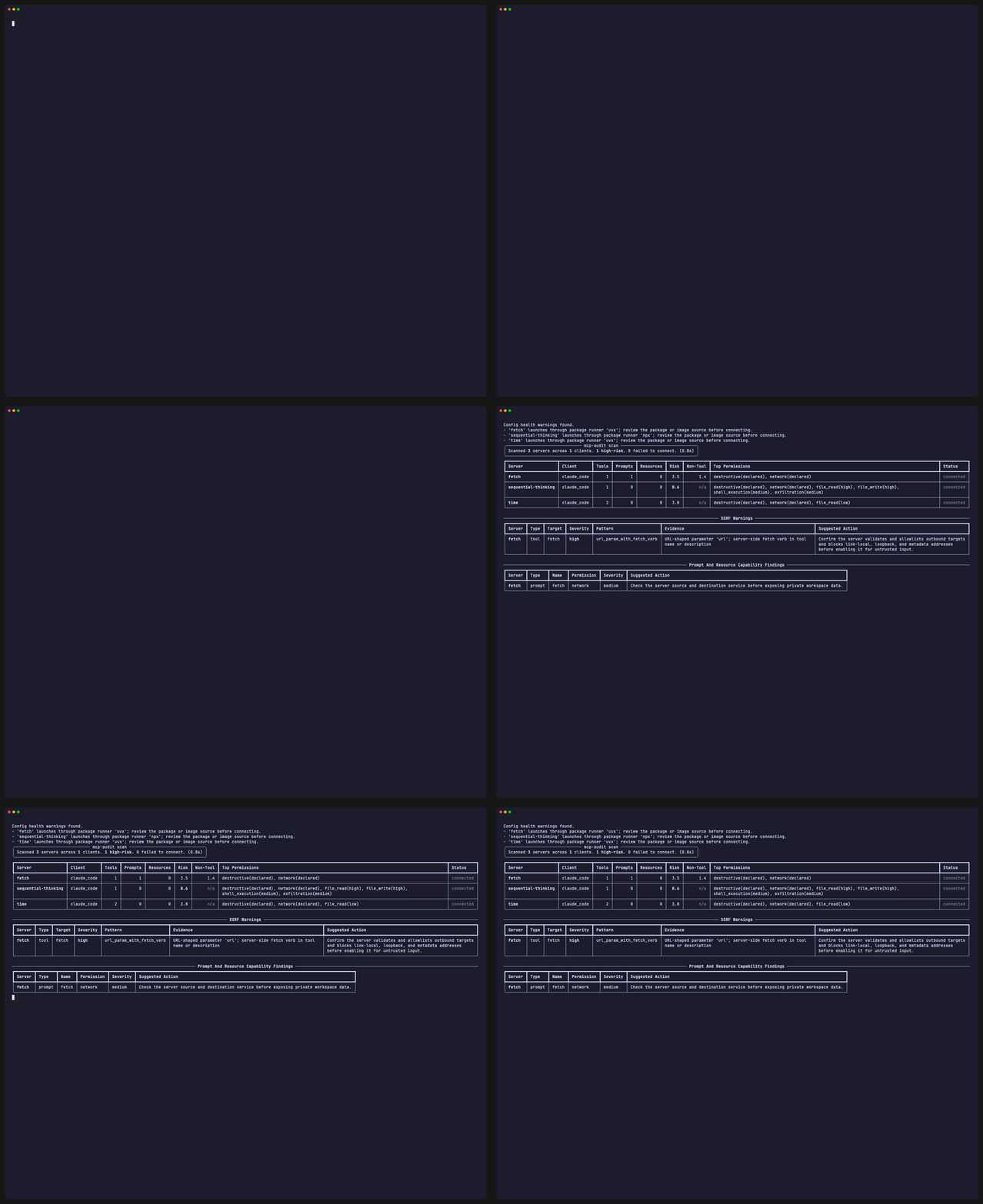
It stays read-only the whole time — it never edits a config and reports env-var key names only, never values. Sample output:
Sample output with illustrative public server names. Higher risk = a broader surface to sandbox, not "malicious." Want a zero-touch pass first? Add
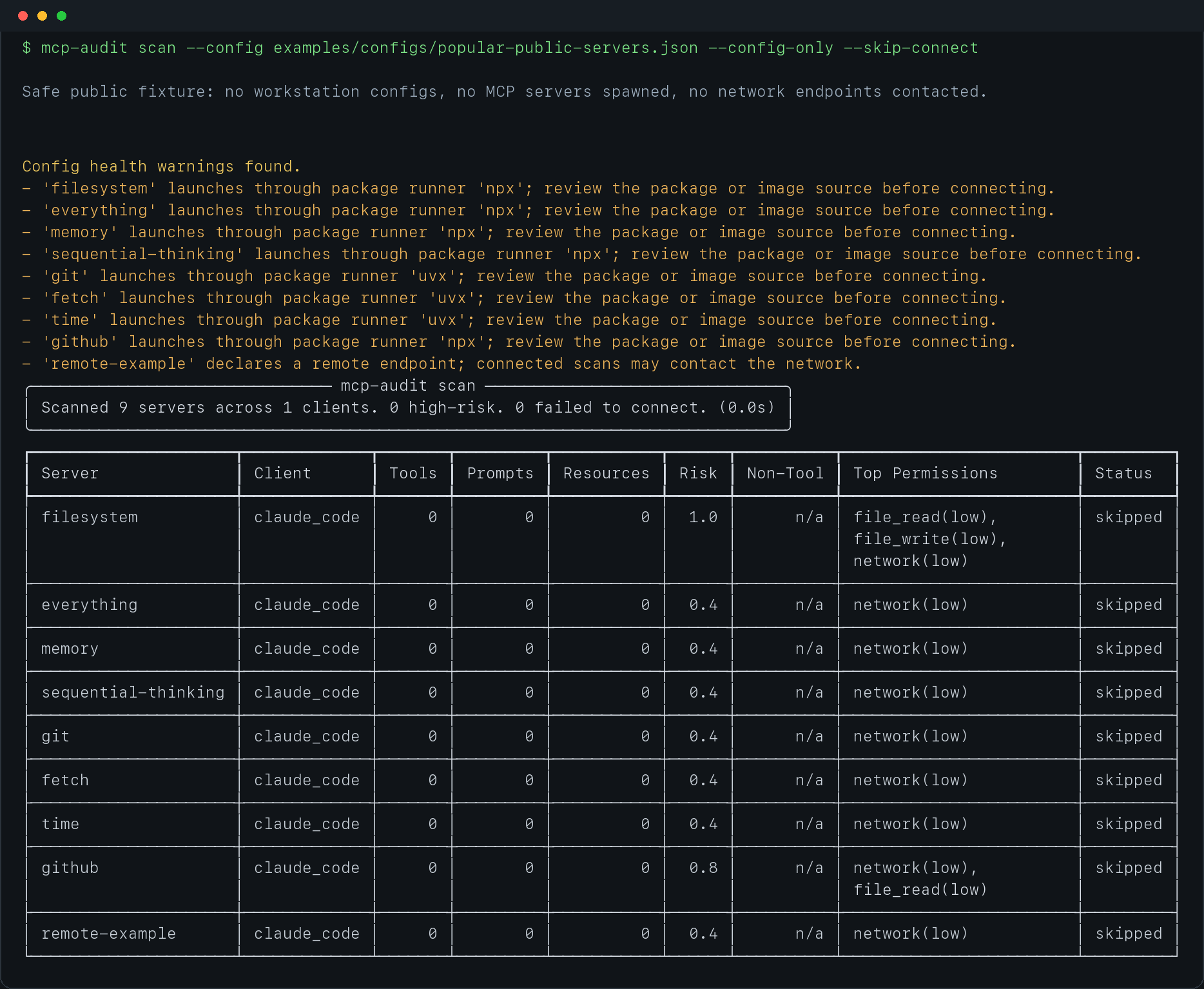
--skip-connectto reason purely from your config — no servers spawned, no network calls. Stack--trifecta-checkor--shadow-checkalongside--ssrf-checkto hunt more attack surfaces, and--json/--sarif/--htmlto pipe results into CI or a dashboard.
Connected public-fixture demo (fetch, sequential-thinking, time; no auth tokens or workstation configs):
Zero-touch preview against the bundled public fixture:
Install it permanently once you're hooked:
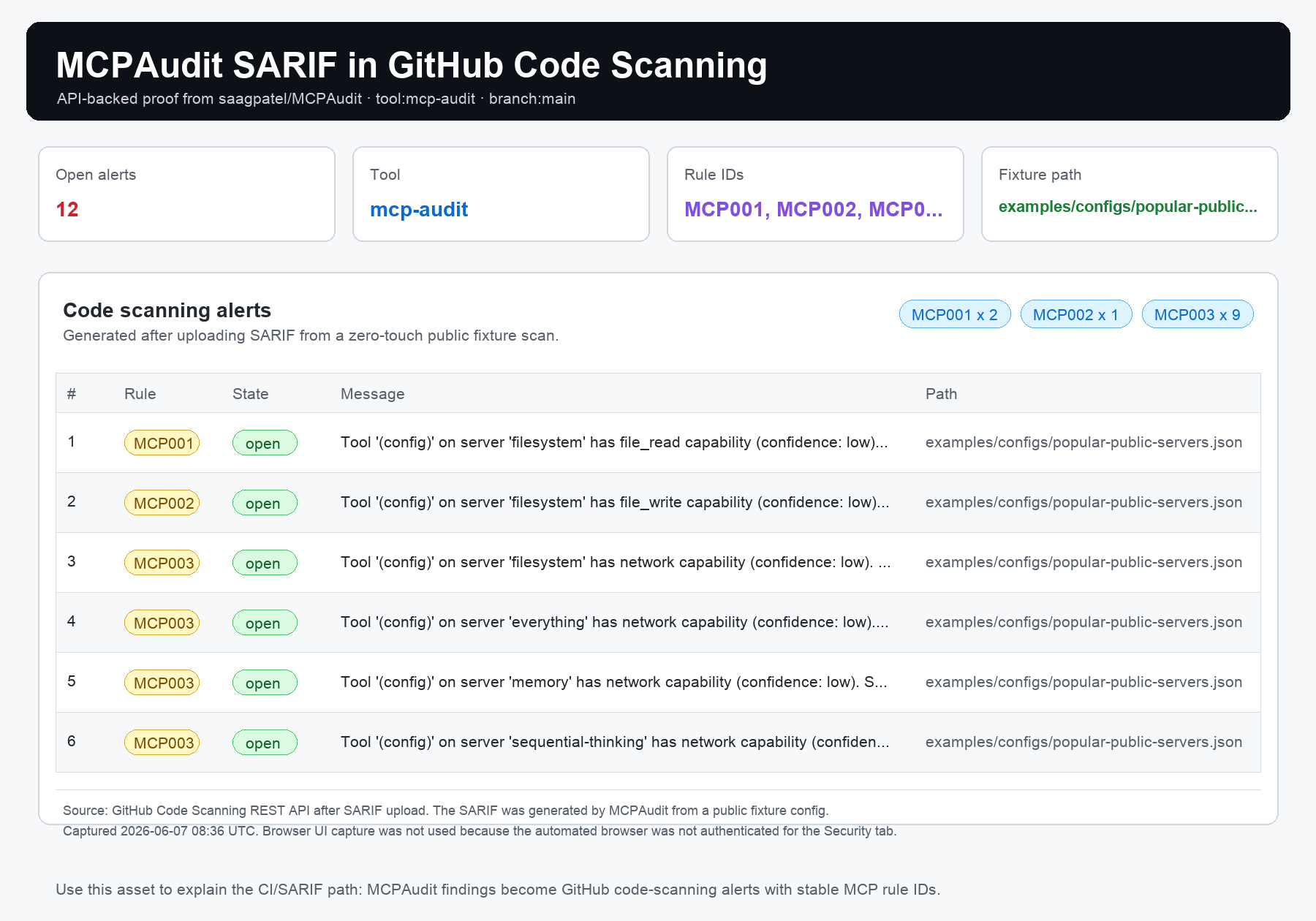
Drop it into CI in one step — the composite GitHub Action runs the scan and writes SARIF straight to GitHub code scanning:
SARIF proof from the public fixture scan:
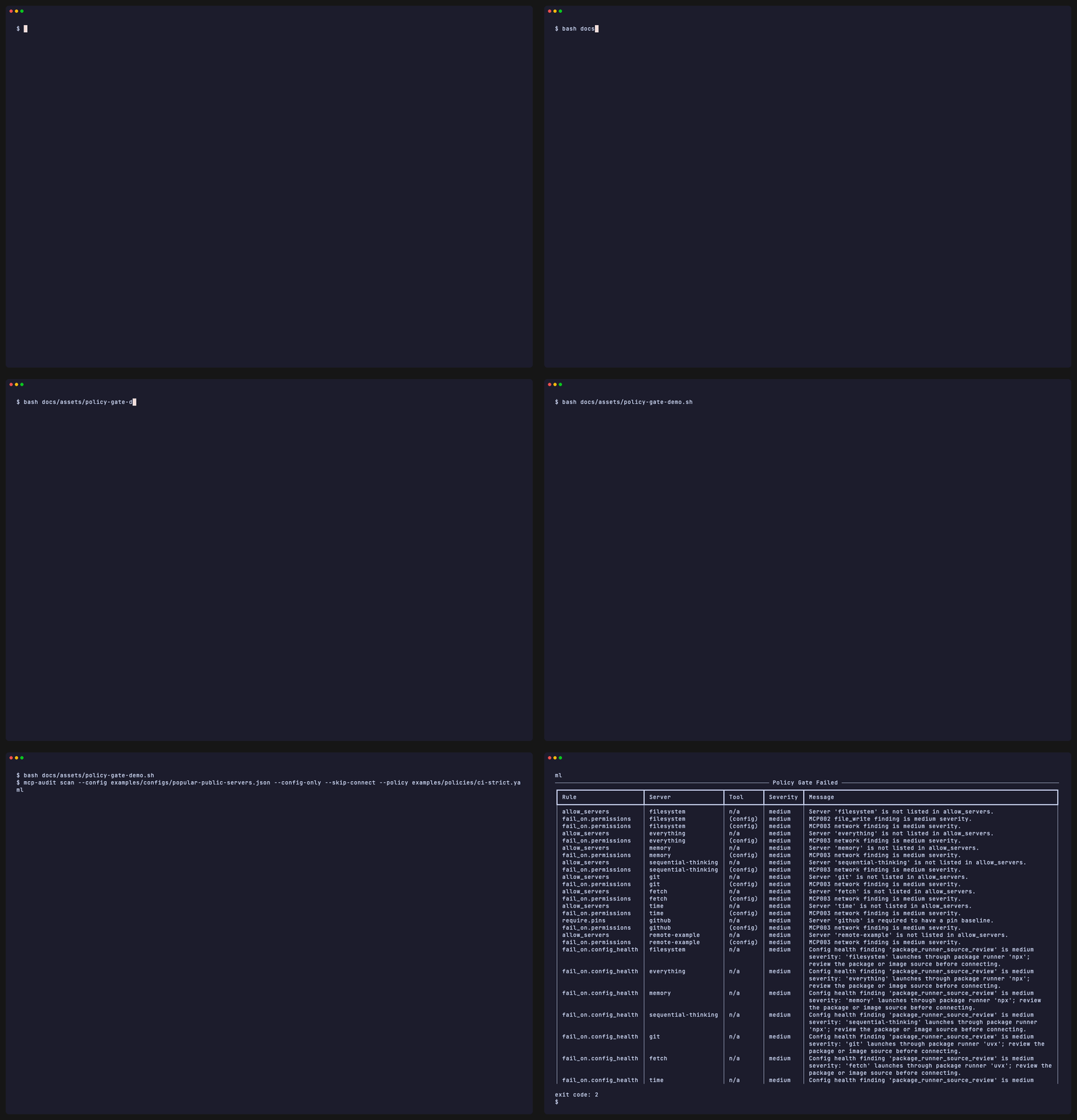
Policy gate demo from the same zero-touch public fixture:
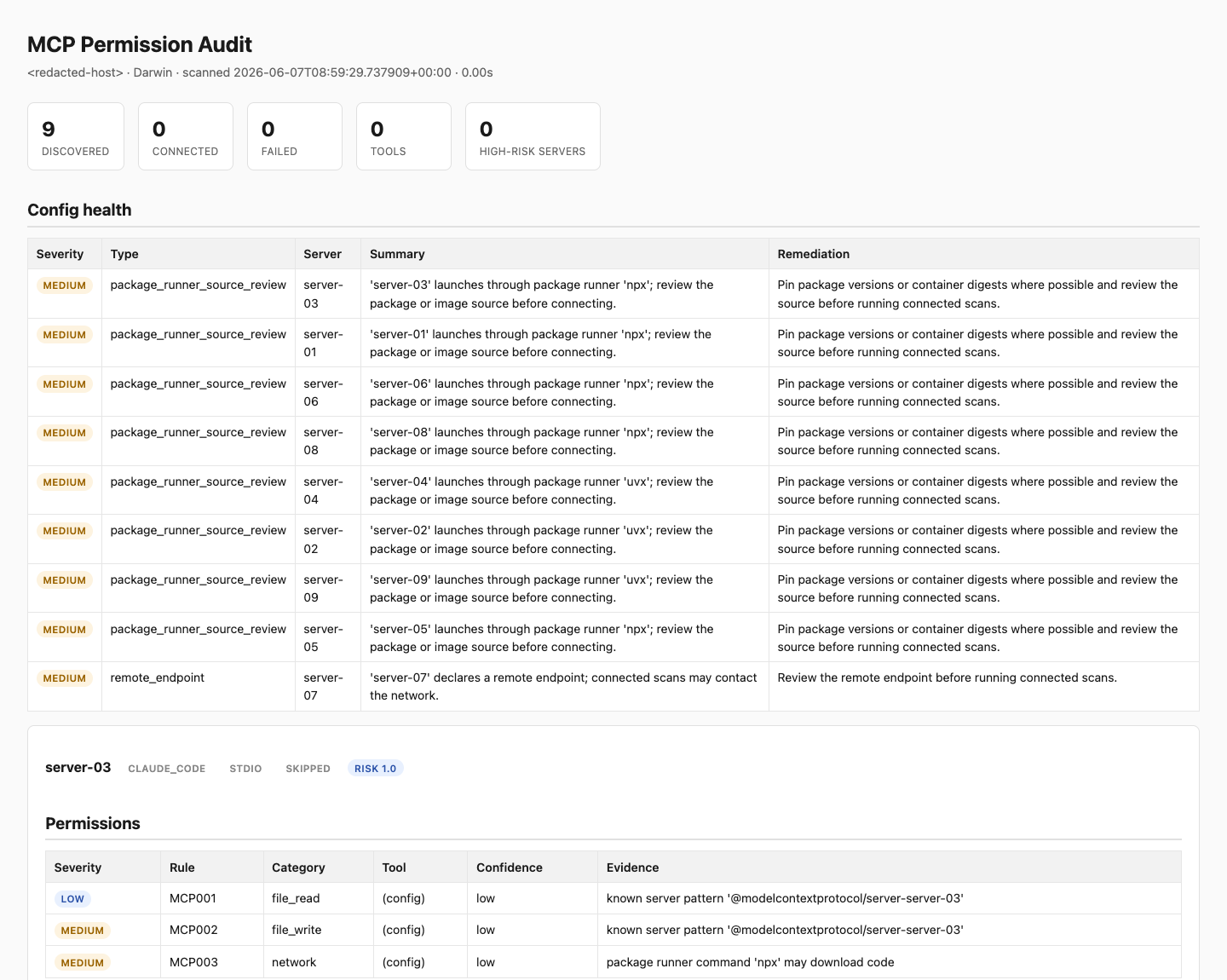
Self-contained HTML report preview from a redacted config-only scan:
Teach the risk safely: examples/sandbox/ is a
public-safe MCP prompt-injection sandbox with synthetic configs, benign twins,
malicious-lookalike tool descriptions, a static config-only MCPAudit report, and
a connected-tool manifest that demonstrates what config-only mode can and cannot
prove.
PyPI package: mcp-audits · installed command: mcp-audit · full flag and detector reference below.
Use as an MCP server
mcp-audit is also an MCP server. Point any MCP client (Claude Code, Claude Desktop, Cursor) at it and your agent can audit its own MCP attack surface on demand: enumerate every configured server, risk-score them, and pull injection, SSRF, lethal-trifecta, shadowing, and drift findings without leaving the conversation.
Add it to a client config (Claude Code shown):
stdio only, by design. This server reads the MCP configs already on your machine, so it runs locally over stdio and is never offered as a hosted remote. It stays read-only (it never edits a config) and reports env-var key names only, never values.
All tools are read-only and take no URL or filesystem path; server discovery is automatic from the standard client config locations.
Related MCP Servers
Reviews
No reviews yet — be the first to share how this listing worked for you.
Frequently Asked Questions about MCP Audit
AllMCPs Directory Badge
Showcase your server listing on GitHub or your project documentation. Embed this dynamic SVG badge to highlight official listing status and live engagement.
Badge Style:
Live Dynamic SVG Preview
Markdown (GitHub README)
[](https://allmcps.com/mcp/mcp-audit-3)HTML Embed
<a href="https://allmcps.com/mcp/mcp-audit-3"><img src="https://allmcps.com/api/badge/mcp-audit-3?style=directory" alt="MCP Audit on AllMCPs" /></a>